Electric Clusters

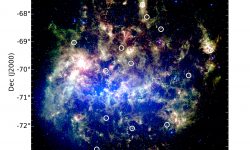
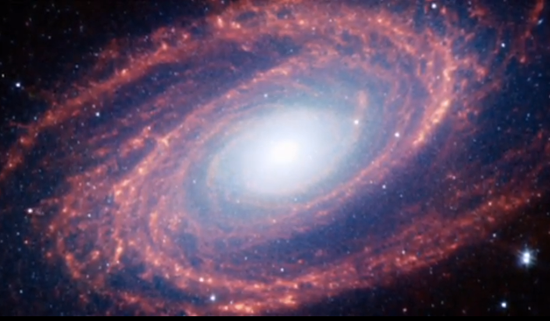
  Jan 9, 2018 Stars are not gravitational entities. A recent press release relates that there is something wrong with how conventional theories describe star formation. Star clusters in the Large Magellanic Cloud (LMC) are not assembled correctly: some stars are too young. As Dr. Bi-Qing For wrote: “Our models…

Continue reading

Electric Earth

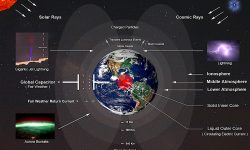
Jan 8, 2018 All celestial bodies exhibit electrical activity, including Earth. NASA launched the four Magnetospheric Multiscale Satellites on March 12, 2015. Their primary mission includes studying the magnetic field around Earth, especially what mainstream astrophysicists call “magnetic reconnection”. The theory states that electromagnetic fields can break, cross and then…

Continue reading

Starquakes?

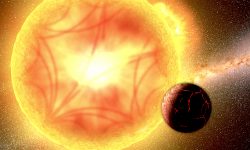
Jan 5, 2018 Shockwaves do not drive stellar evolution and behavior. NASA launched the Kepler mission on March 6, 2009. Its goal was to hunt for planets around nearby stars. Kepler subsequently experienced a failure in its stabilizing mechanism, making it unable to maintain its position accurately enough for planet-hunting, so its systems were repurposed….

Continue reading

Electric Stars in Focus | Space News

Space News -- starexploded

In Part 1 of this three-part presentation, the chief science advisor to The Thunderbolts Project, physicist Wal Thornhill, begins our discussion on the nature of stars with an examination of so-called neutron stars, a hypothetical entity, which was invented in 1960’s after the unexpected discovery of pulsing electromagnetic emissions in…

Continue reading

A Sandy Sea

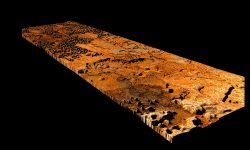
  Jan 4, 2018 Giant dune formations are found on Titan. A previous Picture of the Day noted that there is no flowing liquid on Saturn’s moon, Titan, and that the so-called “river valleys” discovered by the Cassini orbiter are probably the remains of electric discharge effects. Electric Universe advocates…

Continue reading

A New Mission

  Jan 3, 2018 Mercury is in the crosshairs. In October 2018, a joint mission to Mercury will be launched. The BepiColombo mission is named after Giuseppe (Bepi) Colombo (1920-1984) from the University of Padua, Italy. As the mission highlights page indicates, Colombo was the first to understand that Mercury’s…

Continue reading