The Mystery of Dark Energy and Dark Matter
The Mystery of Dark Energy and Dark Matter
by Mathias Hüfner
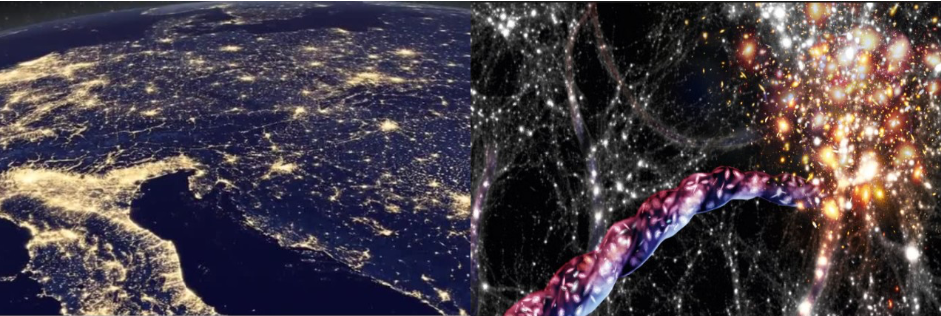
Abstract: This paper challenges the standard cosmological interpretation of dark energy and dark matter,arguing that it rests on a conceptual misunderstanding of physical causality. Instead of invoking unknown forms of energy or negative pressure within the framework of the expanding ΛCDM model, the text highlights the electromagnetic structure of matter and the role of large-scale plasma currents, Birkeland filaments, charge separation, and long-range electric potentials in a spatiotemporal process. Redshift, filamentary cosmic networks, and stellar luminosity are interpreted as electrical phenomena within a dynamic, plasma-filled volume. The observed broadening of spectral lines—particularly the H-alpha line—is cited as evidence of light-wave damping by electrons rather than Doppler expansion. Within this ontological framework, the assumption of dark energy becomes unnecessary, and cosmic dynamics can be explained through established electromagnetic principles.
Introduction: Energy is the fundamental category of physics. A society’s entire endeavors revolve around energy supply. It is therefore all the more important to understand the origins of energy. In recent years, the concept of energy has often been misinterpreted. In mechanics, there are two distinct types of energy: kinetic energy and potential energy—which is addressed through potential theory. We obtain kinetic energy when we decelerate masses. Mass is a portion, just as a quantum is. The difference lies in the fact that the mass of objects is compared against a reference mass, whereas a quantum is counted.
Here is an example: You want to buy screws at a hardware store. You might count out a few screws. But if you need a large number of them, you would use a scale to weigh them and then pay the price per kilogram at the checkout. Thus, mass is a value defined in relation to the kilogram standard kept in Paris, whereas a “quantum” represents a countable quantity of items.
An energy-generating process comprises three phases of motion: the energy source, where the mass is accelerated; momentum transfer at constant velocity; and the energy sink, where the mass is decelerated and thereby exerts its effect. We understand energy itself as a sequence of impulses. But what is matter? In philosophy, matter is understood as everything that exists outside our consciousness. To apply the concept of matter correctly as a physicist, one must state that matter is mass in motion. We are already familiar with three phases of motion regarding translation; however, phases of rotation dominate in the cosmos.
Click below to download Dr. Hüfner’s entire 10-page paper as a PDF document…
Mathias Hüfner – “The Mystery of Dark Energy and Dark Matter”

Dr. Mathias Hüfner is a German translator volunteer for The Thunderbolts Project. He studied physics from 1964 until 1970 in Leipzig Germany, specializing in analytical measurement technology for radioactive isotopes. He then worked at Carl Zeiss Jena until 1978 on the development of laser microscope spectral analysis. There he was responsible for software development for the evaluation of the spectral data. Later he did his doctorate at the Friedrich Schiller University in the field of engineering and worked there 15 years as a scientific assistant. Some years after the change in East Germany, he worked as a freelance computer science teacher the last few years before his retirement.

Since 2015, Mathias has run a German website of The Thunderbolts Project http://mugglebibliothek.de/EU.
His latest book is entitled Quantendynamik.
The ideas expressed in Thunderblogs do not necessarily express the views of T-Bolts Group Inc. or The Thunderbolts Project.