What Science Says

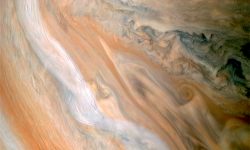
June 6, 2018 It’s common to hear people refer to “what science says.” The usual assumption is that “what science says” is said indefeasibly. But the term ‘science’ has two conflicting senses: science as currently-accepted theory (CAT) and science as method. To conclude that method inevitably leads to CAT and,…

Continue reading

Cold Winds

Jun 4, 2018 Gas giant planets exhibit extreme weather. The fastest winds ever recorded on Earth was a 372 kilometer per hour gust on Mount Washington, New Hampshire in 1934. Tornadoes and hurricanes can achieve higher average velocities for short periods, but the maximum 24 hour speed record of 205…

Continue reading

A New Dawn

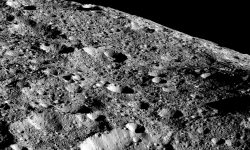
Jun 1, 2018 Investigating the dwarf planet, Ceres. The Dawn spacecraft was launched on September 27, 2007. It began observing the asteroid Vesta on July 17, 2011 and then headed toward the dwarf planet, Ceres on September 5, 2012. Dawn entered orbit around Ceres at 7:39 AM EST on Friday, March 6,…

Continue reading

Saturn’s Polar Vortex

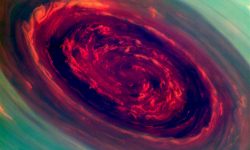
  May 30, 2018 Electricity influences Saturn’s environment. The picture at the top of the page could be mistaken for recent images of Jupiter’s Great Red Spot. However, the swirling vortex is actually located in the center of Saturn’s vast, hexagonal north polar formation. Hexagons and other polygons can sometimes…

Continue reading

Spider Eggs

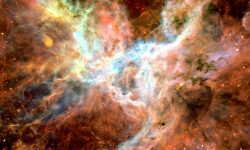
May 30, 2018 Regions inside this nebula are described as “cocoons” for new stars. The Tarantula Nebula’s designation is 30 Doradus. It is an “emission nebula” in the Large Magellanic Cloud (LMC). Readers may remember that a well-known supernova, 1987a, exploded near the nebula’s edge. The nebula’s average diameter exceeds 1000 light-years,…

Continue reading

Comet 134340 Pluto?

May 28, 2018 Is Pluto a cometary body? According to a recent press release, Pluto might be composed of a “billion comets”. As Dr. Christopher Glein of SwRI’s Space Science and Engineering Division wrote: “We’ve developed what we call ‘the giant comet’ cosmochemical model of Pluto formation. We found an…

Continue reading

Explosive Power

  May 25, 2018 Gamma-ray Bursters (GRB), and Fast Radio Bursters (FRB) are thought by astronomers to be the most powerful energy sources in the Universe. The problems associated with GRB observations are partially addressed in previous Pictures of the Day. GRBs are characterized by intense electromagnetic emissions, particularly rapid…

Continue reading

An Electrifying Assembly

  May 24, 2018 Jupiter’s moons exhibit electrical activity. On October 18, 1989 NASA launched the Galileo Jupiter orbiter (the pre-cursor to the current Juno mission) onboard the Space Shuttle Atlantis, as part of the STS-34 mission. After gravitational assistance from flybys of Venus and Earth, Galileo arrived at Jupiter…

Continue reading

The Paradigm Shoppe

  May 23, 2018 Electric Universe theory illustrates what has been called the “incommensurability” of paradigms, a scholarly term for what is actually a rather mundane occurrence: the difficulties-and benefits-of communication when words have more than one meaning. The difficulties arise from the listener’s assumption that the speaker means what…

Continue reading