Collisions and Crashes

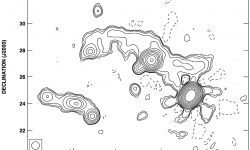
Jun 12, 2017 Hot gravity? Astronomers have only one force in their bag of tricks: gravity. Anomalous observations, such as high temperature in galaxy clusters, “must be” caused by collisions. Shockwaves and ram pressure are invoked because it is assumed that celestial objects are pushing though a medium. It is…

Continue reading

Extinct Light

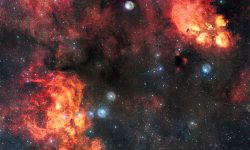
Jun 9, 2017 A hidden star factory. NGC 6334 (the Cat’s Paw nebula) is also known as the Bear Claw nebula. It is 50 light-years across and approximately 5500 light-years away, using redshift distance calculations. It is part of a larger nebular complex near the heart of the Milky Way…

Continue reading

Curiouser and Curiouser

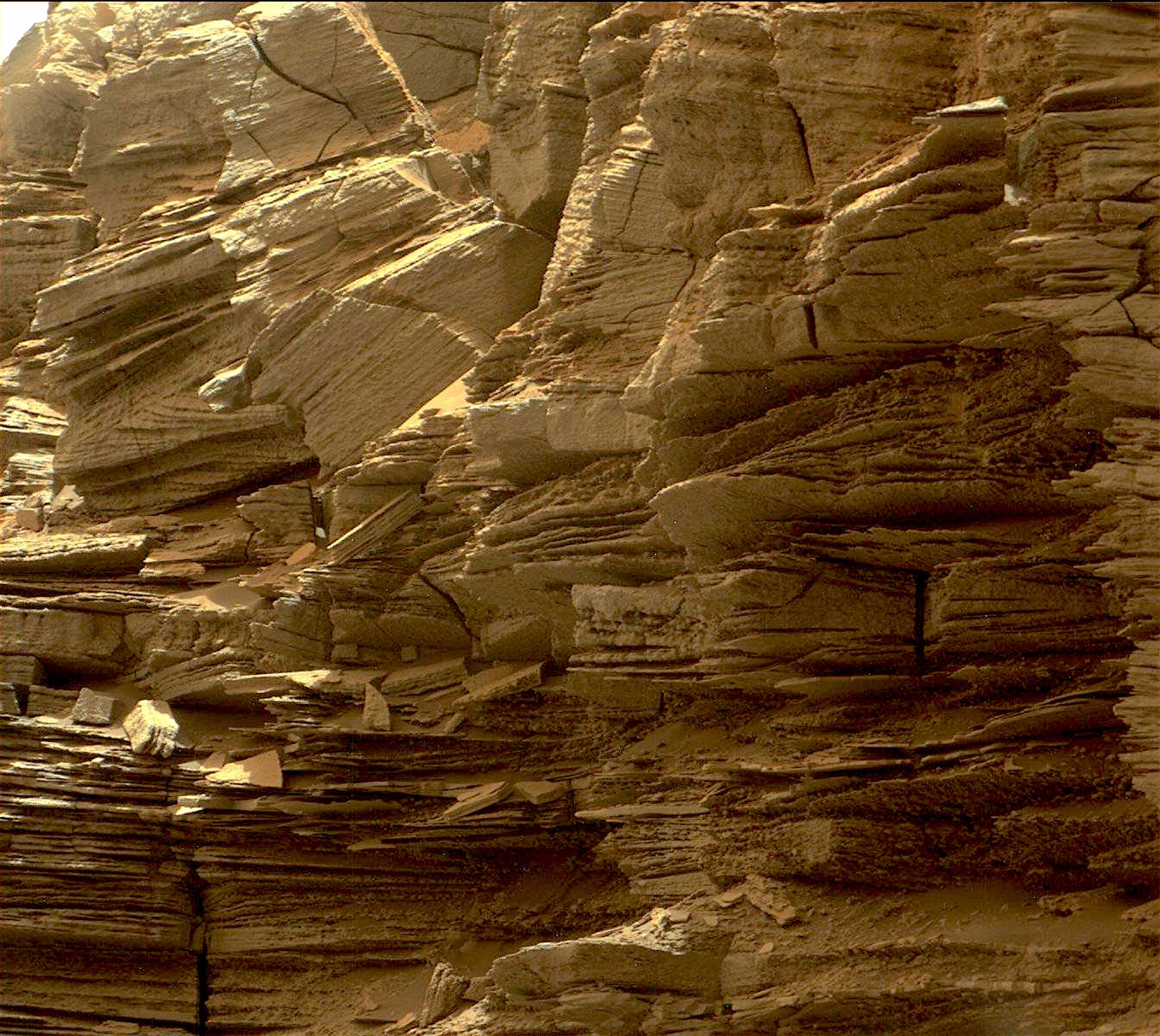
  Jun 8, 2017 Mars is not a dried-out museum of life. “When dealing with other worlds, we must take care to remember that unfamiliar processes are possible and even likely in alien environments.” — Colin Dundas of the U.S. Geological Survey’s Astrogeology Science Center Mars is a freeze-dried wasteland…

Continue reading

Grand Finale Part Two

  Jun 6, 2017 Kinetic physics does not explain Saturn’s features. Planetary scientists already knew about material sticking out of the rings in a few places, but until Saturn reached its equinox it was not possible to measure how high these “ridges” are. Saturn’s main rings are approximately 140,000 kilometers…

Continue reading

Signs

Jun 5, 2017 The signs are all around us; signs that point to a different interpretation of the Earth’s geological history. Rather than vague theories that include millions of years magically appearing out of nowhere to explain what we see, we need only look at what is in front of…

Continue reading

Auroral Generator

Jun 2, 2017 Jupiter’s aurorae are generated by its own electromagnetic fields. There are many Pictures of the Day in the archives that discuss the planet, Jupiter—especially its electromagnetic interaction with its moons and the rest of the Solar System. Jupiter’s magnetosphere extends outward for nearly 650 million kilometers, reaching beyond Saturn’s orbit….

Continue reading

Grand Finale Part One

  Jun 1, 2017 The Cassini mission is nearing its end. The Cassini spacecraft recently celebrated its twelfth year in orbit around Saturn, with its end of life approaching on September 15, 2017. Cassini was launched from Vandenberg Air Force Base on October 15, 1997. Including the Huygens lander, Cassini…

Continue reading

Dark Stars

May 31, 2017 Black holes are most likely electrical phenomena. Black holes are the subject of many previous Picture of the Day articles. The short story, from an Electric Universe perspective, is that black holes are a misperception. The descriptive terminology used by researchers is problematic, relying on loose interpretations….

Continue reading

Ionic Wind

May 26, 2017 Ionic disturbances through electrically charged regolith shaped the Martian surface. Craters, canyons, dunes and many other features do not readily correspond to contemporary theories about their evolution. Dunes on Mars often do not align with prevailing winds, and do not indicate any movement after years of observation….

Continue reading