Frigid Fires

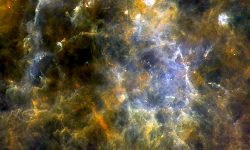
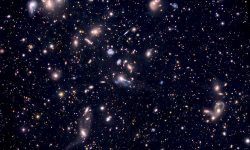
Apr 2, 2018 Even the coldest dust radiates light. The European Space Agency launched the Herschel Space Observatory on May 14, 2009 with the largest spaceborne mirror ever constructed. Herschel was sent into orbit around LaGrange point L2 in order to protect its helium-cooled infrared detectors. Its coolant system lasted…

Continue reading

Ionic Wind

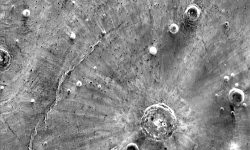
  March 29, 2018 Ionic disturbances through electrically charged regolith shaped the Martian surface. Craters, canyons, dunes and many other features do not readily correspond to contemporary theories about their evolution. Dunes on Mars often do not align with prevailing winds, and do not indicate any movement after years of…

Continue reading

Charge Exchange

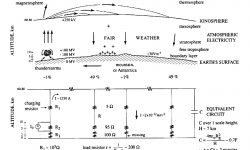
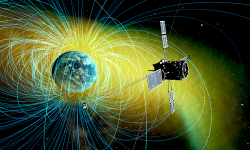
Mar 28, 2018 Earth and the Sun share an electric circuit. “Everybody talks about the weather, but nobody does anything about it.” — Charles Dudley Warner The Magnetospheric Multiscale satellites were launched March 12, 2015 on a mission to study Earth’s electromagnetic fields. The MMS constellation, as well as the…

Continue reading

Above and Below

  March 22, 2018 Phenomena on Earth, as well as in deep space, share similar characteristics. “I have always believed that astrophysics should be the extrapolation of laboratory physics, that we must begin from the present Universe and work our way backward to progressively more remote and uncertain epochs.” —…

Continue reading

Circuit Breakers

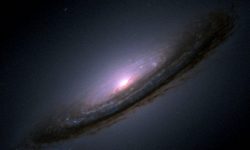
  March 20, 2018 Computer simulations cannot correctly model supernova explosions. Contemporary astrophysical models of stellar evolution rely on the mechanical action of cold gas collapsing from gravitational impetus. Stars are seen as whirling vortices of compressed matter heated to fusion temperatures by pressure, alone. Clouds of gas and dust…

Continue reading