Commemorating Kristian Birkeland
Down to the Sea
Sep 28, 2016 Europa is not a harbor for life. In March of 1979 Voyager 1 found that Europa appeared to be completely encased in water ice, with few craters. Sinuous channels, called “rilles,” extend for thousands of kilometers across its face. Cycloid, dual ridge “faults” mystified NASA mission team…
Collisions and Crashes
Jun 12, 2017 Hot gravity? Astronomers have only one force in their bag of tricks: gravity. Anomalous observations, such as high temperature in galaxy clusters, “must be” caused by collisions. Shockwaves and ram pressure are invoked because it is assumed that celestial objects are pushing though a medium. It is…
Extinct Light
Curiouser and Curiouser
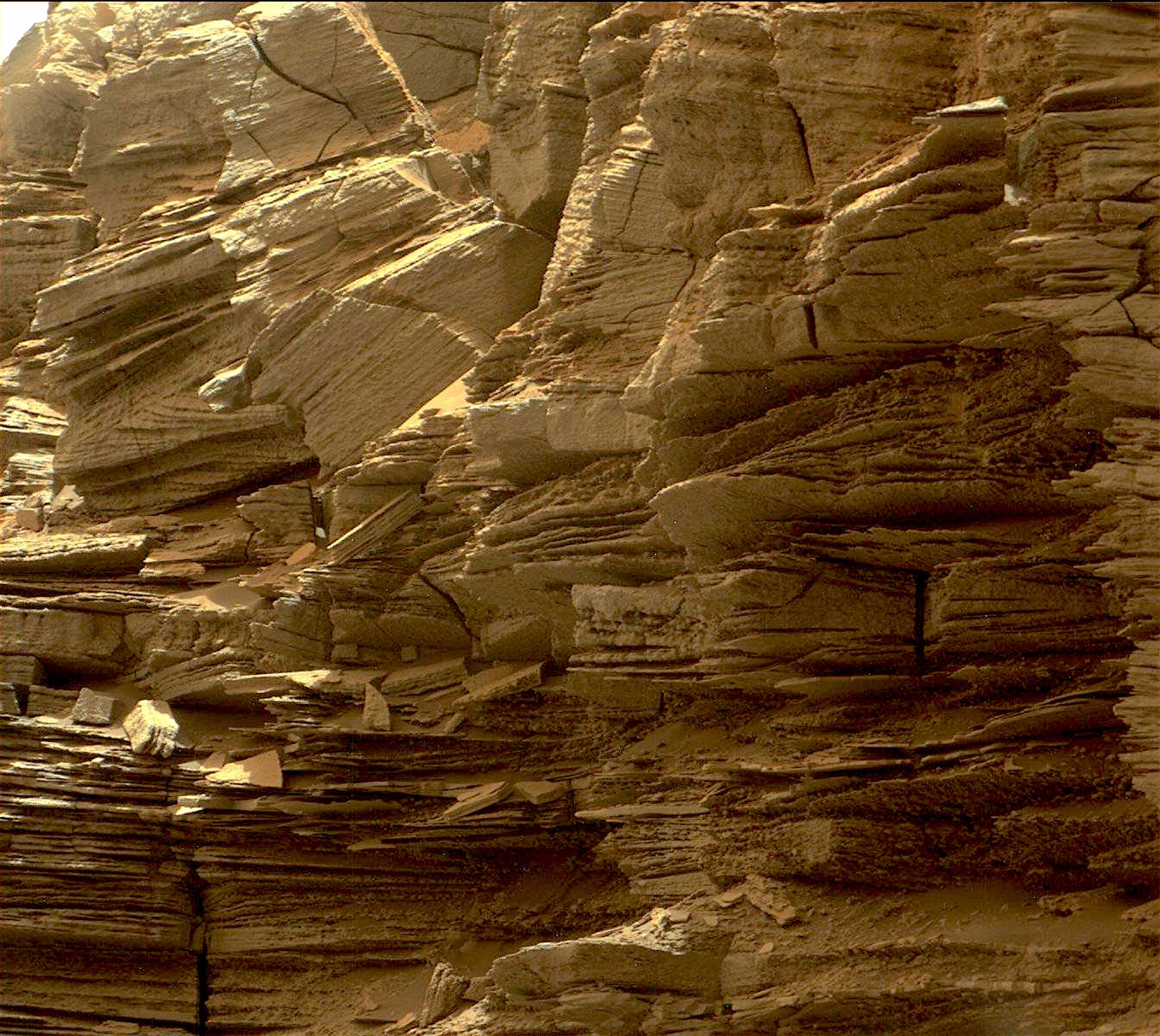
Jun 8, 2017 Mars is not a dried-out museum of life. “When dealing with other worlds, we must take care to remember that unfamiliar processes are possible and even likely in alien environments.” — Colin Dundas of the U.S. Geological Survey’s Astrogeology Science Center Mars is a freeze-dried wasteland…
Water on Mars
Grand Finale Part Two
Jun 6, 2017 Kinetic physics does not explain Saturn’s features. Planetary scientists already knew about material sticking out of the rings in a few places, but until Saturn reached its equinox it was not possible to measure how high these “ridges” are. Saturn’s main rings are approximately 140,000 kilometers…
Auroral Generator
Jun 2, 2017 Jupiter’s aurorae are generated by its own electromagnetic fields. There are many Pictures of the Day in the archives that discuss the planet, Jupiter—especially its electromagnetic interaction with its moons and the rest of the Solar System. Jupiter’s magnetosphere extends outward for nearly 650 million kilometers, reaching beyond Saturn’s orbit….
Grand Finale Part One
Jun 1, 2017 The Cassini mission is nearing its end. The Cassini spacecraft recently celebrated its twelfth year in orbit around Saturn, with its end of life approaching on September 15, 2017. Cassini was launched from Vandenberg Air Force Base on October 15, 1997. Including the Huygens lander, Cassini…