Happy Holidays from the Thunderbolts Group
Dec 25, 2017 “My favorite traditional Christmas movie that I like to watch is All Quiet on the Western Front. It’s just not December without that movie in my house.” — Tom Hanks



Dec 25, 2017 “My favorite traditional Christmas movie that I like to watch is All Quiet on the Western Front. It’s just not December without that movie in my house.” — Tom Hanks
Dec 22, 2017 Black hole physics can never explain the Universe. Recently, the Picture of the Day addressed cosmic filaments connecting vast galactic structures. The formations could mean that the visible Universe is a braided filament that reaches from the Virgo supercluster to the Fornax supercluster across billions of light…
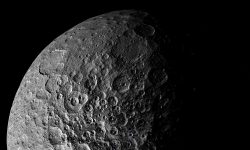
Dec 21, 2017 Is there water ice on Ceres? The dwarf planet Ceres adds weight to an electrical theory of the Solar System long proposed by Electric Universe advocates. Formations on moons and planets conform to that theory far better than they do to conventional ideas. On September 27,…
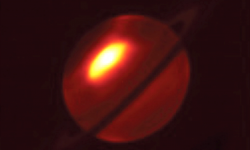
Dec 20, 2017 Earth and Saturn are similar in some ways. Earth exhibits a periodic oscillation in its atmosphere called, the Quasi-Biennial Oscillation (QBO). The QBO involves winds at high altitude above the equator. Stratospheric winds circle the planet, changing direction about every 14 months. This means that the QBO…
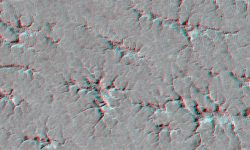
Dec 19, 2017 Martian formations are similar to those found elsewhere in the Solar System, including Earth. Lichtenberg figures are discussed many times in previous Picture of the Day articles. They are forking shapes that lightning bolts make when they strike Earth or some man-made object. Their unique configuration…
Dec 18, 2017 More electric biology. A previous Picture of the Day described the way that some single-celled organisms make use of charge exchange in order to drive their flagella. Rather than the conversion of ATP, they move protons along special cellular structures, converting that flow of electric charge into…
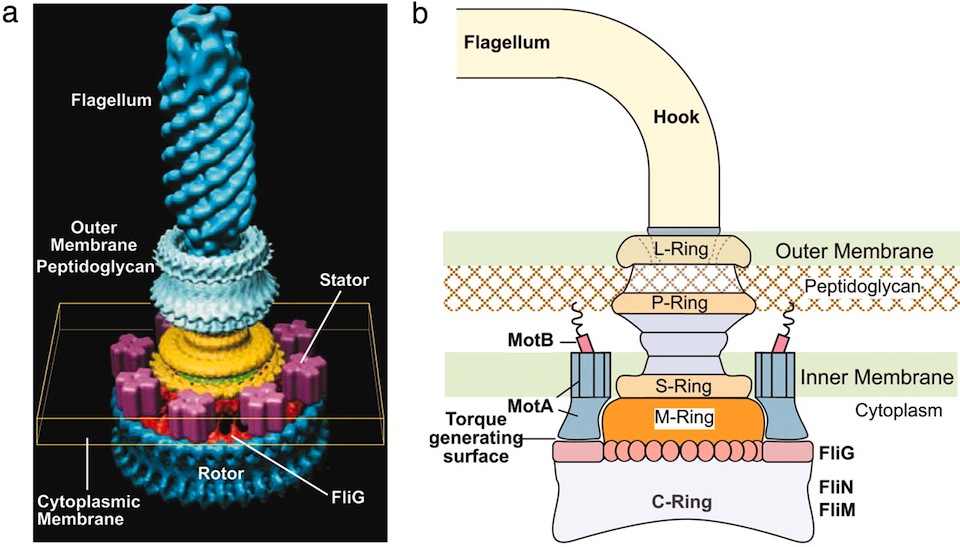
Dec 15, 2017 Rotating motors propel some bacteria. Editor’s note: The Picture of the Day will be on a brief holiday until December 19. In the interim, please enjoy these articles from the archives. Some bacteria can swim through their tiny worlds. They accomplish this feat with the aid of…
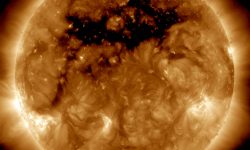
Dec 14, 2017 Why do coronal holes accelerate the solar wind? Recently, the Solar Dynamics Observatory recorded a coronal hole as it moved across the Sun’s photosphere, causing a storm of charged particles to blast toward Earth. Heliophysicists believe that coronal holes are regions of “open magnetic fields”. The…
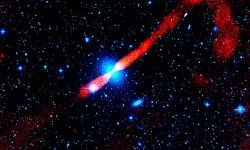
Dec 13, 2017 Matter in the plasma state is electrically active. According to a recent press release, collimated jets result from matter falling into the putative gravity field of a black hole. As stellar matter orbits closer, it is said to accelerate, causing violent collisions among the jet particles, generating…
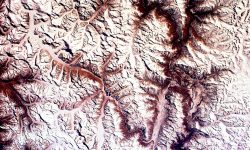
Dec 12, 2017 Vertical cliffs around the world are not easy to explain. The Karakoram mountains are one of the largest mountain ranges on Earth, extending from Pakistan to India and into China. Among its largest peaks is K2, an 8600 meter massif that once was considered impossible to…