Landers Away!

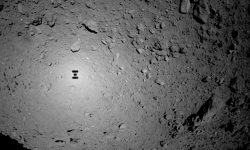
Sep 24, 2018 Five surface instruments are scheduled for Ryugu. The Hyabusa 2 spacecraft is orbiting asteroid 162173 Ryugu, where, on September 21, 2018 it released two landers. Known as MINERVA-II, they “hop” from place-to-place on the surface. Since Ryugu’s gravity field exerts a mere .00012 m/s² acceleration (80,000 times…


Continue reading

Force Multiplier

Sep 21, 2018 Jupiter generates its own power. On August 5, 2011 NASA launched the Juno mission to Jupiter. It is currently analyzing Jupiter’s massive plasmasphere, along with its electromagnetic field. Jupiter radiates more energy in the infrared than it receives from the Sun, so astronomers think that it is…

Continue reading

White and Bright

  Sep 20, 2018 Reflective mineral deposits on Ceres. NASA launched the Dawn spacecraft on September 27, 2007. After its observations of the asteroid, Vesta ended on September 5, 2012 Dawn headed toward Ceres. Dawn encountered the largest known asteroid in the Solar System on March 6, 2015. The mission officially ended…

Continue reading

Dawn’s Twilight

Sep 19, 2018 The mission is winding down. On September 27, 2007 NASA launched the Dawn spacecraft. After observing the asteroid Vesta, Dawn headed toward Ceres. Dawn encountered the largest known asteroid on March 6, 2015, where it remains in orbit. The mission officially ended in June of 2016, but was…

Continue reading

Black Ideas

  Sep 18, 2018 Black holes are said to “warp space”. Consensus theories state that inside of a black hole matter occupies no volume, yet retains its gravitational forces. Those forces are so great that no light can escape, so they are called “black” holes, because they are undetectable with…

Continue reading

X-ray Lightning

Sep 14, 2018 Galaxies are alive with lightning flashes. “Bring in the bottled lightning, a clean tumbler, and a corkscrew.” — Charles Dickens On Earth, a primary electric discharge channel is called a lighting bolt. In slow-motion, it is easy to see that each flash is a complex series of…

Continue reading

Nuclear Fantasies

Sep 12, 2018 Neutron stars cannot exist. “The sky was clear—remarkably clear—and the twinkling of all the stars seemed to be but throbs of one body, timed by a common pulse.” —Thomas Hardy On June 13, 2012 NASA launched the Nuclear Spectroscopic Telescope Array (NuSTAR) on a mission to study…

Continue reading

Cosmic Electromagnetism

  Sep 11, 2018 The Universe is not only in motion. Galactic evolution occurs because large-scale plasma discharges form coherent filaments that exhibit electrodynamic behavior. Since the Universe is an electrical system that is constantly charging and discharging, instead of a gravitational system that is constantly contracting and expanding, gravity is…

Continue reading