Celestial Clouds

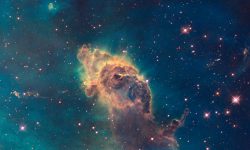
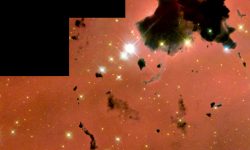
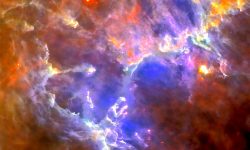
Feb 4, 2019 Dark, opaque structures are common in the Universe. The Interstellar Medium (ISM), through which the Solar System and all other star systems are moving, is mostly hydrogen and helium. Dust particles, a combination of carbon and silicates, account for about 1% of the ISM. Those particles are,…
Continue reading

The Io Plasma Torus

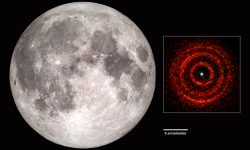
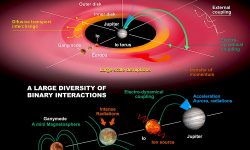
Feb 1, 2019 Io’s rotation creates radiation that is 1000 times stronger than is needed to kill an unprotected human being. “Io is the same size as our moon. And should be a cold dead world. Yet our first glimpses of Io revealed it seething with heat, alive with volcanic activity…Something else…

Continue reading

Life Energy

Jan 30, 2019 Plasma is the fourth state of matter. “Without electricity, the air would rot.”— Ralph Waldo Emerson By definition, “plasma” means that electrons are stripped from atomic nuclei, so they can move within a material. This happens because electron orbital dynamics are overcome by thermal or other energy…

Continue reading

Plasma Sheaths

Jan 29, 2019 Planetary nebulae sometimes reveal bifurcated jets emanating from their interior stars. More often than not, those jets reveal an indication of helical shapes. Common astronomical theories propose that red giant stars expand because they “burn” most of their primordial hydrogen, and begin consuming the helium that was…

Continue reading

Ring in the New

Jan 28, 2019 Science depends on novel ideas. “A good decision is based on knowledge and not on numbers.” — Plato It is commonly believed that science “stands on the shoulders of giants”. In other words, new theories are based on those inherited from older generations. If that is the…

Continue reading

Cold-Hearted

Jan 25, 2019 Dust at a temperature near absolute zero shows up as red and orange in this image of the Carina Nebula.  NGC 3372 is a large, bright nebulosity in the constellation Carina, located between 6500 and 10,000 light-years from Earth. Since there are so many nebulae, and all…

Continue reading

Galaxy Wheels

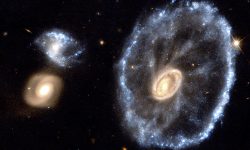
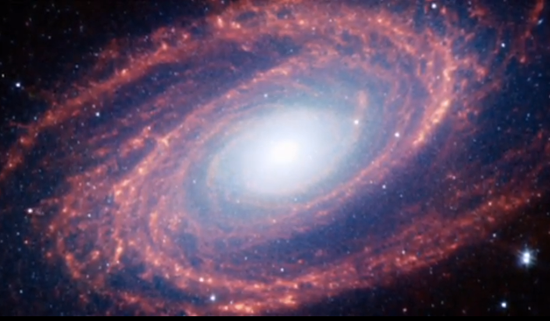
Jan 24, 2019 What forms galactic disks? Observations by the Sloan Digital Sky Survey (SDSS) indicate that a torus of stars surrounds the Milky Way at a distance of 120,000 light-years. The Milky Way’s stellar population was previously estimated to be about 200 billion stars contained in the spiral arms…

Continue reading

Electric Nodes

Jan 22, 2019 Recent data calls black holes into question. Astronomers “know” that black holes exist because they see energetic radiation and collimated jets erupting from small regions of space. Collimated jets are said to result from matter falling into a black hole’s gravity field. As material orbits closer, it…

Continue reading