Potato Pancake

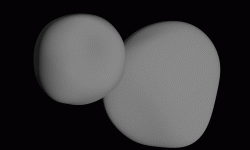
Mar 4, 2019 Ultima Thule continues to confound astronomers. According to a recent press release, (486958) 2014 MU69, otherwise known as Ultima Thule, is not shaped like a snowman. The newest images from the New Horizons spacecraft reveal it to be a “squashed walnut” combined with a “flattened cookie”. Alan…
Continue reading

Constant Confusion

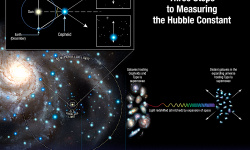
Feb 28, 2019 In 1997, two teams of astronomers studying Type 1a supernovae found there was “something wrong” with their observations. Type 1a supernovae are a sub-class of stellar explosions involving binary stars, but they are thought to occur through a different process. Their particular way of exploding is still…

Continue reading

Warped Theories

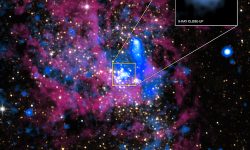
Feb 27, 2019 Inside of a black hole, astronomers believe that matter occupies no volume, yet maintains a gravitational force so great that no light can escape its event horizon. They are “black” holes, because they are undetectable with optical telescopes. The fact that they are impossible to observe, directly,…

Continue reading

Electric Aurorae

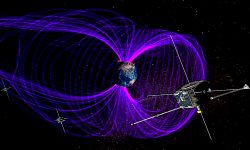
Feb 26, 2019 There is an electrical structure called a magnetotail extending away from Earth for millions of kilometers. In 1966, the U.S. Navy satellite, TRIAD, recorded electromagnetic disturbances as it passed over Earth’s poles and through the Van Allen Radiation Belts. Those vertical electric currents that flow to Earth from the…

Continue reading

Fusion Confusion

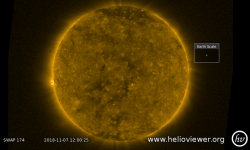
Feb 25, 2019 Coronal holes are the source of fast solar winds that can produce geomagnetic storms on Earth. The thermonuclear model of the Sun proposes that the temperature in its core is more than 15 million Celsius, with compressive strain greater than 340 billion times Earth’s atmospheric pressure. 700…

Continue reading

Cut the Dust

Feb 22, 2019 Stars are formed from charged particles. “Men think highly of those who rise rapidly in the world; whereas nothing rises quicker than dust, straw, and feathers.”— Lord Byron Immanuel Kant, the 18th Century philosopher, suggested that stars, in general, as well as the Solar System, in particular,…

Continue reading

How’s the Weather?

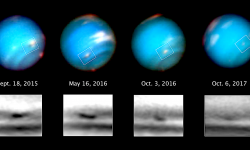
Feb 21, 2019 Neptune’s clouds contradict consensus viewpoints. On July 12, 2011 Neptune completed its first orbit around the Sun since it was discovered on September 23, 1846. This means that observations are limited, since great distance strains technology’s ability. Spectrographic data about Neptune, for instance, is limited to the…

Continue reading

Ice Moon

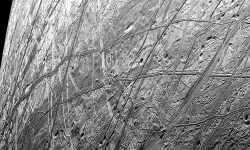
Feb 20, 2019 A new mission to Europa. The Galileo spacecraft entered orbit around Jupiter in December 1995. When it ran out of maneuvering fuel, the 320 kilogram probe was incinerated by the Jovian atmosphere, so that it would not crash into one of Jupiter’s moons, particularly Europa. Planetary scientists were surprised…

Continue reading

Forbidden Doughnut

Feb 19, 2019 A ring of galactic plasma. There is a twisted ring of material surrounding the nucleus of Galaxy Centaurus A; an “active galaxy” that exhibits axial jets and a doughnut-shaped plasma discharge. Active galaxies are brighter than other galaxies of the same type, since they radiate excess energy…

Continue reading