Alpha, Beta, Gamma

Jan 14, 2019 Gamma-rays from electric particle accelerators in space. Gamma-rays are the highest energy wavelength in the electromagnetic spectrum, according to physicists. They are “electromagnetic particles” called photons. Since matter is thought to exist as both waves and particles, and photons are a class of particle called “bosons”, they…

Continue reading

Plasma Filaments

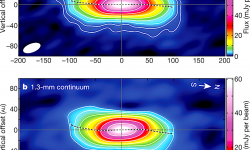
Jan 9, 2019 Plasma is electrically ionized. In plasmas, thermal and other energy sources strip electrons from atomic nuclei. When excess charge develops in various regions, due to gravity or other influences, electric discharges can take place, forming electromagnetic sheaths along the discharge axes. If there is enough charge flow,…

Continue reading

(486958) 2014 MU69

Jan 7, 2019 New Horizons recently flew by the most distant object imaged by any spacecraft. The Kuiper Belt theory is the creation of astronomer Kenneth Edgeworth from Ireland and also, separately, by American astronomer Gerard Kuiper in 1951. The first Kuiper Belt Object (KBO) was discovered in 1992. Sometimes…

Continue reading

Electric Earth

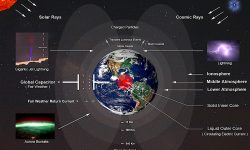
  Jan 3, 2019 All celestial bodies exhibit electrical activity, including Earth. NASA launched the four Magnetospheric Multiscale Satellites on March 12, 2015. Their primary mission includes studying the magnetic field around Earth, especially what mainstream astrophysicists call “magnetic reconnection”. The theory states that electromagnetic fields can break, cross and…

Continue reading

Electrical Giant

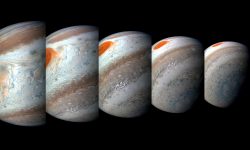
Jan 2, 2019 Jupiter is electrodynamic. Many Pictures of the Day discuss the planet, Jupiter—especially its electromagnetic interaction with its moons and the rest of the Solar System. Jupiter’s magnetosphere extends for almost 650 million kilometers; even beyond Saturn’s orbit. Bands of radiation, similar to the Van Allen radiation belts, except thousands of…

Continue reading

Starquakes?

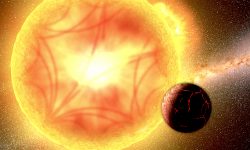
  Jan 5, 2018 Shockwaves do not drive stellar evolution and behavior. NASA launched the Kepler mission on March 6, 2009. Its goal was to hunt for planets around nearby stars. Kepler subsequently experienced a failure in its stabilizing mechanism, making it unable to maintain its position accurately enough for planet-hunting, so its systems were…

Continue reading