Category: Picture of the Day
A picture and essay from the perspective of the Electric Universe.
Ant Gun
Mar 11, 2019 The Herschel space observatory operated between 2009 and 2013. The Herschel Space Observatory was launched on May 14, 2009 into an orbit around LaGrange point L2 (behind Earth in relation to the Sun). Herschel’s supercooled infrared detectors were built to last only three years, so its cooling systems has long…
Recent Renovation
An Electric Wreath in Space
Filaments of Reason
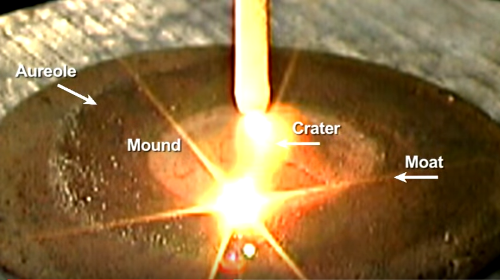
Mar 6, 2019 Lightning phenomena vary in magnitude. “Thunder is good, thunder is impressive; but it is lightning that does the work.”— Mark Twain Lightning, along with other electrical manifestations, includes a phenomenon called, “transverse electric currents” with the main discharge channel. Slow-motion videos of lightning reveal multiple leader strokes…
Frozen Moon
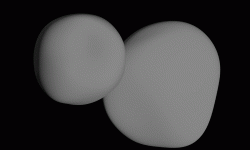
Potato Pancake
Mar 4, 2019 Ultima Thule continues to confound astronomers. According to a recent press release, (486958) 2014 MU69, otherwise known as Ultima Thule, is not shaped like a snowman. The newest images from the New Horizons spacecraft reveal it to be a “squashed walnut” combined with a “flattened cookie”. Alan…
Water, Water, Everywhere?
Mar 1, 2019 Liquid water is thought to be abundant in the Solar System, especially on Mars. NASA launched the Mars Science Laboratory, otherwise known as “Curiosity” on November 26, 2011. Curiosity is currently rolling through Gale Crater, located just southwest of Elysium Mons on the edge of the vast…
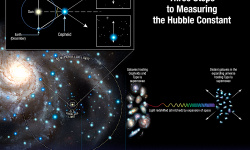
Constant Confusion
Feb 28, 2019 In 1997, two teams of astronomers studying Type 1a supernovae found there was “something wrong” with their observations. Type 1a supernovae are a sub-class of stellar explosions involving binary stars, but they are thought to occur through a different process. Their particular way of exploding is still…
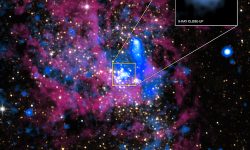
Warped Theories
Feb 27, 2019 Inside of a black hole, astronomers believe that matter occupies no volume, yet maintains a gravitational force so great that no light can escape its event horizon. They are “black” holes, because they are undetectable with optical telescopes. The fact that they are impossible to observe, directly,…