November 11, 2020
Is Europa covered with ice on top of a briny ocean?
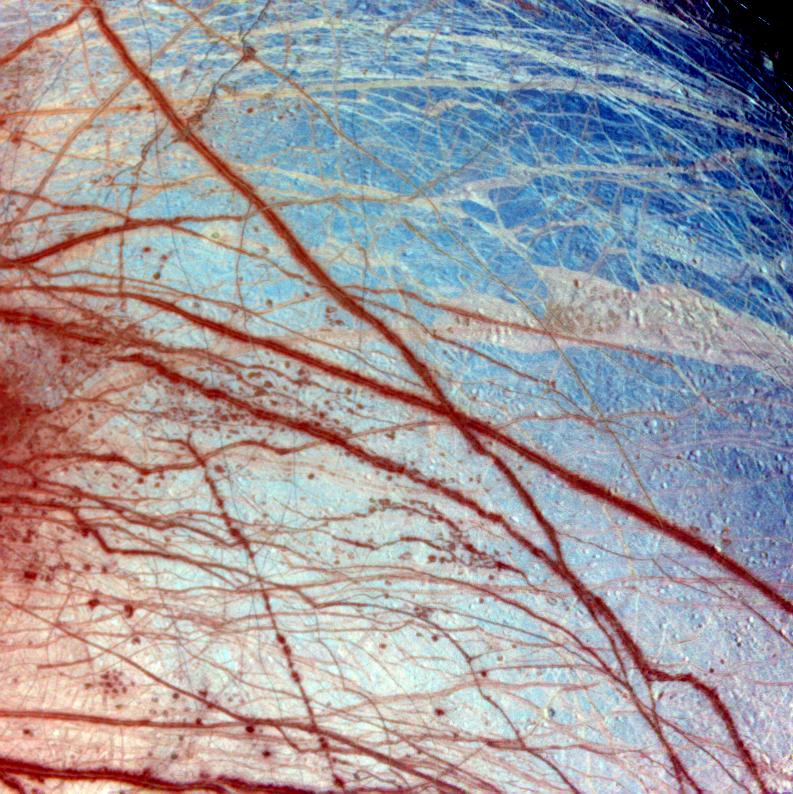
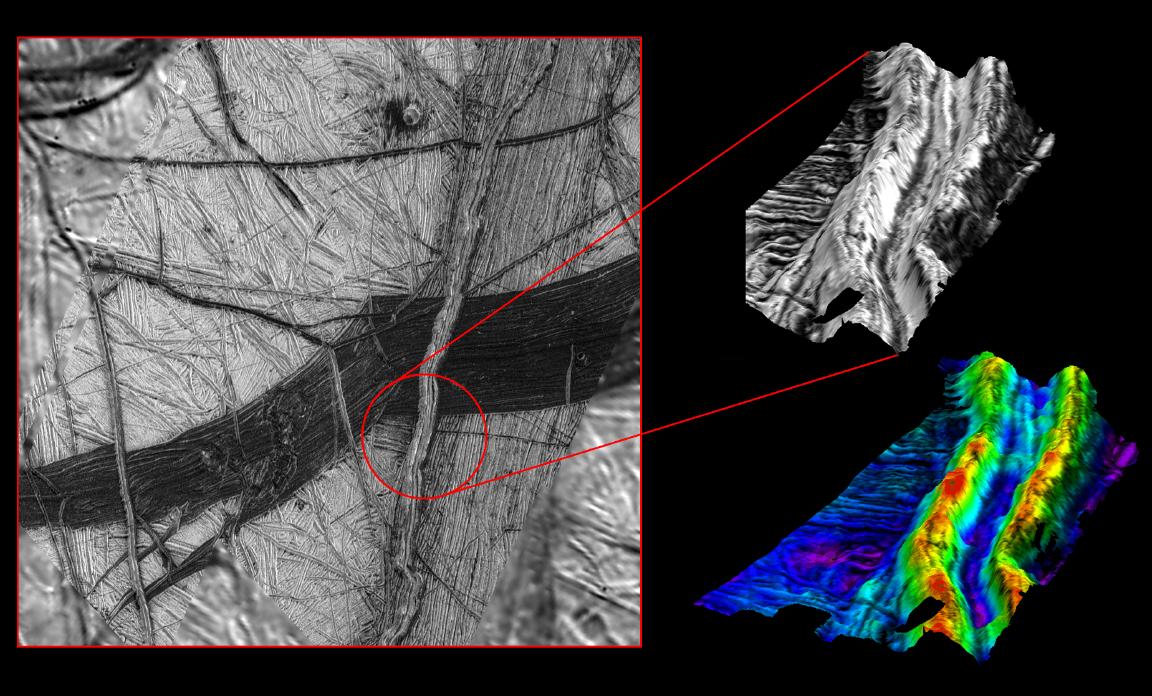
When Voyager 1 flew by Europa on March 1979, planetary scientists were surprised to see that the moon was completely encased in water ice. Another surprise was that Europa exhibited few craters. Instead, its surface is dominated by sinuous channels, called “rilles,” that extend for thousands of kilometers in some cases. Formations known as “flexi“, which appear to be rilles with two ridges, also mystified NASA mission team members.
Some astrophysicists speculate that there are lakes of water beneath Europa’s ice, just above a salty ocean. Using computer simulations for support, consensus astrophysicists believe that the surface of Europa is a thick shell of water ice floating on top of the conjectural sea. The ice is said to be “kneaded” by gravitational tides from Jupiter, creating gigantic ice rafts.
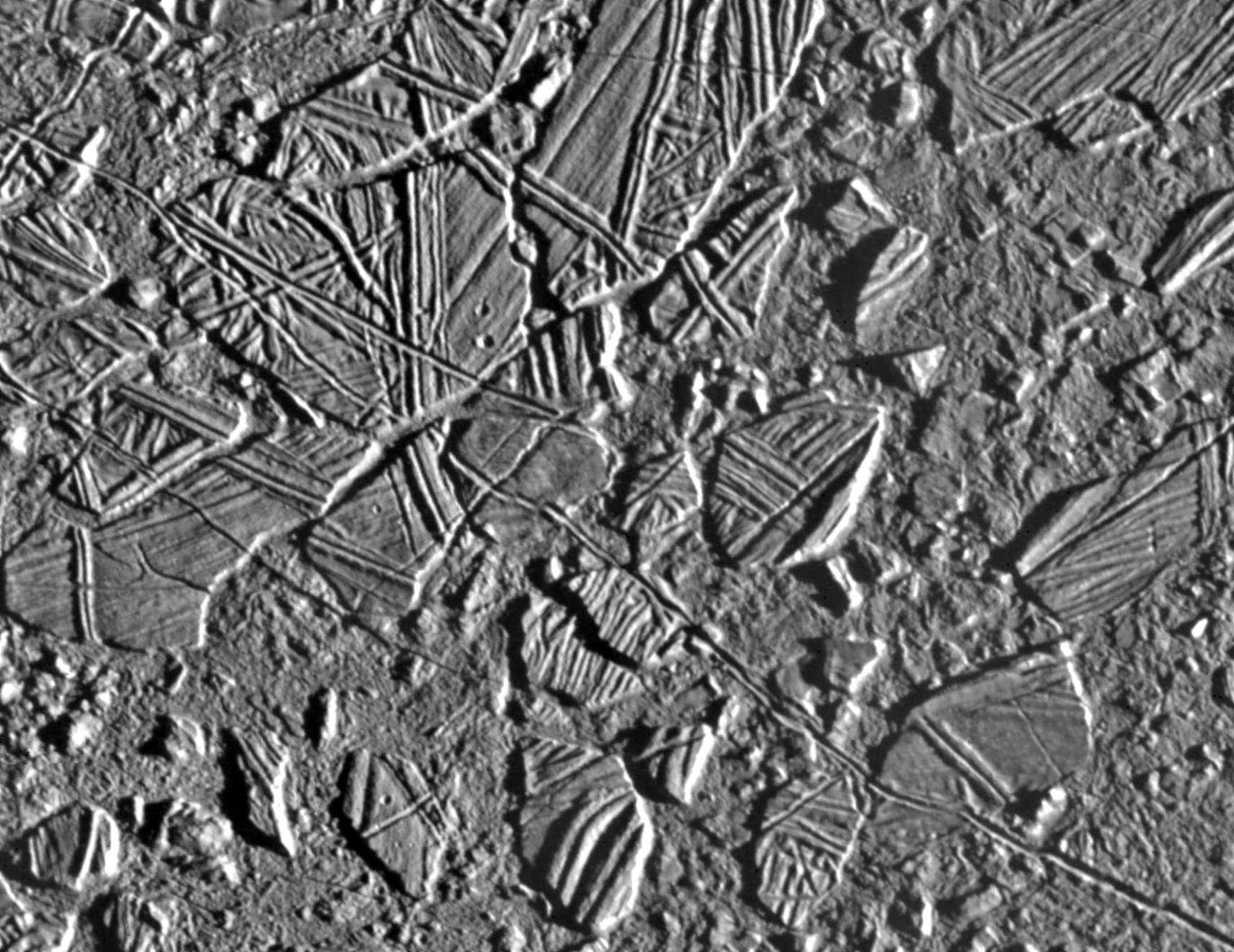
Everywhere on Europa are complexes of parallel and side-by-side grooves with no indications of fracturing. Sometimes, the trenches run through a field of chaos, ignoring the topography as they cut the surface. Does repeated breaking and mingling of ice rafts produce extensive parallel grooves that exhibit levees several meters high? No.
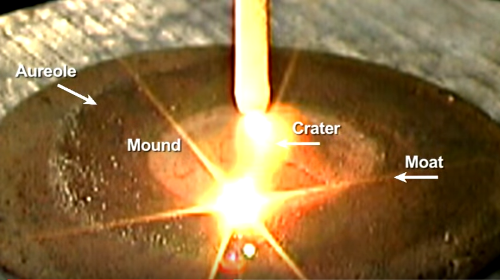
Europa’s rilles have no analog to ice cracks on Earth. Ice breaks chaotically, so variations in thickness and composition that repeat over long distances do not occur. Yet, repetitive patterns are observed on Europa. The swirls and loops that cover it can be duplicated in the laboratory using plasma discharge equipment.
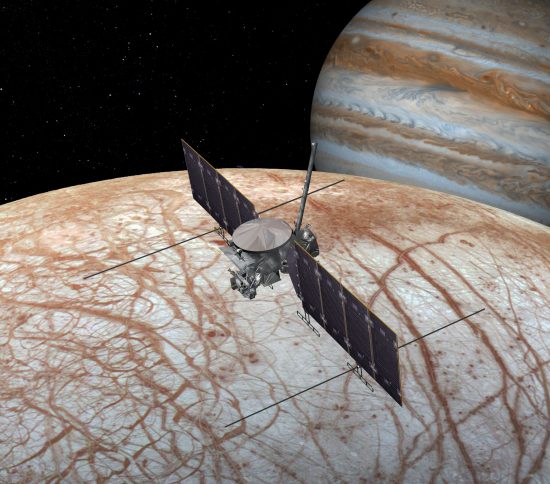
According to a recent press release, astronomers interpreted observations from the Hubble Space Telescope to mean that giant “geysers” were erupting from the south pole of Europa. Those plumes are thought to come from the aforementioned cracks in Europa’s surface, similar to the “tiger stripes” on Saturn’s moon Enceladus. Their new model predicts that brine pockets can “migrate” and then erupt to the surface when they re-freeze. The upcoming Europa Clipper mission means that astronomers need to “understand” cryogenic eruptions across icy bodies in the Solar System.
One of the most surprising results of the Galileo space probe’s mission to Jupiter was the identification of electrical activity between several Jovian moons and their parent. So-called “volcanoes” were seen erupting from the moon Io. The plumes are the result of cathode arcs, not internal heat, electrically etching Io’s surface and blasting sulfur dioxide “snow” up to 150 kilometers into space.
Io acts like an electrical generator as it travels through Jupiter’s plasmasphere, inducing over 400,000 volts across its diameter at more than three million amperes. That tremendous electric charge flows along Io’s magnetic field into the electric environment of Jupiter. Some astronomers acknowledged the electrical connection when Io’s electromagnetic “footprint” was seen in Jupiter’s polar aurora. It was later found that all four of Jupiter’s large moons leave imprints in the aurora, including Europa.
Scientists persist in misinterpreting rilles on Europa as “vents,” channeling water to the surface. They are actually incisions on the moon caused by traveling electric arcs. It appears that Europa was gouged and torn, rather than cracked and broken. A giant auger cut across the surface, disregarding the prior topography: a sure sign that an electric arc was the active agent. The rilles show parallelism not because they are open cracks, but because filamentary electric currents flowing across a surface tend to align and follow the ambient magnetic field direction.
Electric Universe advocates propose that the rilles and hot pole on Europa are heated by electromagnetic induction, where an electric current returns to Jupiter’s plasma sheath. As electrical input to Europa varies, the strength of the ultraviolet signal also varies, creating a false impression of water vapor plumes that come and go.
Stephen Smith