Blob of Conformity

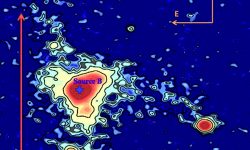
  Nov 9, 2017 What is illuminating this gigantic nebula? Astronomers from the University of California, Santa Cruz recently announced the discovery of a massive cloud of gas called an “enormous Lyman-alpha nebula” (ELAN). The “blob” of gas resides in a region of space thought to be 10 billion light-years…

Continue reading

Solar Plasma

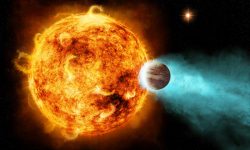
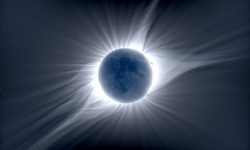
Nov 8, 2017 The Sun is not a ball of hot gas. The conventional model of how the Sun works relies on thermonuclear processes. Although no direct measurement is possible, temperatures in its core are thought to be more than 15 million Celsius, with compressive strain greater than 340 billion…

Continue reading

Cluster Crash

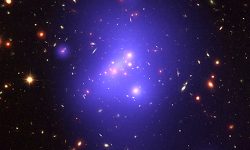
  Nov 7, 2017 Do galaxies bump into each other? High temperatures in galaxy clusters are an enigma. Because astronomers have only one force in their bags of tricks—gravity—whenever energetic events are found, like high temperatures in the galaxy cluster shown above, it “must be” caused by a gravity-driven collision…

Continue reading

Charged Aurora

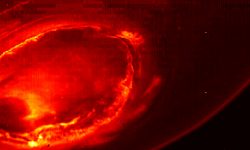
  Nov 6, 2017 Aurorae on Jupiter are poorly understood by consensus astrophysicists. Jupiter is 142,984 kilometers in diameter at its equator. A day on Jupiter lasts only 9.925 hours. Its rapid rotational velocity means that its equatorial diameter is 9275 kilometers more than the distance between its poles. According…

Continue reading

Dust Eruption

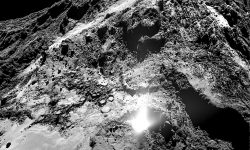
Nov 4, 2017 How can water vapor explode from a comet far from the Sun? The Rosetta Cometary Probe was launched March 2, 2004 on a rendezvous mission with comet 67P/Churyumov-Gerasimenko. It was in hibernation for most of the trip, only powering up its instruments in January of 2014. One…

Continue reading