Armed Forces

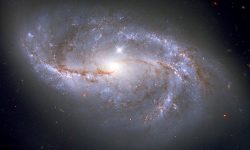
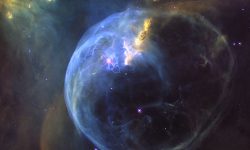
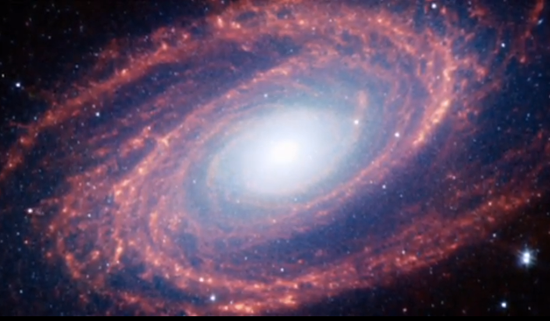
June 15, 2020 As written many times in the past, stellar evolution is conventionally thought to proceed from compressed clouds of hydrogen and helium, which derive their energetic emissions from thermonuclear processes. NGC 2608 is considered an example of those activities, because astronomers find that the galaxy’s spiral arms exhibit…

Continue reading

Warped Theories

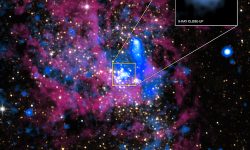
June 11, 2020 Inside of a black hole, astronomers believe that matter occupies no volume, yet maintains a gravitational force so great that no light can escape its event horizon. They are “black” holes, because they are undetectable with optical telescopes. The fact that they are impossible to observe directly…

Continue reading

Langmuir Sheaths

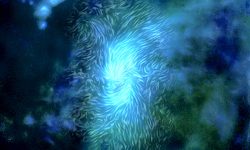
June 10, 2020 The Interstellar Medium is sparse. As written in previous Pictures of the Day, particles in space are far more diffuse than any vacuum on Earth. The best vacuums created on Earth reach a 0.1 millimeter distance between individual atoms. Between stars, however, there is only one atom…

Continue reading

Fusion Confusion

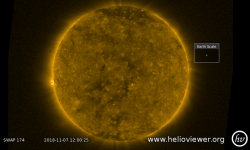
June 9, 2020 Coronal holes are the source of fast solar winds that can produce geomagnetic storms on Earth. The thermonuclear model of the Sun proposes that the temperature in its core is more than 15 million Celsius, with compressive strain greater than 340 billion times Earth’s atmospheric pressure. 700…

Continue reading

Cut the Dust

June 4, 2020 Stars are formed from charged particles. “Men think highly of those who rise rapidly in the world; whereas nothing rises quicker than dust, straw, and feathers.”— Lord Byron Immanuel Kant, the 18th Century philosopher, suggested that stars, in general, as well as the Solar System, in particular,…

Continue reading

Voids in Space?

June 3, 2020 There is no emptiness in the Electric Universe. According to a recent press release, astronomers are puzzled by the extent, as well as its lack of galaxies, in what is deemed the largest “void” yet discovered. The void is approximately 2 billion light-years in diameter, as astronomers…

Continue reading