Rhea’s Ribbon of Dust

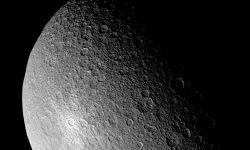
July 28, 2020 The first detection of a ring around a moon. The Cassini space probe is no more; it was burned-up in Saturn’s atmosphere on September 17, 2017. Its data set continues to be analyzed, however, since its observations comprised thousands of terabytes. Planetary scientists announced that they discovered…

Continue reading

There’s a Light Up Ahead!

July 27, 2020 Electric Universe theory contradicts the theory of dark matter. Along with the general idea of invisible, undetectable materials in space that can release vast amounts of radiation, dark matter theory inserts unreasonable dilemmas into an already confused environment. Mainstream astrophysicists believe that dark matter is a necessary…

Continue reading

Cup-Bearer

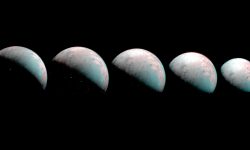
July 24, 2020 Ganymede is the largest moon. Beginning with Pioneer 10 in 1973, and including the most recent visit by Juno, Jupiter and its moons continue to be the subject of deep space missions. Over the last four decades, eight different spacecraft have flown past the planet and many…

Continue reading

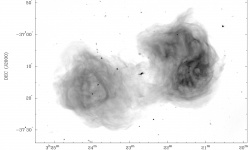
Galactic Cocoon

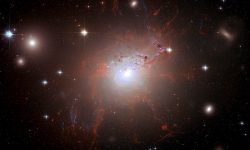
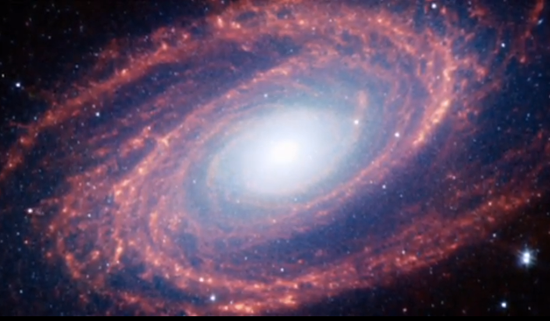
July 23, 2020 Galaxy filaments are also called, Birkeland currents. “Everyday life depends on the structure of the atom. Turn off the electrical charges and everything crumbles to an invisible fine dust, without electrical forces, there would no longer be things in the universe – merely diffuse clouds of electrons, protons,…

Continue reading

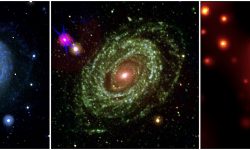
Spatial Wiring

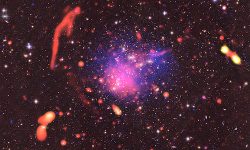
July 22, 2020 High temperatures in galaxy clusters are an enigma, because astronomers have only one force in their bag of tricks: gravity. Whenever energetic events are found in deep space, like high temperatures in galaxy clusters, it “must be” caused by a gravity-driven collision in the remote past. Electric…

Continue reading

Cosmic Blink

July 21, 2020 Objects spinning faster than a dentist’s drill? According to a recent press release, another “millisecond pulsar” was discovered by a team from NASA’s Goddard Spaceflight Center. Pulsars are often referred to as “lighthouses in space”, with beams of radiation focused at specific points. Since conventional astrophysicists are…

Continue reading

Dark Velocity

July 20, 2020 Is the Universe expanding? Maybe not. Stars are primarily composed of hydrogen, according to consensus ideas. Nuclear reactions are thought to convert that hydrogen into helium, initiating the energetic emissions that make life on Earth possible. When temperatures in average stellar cores reach about 100 million Kelvin,…

Continue reading

ORCs

July 17, 2020 A new class of celestial object? Many astrophysical phenomena are “puzzling” to astronomers, Fast Radio Bursts (FRB), Gamma-Ray Bursts (GRB), blazars, magnetars, black holes, etc. Now, some new mysterious observations are beckoning: ORCS, or Odd Radio Circles. None of the other previously discovered radio objects seem able…

Continue reading

Electric Explosions

July 16, 2020 Supernovae illustrate the same old problems. Type 1A class supernovae are important to consensus astronomers for two reasons: their light-curves, or graphs of their intensity over time, are considered to be so predictable that they can be used as cosmic measuring rods. Since redshift equals distance in…

Continue reading

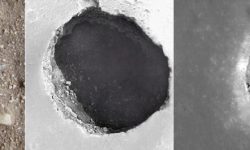
Electrical Etchings

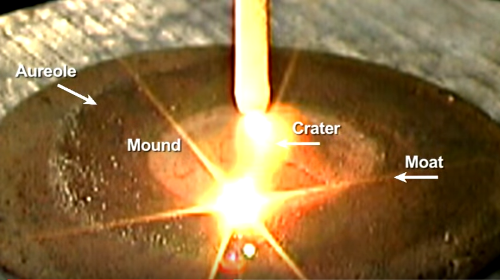
July 15, 2020 Holes in theories. Previous Picture of the Day articles discuss many unusual formations on planets and moons. Craters, canyons, dunes, and many other features on Mars do not readily correspond to contemporary theories about their formation: crater rims with steep vertical walls and kilometer-deep canyons with no…

Continue reading