Extended Mission

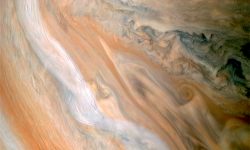
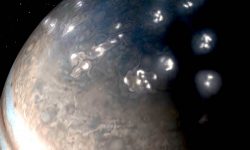
Jul 10, 2019 Juno will circle Jupiter for another four years. Jupiter is the largest planet. It is so large that all of the other planets could fit comfortably inside its 1.77 X 10^15 cubic kilometer volume. Jupiter rotates in 9.925 hours, causing its diameter to be 9275 kilometers more…

Continue reading

On and Off

Jul 8, 2019 Stars respond to incoming electric charge flow. According to consensus theory, when a star uses up its hydrogen it contracts because radiation pressure no longer overcomes the gravity pulling its outer layers into its core. As that compression increases, internal pressure rises and heats up the star,…

Continue reading

Colliding Theories

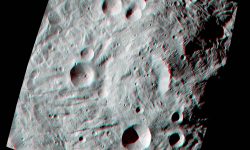
Jul 5, 2019 More data analysis from the Dawn spacecraft. Vesta experienced some powerful forces. There are craters more than 50 kilometers in diameter on its surface, even though it is a mere 564 kilometers by 531 kilometers. There is a particularly large crater near Vesta’s south pole that is…

Continue reading

Cold Winds

Jul 4, 2019 Gas giant planets exhibit extreme weather. The fastest winds ever recorded on Earth was a 372 kilometer per hour gust on Mount Washington, New Hampshire in 1934. Tornadoes and hurricanes can achieve higher average velocities for short periods, but the maximum 24 hour speed record of 205…

Continue reading

A New Dawn

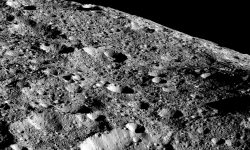
Jul 2, 2019 Investigating the dwarf planet, Ceres. The Dawn spacecraft was launched on September 27, 2007. It began observing the asteroid Vesta on July 17, 2011 and then headed toward the dwarf planet, Ceres on September 5, 2012. Dawn entered orbit around Ceres at 7:39 AM EST on Friday, March 6,…

Continue reading

Star Giants

Jun 28, 2019 Are red giant stars old or young? “Children will always be afraid of the dark, and men with minds sensitive to hereditary impulse will always tremble at the thought of the hidden and fathomless worlds of strange life which may pulsate in the gulfs beyond the stars…”—…

Continue reading

Spider Eggs

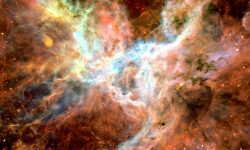
Jun 27, 2019 Regions inside this nebula are described as “cocoons” for new stars. The Tarantula Nebula’s designation is 30 Doradus. It is an “emission nebula” in the Large Magellanic Cloud (LMC). Readers may remember that a well-known supernova, 1987a, exploded near the nebula’s edge. The nebula’s average diameter exceeds 1000 light-years,…

Continue reading

Comet 134340 Pluto?

Jun 25, 2019 Is Pluto a cometary body? According to a recent press release, Pluto might be composed of a “billion comets”. As Dr. Christopher Glein of SwRI’s Space Science and Engineering Division wrote: “We’ve developed what we call ‘the giant comet’ cosmochemical model of Pluto formation. We found an…

Continue reading