Plasma Science

October 16, 2020 Astronomers find many celestial phenomena to be unexpected. Many of those phenomena are familiar, even though they are not easily explained. The aurorae at each of Earth’s poles are familiar to most people, although the way they form is not completely understood. Similarly, lightning bolts are familiar…
Continue reading

Langmuir Bursts

October 15, 2020 What powers coronal mass ejections? According to a recent press release, solar flares are driven by magnetized loops of plasma. The magnetic fields in the “magnetic flux ropes” experience “reconnection events” in which the field lines break and then reconnect, causing explosions of “magnetic energy.” Some of that…

Continue reading

Space Is Not a Thing

October 13, 2020 Stars are born where regions of space accumulate dense electric charge. Stars are concentrations of electricity that result from Birkeland currents and electric charge separation in space. Therefore, conventional models of stellar evolution reveal almost nothing about how stars are born and behave. Red giant stars, as…

Continue reading

Calm Before the Storm

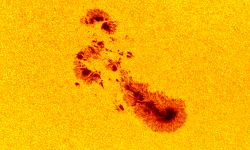
October 12, 2020 Sunspots are mysterious. According to a recent press release, heliophysicists are studying sunspots fields in order to understand how similar phenomena might occur on other stars. Beginning with data from the Solar Dynamics Observatory and the Hinode mission, scientists “smeared” the datapoints into broad images. This gave…

Continue reading

On and Off

October 8, 2020 Stars respond to incoming electric charge flow. According to consensus theory, when a star uses up its hydrogen it contracts because radiation pressure no longer overcomes the gravity pulling its outer layers into its core. As that compression increases, internal pressure rises and heats up the star,…

Continue reading

No Wind in the Dust

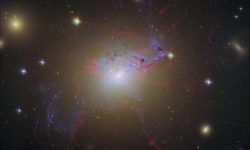
October 7, 2020 Galactic filaments are not kinetic phenomena. Astronomers ponder the enigmatic structure of Galaxy NGC 1275. Multiple strands of material extend outward in light-years-long tendrils, enclosing it in a loose cocoon. The filaments are examples of ionized hydrogen atoms. Since hydrogen is composed of one electron and one…

Continue reading

Star Giants

October 6, 2020 Are red giant stars old or young? “Children will always be afraid of the dark, and men with minds sensitive to hereditary impulse will always tremble at the thought of the hidden and fathomless worlds of strange life which may pulsate in the gulfs beyond the stars…”—…

Continue reading

Dim Companions

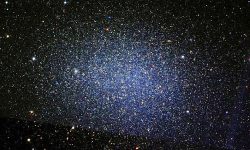
October 5, 2020 Solving a particular puzzle can be clouded by a layer of presumptions. The Milky Way hosts at least two smaller satellite galaxies, the Large and Small Magellanic Clouds. However, some astronomers suspect that there are as many as 80 or more, such as the Wolf-Lundmark-Melotte dwarf galaxy….

Continue reading