Thunderbolts.info  
  home   •   picture of the day   •   thunderblogs   •   predictions   •   resources   •   forum   •   updates   •   contact us   •   donate


picture of the day

chronological archive               subject archive


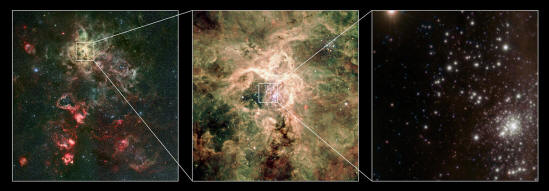
The Tarantula Nebula (left and center). Star cluster R136 (right).
Credit: ESO/P. Crowther/C.J. Evans.


Galactic Thunderbolts
Jul 26, 2010

Consensus astronomers look at individual points of light and discover the most massive stars. Electric Universe observers look at the entire complex of filaments and discover the characteristic features of a galactic thunderbolt.

“Mass” astronomy posits a relationship between mass and luminosity. By observing a double star system in the cluster shown at the top of the page, astronomers were able to calculate a baseline for the relationship and extrapolate the masses of brighter stars. They found some that were nearly twice as massive as they had thought possible. Although, since theories are often adjusted to explain any observation, failures of expectations cannot be equated with falsifications of theory.

Plasma astronomy posits a relationship between electrical stress and luminosity. Gravity, and consequently mass, is a weak manifestation of electrical stress. In regions that are relatively insulated from the primary effects of electricity (within stellar sheaths, such as the Sun’s heliosphere), gravity will largely determine orbital motions.

However, the mass that is calculated from analysis of the orbits is a result of the charge contained, not of the quantity of matter as is commonly assumed. In an Electric Universe, there are no maximum or minimum sizes for stars.

The objects of interest to plasma astronomers are the helical filaments that give the regions around the clusters their characteristic electrical structure. In the far view (left), arcs of parallel filaments appear to wind around kinked tubes that converge on the cluster, evidence for large plasma discharge channels.

Where channels intersect (center view), the stress increases. Bubbles form (exploding double layers, similar to coronal mass ejections), secondary discharges are induced, and instabilities pinch plasma into stars. The observed large outflow of material, mischaracterized as mass (and misnamed “wind”), is the electrical current flow coursing through the region like a galactic lightning bolt.

Instead of a random scattering of gravitationally collapsing clouds shaped by hot winds, these regions are unitary plasma discharge formations better called galactic thunderbolts.

Mel Acheson


"The Cosmic Thunderbolt"

YouTube video, first glimpses of Episode Two in the "Symbols of an Alien Sky" series.


And don't forget: "The Universe Electric"

Three ebooks in the Universe Electric series are now available. Consistently praised for easily understandable text and exquisite graphics.


SITE SEARCH


Thunderbolts whole site
       Tpods only
       Thunderblogs only
       Forum only
Holoscience (Thornhill)
Web
 
  Search powered by Scroogle
using SSL encryption
for your privacy
 
 
SUBSCRIBE
 
  FREE update -

Weekly digest of Picture of the Day, Thunderblog, Forum, Multimedia and more.
 
 
*** NEW DVD ***
 
  Symbols of an Alien Sky
Selections Playlist


E-BOOKS
 
 
An e-book series
for teachers, general readers and specialists alike.
 
 
VIDEO
(FREE viewing)
 
  Thunderbolts of the Gods


PREDICTIONS
 
  Follow the stunning success of the Electric Universe in predicting the 'surprises' of the space age.  
 
MULTIMEDIA
 
  Our multimedia page explores many diverse topics, including a few not covered by the Thunderbolts Project.  


Authors David Talbott and Wallace Thornhill introduce the reader to an age of planetary instability and earthshaking electrical events in ancient times. If their hypothesis is correct, it could not fail to alter many paths of scientific investigation.
More info
Professor of engineering Donald Scott systematically unravels the myths of the "Big Bang" cosmology, and he does so without resorting to black holes, dark matter, dark energy, neutron stars, magnetic "reconnection", or any other fictions needed to prop up a failed theory.
More info
In language designed for scientists and non-scientists alike, authors Wallace Thornhill and David Talbott show that even the greatest surprises of the space age are predictable patterns in an electric universe.
More info


EXECUTIVE EDITORS: David Talbott, Wallace Thornhill
MANAGING EDITORS: Steve Smith, Mel Acheson
CONTRIBUTING EDITORS: Michael Armstrong, Dwardu Cardona,
Ev Cochrane, C.J. Ransom, Don Scott,
Rens van der Sluijs, Ian Tresman,
Tom Wilson
WEBMASTER: Brian Talbott
 
© Copyright 2010: thunderbolts.info
 
top ]
 
thunderbolts.info

home   •   picture of the day   •   thunderblogs   •   multimedia   •   resources   •   forum   •   updates   •   contact us   •   donate