Thunderbolts.info  
  home   •   picture of the day   •   thunderblogs   •   predictions   •   resources   •   forum   •   updates   •   contact us   •   donate


picture of the day

chronological archive               subject archive


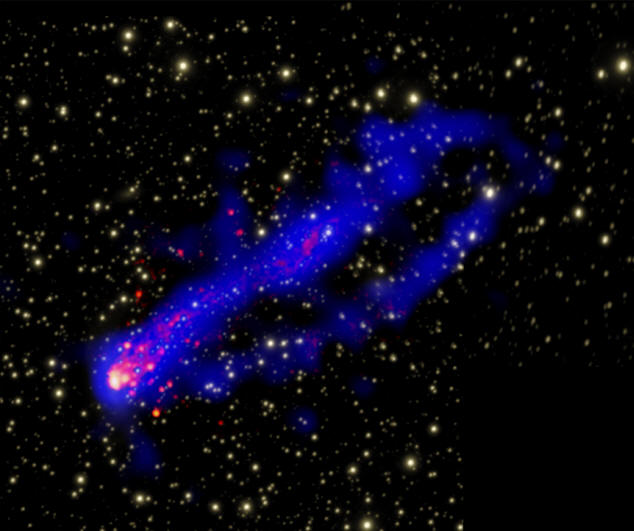
Galaxy ESO 130-001. Credit: X-ray NASA/CXC/UVa/M. Sun, et al;
H-alpha/Optical: SOAR (UVa/NOAO/UNC/CNPq-Brazil)/M.Sun et al.


A Galaxy with Its Tail in a Knot
Feb 01, 2010

A new x-ray image of a galaxy in the Abell cluster 3627 reveals a second tail parallel to the first, which was already known. The second tail is fainter but also contains knots. Both tails are surrounded by x-ray point sources.

The second tail visible in the image above is “a surprise” to plasma-impaired astronomers, who must explain it with the mechanics of evaporation. Plasma-wise astronomers immediately recognize that Birkeland currents tend to come in pairs. Actually, they come in pairs of pairs, braided pairs, and cables of braids—hence explaining the filamentary universe. (Perhaps one could call it the “fibrous universe.”)

A plasma astronomer will notice that the second tail is not so much parallel to the first as twisted around it in a half-turn. Since Birkeland currents—even galaxy-cluster size ones such as this—are the transmission lines of a larger circuit, the current must continue in dark mode beyond the region in which it emits x-rays.

Presumably, the two “tails” continue to twist around each other. This conclusion is reinforced by the optical (red) filament at the core of the first tail: It appears to be a twisted pair of filaments itself. The knots in the tails and the point sources around them are likely to be pinch instabilities.

Electromagnetic forces concentrate matter in the current flow into clumps. They also pull in matter from the surrounding region and sort it into layers of similar composition according to ionization potential. This process, observable in laboratory discharges and involving forces many, many times stronger than gravity, is more likely to be the cause of star formation than the gravitational collapse of gas clouds. Gravitational collapse has never been demonstrated, nor has it overcome the theoretical difficulties—seldom discussed—that seem to render it impossible.

Halton Arp and a number of colleagues have shown that clusters of galaxies such as those in the Abell catalogue are often associated with nearby active galaxies and are positioned within the active galaxies’ ejection cones. Being nearby, as distinguished from the conventional redshift-distance placement, they are small. They appear to be the next step in growth of BL Lac objects, quasars with multiple or “fractured” centers, which are the first products of ejection from the nuclei of the active galaxies. (The “grown-up” results are companion galaxies, which have evolved step-wise down the Karlsson redshift periodicity from high-redshift quasars.)

As such, in the Electric Universe the entire cluster is the focus of an electrical plasma discharge. Individual galaxies are foci of only a part of the discharge current and can only be understood in relation to the whole circuit. One possible view is in analogy with stellar circuits. The dominant galaxy in a cluster would be the anode within a sheath that surrounds the entire cluster, similar to the heliosphere around the solar system. The smaller galaxies would be secondary cathodic elements within that sheath, similar to comets. The double tail on this galaxy marks it as a galaxy-sized comet.

Mel Acheson


"SYMBOLS OF AN ALIEN SKY" DVD - Now Available:

When the "Saturn Theory" converged with Electric Universe theory in 1997, this meeting of the minds lit a fire in two independent camps. Comparative mythology found a stunning counterpart in the discoveries of the electric universe.

But don't just take our word for it. Please give consideration to what others say about this DVD.

Reviews from principals of the Thunderbolts Project

Independent reviews

Selections from the DVD on YouTube

Order now


AND DON'T FORGET:

Three ebooks in the new series are now available. Delightful reading, consistently praised for easily understandable text and exquisite graphics.
http://www.mikamar.biz/thunderbolts-product.htm#ebooks


SITE SEARCH


whole site
       tpods
       thunderblogs
       forum
web
 
  Search powered by Scroogle
using SSL encryption
for your privacy
 
 
SUBSCRIBE
 
  FREE update -

Weekly digest of Picture of the Day, Thunderblog, Forum, Multimedia and more.
 
 
*** NEW DVD ***
 
  Symbols of an Alien Sky
Selections Playlist


E-BOOKS
 
 
An e-book series
for teachers, general readers and specialists alike.
 
 
VIDEO
(FREE viewing)
 
  Thunderbolts of the Gods


PREDICTIONS
 
  Follow the stunning success of the Electric Universe in predicting the 'surprises' of the space age.  
 
MULTIMEDIA
 
  Our multimedia page explores many diverse topics, including a few not covered by the Thunderbolts Project.  


Authors David Talbott and Wallace Thornhill introduce the reader to an age of planetary instability and earthshaking electrical events in ancient times. If their hypothesis is correct, it could not fail to alter many paths of scientific investigation.
More info
Professor of engineering Donald Scott systematically unravels the myths of the "Big Bang" cosmology, and he does so without resorting to black holes, dark matter, dark energy, neutron stars, magnetic "reconnection", or any other fictions needed to prop up a failed theory.
More info
In language designed for scientists and non-scientists alike, authors Wallace Thornhill and David Talbott show that even the greatest surprises of the space age are predictable patterns in an electric universe.
More info


EXECUTIVE EDITORS: David Talbott, Wallace Thornhill
MANAGING EDITORS: Steve Smith, Mel Acheson
CONTRIBUTING EDITORS: Michael Armstrong, Dwardu Cardona,
Ev Cochrane, C.J. Ransom, Don Scott,
Rens van der Sluijs, Ian Tresman,
Tom Wilson
WEBMASTER: Brian Talbott
 
© Copyright 2010: thunderbolts.info
 
top ]
 
thunderbolts.info

home   •   picture of the day   •   thunderblogs   •   multimedia   •   resources   •   forum   •   updates   •   contact us   •   donate