Electrode
noun
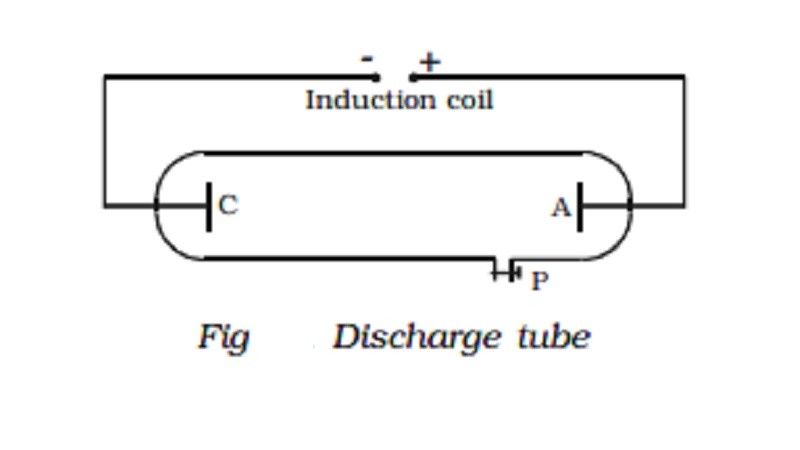
a conductor, not necessarily metallic, through which a current enters or leaves a nonmetallic medium, as an electrolytic cell, arc generator, vacuum tube, or gaseous discharge tube.
Electrode | Definition of Electrode
1 : a conductor used to establish electrical contact with a nonmetallic part of a circuit. 2 : an element in a semiconductor device (such as a transistor) that emits or collects electrons or holes or controls their movements.
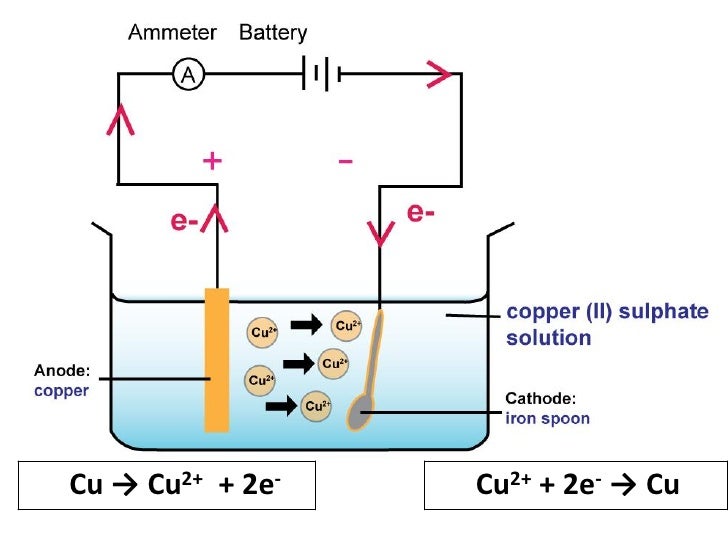
Some examples of the use of electrodes in every day life include electric discharge tubes, the processing of ores in electrolysis, and the deposition of metals in electroplating. For these applications to work, there must be two electrodes of opposite polarity, an anode and a cathode. When a current is applied and the circuit complete, the charged particles migrate between them. You can light up a room or make a silver spoon.
Originally, Ralph Juergens used a gaseous electric discharge tube to describe many features of the electric sun, including the anode tufts. The anode sun model was further developed by Wal Thornhill, and also Donald Scott, to include the "virtual cathode" at the sun's heliopause. This model has been useful in the decades since for interpreting space discoveries, making predictions, and carrying out experiments.
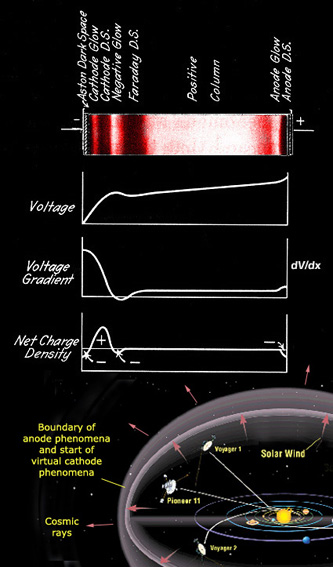
- Figure 3
https://www.holoscience.com/wp/wp-conte ... charge.jpg
"Diagram showing the important electrical features of a glow discharge aligned with the heliosphere and with the Sun as the anode. Note that in a spherically symmetrical corona discharge the cathode glows and extensive positive column glow are absent because the drift current is spread through a huge volume. The heliosphere boundary is a double layer with charge concentrations shown. A reverse electric field is strongest at the point of inflection between the two charge concentrations. Discharge diagram from J. D. Cobine's Gaseous Conductors.
This model predicts that there are not only sunward electrons in sufficient numbers within the heliosphere to light the anode sun, but that there are also sunward electrons from the planets to the sun.