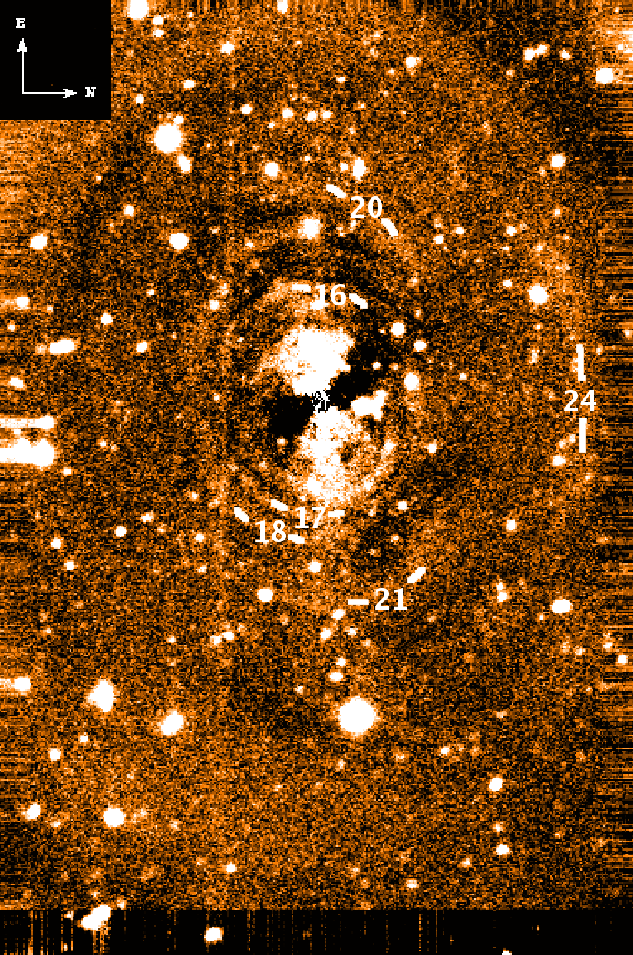
Some time ago observations began detecting very faint spherical “shells” surrounding some galaxies. The shells resemble spherical "ripples in a pond”. Initially they were primarily noticed associated with Elliptical Galaxies but they’ve also been detected around Lenticular, and Spirals as well. Remember, they are not ‘flat’ like a galactic disc; they are spherical “shells”. Not only can these "shells" extend quite far from galactic center they also contain dust and stars leading them to sometimes be referred to as “stellar halos”.
The current view is that these “shells” were formed as a result of “mergers”, weak interactions, and/or tidal activities. Even if either were the case what could subsequently induce the random dust and stars of a supposed merger to coalesce into several concentric spheres. Maybe they formed as a result of episodic AGN phases? MOND theory has been applied to them, Cold Dark Matter theory has poked its head in the door, Gravitational approaches etc, but no one really knows how these concentric features are formed. Without further adieu what induces this spherical 'waving':
Galaxy NGC 474: Shells and Star Streams
The Outer Shells of Centaurus A
Galaxy NGC 3923
Shell System NGC 5982
Might they be formed by spherical Standing Waves? Could they be formed by Electric Fields inducing double-layers such as the radial striations observed in spherical glow discharges? Do galaxies oscillate?
“Shell Galaxies”; Galactic Oscillations?
-
Solar

- Posts: 1457
- Joined: Mon Mar 17, 2008 10:05 am
“Shell Galaxies”; Galactic Oscillations?
"Our laws of force tend to be applied in the Newtonian sense in that for every action there is an equal reaction, and yet, in the real world, where many-body gravitational effects or electrodynamic actions prevail, we do not have every action paired with an equal reaction." — Harold Aspden
-
Rick

- Posts: 11
- Joined: Tue Sep 08, 2020 7:42 pm
- Location: erehwon
- Contact:
Re: Quote of Harold Aspden
Re your quote:
Our laws of force tend to be applied in the Newtonian sense in that for every action there is an equal reaction, and yet, in the real world, where many-body gravitational effects or electrodynamic actions prevail, we do not have every action paired with an equal reaction." — Harold Aspden
True. There is a multiplicity of relationships, perhaps uncountable, governed by (n*n-n)/2. The computed quantity of relationships in the solar system would be enormous.
Our laws of force tend to be applied in the Newtonian sense in that for every action there is an equal reaction, and yet, in the real world, where many-body gravitational effects or electrodynamic actions prevail, we do not have every action paired with an equal reaction." — Harold Aspden
True. There is a multiplicity of relationships, perhaps uncountable, governed by (n*n-n)/2. The computed quantity of relationships in the solar system would be enormous.
You do not have the required permissions to view the files attached to this post.
-
Solar
- Posts: 1457
- Joined: Mon Mar 17, 2008 10:05 am
“Shell Galaxies”; Galactic Oscillations?
Welcome to the forum! And yes, Mach's Principle comes to mind.So many different kinds of relations can be superimposed atop one another that it boggles the mind.Rick wrote: ↑Wed Sep 16, 2020 1:23 am Re your quote:
Our laws of force tend to be applied in the Newtonian sense in that for every action there is an equal reaction, and yet, in the real world, where many-body gravitational effects or electrodynamic actions prevail, we do not have every action paired with an equal reaction." — Harold Aspden
True. There is a multiplicity of relationships, perhaps uncountable, governed by (n*n-n)/2. The computed quantity of relationships in the solar system would be enormous.
______________________________
On the topic of this thread:
In relation to these Shell Galaxies I've just realized that this image:
The Cat’s Eye Nebula
... may have been speaking to Spherical Standing Waves all along.
Hands down one of the most beautiful images NASA, ESA, HEIC, and The Hubble Heritage Team (STScI/AURA) has produced - the “rings” (or “shells”) are attributed to the star loosing “mass in a series of pulses at 1,500-year intervals", otherwise known as episodic mass loss. In other words, for some reason, as one of several modes of oscillation this star is also pulsing in-and-out. There are a lot of stars and stellar types that do this in an attempt to "maintain equilibrium" and several theoretical "Stellar Pulsations Mechanisms" exist.
Interestingly, this next 3 page paper from 2017 says that the disk of the Milky is undergoing “vertical displacement” (uplift and subsidence) and as a result the disc undergoes “wavelike oscillations” but the cause is attributed to the influence of a satellite dwarf galaxy:
The Milky Way’s disc is asymmetrically oscillating up and down. This suggest that the galaxy is slightly out of equilibrium and will eventually ‘restore’ itself when not being perturbed by the presence of an interloper. At some distant time far into the future these perturbations might extend into halo regions and present a unique sphere, or "shell" as one of many denoting this current observation.An oscillating vertical displacement of the Milky Way, with a wavelength of about8 kpc and and amplitude of about 100 pc (increasing with distance from the Galactic center)is observed towards the Galactic anticenter. These oscillations are thought to be the result of disk perturbations from dwarf satellites of the Milky Way. They explain the Monoceros Ringand could be related to Milky Way spiral structure. - The Vertical Displacementof the Milky Way Disk Heidi Jo Newberg, and Yan Xu
What is the "driver"? Perhaps: Resonance
"... the superposition of ingoing and outgoing waves produce a well-known structure: standing waves." - Gabriel LaFreniere
"Our laws of force tend to be applied in the Newtonian sense in that for every action there is an equal reaction, and yet, in the real world, where many-body gravitational effects or electrodynamic actions prevail, we do not have every action paired with an equal reaction." — Harold Aspden
-
beekeeper
- Posts: 195
- Joined: Tue Feb 23, 2010 3:53 am
Re: “Shell Galaxies”; Galactic Oscillations?
Greetings EU Pilgrims, Solar in his latest post I believe quote that "a star have a cycle of 1500 years by which it will loose or gain mass" I really wonder where that information came from and be for what I read basically accepted as factual there is no way that anyone in the middle ages could have gathered that kind of info, let alone 1000 years earlier. If some one can clarify this I would appreciate. Regards Beekeeper
If nothing can travel faster than light, how can darkness escape it
-
Solar
- Posts: 1457
- Joined: Mon Mar 17, 2008 10:05 am
Re: “Shell Galaxies”; Galactic Oscillations?
Hello Beekeeperbeekeeper wrote: ↑Wed Sep 16, 2020 11:52 pm Greetings EU Pilgrims, Solar in his latest post I believe quote that "a star have a cycle of 1500 years by which it will loose or gain mass" I really wonder where that information came from and be for what I read basically accepted as factual there is no way that anyone in the middle ages could have gathered that kind of info, let alone 1000 years earlier. If some one can clarify this I would appreciate. Regards Beekeeper
That quote is contained in 2nd paragraph of the brief text on the NASA page for the Cat's Eye Nebula linked above (Scroll below the image). Here is the link including relevant quote again mate:
Here also is a paper containing that assessment:Observations suggest the star ejected its mass in a series of pulses at 1,500-year intervals. These convulsions created dust shells, each of which contain as much mass as all of the planets in our solar system combined (still only one percent of the Sun's mass). These concentric shells make a layered, onion-skin structure around the dying star. The view from Hubble is like seeing an onion cut in half, where each skin layer is discernible.
The bull's-eye patterns seen around planetary nebulae come as a surprise to astronomers because they had no expectation that episodes of mass loss at the end of stellar lives would repeat every 1,500 years. - The Cat's Eye Nebula: NASA 2008
Hubble archival images of NGC 6543 reveal a series of at least nine regularly spaced concentric circular rings that surround the famous nebular core, known as the Cat's Eye Nebula. The rings are almost certainly spherical bubbles of periodic isotropic nuclear mass pulsations that preceded the formation of the core. The bubbles are detected solely in the lines of Hα, [O III], and [N II]. The core and the bubbles around it appear to have very similar temperature, ionization, and chemical properties. Assuming a distance of 1 kpc and an outflow velocity of 10 km s-1, a good fit to the Hα surface brightness distribution suggests that the bubbles were ejected with constant mass (∼0.01 M⊙) and thickness (∼1000 AU) approximately every 1500 years. The combined mass of the visible bubbles, ∼0.1 M⊙, is comparable to that of the present mass of the core (∼0.05 M⊙). Since the bubbles are evenly spaced and there is no sign of bubble-bubble collisions, the bubble ejection mechanism regulates the outflow speed to better than 10%. The line widths of the bubbles, ∼30 km s-1, argue that the bubbles are in the process of thickening and merging on timescales ≲103 yr. Their ejection period is consistent with a suggestion that quasi-periodic shells are launched every few hundred years in dust-forming asymptotic giant branch (AGB) winds but not consonant with the predictions of extant models of core thermal pulses (∼105 yr) and surface pulsations (∼10 yr). It appears that regular isotropic AGB mass pulses can precede the formation of brighter, denser, and more complex planetary nebula cores that are formed when an abrupt change of mode of mass loss occurs. Disruptive binary companion mergers or the sudden emergence of a magnetic field might account for the mode change.- NGC 6543: THE RINGS AROUND THE CAT'S EYE - BRUCE BALICK, AND JEANINE WILSON, ARSEN R. HAJIAN 2001
"Our laws of force tend to be applied in the Newtonian sense in that for every action there is an equal reaction, and yet, in the real world, where many-body gravitational effects or electrodynamic actions prevail, we do not have every action paired with an equal reaction." — Harold Aspden
-
beekeeper
- Posts: 195
- Joined: Tue Feb 23, 2010 3:53 am
Re: “Shell Galaxies”; Galactic Oscillations?
Greetings Solar, thank you for the clarifications, I can now see how main stream can propose this view, but when we take into account the proposal that the univers may be lot younger then the prevailing views, it is also possible that these shells were formed right where we detect them now in the same way as propose by the EU theory !!!thanks regards Beekeeper
If nothing can travel faster than light, how can darkness escape it
-
Solar
- Posts: 1457
- Joined: Mon Mar 17, 2008 10:05 am
Astrophysical "Shells" and Gravitational Lensing
Question please:
Might it be possible that “gravitational lensing” misinterprets an optical effect induced by the presence of spherical “Shells” surrounding a foreground object and thereby distorting the appearance of a background object?
Might it be possible that “gravitational lensing” misinterprets an optical effect induced by the presence of spherical “Shells” surrounding a foreground object and thereby distorting the appearance of a background object?
"Our laws of force tend to be applied in the Newtonian sense in that for every action there is an equal reaction, and yet, in the real world, where many-body gravitational effects or electrodynamic actions prevail, we do not have every action paired with an equal reaction." — Harold Aspden
-
beekeeper
- Posts: 195
- Joined: Tue Feb 23, 2010 3:53 am
Re: “Shell Galaxies”; Galactic Oscillations?
Greetings again great question solar I would also advance that their form and composition could make them into some form of prisms scattering the light in all directions maybe even breaking it down to its various components. Regards Beekeeper
If nothing can travel faster than light, how can darkness escape it
-
Solar
- Posts: 1457
- Joined: Mon Mar 17, 2008 10:05 am
Re: “Shell Galaxies”; Galactic Oscillations?
I seem to be full of questions lately. If someone can help me understand this next one its greatly appreciated.
At one time the idea was that Light were borne aloft by a ‘substance’; a Light bearing medium.
Along came MM experiments where such a ‘substance’ was supposedly not detected and subsequently, in some quarters of physics (not all), the idea was dispensed with.
Then, here again comes some type of ‘substance’ called “space time” that, even though Light supposedly has no “mass”, it gravitation-ally performs the exact same act by bearing Light aloft with it while said ‘substance supposedly “curves” around massive bodies “bending” the path of Light with it as it does so.
Yet, the previous idea invoking the very same concept was rejected? Might someone explain how are these not one and the same concept under different garb???
_____________________
It also seems that these optical affects might have relevance under Superfluid Cosmogony theories wherein, at the appropriate angle(s), the actual 'curvature' occurring at the uneven 'surface(s)' of one or more Astrophysical Shells might present distortions as if by they have some Laminar Sheath type of qualities.
Even this official ESA/Hubble lensing animation had to include a foreground "bubble" to magnify, reflect, refract and distort background objects:
Animation of a gravitational lensing effect
Are there "bubbles" in Space?
Bubble Nebula
Shell Galaxies
Loop I Superbubble (sitting right here in the Milky Way coming at you)
They are literally everywhere. They exist because they are "membranes" (aka double layers) modulating differences in the electric potential of their exterior environment relative to their interior environment. When I cannot see the bubbles, the Shells, their 'surfaces', and their lumpy laminar-like actual curvature(s) such as with this image:
Weak Lensing Abell 2218
I'm supposed to believe that "the curvature of spacetime" did it?
I think not.
At one time the idea was that Light were borne aloft by a ‘substance’; a Light bearing medium.
Along came MM experiments where such a ‘substance’ was supposedly not detected and subsequently, in some quarters of physics (not all), the idea was dispensed with.
Then, here again comes some type of ‘substance’ called “space time” that, even though Light supposedly has no “mass”, it gravitation-ally performs the exact same act by bearing Light aloft with it while said ‘substance supposedly “curves” around massive bodies “bending” the path of Light with it as it does so.
Yet, the previous idea invoking the very same concept was rejected? Might someone explain how are these not one and the same concept under different garb???
_____________________
It also seems that these optical affects might have relevance under Superfluid Cosmogony theories wherein, at the appropriate angle(s), the actual 'curvature' occurring at the uneven 'surface(s)' of one or more Astrophysical Shells might present distortions as if by they have some Laminar Sheath type of qualities.
Even this official ESA/Hubble lensing animation had to include a foreground "bubble" to magnify, reflect, refract and distort background objects:
Animation of a gravitational lensing effect
Are there "bubbles" in Space?
Bubble Nebula
Shell Galaxies
Loop I Superbubble (sitting right here in the Milky Way coming at you)
They are literally everywhere. They exist because they are "membranes" (aka double layers) modulating differences in the electric potential of their exterior environment relative to their interior environment. When I cannot see the bubbles, the Shells, their 'surfaces', and their lumpy laminar-like actual curvature(s) such as with this image:
Weak Lensing Abell 2218
I'm supposed to believe that "the curvature of spacetime" did it?
I think not.
"Our laws of force tend to be applied in the Newtonian sense in that for every action there is an equal reaction, and yet, in the real world, where many-body gravitational effects or electrodynamic actions prevail, we do not have every action paired with an equal reaction." — Harold Aspden
-
celeste
- Posts: 830
- Joined: Tue Apr 12, 2011 2:41 am
Re: Astrophysical "Shells" and Gravitational Lensing
Solar,Solar wrote: ↑Thu Sep 17, 2020 5:24 pm Question please:
Might it be possible that “gravitational lensing” misinterprets an optical effect induced by the presence of spherical “Shells” surrounding a foreground object and thereby distorting the appearance of a background object?
Have you tried playing with Edward Dowdye’s idea here? The key point in his model, is that we get only that fixed degree of light bending, and that would yield images like we see.
The idea would be that we would see these rings or shells of light if we were near the focal point of the light bending object. Interestingly, his idea still uses gravity for the bending of light, but we don’t need as much mass as you might think. He calculates the focal length for the plasma bending of light at the sun’s surface, based on the sun’s gravity, but the point is, even a weaker gravitational field (weaker than at the solar surface)), in his model could explain the images, simply by having that light bending object farther away.
Why I’d ask you to look at his formula closely, is that it actually would make of a smaller gravitational field (compared to the sun), in a larger diameter shell of plasma, a better collector of light. I hope you see where I’m going. If there are shells of plasma around galaxies, then they should bend the light from even more distant galaxies. The strength of the gravitational field might be insanely weak, and yield only the smallest angular light bending, but that’s what we would need to be at the focal point for such a distant object.
Am I correct in logic here?
-
Solar
- Posts: 1457
- Joined: Mon Mar 17, 2008 10:05 am
Re: Astrophysical "Shells" and Gravitational Lensing
Hello Celesteceleste wrote: ↑Sun Sep 27, 2020 4:10 am Solar,
Have you tried playing with Edward Dowdye’s idea here? The key point in his model, is that we get only that fixed degree of light bending, and that would yield images like we see.
The idea would be that we would see these rings or shells of light if we were near the focal point of the light bending object. Interestingly, his idea still uses gravity for the bending of light, but we don’t need as much mass as you might think. He calculates the focal length for the plasma bending of light at the sun’s surface, based on the sun’s gravity, but the point is, even a weaker gravitational field (weaker than at the solar surface)), in his model could explain the images, simply by having that light bending object farther away.
Why I’d ask you to look at his formula closely, is that it actually would make of a smaller gravitational field (compared to the sun), in a larger diameter shell of plasma, a better collector of light. I hope you see where I’m going. If there are shells of plasma around galaxies, then they should bend the light from even more distant galaxies. The strength of the gravitational field might be insanely weak, and yield only the smallest angular light bending, but that’s what we would need to be at the focal point for such a distant object.
Am I correct in logic here?
Thank you for bringing E. Dowdye's work into the mix. I literally forgot about it (for shame; yes I know).
Yes; I see the logical progression. Greater density (mass) means shorter plasma focal length; lower density (less mass) means longer plasma focal length. Perhaps a 'plasma focal range' might be something to consider as opposed to the limitation of a definite 'focal point''? For a foreground object and a background object to directly align specifically at a focal point the observer would see a perfect E-ring. There are no such 'perfect' observations. The closest one gets is a description of "near perfect" or "most perfect" in the sense of coming close, but not actually being there.
Notice that generally, in several instances of this optical phenomena, the arcs of supposed gravitational lensing, rarely if ever, line up such that their curvature suggest the circumference of a perfectly spherical shell. Instead, using a circle as reference, more often than not, the arcs can be misaligned. This might seem to suggest (to me) the presence of more than one circumferential presence, it might also suggest an uneven 'surface' leading to an uneven mass distribution. For now I favor misaligned arcs as possibly indicating the presence of more than one circumferential presence (more than one shell). Yet, were it so simple as ‘lensing at shell boundaries’ it seems that such a thing would have been detected already with some frequency. Yet again, there is another feature of Extinction Shift that suggest that it is not as simple as that i.e. wave propagation that stimulates primary, secondary, even tertiary LOCAL "Re-Emissions":
Sometimes Mr. Dowdye describes light as being "deflected around" the plasma limb. So this "light bending" language is being used as more of a colloquialism referencing the topic and the supposed cause while simultaneously refuting it with Extinction Shift. His approach above (based on the corpuscular "photon" theory of light) means that the photon that arrived to the observer from a foreground object is NOT the same photon that left the background object. In contrast here again on the other hand he uses the term "Light Bending" but later on - on that same page refers that term as "so-called solar light bending". So it appears to be just a reference.As opposed to any light bending effect or a warped space as assumed in Relativity, alternatively, an altering of the path of re-emitted photons is accomplished via electrodynamics of re-emission in Euclidean Space as a direct consequence of relative phase and conservation of energy. The principle of emission and re-emission suggest that an undisturbed photon simply cannot change its path. A primary photon moving undisturbed on a given path simply gives rise to a new secondary photon at the point of interference. The path of the new photon would be characteristic of the interfering medium. The primary photon will no longer exists. This Extinction Shift Principle demonstrates with clear examples that any medium continually subjects the photon to processes of re-emission, i.e., from primary to secondary, from secondary to tertiary, etc., etc., each segment propagating along in a pure rectilinear fashion. - Extinction Shift
A background object emits light (primary wave). Once that light encounters the plasma realm of an intervening foreground object said light is extinguished (absorbed). The foreground object is then 'stimulated' to "re-emit" new light relative to its very on "reference fame" (secondary wave). The observer then experiences stimulated re-emission in their very own reference frame (tertiary wave). On and on it goes. There is only one other science that also incorporates this principle. The idea being that photons may travel to some degree; but not very far because of intervening matter.
It would mean that there are some photons who's induced re-emission are punctual (local), created on the spot, at that moment - as a result of wave induced "stimulus" - which is what Extinction Shift seems to be saying. There would be no such thing as "Tired Light" but one could have dampened waves due to the presence of matter decreasing wave amplitude which would then lead to the induction of re-emissions at longer wavelengths. The CMB would not qualify as any sort of "looking back in time". Those tiny photons would be in process of being induced - right now.
To Beekeepers suggestions of "prism"-like qualities (I prefer crystalline but that's saying the same thing): Ever wonder why there are no colors in the air between the prism and a screen? Its because the "stimulus" for light is invisible. The colors on the screen are induced secondarily and are "re-emissions" from the constituent matter composing the screen. The prism has to be situated (angled) just right. Maybe these shells, and/or, the plasma environment surrounding celestial objects have some sort of crystalline quality and also need to be situated just right in order to secondarily re-emit as visible light to an observer somewhere within the 'focal range'?
Have a look at this gorgeous piece of work: Shell-like structures of NGC4414
"Our laws of force tend to be applied in the Newtonian sense in that for every action there is an equal reaction, and yet, in the real world, where many-body gravitational effects or electrodynamic actions prevail, we do not have every action paired with an equal reaction." — Harold Aspden
-
moses
- Posts: 1201
- Joined: Wed Mar 19, 2008 10:18 pm
Re: “Shell Galaxies”; Galactic Oscillations?
If there is a gradient of density of plasma then light travelling through this gradient will be bent. Bye bye parallax.
Cheers,
Mo
Cheers,
Mo
-
Solar
- Posts: 1457
- Joined: Mon Mar 17, 2008 10:05 am
Re: “Shell Galaxies”; Galactic Oscillations?
Well look at that. There *is* a relationship after all. Original post mentions that these shell regions are sometimes referred to as "stellar halos". In this next reference, its an outline, they're peering right through these extended regions with the optical effect of lensing presented as a feature that "revealed" them:
The Stellar Halos of Massive Ellipticals, Revealed with Strong Gravitational Lensing
Even though that is the case notice with a Google Search for that topic that the optical effect is still in theoretical land asserting dark matter, spacetime etc. These extended regions are also casually referred to as stellar and/or galactic "atmospheres". I was going to head into the possibility of "refraction" but there it is already:
Lensing by Refraction…Not Gravity?: Thunderblogs 2015
Title of thread expresses my interest though. How the extended regions are formed, what they consist of etc. Radial In-Out pulsatory-oscillations (probably mediated via radial electric field) perhaps in conjunction with previous episodic discharge phenomena.
The Stellar Halos of Massive Ellipticals, Revealed with Strong Gravitational Lensing
Even though that is the case notice with a Google Search for that topic that the optical effect is still in theoretical land asserting dark matter, spacetime etc. These extended regions are also casually referred to as stellar and/or galactic "atmospheres". I was going to head into the possibility of "refraction" but there it is already:
Lensing by Refraction…Not Gravity?: Thunderblogs 2015
Title of thread expresses my interest though. How the extended regions are formed, what they consist of etc. Radial In-Out pulsatory-oscillations (probably mediated via radial electric field) perhaps in conjunction with previous episodic discharge phenomena.
"Our laws of force tend to be applied in the Newtonian sense in that for every action there is an equal reaction, and yet, in the real world, where many-body gravitational effects or electrodynamic actions prevail, we do not have every action paired with an equal reaction." — Harold Aspden
-
Solar
- Posts: 1457
- Joined: Mon Mar 17, 2008 10:05 am
Re: “Shell Galaxies”; Galactic Oscillations?
There’s something else to consider with this approach. Something mentioned long ago.celeste wrote: ↑Sun Sep 27, 2020 4:10 am
Why I’d ask you to look at his formula closely, is that it actually would make of a smaller gravitational field (compared to the sun), in a larger diameter shell of plasma, a better collector of light. I hope you see where I’m going. If there are shells of plasma around galaxies, then they should bend the light from even more distant galaxies. The strength of the gravitational field might be insanely weak, and yield only the smallest angular light bending, but that’s what we would need to be at the focal point for such a distant object.
Am I correct in logic here?
Stars, galaxies, clusters of stars, and clusters of galaxies are all pulsating. The Solar Cycle could be considered as one ~14 year long 'pulse' where activity increases; then subsides. Where does all of that 'discharged' matter go? Is it possible that this regular activity could form an interleaved transparent series of radial 'solar halos', or shells, having a diameter of several solar radii and co-moving with the Sun? Along with other frequencies of the EM spectrum stars and galaxies are also emitting UV light which can ionize their environment. What is in the environment?
A Universe Aglow
Hydrogen, and other matter, is everywhere (vast "clouds"). Along with radial pulsations these regions surrounding celestial objects are not just ”atmospheres”, they’re not just “double-layers”. Along with radial “forward scattering” of particulates etc those functions are present (as functions) however, maybe there is another simultaneous co-operating function missing. I’ll make the suggestion that perhaps the lensing effect might highlight one or more radial:
1- Ionization Front(s)
2- Ionizing Front
It was 1939 when Strömgren investigated the idea that stars and galaxies can emit UV light that would ionize hydrogen in the environment. The celestial denizens could act as if they were radial ionizing point sources. So, these evacuated regions surrounding some stars embedded within molecular clouds are sometimes referred to as:
Strömgren Spheres
On one had they form bubbles, or shells, on the other hand they ionize large regions of even larger molecular clouds. The language depends on who is interpreting the observation of a particular aspect or function. So there are lots of different terms for what's doing what, when its actually one principle dynamic with a host of features. Here is an example of that prevalent ionizing UV Radiation: Gravitational lensing reveals ionizing ultraviolet photons escaping from a distant galaxy
Astrophysics sometimes refer to the leading edge(s) as “heliopause”, “termination shocks”, or just “shocks” in general, also Astrospheres, and of course "bubbles". For larger sources these 'structures' re the only regions that would seem to correspond with the highly ionized “plasma limb” of some thickness on the Sun (where the re-emission of microwave and radio waves at that different angle occurs). In ES theory the surface of the Gaussian Sphere (itself a “bubble”) might serve as analog for either a primarily 'stable' ionizing front and/or oscillating episodic ionization waves that might present multiple "shells", "stellar halos" etc that allow a star to stabilize the ongoing quest for equilibrium despite the changing circumstances of its environment. At least for awhile.
"Our laws of force tend to be applied in the Newtonian sense in that for every action there is an equal reaction, and yet, in the real world, where many-body gravitational effects or electrodynamic actions prevail, we do not have every action paired with an equal reaction." — Harold Aspden
-
Solar
- Posts: 1457
- Joined: Mon Mar 17, 2008 10:05 am
Re: “Shell Galaxies”; Galactic Oscillations?
Ever wonder how an Ionization Front would act at the shell boundary? They would act like this:
Hubble Image: Sunburst Arc Galaxy
Ionization Method
Spectra were taken with the slit aligned perpendicular to the (“arc”) which is a section of the circumference of the boundary (the shell edge). Where the medium is not so dense (optically thin) spectra detect absorption, emission, and scattering (radiative transfer). They also mention that there are “shell models” so this only underscores the dynamics of known phenomena. When the UV radiation does manage to get through they refer the neutral medium within which the shell advances as being “perforated” by same. This (photoioniation) is fantastic in relation to interpreting these rings as one or more interleaved radial Ionizing Fronts induced by radial oscillations of the central star, galaxy, or cluster of either.
Refraction & Dispersion: Colors
The above document also mentions has another feature that *might* have relevance to the following quandary; but I'll not mention it:
Why is an Einstein Ring Blue? - Jonathan M Blackledge
Astronomers are aware that refraction occurs in plasmas. The effect is known but it is said that the effect “can be accounted for” such that “most of the effects can be eliminated”: See - Gravity Probe B.
Extinction Shift
Watch the simple animation on the following page related to re-emission via refraction:
Characteristics of a Transmitted Pulse A Less Dense to a More Dense Medium
Then NOTICE THIS: The animation of wave dynamics at a boundary between two different mediums on the above page is ALSO the very same principle expressed as a symbol in red at the top of this page for Extinction Shift. The phase "Extinction Shift" itself is a referent for the 'extinction' of the primary wave (photons) at the boundary (edge, limb, surface, interface) and the "shift" of the angle at which the re-emission of new (secondary) photons occurs - which is what refraction does. As a shortcut, all one need do is place a star, a galaxy, or cluster of either in the center where the red circle is. The circle with arrow surrounding the central dot serves as the refracting boundary (or shells) by way of which the optical effect of "lensing" occurs.
Hubble Image: Sunburst Arc Galaxy
Ionization Method
PaperLyman continuum photons (abbrev. LyC), shortened to Ly continuum photons or Lyc photons, are the photons emitted from stars at photon energies above the Lyman limit. Hydrogen is ionized by absorbing LyC. Working from Victor Schumann's discovery of ultraviolet light, from 1906 to 1914, Theodore Lyman observed that atomic hydrogen absorbs light only at specific frequencies (or wavelengths) and the Lyman series is thus named after him.[1][2] All the wavelengths in the Lyman series are in the ultraviolet band. This quantized absorption behavior occurs only up to an energy limit, known as the ionization energy. Lyman Continuum
The introduction alone offers three different models of how the region inside the boundary might interact act with the region immediately outside the boundary. The “Arc” of the sunburst galaxy is supposedly a feature induced by gravitational lens. It has multiple ‘re-emitted reflections’ of objects along the limb, edge, boundary, interface, or surface. Patchy regions of ionizing UV radiation has been detected “escaping”. Sometimes the hydrogen is to dense (optically think) and the UV is attenuated. Recall that the heliosphere has been assessed as being ‘leaky’ as well. The ‘stuff’ inside the heliosphere is ‘leaking’ out; and the stuff outside of the heliosphere can ‘leak’ in. All of it has to occur across the thickness of the heliosphere boundary.We present rest-frame ultraviolet and optical spectroscopy of the brightest lensed galaxy yet discovered, at redshiftz=2.4. The source reveals a characteristic triple-peaked Lyman α profile that has been predicted in various theoretical works, but to our knowledge has not been unambiguously observed previously. The feature is well fit by a superposition of two components: a double-peak profile emerging from substantial radiative transfer, and a narrow, central component resulting from directly escaping Lyman α photons, but it is poorly fit by either component alone. We demonstrate that the feature is unlikely to contain contamination from nearby sources, and that the central peak is unaffected by radiative transfer effects except for very slight absorption. The feature is detected at signal-to-noise ratios exceeding 80 per pixel at line center, and bears strong resemblance to synthetic profiles predicted by numerical models. The Sunburst Arc: Direct Lyman α escape observed in the brightest known lensed galaxy
Spectra were taken with the slit aligned perpendicular to the (“arc”) which is a section of the circumference of the boundary (the shell edge). Where the medium is not so dense (optically thin) spectra detect absorption, emission, and scattering (radiative transfer). They also mention that there are “shell models” so this only underscores the dynamics of known phenomena. When the UV radiation does manage to get through they refer the neutral medium within which the shell advances as being “perforated” by same. This (photoioniation) is fantastic in relation to interpreting these rings as one or more interleaved radial Ionizing Fronts induced by radial oscillations of the central star, galaxy, or cluster of either.
Refraction & Dispersion: Colors
The above document also mentions has another feature that *might* have relevance to the following quandary; but I'll not mention it:
Why is an Einstein Ring Blue? - Jonathan M Blackledge
Astronomers are aware that refraction occurs in plasmas. The effect is known but it is said that the effect “can be accounted for” such that “most of the effects can be eliminated”: See - Gravity Probe B.
Extinction Shift
Watch the simple animation on the following page related to re-emission via refraction:
Characteristics of a Transmitted Pulse A Less Dense to a More Dense Medium
Then NOTICE THIS: The animation of wave dynamics at a boundary between two different mediums on the above page is ALSO the very same principle expressed as a symbol in red at the top of this page for Extinction Shift. The phase "Extinction Shift" itself is a referent for the 'extinction' of the primary wave (photons) at the boundary (edge, limb, surface, interface) and the "shift" of the angle at which the re-emission of new (secondary) photons occurs - which is what refraction does. As a shortcut, all one need do is place a star, a galaxy, or cluster of either in the center where the red circle is. The circle with arrow surrounding the central dot serves as the refracting boundary (or shells) by way of which the optical effect of "lensing" occurs.
"Our laws of force tend to be applied in the Newtonian sense in that for every action there is an equal reaction, and yet, in the real world, where many-body gravitational effects or electrodynamic actions prevail, we do not have every action paired with an equal reaction." — Harold Aspden
Who is online
Users browsing this forum: No registered users and 1 guest