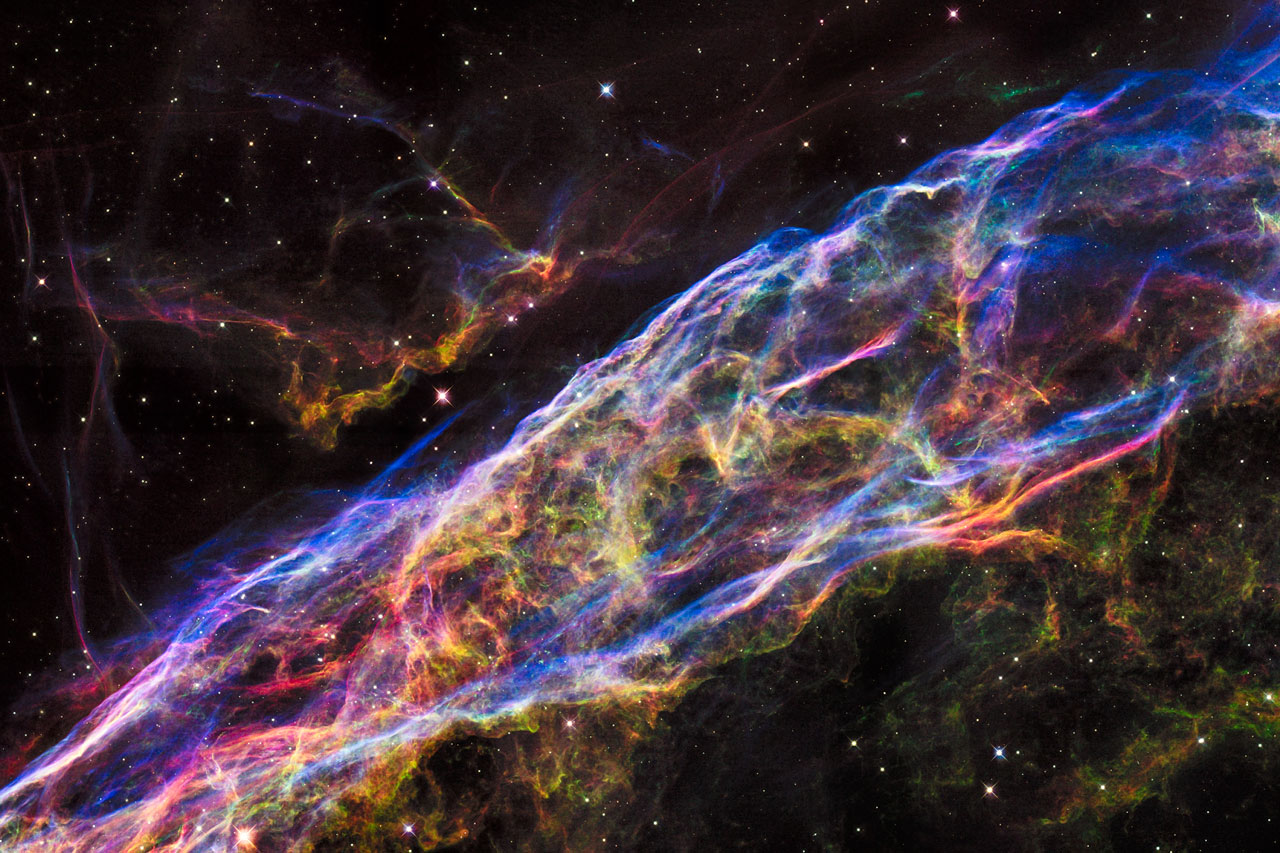
First, what you actually, initially did was deny there were helically wound filaments in the photos I posted to you. Like this one https://upload.wikimedia.org/wikipedia/ ... Nebula.jpg . You made comments like this: "You showed me images that you interpreted as helically wound filaments." I read that to say you did not accept there were braided filaments in that image ... when they are clear as day. In fact, I then pointed out to you that the web page that image came from ( https://en.wikipedia.org/wiki/Veil_Nebula ) states: “When finely resolved, some parts of the image appear to be rope-like filaments.” Like I said back then, so not only does it mention “filaments” but calls them “rope-like”, which brings to mind the helically wound construction of an ordinary rope. You must have also missed the statement that another name for part of the Veil Nebula is the “Filamentary Nebula”. However, here you are now trying to pretend that wasn't ever your position ... so I guess we're making *some* progress.
Second, the idea that your side of this issue doesn't do physics by looking at pretty pictures and making up stories is OUTRIGHT LAUGHABLE. That's EXACTLY what the mainstream physics community has been doing for 40 years where ALL it's many gnomes are concerned. Consider the so-called picture of a black hole they recently created. What they didn't tell the public are all the assumptions and manipulations that went into that picture. The fact that they pre-supposed the image would look like that. And some so-called pictures your side of this debate uses to bolster the case for it's gnomes are images created by computer models that ASSUME things are nothing but gnomes. That pre-suppose the existence of the gnomes.
About that. You, for example, claimed that the Veil Nebula image above was from a Wikipedia page that “recites the standard explanation which is that they are not helically wound filaments (or filaments at all)”. But as I noted in my response to you, the page DOES NOT say that ... it says they are filaments and "rope-like" ... which is just another way of saying helically wound. So you were either illiterate or being dishonest in you're handwaving. As I think your current response here proves you continue to be, Higgsy.
Everyone should also know that you then said "I realised you have nothing. So I come here for a laugh. But I get bored." But as I said then and I'll say again,
And I wrote that at a time when you were still insisting that I haven’t proven these filaments are ubiquitous. But apparently you've changed your mind now. That is correct, isn't it, Higgsy? You are agreeing with your statement today that filaments are ubiquitous? Right? If so, then we've made a little more progress."if I have 'nothing', then you should now have no problem explaining in a clear manner how that helically structured filament discussed above came to be … and do it without referencing gnomes.
You should also be able to explain the existence of the helically wound filaments that are quite obviously visible in the star forming filaments at the bottom of this image …
http://inspirehep.net/record/1255052/files/fig8.png
I find it hilarious that you said you don’t know what that is a picture of, yet almost as soon you wrote that, you cited a scientific article (https://arxiv.org/pdf/1312.6232.pdf) that contains a picture of that filament in the inset. That says it is a portion of the Herschel photographed B211/B213 filament in Taurus. And that article states that “filamentary structure is omnipresent in every cloud observed with Herschel, irrespective of its starforming content.” In fact, Philippe André, Principal Investigator for the Herschel Gould Belt Survey, who you later cited in your post as a good source, has written that “the greatest surprise was the ubiquity of filaments in these nearby clouds and their intimate connection with star formation.” Plus, I think I’ve pointed out on one or more occasions that the Herchel website at esa states (http://sci.esa.int/herschel/55942-hersc ... milky-way/ ) that “Observations with ESA's Herschel space observatory have revealed that our Galaxy is threaded with filamentary structures on every length scale. From nearby clouds hosting tangles of filaments a few light-years long to gigantic structures stretching hundreds of light-years across the Milky Way's spiral arms, they appear to be truly ubiquitous.”

I know. Which says a lot about you, not me, after all the evidence and examples I've provided you. The question still remains, how do YOU explain all those helically wound filaments ... without resorting to unproven gnomes that you dream up by looking at pretty pictures and making up stories?You might disagree, but there is no point in asking me the same question over and over again. You're not going to get a different answer.
Folks can go to this link (http://www.thunderbolts.info/forum/phpB ... 05#p126211 ) starting at that post to see the last discussion you and and I had on this topic ... the one from which the above are excerpts. I think they'll walk away believing you learned NOTHING from it. And they'll notice that in the end you RAN.