Plasma and electricity in space. Failure of gravity-only cosmology. Exposing the myths of dark matter, dark energy, black holes, neutron stars, and other mathematical constructs. The electric model of stars. Predictions and confirmations of the electric comet.
-
Brigit
- Posts: 1478
- Joined: Tue Dec 30, 2008 8:37 pm
Unread post
by Brigit » Mon Feb 16, 2026 7:41 pm
Today I came across a Feb 28, 1998 description of one of NASA's early plans for a space shot to comet Tempel 1:
- ELECTRIC UNIVERSE PREDICTIONS FOR SPACE PROBE
By Wal Thornhill
- >"Planned for launch in 2003, the Deep Space 4/Champollion
>spacecraft will rendezvous with Comet Tempel 1 in 2005 and
>spend several months orbiting the comet nucleus making
>high-resolution maps of its surface. The spacecraft will
>deploy a lander with a 1-meter-long (3.3-foot) drill to
>collect samples that will be analyzed on-site; an attempt
>will be made to return a sample to Earth in 2010.
>The project is part of the Deep Space mission series under
>the NASA/JPL New Millennium Program, designed to perform
>flight demonstrations of new spacecraft technologies for
>solar system and Earth-orbiting missions."
"I predict that unless NASA has begun to take notice of The
Electric Universe before they perform this comet caper,
they will be in for some nasty surprises.
To begin with, it will be an interesting exercise to orbit
an object that is firing plasma beams and modifying its
apparent gravity in the process.
Any object that tries to
land on it will need lightning arrestors fitted to
equalize the voltage differences before touchdown. But a
more serious problem will occur after landing.
Any metal object protruding from the surface of the comet will become
a prime candidate for the focus of one of the comet's
plasma discharges. In that case, even if the electronics
survives, radio communications will be lost until the
nucleus rotates the lander to the night side.
Any lander
should be rigorously tested in a plasma lab and allowance
made for loss of communications due to plasma shielding. In
other words, NASA would be well advised to use light
signaling (like an infra-red remote control) between the
lander and the orbiter. The orbiter will also suffer plasma
shielding effects in its communications with Earth.
If these precautions are not taken, I expect the mission to
fail mysteriously just as the Pioneer Venus probes had
mysterious sensor failures, all at the same level in Venus'
atmosphere, and where a voltage inexplicably appeared
between the ends of disconnected external electrical
leads on the probes.
This is an Electrical Universe!"
~Wal Thornhill
----------------------------------------------
Of course we know that the mission to Tempel 1 in its final form did not have a drilling and sampling element, but it did end in a spectacular electrical discharge from the comet to the lander. The intense energetic electromagnetic events surrounding the later (2005) Deep Impact mission were again predicted, in much greater detail, in an October paper on Wal Thornhill's site in 2001 entitled, "Comet Borrelly rocks core scientific beliefs" here:
https://www.holoscience.com/wp/comet-bo ... c-beliefs/
The subject has been an ongoing problem in the Space Age, and yet remains completely unacknowledged by any of the space agencies. So here is a place dedicated to all of the instances involving electric discharges to space craft that we can find, across the last 70 years in space.
"The important thing in all of this, and something which Velikovsky in his usual intuitive way presaged, is that gravity itself is linked to [subatomic] electrostatics. It is not some innate quality associated with matter, unrelated to its electrical structure." ~Wal Thornhill
-
Brigit
- Posts: 1478
- Joined: Tue Dec 30, 2008 8:37 pm
Unread post
by Brigit » Mon Feb 16, 2026 8:20 pm
We will take a hint from Wal Thornhill's contemporary report in the original post, and go to Venus.
Most modern documentaries and youtube videos appear to me to be almost completely barren of any references to the extraordinary lightning found on Venus. The lightning on Venus, after all, was not expected in the fog of sulfuric acid and carbon dioxide that makes up its atmosphere.
- https://www.holoscience.com/wp/wp-conte ... htning.jpg
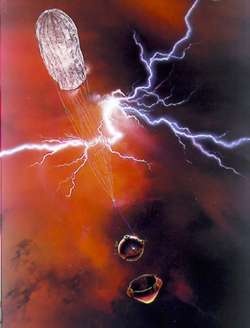
Image: "The image above is a NASA artist’s view of lightning on Venus during the descent of one of the Pioneer probes. Venus has smog-like clouds that are not expected to generate lightning and yet the planet suffers intense lightning. This argues against the popular notion of what causes lightning."
Nearly all probes that attempted to go through Venus' atmosphere were "burned up" except a couple Russian Venera missions (iirc).
So we will continue and add to our list with
- Pioneer Probes "the Pioneer Venus probes had
mysterious sensor failures, all at the same level in Venus'
atmosphere, and where a voltage inexplicably appeared
between the ends of disconnected external electrical
leads on the probes."
ps. I will just add the specific Pioneer numbers later !
"The important thing in all of this, and something which Velikovsky in his usual intuitive way presaged, is that gravity itself is linked to [subatomic] electrostatics. It is not some innate quality associated with matter, unrelated to its electrical structure." ~Wal Thornhill
-
Brigit
- Posts: 1478
- Joined: Tue Dec 30, 2008 8:37 pm
Unread post
by Brigit » Sun Feb 22, 2026 1:57 am
To recap, in 2001 Wal Thornhill predicted that there would be an electrical discharge between the probe and the Comet, Tempel 1. Here are the detailed mechanisms behind this arc discharge, 4 years in advance:
- Comet Borrelly Rocks Core Scientific Beliefs
by Wal Thornhill
Oct 2001
- In future: There is a plan for a comet mission called Deep Impact. Scheduled for July 2005, Deep Impact’s spacecraft will arrive at comet Tempel 1 and become the first mission to impact the surface of a comet. A 350-kg (770-lb) copper mass impactor will create a spectacular football field-sized crater, seven stories deep on a comet 6-km (approximately 4 miles) in diameter. This is the first attempt to peer beneath the surface of a comet to its freshly exposed material for clues to the early formation of the solar system.
Given the erroneous standard model of comets it is an interesting exercise to imagine what surprises are in store for astronomers if the plan is successful. The electrical model suggests the likelihood of an electrical discharge between the comet nucleus and the copper projectile, particularly if the comet is actively flaring at the time.
The projectile will approach too quickly for a slow electrical discharge to occur. So the energetic effects of the encounter should exceed that of a simple physical impact, in the same way that was seen with comet Shoemaker-Levy 9 at Jupiter.
Changes to the appearance of the jets may be seen before impact.
The signature of an electrical discharge would be a high-energy burst of electrical noise across a wide spectrum, a “flash” from infra-red to ultraviolet and the enhanced emission of x-rays from the vicinity of the projectile. The energy of a mechanical impact is not sufficient to generate x-rays.
If the arc vaporizes the copper projectile before impact the comet will not form the crater expected.
On the other hand, any copper metal reaching the surface of the comet will act as a focus for an arc. And copper can sustain a much higher current density than rock or ice. There would then be the likelihood of an intense arc, with possibly a single jet, until the copper is electrically “machined” from the comet’s surface.
Copper atoms ionized to a surprisingly high degree should be detectable from Earth-based telescopes. Electrical discharges through the body of a poor conductor can be disruptive and are probably responsible for the breakup of comets. It is not necessary for them to be poorly consolidated dust and ice and to simply fall apart. So there is some small chance that astronomers will be surprised to see the comet split apart, if the projectile reaches the surface of the comet and results in an intense arc.
~https://www.holoscience.com/wp/comet-bo ... c-beliefs/
There is even more context in the paper by Wal Thornhill. The basic model of the comet is that it is an electrically charged object, and if any space craft or probe approaches it, there is the possibility of an electric discharge between the two, if there is enough potential difference.
How can all objects in the Solar System be assumed to possess an electric charge (not just a magnetic field)? You can read the paper but the simple answer is that when plasma z-pinches compress materials, the electric arc imparts a permanent electric field. Very simple.
"The important thing in all of this, and something which Velikovsky in his usual intuitive way presaged, is that gravity itself is linked to [subatomic] electrostatics. It is not some innate quality associated with matter, unrelated to its electrical structure." ~Wal Thornhill
-
Brigit
- Posts: 1478
- Joined: Tue Dec 30, 2008 8:37 pm
Unread post
by Brigit » Fri Feb 27, 2026 1:16 am
Here is a minute by minute account, by the Thunderbolts Project, of the results of the mission to impact the comet, Tempel 1.
Here is the transcript:
- "The second thing is that because comets trace an elongated orbit,
both away from the Sun and toward the Sun, in that trajectory its charge changes, its voltage changes.
Since it spends most of its time in the outer solar system, the voltage that it has reflects the voltage in the outer solar system.
But as it hurtles towards the Sun, as it enters toward the Earth orbit,
the voltage is changing rapidly and the comet has to respond to that by beginning to discharge and that's where we see the familiar
cometary phenomena of the coma and the various tails that it produces.
This creates a very distinct difference between the two models, the Standard Model of a comet, which is supposed to be a dust and ice leftover
from the formation of the solar system, and the Electrical Model, which says that a comet is an electrical body,
which begins to discharge as it enters the inner solar system.
Comet 'Jets'
Ever since we began to look at comets in close-up, and Halley was the first one that was observed by several spacecraft close-up,
it was found to astronomer's surprise that the material coming off the comet
was coming in discrete jets and seemed to be coming from what looked like circular areas on the crater.
But the imagry wasn't sufficiently sharp to be able to tell exactly what was going on. This required the Standard Model to come up with an idea that
maybe the surface of the comet is coated in black tarry substance or something which was preventing the material from
just evaporating from the surface and forming jets as it burst through the surface.
But when later images were looked at as we passed other comets, it was found to the astronomers' amazement that they were seeing very sharp relief.
It was not like a melted ice cream, it was looking like a piece of heavily cratered rock.
Now this fits the Electric Model of the electrical discharge birth of such a body.
In other words, there is rather no distinction between an asteroid and a comet other than its orbit.
Comet Tempel One
It was in this context that I looked at Comet Tempel 1,
which was chosen as the target for an impact. The idea was that the impact would create a small crater,
which could then be photographed by the passing spacecraft and we can determine whether the material was ice or dust or rock based on the size of the impact crater.
It seemed to me that, if this comet was a charged body, there would be several other effects that were unexpected.
Principally as a metal copper object approached the comet, there should be an electric discharge to that copper projectile.
In other words, there will be an initial flash and then there would be the impact itself.
And the impact, I suggested, would be far more energetic than was expected because it would tend to concentrate the electrical discharge in the area of the impact
and also it may change the nature of the jets nearby. So, it was with great interest that I waited the results of the impact
and watched that on television. Before the impact, the astronomers in the assembled control room
were worried that they wouldn't see anything, that the impact would result in a very small puff
of dust and that would be the end of it.
So, when the impact occurred, they were surprised by two things.
One was that there was an initial flash followed by the main impact which was so energetic that
some of the sensors were almost swamped and the passing spacecraft was unable to achieve it's primary aim, which was to photograph the crater.
Comet Tempel One
Finely Divided Dust
Apart from the surprising brightness of the dust released from the impact
with Comet Tempel 1 was due to the fact that it was so intense and so wide-spread
and one of the initial findings was that it seems to be very finely divided dust.
Now this is the same thing that was found at Comet Halley, and it was a surprise then. So, it's rather surprising that they were surprised once more.
The point is that an electrical discharge on a surface will release material,
dusty material, very finely divided. It's a technique that's used in sputtering
of metals on to, for instance, astronomical mirrors. So this production of very fine dust is to be expected in the Electrical Model.
But in the Standard Model you are asking ices to evaporate
or to sublimate and in doing so to drive off pre-existing dust grains. So there is no way that the dust can be finely divided;
it will be in its pristine state. So, the production of this great cloud of very fine dust
is rather inexplicable in the Standard Model.
Last edited by
Brigit on Fri Feb 27, 2026 1:41 am, edited 1 time in total.
"The important thing in all of this, and something which Velikovsky in his usual intuitive way presaged, is that gravity itself is linked to [subatomic] electrostatics. It is not some innate quality associated with matter, unrelated to its electrical structure." ~Wal Thornhill
-
Brigit
- Posts: 1478
- Joined: Tue Dec 30, 2008 8:37 pm
Unread post
by Brigit » Fri Feb 27, 2026 1:31 am
Even though this topic is called, "Spacecraft
Destroyed by Lightning: A Growing List," I want to include not just the casualties, but also the "wounded in action." In other words, as we saw,
- "When the impact occurred, they were surprised by two things.
One was that there was an initial flash followed by the main impact which was so energetic that
some of the sensors were almost swamped and the passing spacecraft was unable to achieve its primary aim, which was to photograph the crater."
So on this Board we must include the
"wounded in action" or the damaged space missions -- meaning those not destroyed entirely by an electrical discharge -- but still damaged in some way by the high frequencies involved in a flash of radiation from an electrical discharge. In this case, the sensors were almost swamped and Deep Impact (2005) was not able to achieve its primary aim, which was to photograph the newly created crater.
"The important thing in all of this, and something which Velikovsky in his usual intuitive way presaged, is that gravity itself is linked to [subatomic] electrostatics. It is not some innate quality associated with matter, unrelated to its electrical structure." ~Wal Thornhill
Who is online
Users browsing this forum: No registered users and 6 guests