Prof. Devan Asoka Mendis' paper A postencounter view of comets published in 1988 shows in fig.18 the electromagnetic field around a comet based on the International Comet Explorer (ICE, ISEE) probe fly-by through the tail of 21P Giacobini-Zinner in 1985 on the way to Comet Halley.
A (magnetic) field-aligned electron beam inside the tail, flowing towards the nucleus is labeled in that drawing. The same drawing was later reused as fig.1 in his 2014 paper coauthored with Mihaly Horányi about comets 67P. Magnetic field-aligned electric currents are of course also known as Birkeland Currents. In academic science, that name is only used for currents in the Earth's EM field, otherwise field-aligned current (FAC) is more common in those.
Neither paper refers to that tail current in the text!
In the 1988 paper he refers to Hannes Alfvén's 1957 magnetotail theory, but I couldn't find out yet if Alfvén already considered that tail current.
Devan Asoka Mendis
Professor Emeritus, Electrical and Computer Engineering
Jacobs School of Engineering, UC San Diego
https://jacobsschool.ucsd.edu/people/pr ... oka-mendis
Mihaly Horányi
Professor, Laboratory for Atmospheric and Space Physics (LASP)
Physics Department, University of Colorado Boulder:
https://lasp.colorado.edu/people/mihaly-horanyi
A postencounter view of comets.
Devan Asoka Mendis, 1988:
https://adsabs.harvard.edu/full/1988ARA%26A..26...11M
The Global Morphology of the Solar Wind Interaction with Comet Churyumov-Gerasimenko.
Devan Asoka Mendis, Mihaly Horányi, 2014:
https://www.researchgate.net/publicatio ... erasimenko
Birkeland Current in comet tail in 1988 academic paper by D. A. Mendis
-
Holger Isenberg
- Posts: 189
- Joined: Sat Oct 22, 2011 6:10 pm
- Location: California
- Contact:
Birkeland Current in comet tail in 1988 academic paper by D. A. Mendis
You do not have the required permissions to view the files attached to this post.
-
Maol
- Posts: 611
- Joined: Fri Mar 11, 2011 8:40 pm
Re: Birkeland Current in comet tail in 1988 academic paper by D. A. Mendis
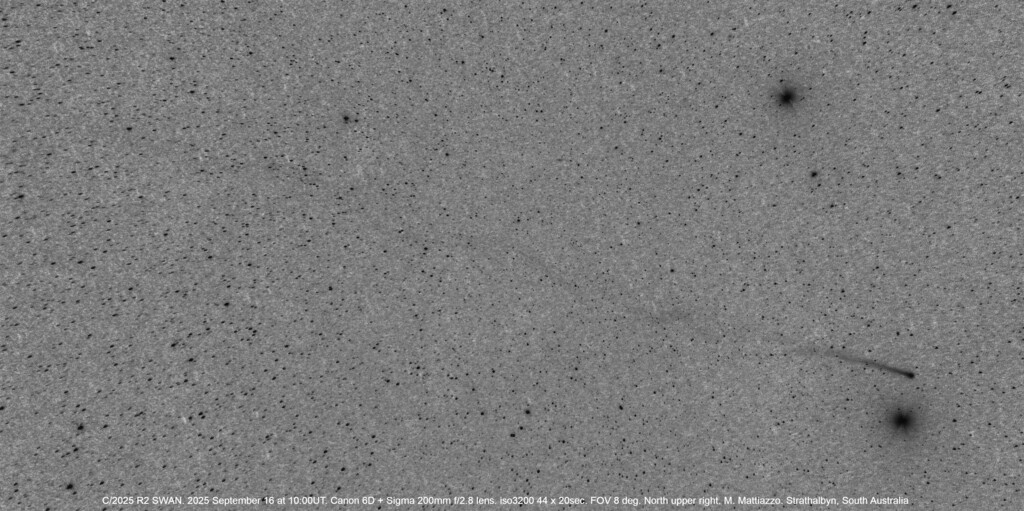
Did you see this image of interstellar comet Atlas seems to show a spiral tail?
https://www.spaceweather.com/archive.ph ... &year=2025
A CME IS HEADING FOR INTERSTELLAR COMET ATLAS: How often does a CME from our sun strike a comet from interstellar space? Almost never--so today’s collision is worth watching. According to a NASA forecast model, a CME launched on Sept. 19th will reach Comet 3I/ATLAS on Sept. 24th or 25th. CMEs hitting Solar System comets have been known to kink or even disconnect their tails. What happens to an interstellar comet is anyone’s guess.
https://www.spaceweather.com/archive.ph ... &year=2025
A CME IS HEADING FOR INTERSTELLAR COMET ATLAS: How often does a CME from our sun strike a comet from interstellar space? Almost never--so today’s collision is worth watching. According to a NASA forecast model, a CME launched on Sept. 19th will reach Comet 3I/ATLAS on Sept. 24th or 25th. CMEs hitting Solar System comets have been known to kink or even disconnect their tails. What happens to an interstellar comet is anyone’s guess.
-
Holger Isenberg
- Posts: 189
- Joined: Sat Oct 22, 2011 6:10 pm
- Location: California
- Contact:
Re: Birkeland Current in comet tail in 1988 academic paper by D. A. Mendis
Nice! Haven't seen it yet on I3/Atlas, that's a new one now! For a spiraling tail in a local magnetic field of course an electric current through the tail is needed to produce the local magnetic field.
The real anti-tail seen on it was the reason I looked again at older electric comet research for others also pointing out tail currents in the same way as James McCanney already did earlier in the 1980s.
His drawing from 1986, "Dynamics of a small Comet" also shows an electric current through the tail and in addition an electron beam between Sun and nucleus on the front side. The drawing can be found here:
James McCanney, 1987: Dynamics of a Small Comet
reprinted in: Atlantis to Tesla - The Kolbrin Connection
https://jmccanneyscience.com/books-cds- ... ar-posters
Los Alamos presentation 1986: https://youtu.be/SpKIfvfZtG8?si=8rdLmQKtkho_Ah-g&t=2777 at minute 46
-
Holger Isenberg
- Posts: 189
- Joined: Sat Oct 22, 2011 6:10 pm
- Location: California
- Contact:
Re: Birkeland Current in comet tail in 1988 academic paper by D. A. Mendis
The actual measurement of the circular magnetic field around the tail as experienced by ICE at Giacobini-Zinner where it switches polarity at the tail center, is shown in fig.1 of
Giacobini-Zinner Magnetotail: Ice Magnetic Field Observations, 1986:
https://www.researchgate.net/publicatio ... servations
According to the paper the author interpreted that polarity switch as the probe crossing the IMF from south to north at the very same time when it crossed the tail. I'm currently not sure if that coincidence really happened. The chance exists as the probe most likely was still in the ecliptic at that time as its primary mission was Comet Halley later and I don't think they added a fuel-intensive inclination change to its orbit for this secondary target.
Giacobini-Zinner Magnetotail: Ice Magnetic Field Observations, 1986:
https://www.researchgate.net/publicatio ... servations
According to the paper the author interpreted that polarity switch as the probe crossing the IMF from south to north at the very same time when it crossed the tail. I'm currently not sure if that coincidence really happened. The chance exists as the probe most likely was still in the ecliptic at that time as its primary mission was Comet Halley later and I don't think they added a fuel-intensive inclination change to its orbit for this secondary target.
-
Holger Isenberg
- Posts: 189
- Joined: Sat Oct 22, 2011 6:10 pm
- Location: California
- Contact:
Re: Birkeland Current in comet tail in 1988 academic paper by D. A. Mendis
Another historic drawing showing the tail current in a comet, here in the post mission report about ISEE-3 (International Comet Explorer, ICE), but the drawing itself appears to be from the early 1980s or even older:
Fifty Years on the Space Frontier, January 2016, Robert W. Farquhar, fig 6-19:
https://www.researchgate.net/publicatio ... gures?lo=1
Fifty Years on the Space Frontier, January 2016, Robert W. Farquhar, fig 6-19:
https://www.researchgate.net/publicatio ... gures?lo=1
You do not have the required permissions to view the files attached to this post.
-
Maol
- Posts: 611
- Joined: Fri Mar 11, 2011 8:40 pm
Re: Birkeland Current in comet tail in 1988 academic paper by D. A. Mendis
Another comet tail affected by a CME. Good pictures and links to more here: https://www.spaceweather.com/archive.ph ... &year=2025
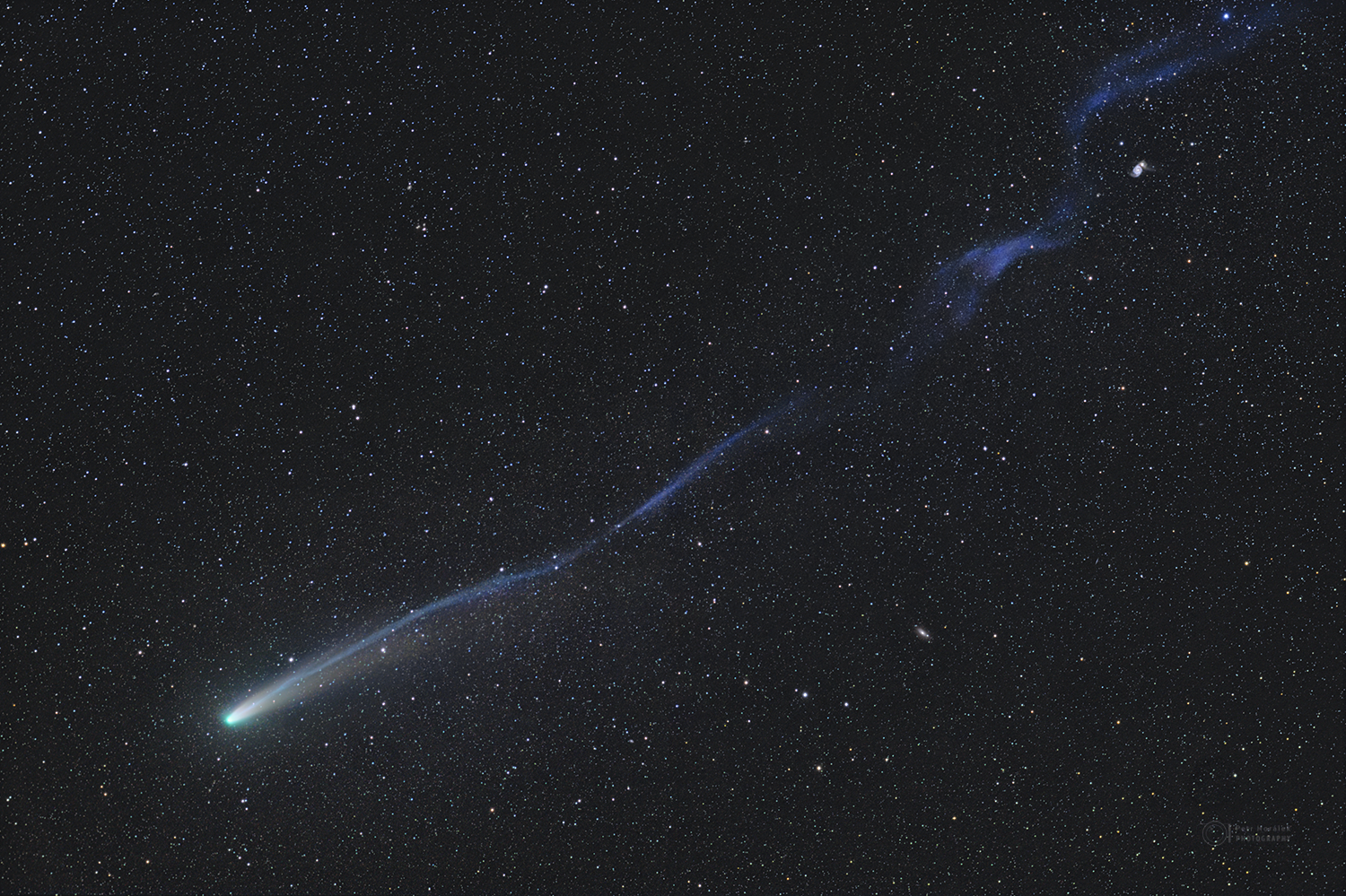
COMET LEMMON AND THE GEOMAGNETIC STORM: An overdue CME passed near Earth during the late hours of Oct. 17th. The near-miss produced an unexpected photo-op. Auroras swallowed Comet Lemmon (C/2025 A6):
Alan C. Tough captured the event from Elgin, Moray, Scotland. "I set up a star tracker with a DSLR and 150mm lens in my back garden to photograph Comet Lemmon when the auroras erupted," he says.
The CME was expected to reach Earth two days earlier. Better late than never. It sparked a G1/G2-class storm with auroras sighted in the USA as far south as New York and Utah.
In the Czech Republic, Petr Horálek observed the effect of the solar wind on the comet itself:
"This was a truly unusual view," Horálek says. "During the storm, the comet over Seč Lake was surrounded by red auroras. When I zoomed in on the comet, I could see its ion tail was twisted by the buffeting of the solar wind."
The storm is over, but the comet is still there. In fact, it's about to make its closest approach to Earth, only 0.6 AU away on Oct. 21st. Shining at 4th magnitude, it will be visible to the naked eye and even cell phones (with night-sky photo settings) should be able to catch it. Point your optics low in the northwestern sky after sunset. Sky maps: Oct. 19, 20, 21.
more images: from Lauri Kangas of Amethyst Bay, Lake Superior, Ontario; from P-M Hedén of Norrtälje, Sweden; from Patrick Lecureuil of Mauroux, France
Realtime Space Weather Photo Gallery
Free: Spaceweather.com Newsletter
COMET SWAN AND THE EAGLE NEBULA: "From the Southern Hemisphere, Comet Lemmon is out of sight, but another, almost forgotten comet is currently crossing the Milky Way," says astronomer Daniele Gasparri of Atacama, Chile. "Here is Comet SWAN (C/2025 R2) passing through one of the most iconic and spectacular regions of the sky: the Eagle Nebula."
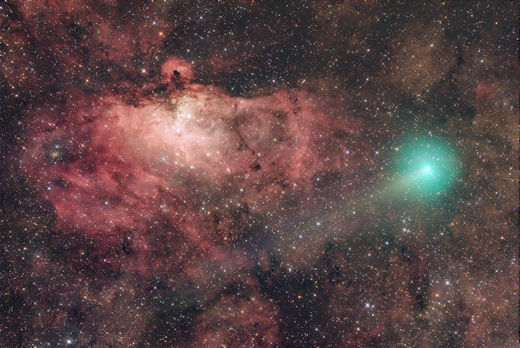
The Eagle Nebula (M16) is a young star cluster located 5,700 light-years away in the constellation Serpens. It is home to the famous "Pillars of Creation."
"At 6th magnitude, Comet SWAN is visible to the naked eye under the pristine skies of the Atacama Desert," adds Gasparri. "It was also an amazing sight through the eyepiece, with its characteristic green coma drifting across one of the most observed nebulae in the sky."
Coincidentally, Comet SWAN is making a close approach to Earth on Oct. 20th, only one day before Comet Lemmon does the same thing. This gives photographers a double photo-op this week. Look for Comet SWAN near the constellation Sagittarius after sunset. Sky maps: Oct. 19, 20, 21.
more images: from Chris Schur of Payson, Arizona; from Jeremy Perez at Robinson Crater, Arizona; from Rolando Ligustri using a remote telescope in Namibia
Realtime Comet Photo Gallery
Free: Spaceweather.com Newsletter
COMET LEMMON AND THE GEOMAGNETIC STORM: An overdue CME passed near Earth during the late hours of Oct. 17th. The near-miss produced an unexpected photo-op. Auroras swallowed Comet Lemmon (C/2025 A6):
Alan C. Tough captured the event from Elgin, Moray, Scotland. "I set up a star tracker with a DSLR and 150mm lens in my back garden to photograph Comet Lemmon when the auroras erupted," he says.
The CME was expected to reach Earth two days earlier. Better late than never. It sparked a G1/G2-class storm with auroras sighted in the USA as far south as New York and Utah.
In the Czech Republic, Petr Horálek observed the effect of the solar wind on the comet itself:
"This was a truly unusual view," Horálek says. "During the storm, the comet over Seč Lake was surrounded by red auroras. When I zoomed in on the comet, I could see its ion tail was twisted by the buffeting of the solar wind."
The storm is over, but the comet is still there. In fact, it's about to make its closest approach to Earth, only 0.6 AU away on Oct. 21st. Shining at 4th magnitude, it will be visible to the naked eye and even cell phones (with night-sky photo settings) should be able to catch it. Point your optics low in the northwestern sky after sunset. Sky maps: Oct. 19, 20, 21.
more images: from Lauri Kangas of Amethyst Bay, Lake Superior, Ontario; from P-M Hedén of Norrtälje, Sweden; from Patrick Lecureuil of Mauroux, France
Realtime Space Weather Photo Gallery
Free: Spaceweather.com Newsletter
COMET SWAN AND THE EAGLE NEBULA: "From the Southern Hemisphere, Comet Lemmon is out of sight, but another, almost forgotten comet is currently crossing the Milky Way," says astronomer Daniele Gasparri of Atacama, Chile. "Here is Comet SWAN (C/2025 R2) passing through one of the most iconic and spectacular regions of the sky: the Eagle Nebula."
The Eagle Nebula (M16) is a young star cluster located 5,700 light-years away in the constellation Serpens. It is home to the famous "Pillars of Creation."
"At 6th magnitude, Comet SWAN is visible to the naked eye under the pristine skies of the Atacama Desert," adds Gasparri. "It was also an amazing sight through the eyepiece, with its characteristic green coma drifting across one of the most observed nebulae in the sky."
Coincidentally, Comet SWAN is making a close approach to Earth on Oct. 20th, only one day before Comet Lemmon does the same thing. This gives photographers a double photo-op this week. Look for Comet SWAN near the constellation Sagittarius after sunset. Sky maps: Oct. 19, 20, 21.
more images: from Chris Schur of Payson, Arizona; from Jeremy Perez at Robinson Crater, Arizona; from Rolando Ligustri using a remote telescope in Namibia
Realtime Comet Photo Gallery
Free: Spaceweather.com Newsletter
Who is online
Users browsing this forum: No registered users and 4 guests