Little Ice Age in Austria?
-
jimmywalter
- Posts: 21
- Joined: Wed Jun 15, 2022 2:31 pm
Little Ice Age in Austria?
Does anyone have information on what the Little Ice Age was like in Austria? I live in Vienna would like to know of any historical record written at the time.
-
nick c

- Posts: 3075
- Joined: Mon Mar 17, 2008 3:12 am
Re: Little Ice Age in Austria?
Were you inspired to pose your question after seeing the TB videos by Peter Mungo Jupp?
https://www.youtube.com/watch?v=4dU2IiFK5wc
https://www.youtube.com/watch?v=lvOHBjkBpyM
The "Little Ice Age" was not in any respect a real Ice Age. However from circa 1300 AD to circa 1850 AD was period of colder weather and is associated with famine, pestilence, and plagues. Up to 50% of Europe perished. The entire Earth cooled.
I would argue that the present warming period has nothing to do with the activities of humans, but is rather part of a larger historical cycle, that is we are now moving out of the Little Ice Age (which was not in any way a real Ice Age) and back into a warming period. Before the Little Ice Age the Earth was much warmer than now.
https://www.youtube.com/watch?v=4dU2IiFK5wc
https://www.youtube.com/watch?v=lvOHBjkBpyM
The "Little Ice Age" was not in any respect a real Ice Age. However from circa 1300 AD to circa 1850 AD was period of colder weather and is associated with famine, pestilence, and plagues. Up to 50% of Europe perished. The entire Earth cooled.
I would argue that the present warming period has nothing to do with the activities of humans, but is rather part of a larger historical cycle, that is we are now moving out of the Little Ice Age (which was not in any way a real Ice Age) and back into a warming period. Before the Little Ice Age the Earth was much warmer than now.
-
jimmywalter
- Posts: 21
- Joined: Wed Jun 15, 2022 2:31 pm
Re: Little Ice Age in Austria?
Thank you for your reply, Nick C.
You said the entire earth cooled. But some dispute this. Do you have data?
You said that we are moving out of the little ice age, but researchers, such as Zharkova say they have been periodic and we are moving into one now.
Since I live in Austria, I am, naturally concerned about how bad it will be and if it will be.
You said the entire earth cooled. But some dispute this. Do you have data?
You said that we are moving out of the little ice age, but researchers, such as Zharkova say they have been periodic and we are moving into one now.
Since I live in Austria, I am, naturally concerned about how bad it will be and if it will be.
-
BeAChooser
- Posts: 1318
- Joined: Thu Oct 15, 2015 2:24 am
Re: Little Ice Age in Austria?
First, it's important to know that the Little Ice Age is a period marked by repeated drops in solar output: namely, the Wolf Minimum (1280-1350), Sporer Minimum (1450–1550), Maunder Minimum(1645-1415), and finally the Dalton Minimum (1790-1820):jimmywalter wrote: ↑Mon Dec 30, 2024 3:36 am You said the entire earth cooled. But some dispute this. Do you have data?
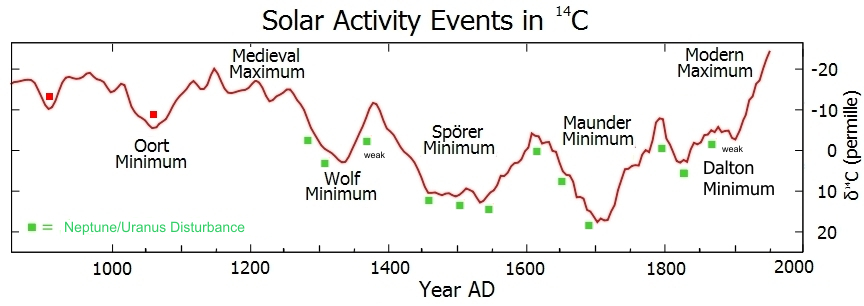
Solar output affects the whole world so common sense says the temperature reductions from this would be worldwide.
This source (http://wattsupwiththat.com/2013/08/23/t ... more-92205 ) cites studies at locations throughout Europe, Greenland, Iceland, Sweden, Finland and Canada that clearly saw significantly lower temperatures. And other regions were affected too. Wikipedia notes (http://en.wikipedia.org/wiki/Little_Ice ... n_painting ), for example, that warm weather crops, such as oranges, were abandoned in China where they'd grown for centuries. If that's not an indication of cooling on a global scale during that time, then what is?
Wikipedia also points to changes in global temperatures in the southern hemisphere during the LIA. For example, it states "in Southern Africa, sediment cores retrieved from Lake Malawi show colder conditions between 1570 and 1820." Here's that study: https://harvardforest1.fas.harvard.edu/ ... y_2001.pdf . The authors look at what records are available, and conclude that "our biogenic silica profiles further support, and extend, the global expanse of the Little Ice Age. The biogenic silica profiles indicate Lake Malawi underwent pronounced low-stand during much of the Little Ice Age, when the Northern Hemisphere was relatively cool, and so, perhaps, were the Peruvian Andes and the South Pole".
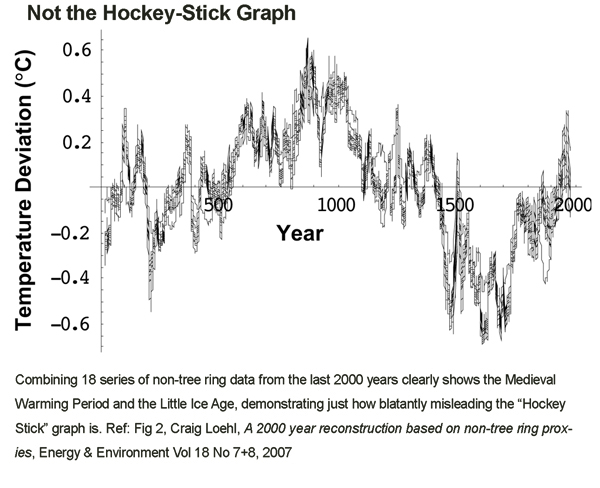
And below is another reconstruction (by Loehle in 2007) of LIA global temperature based on proxies from all over the world, including Africa, China, the Caribbean, and the tropical Pacific from https://www.researchgate.net/publicatio ... ng_Proxies . Cooling is apparent in every single proxy ...
-
jimmywalter
- Posts: 21
- Joined: Wed Jun 15, 2022 2:31 pm
Re: Little Ice Age in Austria?
Thank you, BeAChooser.
Part of my question was the LIA periodic, some say every 400 years, which the charts you posted seem to "disprove", in that the more recent previous minimums were much less, 1050 and 850, while the LIA minimums were deeper and more frequent.
This chart of Greenland temps may be a little better
https://en.wikiversity.org/wiki/History ... Grtemp.png
That page has a lot of info on other places
https://en.wikiversity.org/wiki/History ... le_Ice_Age
Farms and villages in the Swiss Alps were destroyed by encroaching glaciers during the mid-17th century.[22] Canals and rivers in Great Britain and the Netherlands were frequently frozen deeply enough to support ice skating and winter festivals.[22]
Sea ice surrounding Iceland extended for miles in every direction, closing harbors to shipping: the population of Iceland fell by half, but that may have been caused by skeletal fluorosis after the eruption of Laki in 1783.[23] Iceland also suffered failures of cereal crops and people moved away from a grain-based diet.[24] The Norse colonies in Greenland starved and vanished by the early 15th century, as crops failed and livestock could not be maintained through increasingly harsh winters: Greenland was largely cut off by ice from 1410 to the 1720s.[25]
Snowfall "was much heavier than recorded before or since, and the snow lay on the ground for many months longer than it does today."[26] In Lisbon, Portugal, snowstorms were much more frequent than today; one winter in the 17th century produced eight snowstorms.[27] Many springs and summers were cold and wet but with great variability between years and groups of years, crop practices throughout Europe had to be altered to adapt to the shortened, less reliable growing season, and there were many years of dearth and famine (such as the Great Famine of 1315–1317, but that may have been before the Little Ice Age).[28]
"Famines in France 1693–94, Norway 1695–96 and Sweden 1696–97 claimed roughly 10 percent of the population of each country, whereas in Estonia and Finland in 1696–97, losses have been estimated at a fifth and a third of the national populations, respectively."[29] Viticulture disappeared from some northern regions and storms caused serious flooding and loss of life, some resulted in permanent loss of large areas of land from the Danish, German, and Dutch coasts.[26]
The violin maker Antonio Stradivari produced his instruments during the Little Ice Age: the colder climate is proposed to have caused the wood used in his violins to be denser than in warmer periods, contributing to the tone of his instruments.[30] The period inspired such novelties in everyday life as the widespread use of buttons and button-holes, and knitting of custom-made undergarments to better cover and insulate the body, fireplace hoods were installed to make more efficient use of fires for indoor heating, and enclosed stoves were developed, with early versions often covered with ceramic tiles.[31]
The plight of European peasants during the 1300 to 1850 chill consisted of famines, hypothermia, bread riots and the rise of despotic leaders brutalizing an increasingly dispirited peasantry; in the late 17th century, agriculture had dropped off dramatically: "Alpine villagers lived on bread made from ground nutshells mixed with barley and oat flour."[32] Intensive witch-hunting episodes in Europe have been linked to agricultural failures during the Little Ice Age.[33]
However, worldwide,
"Evidence from mountain glaciers does suggest increased glaciation in a number of widely spread regions outside Europe prior to the twentieth century, including Alaska, New Zealand and Patagonia. However, the timing of maximum glacial advances in these regions differs considerably, suggesting that they may represent largely independent regional climate changes, not a globally-synchronous increased glaciation. Thus current evidence does not support globally synchronous periods of anomalous cold or warmth over this interval, and the conventional terms of "Little Ice Age" and "Medieval Warm Period" appear to have limited utility in describing trends in hemispheric or global mean temperature changes in past centuries.... [Viewed] hemispherically, the "Little Ice Age" can only be considered as a modest cooling of the Northern Hemisphere during this period of less than 1°C relative to late twentieth century levels."[19] "Climate Change 2001: The Scientific Basis". UNEP/GRID-Arendal. Archived from the original on 29 May 2006. Retrieved 2 August 2007.
https://www.aanda.org/articles/aa/pdf/2 ... 843-10.pdf
This pdf seems to indicate, as well as your first chart, that at least until around 2000, the solar level had broken threw the previous maximums-
However, your second chart, Loehle, shows that it did not.
The fig 5a shows 850 BCE was about the same as the Maunder which would give a grand solar minimum period of about 1000 years. However, with only 2 points, it is dangerous to project even that.
Thank you for your info. I now deduce that we just do not know how minimum this minimum will be in Europe or elsewhere, but in the last one, Austria suffered greatly
Part of my question was the LIA periodic, some say every 400 years, which the charts you posted seem to "disprove", in that the more recent previous minimums were much less, 1050 and 850, while the LIA minimums were deeper and more frequent.
This chart of Greenland temps may be a little better
https://en.wikiversity.org/wiki/History ... Grtemp.png

That page has a lot of info on other places
https://en.wikiversity.org/wiki/History ... le_Ice_Age
Farms and villages in the Swiss Alps were destroyed by encroaching glaciers during the mid-17th century.[22] Canals and rivers in Great Britain and the Netherlands were frequently frozen deeply enough to support ice skating and winter festivals.[22]
Sea ice surrounding Iceland extended for miles in every direction, closing harbors to shipping: the population of Iceland fell by half, but that may have been caused by skeletal fluorosis after the eruption of Laki in 1783.[23] Iceland also suffered failures of cereal crops and people moved away from a grain-based diet.[24] The Norse colonies in Greenland starved and vanished by the early 15th century, as crops failed and livestock could not be maintained through increasingly harsh winters: Greenland was largely cut off by ice from 1410 to the 1720s.[25]
Snowfall "was much heavier than recorded before or since, and the snow lay on the ground for many months longer than it does today."[26] In Lisbon, Portugal, snowstorms were much more frequent than today; one winter in the 17th century produced eight snowstorms.[27] Many springs and summers were cold and wet but with great variability between years and groups of years, crop practices throughout Europe had to be altered to adapt to the shortened, less reliable growing season, and there were many years of dearth and famine (such as the Great Famine of 1315–1317, but that may have been before the Little Ice Age).[28]
"Famines in France 1693–94, Norway 1695–96 and Sweden 1696–97 claimed roughly 10 percent of the population of each country, whereas in Estonia and Finland in 1696–97, losses have been estimated at a fifth and a third of the national populations, respectively."[29] Viticulture disappeared from some northern regions and storms caused serious flooding and loss of life, some resulted in permanent loss of large areas of land from the Danish, German, and Dutch coasts.[26]
The violin maker Antonio Stradivari produced his instruments during the Little Ice Age: the colder climate is proposed to have caused the wood used in his violins to be denser than in warmer periods, contributing to the tone of his instruments.[30] The period inspired such novelties in everyday life as the widespread use of buttons and button-holes, and knitting of custom-made undergarments to better cover and insulate the body, fireplace hoods were installed to make more efficient use of fires for indoor heating, and enclosed stoves were developed, with early versions often covered with ceramic tiles.[31]
The plight of European peasants during the 1300 to 1850 chill consisted of famines, hypothermia, bread riots and the rise of despotic leaders brutalizing an increasingly dispirited peasantry; in the late 17th century, agriculture had dropped off dramatically: "Alpine villagers lived on bread made from ground nutshells mixed with barley and oat flour."[32] Intensive witch-hunting episodes in Europe have been linked to agricultural failures during the Little Ice Age.[33]
However, worldwide,
"Evidence from mountain glaciers does suggest increased glaciation in a number of widely spread regions outside Europe prior to the twentieth century, including Alaska, New Zealand and Patagonia. However, the timing of maximum glacial advances in these regions differs considerably, suggesting that they may represent largely independent regional climate changes, not a globally-synchronous increased glaciation. Thus current evidence does not support globally synchronous periods of anomalous cold or warmth over this interval, and the conventional terms of "Little Ice Age" and "Medieval Warm Period" appear to have limited utility in describing trends in hemispheric or global mean temperature changes in past centuries.... [Viewed] hemispherically, the "Little Ice Age" can only be considered as a modest cooling of the Northern Hemisphere during this period of less than 1°C relative to late twentieth century levels."[19] "Climate Change 2001: The Scientific Basis". UNEP/GRID-Arendal. Archived from the original on 29 May 2006. Retrieved 2 August 2007.
https://www.aanda.org/articles/aa/pdf/2 ... 843-10.pdf
This pdf seems to indicate, as well as your first chart, that at least until around 2000, the solar level had broken threw the previous maximums-
However, your second chart, Loehle, shows that it did not.
The fig 5a shows 850 BCE was about the same as the Maunder which would give a grand solar minimum period of about 1000 years. However, with only 2 points, it is dangerous to project even that.
Thank you for your info. I now deduce that we just do not know how minimum this minimum will be in Europe or elsewhere, but in the last one, Austria suffered greatly
-
nick c
- Posts: 3075
- Joined: Mon Mar 17, 2008 3:12 am
Re: Little Ice Age in Austria?
The Little Ice Age was not a local Greenland or European event. It was global.jimmywalter wrote: You said the entire earth cooled. But some dispute this. Do you have data?
The Little Ice Age in China
The Little Ice Age and the Fall of the Ming Dynasty
Also:
https://www.britannica.com/science/Litt ... c-patternsLittle Ice Age (LIA), climate interval that occurred from the early 14th century through the mid-19th century, when mountain glaciers expanded at several locations, including the European Alps, New Zealand, Alaska, and the southern Andes, and mean annual temperatures across the Northern Hemisphere declined by 0.6 °C (1.1 °F) relative to the average temperature between 1000 and 2000 ce.
https://www.oldsaltblog.com/2018/01/upd ... bor-froze/Yet, as frigid as the recent cold snap has been, it has been a lot worst in the past. Even the recent past. In 2015, ferry traffic was interrupted by heavy ice in New York’s East River and sections of the Hudson River partially froze over. And that is nothing compared to conditions in the late 18th and 19th centuries......
Despite tidal currents that can run up to four knots, New York’s East River froze solid at least eight times between 1780 and 1888. The East River isn’t actually a river. It is a tidal strait connecting Upper New York Bay to Long Island Sound. Nevertheless, it froze often enough so that after the particularly hard winter of 1866-1867, there was a public outcry that lead ultimately to the construction of the Brooklyn Bridge.
In order to determine whether or not these and previous climate changes are periodic, we have to understand what causes the weather on the Earth. Obviously, there is heating from the Sun, but there is another major factor which modern consensus meteorology does not consider.
That is that all stars, including the Sun, are variable stars; in that their power source comes from galactic Birkeland Currents and unless we know what is the Sun's position in the arrangement of these currents, we cannot say for certain if there are larger patterns and/or sudden changes.
see:
Electric Weather
Weather: Fair, Foul, or Electric?
How's the Weather
Who is online
Users browsing this forum: No registered users and 1 guest