The Milky Way's Black Hole Imaged ...

Plasma and electricity in space. Failure of gravity-only cosmology. Exposing the myths of dark matter, dark energy, black holes, neutron stars, and other mathematical constructs. The electric model of stars. Predictions and confirmations of the electric comet.
BeAChooser
Posts: 1318
Joined: Thu Oct 15, 2015 2:24 am

M87's Black Hole RE-Imaged At Higher Resolution

Unread post by BeAChooser » Fri Jan 19, 2024 4:10 am

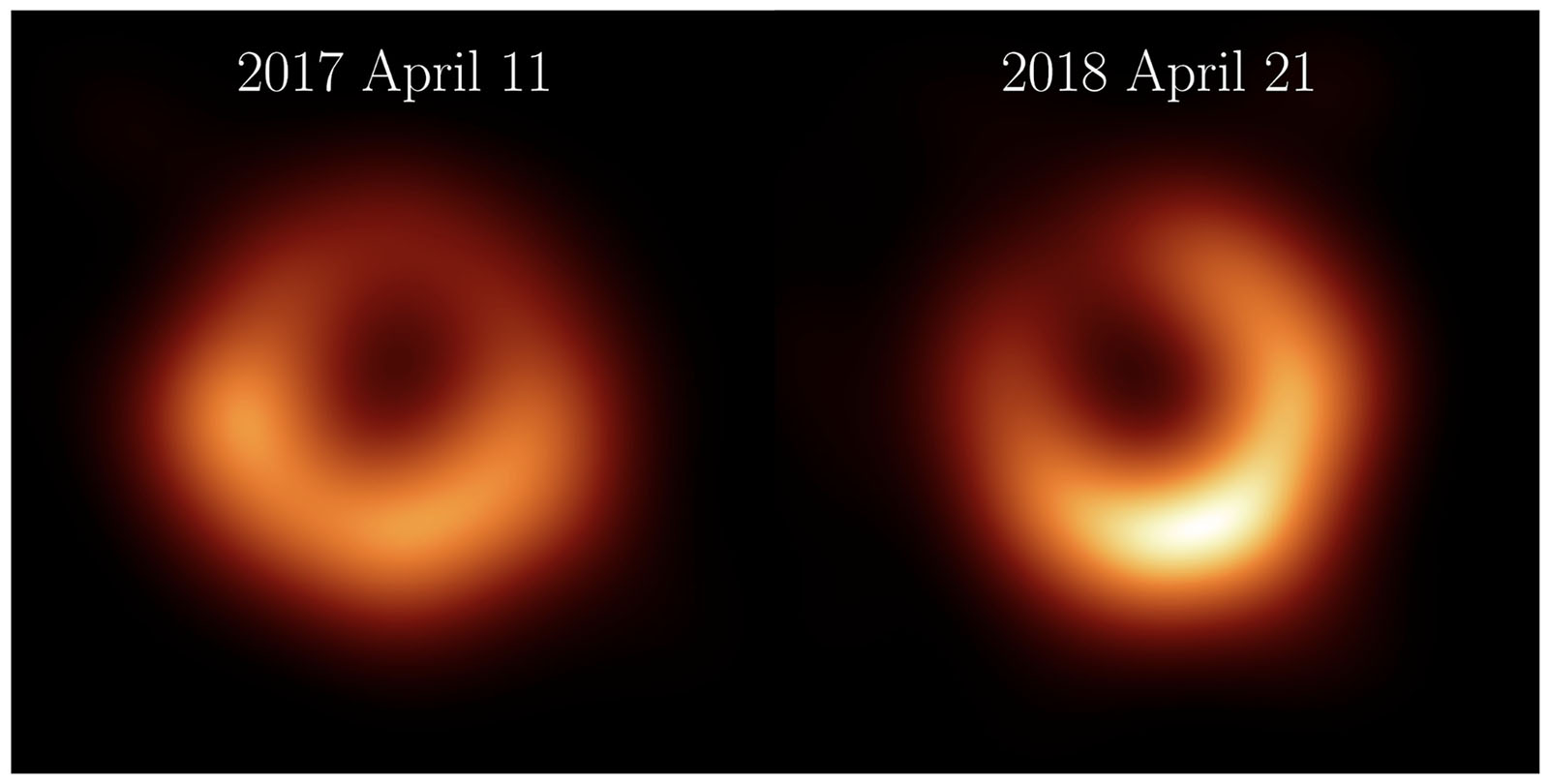
Now the mainstream claims (https://news.yahoo.com/first-ever-black ... 10895.html) that a newly created image of the black hole in M87 (the one on the right in this picture) …

Image

... is “higher resolution” than the original one (the one on the left). I just wonder how much or our tax money they spent to get this *improved* result, given that the first, probably bogus, image reportedly cost about $19 million.

And mind you, I suspect they got the same basic result (a ring) because they used the same biased methodology to produce the image that Miyoshi, et. al., warned them about. That being the case, I got to wondering if there had been any additional discussion of the issues Miyoshi and his associates raised. I discovered that after the original imaging team (referred to hereafter as EHTC) commented on Miyoshi's work in the June 2022 WEB PAGE titled “Imaging Reanalyses of EHT Data” on the EHT website, the three Japanese scientists responded to those criticisms with this (https://arxiv.org/pdf/2207.13279.pdf) in August 2022. In their response, they accurately summarized the EHTC’s June 2022 criticisms as follows:
a) The EHT images of M87 are among the most vetted interferometric images ever published (Event Horizon Telescope Collaboration et al., 2019a,b).

(b) Four independent analyses (Arras et al., 2022; Carilli & Thyagarajan, 2022; Lockhart & Gralla, 2022; Patel et al., 2022) have reconstructed the ring-like structure of M87, employing a diverse set of techniques.

(c) The EHTC and its members have published two additional papers, employing newly developed and independent techniques, that confirm the original results (Event Horizon Telescope Collaboration et al., 2021; Sun & Bouman, 2021).

(d) The EHTC has determined that a new re-analysis (Miyoshi et al., 2022) is based on a flawed understanding of EHTC data and its methods.

(e) Ring-like structures are unambiguously recovered under a broad range of imaging assump- tions, including field of view. Additionally, large-scale jet structures are unconstrained by this high-resolution data.
Then they proceeded to demolish each criticism.

I think they make quite valid points about the EHTC’s criticisms.

They write …
Point (a) is the subjective claim of the EHTC without any supporting data or fact. In our paper we have demonstrated that this claim is not true.

Concerning point (b), it is important whether the analyses in four papers are really in- dependent and supporting the EHTC result or not. So we have carefully studied the ”Four independent analyses” and have found that, one of them, Carilli & Thyagarajan (2022) ac- tually obtains the result very similar to ours, using the imaging algorithm similar to what we have used (the so-called hybrid mapping). … snip … Therefore, one of the four papers the EHTC listed as ”have reconstructed the ring-like structure” prove the validity of our result as well. Therefore, EHTC’s statement ”new re-analysis (Miyoshi et al., 2022) is based on a flawed understanding of EHTC data and its methods, leading to erroneous conclusions.” doesn’t make sense.

Concerning the other three papers, Lockhart & Gralla (2022) started from a ring, Arras et al. (2022) used essentially the same method as that of EHTC, and Patel et al. (2022) used the EHTC software itself. Therefore these three papers cannot be regarded as ”independent analyses”.

Point (c) does not really add anything new to point (a), since the methods they used in these papers have the same problems as those in their original papers. Event Horizon Telescope Collaboration et al. (2021) tried to determine the polarization but the imaging software is the same as that used in Paper IV(SMILI). Sun & Bouman (2021) used a machine-learning technique, and apparently their training input images are all compact. Thus, most likely the neural network of Sun & Bouman (2021) is trained to find compact structure, even when the data actually contain emissions from a wider region.

In point (d), the EHTC claimed our re-analysis is based on ”a flawed understanding of EHTC data and its methods.” However, the EHTC did not make clear where our understanding is flawed. Moreover, as we have stated above, one of the ”Four independent analyses”, Carilli & Thyagarajan (2022), have actually obtained the result very similar to ours. Since the method and results of Carilli & Thyagarajan (2022) are quite close to ours, EHTC should make clear what is ”a flawed understanding of their data and methods”, not only for our work but also for Carilli & Thyagarajan (2022).

In point (e), the EHTC claimed that Ring-like structures are recovered under a broad range of imaging assumptions, including the field of view. However, the actual fields of view set by the EHTC are limited to a very narrow area. In Miyoshi et al. (2022), we have calculated and shown the range of the field of view (FOV) over which the data contains information. The FOV settings of the EHTC are two orders of magnitude narrower than ours.
And then they sum things up as follows:
In conclusion, all of the five points raised by the EHTC are subjective and unsubstantiated claims. Thus they do not prove the correctness of the result of EHTC. Sincerely we hope that the EHTC will publish, not a collection of unsubstantiated claims, but a discussion based on scientific arguments.

Otherwise, they should retract the statement of ”new re-analysis(Miyoshi et al., 2022) is based on a flawed understanding of EHTC data and its methods, leading to erroneous conclusions.”
Unfortunately (and as expected) the media just ignored their response … as did the EHTC.

So I ask ... is this scientific method at work?

No, it isn’t.

It’s the mainstream IN HIDING, unable to defend itself from the criticisms.

So instead, we have them wasting more of YOUR tax money to get basically the same probably incorrect ring image they did before, using the same problematic procedure as before, then getting that bogus work promoted by the mainstream media that is in cahoots with them to keep you funding their bogus work. After all, both mainstream astrophysicists and mainstream media have the costs associated with their rather pleasant standards of living to support (at your expense). That's the important part. Sad but true. But then science is dead and we are headed for a new dark ages.

User avatar
Cargo
Posts: 769
Joined: Fri Sep 17, 2010 2:02 am

Re: The Milky Way's Black Hole Imaged ...

Unread post by Cargo » Tue Jan 23, 2024 7:04 am

subjective and unsubstantiated claims
Sounds exactly like Big Bang and Black Holes.
interstellar filaments conducted electricity having currents as high as 10 thousand billion amperes
"You know not what. .. Perhaps you no longer trust your feelings,." Michael Clarage
"Charge separation prevents the collapse of stars." Wal Thornhill

BeAChooser
Posts: 1318
Joined: Thu Oct 15, 2015 2:24 am

Re: The Milky Way's Black Hole Imaged ...

Unread post by BeAChooser » Sat Jan 27, 2024 5:19 pm

And the HYPE goes on ...

https://phys.org/news/2024-01-m87.html
New data, same appearance for M87*
I wonder why? Well first …
This new M87* image was produced with key contributions from an imaging team at Caltech, including Professor Katherine (Katie) L. Bouman, assistant professor of computing and mathematical sciences, electrical engineering, and astronomy; former Caltech Ph.D. student Nitika Yadlapalli Yurk, Ph.D.; and current Caltech postdoctoral research associate in computing and mathematical sciences Aviad Levis.

Bouman is a coordinator of the EHT Imaging Working Group and was a postdoctoral fellow at the Harvard Smithsonian Center for Astrophysics and co-lead of the EHT imaging team when the original image was published in 2019. In that role, she helped develop the algorithms that assembled the trove of data collected by the EHT's multiple radio telescopes into a single, cohesive image. … snip … She also co-led the imaging of the Milky Way's supermassive black hole published in 2022.

Yurk joined the EHT Collaboration in 2020 and played an active role in the imaging team for the latest M87* image. Her main contributions included developing synthetic datasets to be used in the training and validation of the imaging algorithms. Yurk also wrote software that was used in the exploration of image candidates.
In other words, this was NOT an independent effort. It used the same people ... people who have a vested interest in validating what they did earlier … given that they staked their reputations and careers on it, and spent a bundle of taxpayer money to boot (and want to spend even more such money).

Then there is this …
Imaging an object like M87* with the EHT is very different than imaging a planet like Saturn with a conventional telescope. Instead of seeing light, the EHT observes the radio waves emitted by objects and must computationally combine the information to form a picture.

"The raw data that comes out of these telescopes are basically just voltage values," Yurk says. "I like to describe radio telescopes as the world's most sensitive volt meters, and they collect voltages really accurately from different parts of the sky."

Turning those voltage values into an image is tricky, Bouman says, because the information the researchers are working with is incomplete, and there is nothing to compare the image against since no one has seen M87* with their own eyes.

"We don't want to plug in our expectations of what the black hole should look like when we're computationally forming the image," Bouman says. "Otherwise, it might lead us to an image that we expect rather than one that captures reality."

To avoid that problem, the researchers test their image processing algorithms with what is known as synthetic data, a suite of simulated images with simple geometric shapes.
But the methodology they used to do that is precisely what Miyoshi and his team found to be problematic … criticisms that the EHT group dismissed out of hand with spurious logic and outright dishonesty (as Miyoshi, et.al., showed in their response to those criticisms ... see my previous post). Miyoshi and company found that the EHTG methodology could not come up with the true image because they limited the field of view and thus their methodology couldn’t possibly arrive at images of what appear to to be a jet coming from a central non-ring point.

And then comes the most laughable statement of all …
Reproducibility with independent data is a big deal, too.
Well I say Garbage In, Garbage Out, no matter how many times the same researchers reproduce it using the same methodology.

And by the way, isn’t it also a "big deal" that the gnome believing mainstream media NEVER mentions the still outstanding dispute between Miyoshi and the EHTG over the veracity of the image? Never mentioned Miyoshi's response to the EHTG's dismissal of his work? Censorship is a “big deal, too”, though apparently not in the modern world where censorship is increasing called upon to defend the mainstream’s various gnomes. Why just the other day USAToday called for censoring anyone on social media who disputes AGWalarmism. And then there was the censorship of those who questioned the Covid-19 vaccine and other claims about the pandemic. Plus the censorship of those questioning the 2020 election and what happened on J6.

Just saying, how can science survive in such an environment?

BeAChooser
Posts: 1318
Joined: Thu Oct 15, 2015 2:24 am

EHT studies jets around another black hole ...

Unread post by BeAChooser » Sat Feb 03, 2024 7:48 pm

This letter to the editor (https://www.aanda.org/articles/aa/full_ ... 08-23.html) concerns another study using the EHT. They authors announce the detection of “a highly ordered magnetic field” and a jet around the black hole of 3C 84.

While I think they deliberately ignored the presence of jets in their previously described use of the Event Horizon Telescope (where they … I think … erroneously imaged black holes in order to confirm their gnomes), all of a sudden jets are of interest. Why?

They now claim the “EHT makes it possible to conduct multi-frequency studies, which provide valuable insights into jet formation and jet launching.” Of course, they want to do “follow-up studies with higher fidelity” … and burn up some more taxpayer money … so maybe that explains it!

Finally, notice the number of authors of this paper … 284. 284! All I see are 284 people living off YOU, folks, because this is all taxpayer funded work. But I wonder what YOU are getting for that expense? How does ANY of their results materially affect your life other than to make you a little poorer?

BeAChooser
Posts: 1318
Joined: Thu Oct 15, 2015 2:24 am

Re: The Milky Way's Black Hole Imaged ...

Unread post by BeAChooser » Mon Oct 28, 2024 3:31 am

As far as I can tell Miyoshi and his team's work has basically been ignored by the mainstream. Or at least their response to the initial criticism of their payer by the mainstream has been ignored. But apparently, they aren't' giving up. They have a new paper out.

https://gizmodo.com/breakthrough-image- ... 2000516590
A team of researchers from Japan’s National Astronomical Observatory (NAOJ) is claiming that the groundbreaking image of the supermassive black hole at the center of our galaxy is not accurate.

The original image of Sagittarius A* was constructed from data taken by the Event Horizon Telescope Collaboration, which revealed the picture to the public in May 2022. It showed our galaxy’s central black hole as an ominous black cloud surrounded by a ring of light—the hole’s accretion disk. In its paper, the recent team suggests that the the object is more likely to have an elongated disk. The team published its proposed black hole structure in the Monthly Notices of the Royal Astronomical Society.

… snip …

Black holes are regions of spacetime with gravitational fields so intense that not even light can escape them at a certain distance. That distance is the black hole’s event horizon. There is a field of glowing superheated matter around the event horizon: the accretion disk. The team’s recent paper focused on the accretion disk of Sagittarius A*, which they claim has a different shape than previously thought.

… snip …

“We hypothesise that the ring image resulted from errors during EHT’s imaging analysis and that part of it was an artefact, rather than the actual astronomical structure,” said Miyoshi Makoto, an astronomer at the NAOJ and co-author of the paper, in a Royal Astronomical Society release.

In its study, the team analyzed the same 2017 data on which the EHT Collaboration built its black hole image. But the team used a different method of analysis than the collaboration, indicating an elongated accretion disk compared to the doughnut structure seen in the 2022 image.

The recent team contends that the black hole’s accretion disk is elongated. In other words, it has a different structure than the ring-like disk imaged in 2022. The M87 black hole also appears to have a ring-like shape in the EHT image, which a later team developed into a polarized image of the object, complete with the structure of its magnetic fields.

In August, the EHT published a new method by which they improved the telescope’s resolution, hinting at sharper images of black holes in the near future. Should they follow through, future observations could clarify the actual structure of Sagittarius A*.
Here’s the new paper …

https://academic.oup.com/mnras/article/ ... ogin=false
ABSTRACT

We propose that the ring structure found by the Event Horizon Telescope Collaboration (EHTC) as the black hole shadow of Sgr A* is an artefact caused by the bumpy point spread function (PSF) of the EHT 2017 data. The imaging using sparse u-v data requires detailed scrutiny of the PSF. ... snip ... We show that the ring image can be derived from non-ring simulated data sets (noise only; point source) with a narrow field-of-view (FOV) and an assumed self-calibration, suggesting that the EHT 2017 u-v coverage is insufficient for reliable imaging. The EHTC analysis, based on calibrations with assumptions about the source's size and properties, selected the final image by prioritizing the appearance rate of a similar structure from a large imaging parameter space over data consistency. Our independent analysis with conventional hybrid mapping reveals an elongated east–west structure, consistent with previous observations. We believe it to be more reliable than the EHTC image, owing to half the residuals in normalized visibility amplitude. The eastern half is brighter, possibly due to a Doppler boost from the rapidly rotating disc. We hypothesize that our image shows a portion of the accretion disc from about 2 to a few RS (where RS is the Schwarzschild radius) away from the black hole, rotating with nearly of the speed of light and viewed from an angle of 40°−45°.

… snip …

7 CONCLUSION

Using conventional hybrid mapping, we reanalysed the Sgr A* data released by EHTC for the 2017 observations independently, and found a resulting image that differs from the one reported by EHTC. Our analysis shows a roughly east–west elongated structure, which is consistent with previous millimetre-wavelength VLBI observations. The elongation is asymmetrical, with the east side being bright and the west side being dark. We believe that our image is more reliable than the EHTC image because our image shows half the residuals of the EHTC image in normalized visibility amplitude, although the residuals of the closure quantities of the two are comparable. ... snip ...

In contrast, the EHTC analysis, based on calibrations with assumptions about the source’s size and properties, selected the final image by prioritizing the appearance rate of a similar structure from a large imaging parameter space over data consistency. ... snip ...

In our view, the ring-like image found by the EHTC is not the intrinsic structure of Sgr A* but arises from the sparse u-v coverage of the EHT array in 2017; that is, from the corresponding -scale structure in the PSF.

The imaging using sparse u-v data requires careful scrutiny of the PSF. The estimated shadow diameter (⁠⁠... snip ...) is equal to the spacing between the main beam and the first sidelobe of the PSF (... snip ...⁠⁠), which immediately suggests a potential problem in the deconvolution of the PSF. Also, this can be recognized from the fact that the ring image can be reproduced from simulated non-ring visibility data, and that a ring with a diameter of ... snip ...  is the most successfully produced. We found internal inconsistencies in the closure quantities within the EHT 2017 Sgr A* data, making it challenging to identify the most credible image from the size of closure residuals. This issue is not related to the strong time variability of Sgr A*. Investigating the cause of "different closure values for different recording channels", including the correlation process of the data, is crucial for the reliability of resultant images.
So I guess the dispute is not over yet ... unless the mainstream again ignores what Miyoshi and his team have done.

BeAChooser
Posts: 1318
Joined: Thu Oct 15, 2015 2:24 am

Re: The Milky Way's Black Hole Imaged ...

Unread post by BeAChooser » Tue Oct 29, 2024 1:34 am

Looks like the response the mainstream is going to give to Miyoshi is the same as what they gave previously.

https://www.newsweek.com/first-ever-pho ... my-1976065
A trio of Japanese astronomers has challenged the accuracy of the first-ever image showing the supermassive black hole that lies at the heart of our galaxy.

… snip …

In the latest study, which is based on a reanalysis of the EHTC data, Miyoshi and his colleagues argue that part of the black hole's appearance in the original image may actually be an artifact resulting from the process of its creation.

… snip …

Newsweek contacted members of the EHTC, who said that their team is formulating a collective response to the findings of Miyoshi and colleagues.

For now, Event Horizon Telescope Director Huib Jan van Langevelde directed Newsweek to a previous response addressing previous findings by the same trio of Japanese researchers that called into question another EHTC image.
But here’s the thing, Miyoshi’s team responded the critique the EHTC director refers to on two occasions that I know of … here: http://thunderbolts.info/wp/forum3/phpB ... t=15#p7147 and here: http://thunderbolts.info/wp/forum3/phpB ... t=30#p9693 and silence was all they’ve received in response, as noted here: http://thunderbolts.info/wp/forum3/phpB ... t=15#p7551.

I think Miyoshi’s team made some very good points about flaws in the EHTC methodology which still have not been addressed. So it will be curious to see if the EHTC team and supportive mainstream media continue the same tactic as their response to the first paper. If they do, then again all I can say is this is not scientific method at work. This is the mainstream IN HIDING, unable to defend itself from criticism.

Post Reply

Who is online

Users browsing this forum: No registered users and 2 guests