Another comet tail affected by a CME. Good pictures and links to more here:
https://www.spaceweather.com/archive.ph ... &year=2025
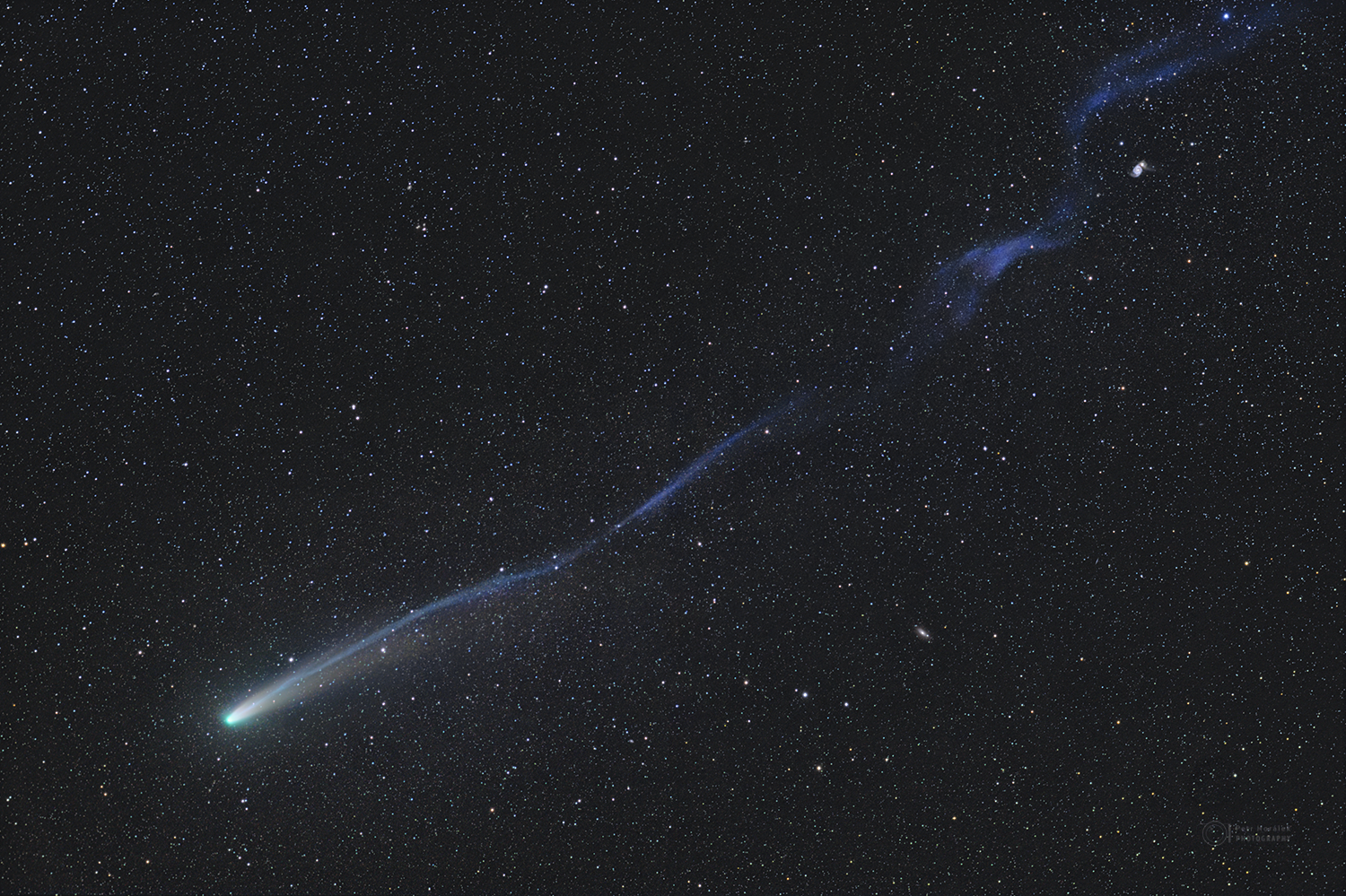
COMET LEMMON AND THE GEOMAGNETIC STORM: An overdue CME passed near Earth during the late hours of Oct. 17th. The near-miss produced an unexpected photo-op. Auroras swallowed Comet Lemmon (C/2025 A6):
Alan C. Tough captured the event from Elgin, Moray, Scotland. "I set up a star tracker with a DSLR and 150mm lens in my back garden to photograph Comet Lemmon when the auroras erupted," he says.
The CME was expected to reach Earth two days earlier. Better late than never. It sparked a G1/G2-class storm with auroras sighted in the USA as far south as New York and Utah.
In the Czech Republic, Petr Horálek observed the effect of the solar wind on the comet itself:
"This was a truly unusual view," Horálek says. "During the storm, the comet over Seč Lake was surrounded by red auroras. When I zoomed in on the comet, I could see its ion tail was twisted by the buffeting of the solar wind."
The storm is over, but the comet is still there. In fact, it's about to make its closest approach to Earth, only 0.6 AU away on Oct. 21st. Shining at 4th magnitude, it will be visible to the naked eye and even cell phones (with night-sky photo settings) should be able to catch it. Point your optics low in the northwestern sky after sunset. Sky maps: Oct. 19, 20, 21.
more images: from Lauri Kangas of Amethyst Bay, Lake Superior, Ontario; from P-M Hedén of Norrtälje, Sweden; from Patrick Lecureuil of Mauroux, France
Realtime Space Weather Photo Gallery
Free: Spaceweather.com Newsletter
COMET SWAN AND THE EAGLE NEBULA: "From the Southern Hemisphere, Comet Lemmon is out of sight, but another, almost forgotten comet is currently crossing the Milky Way," says astronomer Daniele Gasparri of Atacama, Chile. "Here is Comet SWAN (C/2025 R2) passing through one of the most iconic and spectacular regions of the sky: the Eagle Nebula."
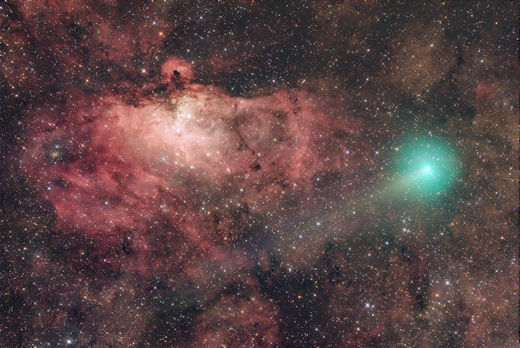
The Eagle Nebula (M16) is a young star cluster located 5,700 light-years away in the constellation Serpens. It is home to the famous "Pillars of Creation."
"At 6th magnitude, Comet SWAN is visible to the naked eye under the pristine skies of the Atacama Desert," adds Gasparri. "It was also an amazing sight through the eyepiece, with its characteristic green coma drifting across one of the most observed nebulae in the sky."
Coincidentally, Comet SWAN is making a close approach to Earth on Oct. 20th, only one day before Comet Lemmon does the same thing. This gives photographers a double photo-op this week. Look for Comet SWAN near the constellation Sagittarius after sunset. Sky maps: Oct. 19, 20, 21.
more images: from Chris Schur of Payson, Arizona; from Jeremy Perez at Robinson Crater, Arizona; from Rolando Ligustri using a remote telescope in Namibia
Realtime Comet Photo Gallery
Free: Spaceweather.com Newsletter
Another comet tail affected by a CME. Good pictures and links to more here: https://www.spaceweather.com/archive.php?view=1&day=20&month=10&year=2025
[img]https://spaceweathergallery2.com/submissions/pics/p/Petr-Horalek-2025_10_19_Kometa_A6Lemmon_Z6III_1500px_1760882454.png[/img]
COMET LEMMON AND THE GEOMAGNETIC STORM: An overdue CME passed near Earth during the late hours of Oct. 17th. The near-miss produced an unexpected photo-op. Auroras swallowed Comet Lemmon (C/2025 A6):
Alan C. Tough captured the event from Elgin, Moray, Scotland. "I set up a star tracker with a DSLR and 150mm lens in my back garden to photograph Comet Lemmon when the auroras erupted," he says.
The CME was expected to reach Earth two days earlier. Better late than never. It sparked a G1/G2-class storm with auroras sighted in the USA as far south as New York and Utah.
In the Czech Republic, Petr Horálek observed the effect of the solar wind on the comet itself:
"This was a truly unusual view," Horálek says. "During the storm, the comet over Seč Lake was surrounded by red auroras. When I zoomed in on the comet, I could see its ion tail was twisted by the buffeting of the solar wind."
The storm is over, but the comet is still there. In fact, it's about to make its closest approach to Earth, only 0.6 AU away on Oct. 21st. Shining at 4th magnitude, it will be visible to the naked eye and even cell phones (with night-sky photo settings) should be able to catch it. Point your optics low in the northwestern sky after sunset. Sky maps: Oct. 19, 20, 21.
more images: from Lauri Kangas of Amethyst Bay, Lake Superior, Ontario; from P-M Hedén of Norrtälje, Sweden; from Patrick Lecureuil of Mauroux, France
Realtime Space Weather Photo Gallery
Free: Spaceweather.com Newsletter
COMET SWAN AND THE EAGLE NEBULA: "From the Southern Hemisphere, Comet Lemmon is out of sight, but another, almost forgotten comet is currently crossing the Milky Way," says astronomer Daniele Gasparri of Atacama, Chile. "Here is Comet SWAN (C/2025 R2) passing through one of the most iconic and spectacular regions of the sky: the Eagle Nebula."
[img]https://www.spaceweather.com/images2025/19oct25/swan_strip.jpg[/img]
The Eagle Nebula (M16) is a young star cluster located 5,700 light-years away in the constellation Serpens. It is home to the famous "Pillars of Creation."
"At 6th magnitude, Comet SWAN is visible to the naked eye under the pristine skies of the Atacama Desert," adds Gasparri. "It was also an amazing sight through the eyepiece, with its characteristic green coma drifting across one of the most observed nebulae in the sky."
Coincidentally, Comet SWAN is making a close approach to Earth on Oct. 20th, only one day before Comet Lemmon does the same thing. This gives photographers a double photo-op this week. Look for Comet SWAN near the constellation Sagittarius after sunset. Sky maps: Oct. 19, 20, 21.
more images: from Chris Schur of Payson, Arizona; from Jeremy Perez at Robinson Crater, Arizona; from Rolando Ligustri using a remote telescope in Namibia
Realtime Comet Photo Gallery
Free: Spaceweather.com Newsletter