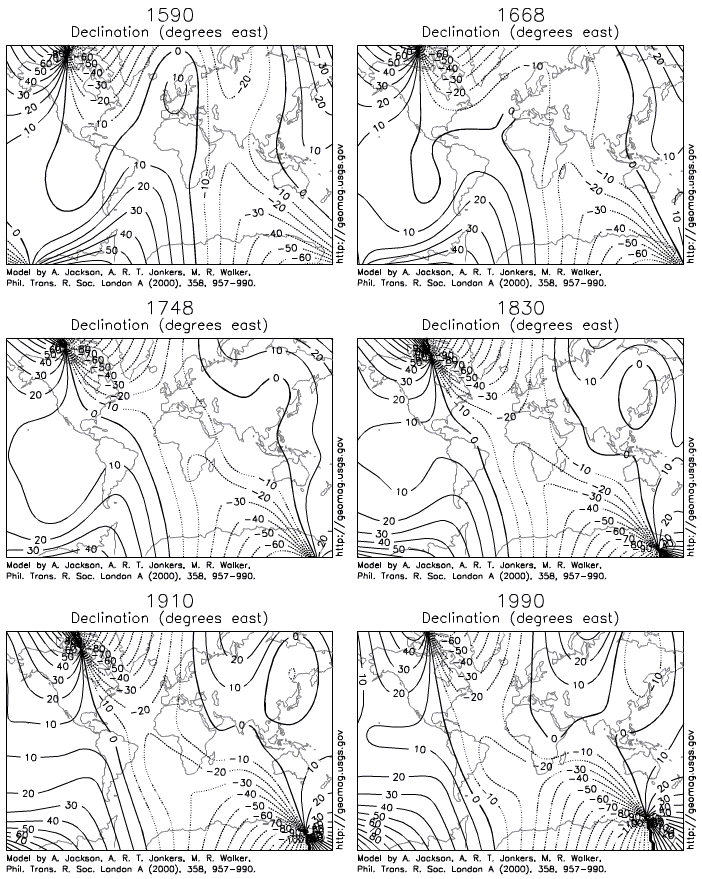
Those lines are simply indicating bands of varying intensity in a a field.
Imagine you were trying to convey to someone on a flat piece of paper how a streetlamp looked on a foggy night. You want to convey how this foggy glow surrounds the incandescent bulb, and how the level of illumination fell off with distance 3-dimensionally in a sphere the further away from the bulb you are.
You start with a graphic of the bulb, and you determine that you will use lines to indicate how the strength of illumination falls off at say- 5 centimeter incriments (you don't want to have to draw quite that many lines!)
In your schematic therefore, you determine that you will attach to each line a number corresponding to lumens of light of each 'band' (remember- you're actually looking at a 3-dimensional sphere of light, but you've 'squashed' it flat for the purpose of your drawing), an starting at the highest lumens next to the bulb (brightest) to the lowest lumens (dimmest) on the outside of your glow diagram.
Now- here is where modern astronomy gets this completely messed up- are the lines in your schematic real, or just a tool you used to convey brightness in a 3-dimensional sphere on a 2-dimensional piece of paper?
Modern astronomy would have you believe your lines were real objects!
No joke. The lines in the above diagrams are nothing more than tools used to convey intensity of a 3-dimensional field on a 2-dimensional image. If the lines appear to 'merge' that simply means that a particular area changed in intensity fluidly,
because there never were any real lines to separate or join to begin with!
Hope that makes sense that way... and I hope that Vukcevic and Lloyd and other professionals will forgive this gross oversimplification of the matter (please note that I'm no scientist myself!)

By the way- I'm really impressed by the work you've been posting here recently, Vukcevic!
Mike H.
Mike H.
"I have no fear to shout out my ignorance and let the Wise correct me, for every instance of such narrows the gulf between them and me." -- Michael A. Harrington