Well, I was doing some searching online and came across this article:
(Optical polarization of the M87 jet)
http://adsabs.harvard.edu/abs/1989A&A...224...17F
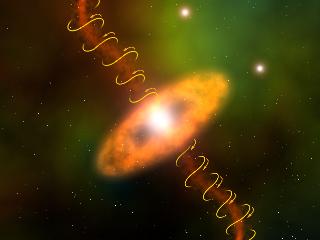
Now, to me, this sounds suspiciously like the description of how you draw field lines around a straight electric current as concentric rings / cylinders.Beyond knot A, the magnetic field presents a complex structure: it is nearly parallel to the main direction of the jet on the edges while it is oblique with respect to it on the ridge line where a very low polarization rate is observed. This suggests that the magnetic field is wrapped at the surface of a hollow cylinder, whose axis is parallel to the main direction of the jet, right beyond knot A

So, is what they're saying tantamount to saying that they've observed a magnetic field around the jet? If so, are they saying the "field lines" form a cylindrical structure around the jet? And if so, does that not (by the right hand rule) imply that there is a current in the direction of the jet?
Have I misinterpreted their statement somehow? Their statement is a bit ambiguous: "the magnetic field is wrapped at the surface of a hollow cylinder." I assume they mean the "field lines" are wrapped around the surface of an imaginary cylinder. If so, I say the right hand rule applies and they've shown that a current flows there.
Reminds me of the crack about "magnetic slinkies" from a prior thread.
In fact, the description of the "magnetic slinky" in Orion is rather apt, when one considers the pinch effect (magnetic pinch effect, electromagnetic pinch effect, Bennett Pinch, z-pinch; call it what you will), a well-known effect in plasma physics...
Translation: A current flows through the "interstellar cloud." The current generates a magnetic field around itself. The magnetic field constricts the flow of the current squeezing it into a smaller space... Filamentation is a natural result of currents flowing through cosmic plasma."You can think of this structure as a giant, magnetic Slinky wrapped around a long, finger-like interstellar cloud," said Timothy Robishaw, a graduate student in astronomy at the University of California, Berkeley. "The magnetic field lines are like stretched rubber bands; the tension squeezes the cloud into its filamentary shape."
I hope I've not botched the interpretation too badly. If not, then could we not do a literature search on Faraday Effect and polarization data to ferret out known magnetic fields? Thence, deduce that the magnetic fields are derived from flowing electric currents (per Maxwell, Faraday, Ampère, etc.)?
Best,
~Michael Gmirkin