Plasma and electricity in space. Failure of gravity-only cosmology. Exposing the myths of dark matter, dark energy, black holes, neutron stars, and other mathematical constructs. The electric model of stars. Predictions and confirmations of the electric comet.
Moderators: MGmirkin, bboyer
-
MGmirkin
- Moderator
- Posts: 1667
- Joined: Thu Mar 13, 2008 11:00 pm
- Location: Beaverton, Oregon, USA
-
Contact:
Unread post
by MGmirkin » Thu Jun 19, 2008 7:55 pm
(Hanny's Voorwerp - Still Alive and Kicking…)
http://www.universetoday.com/2008/06/09 ... d-kicking/
The question is... What
is it? I think I'd mentioned this one or twice on the old forum, but it died and took a little bit of discussion with it.

Anyway, the Voorwerp appears to be a region of ionized hydrogen possibly near a galaxy? But nobody seems quite sure of what it is or where it came from...
Any insights or additional investigations that can be turned up would be appreciated...

Cheers,
~Michael Gmirkin
"The purpose of science is to investigate the unexplained, not to explain the uninvestigated." ~Dr. Stephen Rorke
"For every PhD there is an equal and opposite PhD." ~Gibson's law
-
junglelord
- Posts: 3693
- Joined: Mon Mar 17, 2008 5:39 am
- Location: Canada
Unread post
by junglelord » Thu Jun 19, 2008 8:27 pm
Its a plasma instability for sure.
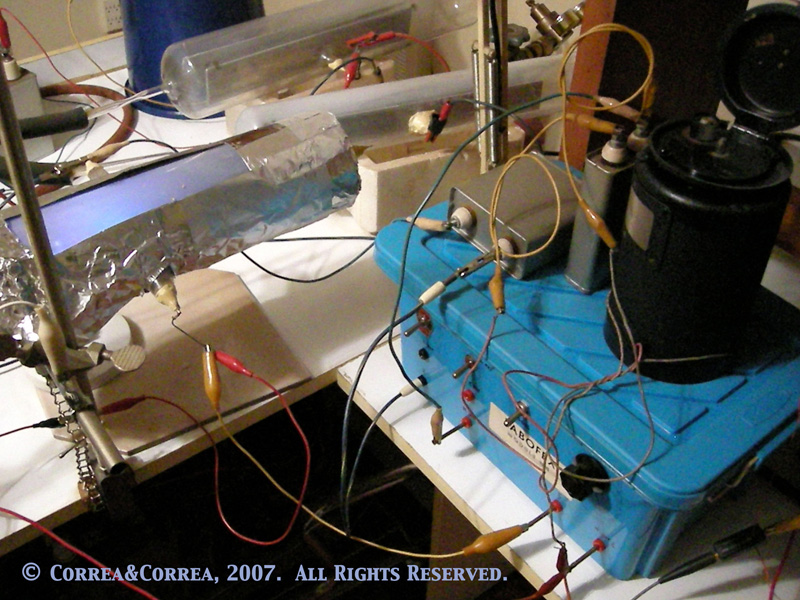
Its not difficult to realize that it is in glow mode. Probably self triggered abnormal glow mode to be specific and acting like the Correa's pulsed plasma abnormal glow mode vacuum tube, hence the colour and expression in a narrow emission for the entire plasma instability.
http://www.aetherenergy.com/Picture_Gal ... 2_2007.jpg
Dr. Paulo Correa and Alexandra Correa made their first experimental breakthrough in 1986, when they discovered and isolated a self-triggered pulsed plasma discharge in the abnormal-glow discharge region (autogenous Pulsed Abnormal Glow Discharge, or aPAGD).
http://www.aetherenergy.com/Technologie ... hor1743617
They call it gas and need to have a none existant quasar cause it to be ionized and glowing....

My guess is better then their's.

If you only knew the magnificence of the 3, 6 and 9, then you would have a key to the universe.
— Nikola Tesla
Casting Out the Nines from PHI into Indigs reveals the Cosmic Harmonic Code.
— Junglelord.
Knowledge is Structured in Consciouness. Structure and Function Cannot Be Seperated.
— Junglelord
-
StevenO
- Posts: 894
- Joined: Tue Apr 01, 2008 11:08 pm
Unread post
by StevenO » Thu Jun 19, 2008 9:22 pm
Some more info about this "Thing" ("Voorwerp" is Dutch for "thing"):
http://www.galaxyzooblog.org/2008/03/20/voorwerp-fever/, some
measurements done with the Swift satellite.
Seems they also have observations of it by the Hubble approved as shown in the blog, that could take another few months though.
First, God decided he was lonely. Then it got out of hand. Now we have this mess called life...
The past is out of date. Start living your future. Align with your dreams. Now execute.
-
MGmirkin
- Moderator
- Posts: 1667
- Joined: Thu Mar 13, 2008 11:00 pm
- Location: Beaverton, Oregon, USA
-
Contact:
Unread post
by MGmirkin » Thu Jun 19, 2008 9:43 pm
Good times.
~Michael Gmirkin
"The purpose of science is to investigate the unexplained, not to explain the uninvestigated." ~Dr. Stephen Rorke
"For every PhD there is an equal and opposite PhD." ~Gibson's law
-
StefanR
- Posts: 1371
- Joined: Sun Mar 16, 2008 8:31 pm
- Location: Amsterdam
Unread post
by StefanR » Fri Jun 20, 2008 12:58 am
Similarities???

Observations with Suprime-Cam on Subaru Telescope have detected for the first time
long filaments of ionized hydrogen gas extending 110,000 light years above the disk of a galaxy. In the new image, the gas shows up in red and purple and appears to burst out of the center of the galaxy, reaching as far as the upper-left corner of the image. This galaxy, called
NGC 4388, belongs to the Virgo Cluster, a large group of galaxies some 60 million light years from our own Milky Way galaxy. These observations provide new clues to how galaxies evolve inside the dense environment of a cluster of galaxies.
It was previously known that NGC 4388 had ionized gas extending 10,000 light years from the center of the galaxy, but
these new results are puzzling as the energy produced by the black hole can only ionize gas for a distance of 50,000 light years. An additional source of ionization may be required to explain the more extended ionized hydrogen gas. As a comparison, the ionized gas in NGC 4388 extends ten times further than the ionized gas in M 82 that is seen in the image taken by FOCAS on Subaru Telescope and released to the public in March 2000.
Michitoshi Yoshida who analyzed this data says: "
I never expected to see such extended ionized gas around NGC 4388. This can really help us understand the origin of gas surrounding galaxies, and its physical state."
http://subarutelescope.org/Pressrelease ... index.htmlThe illusion from which we are seeking to extricate ourselves is not that constituted by the realm of space and time, but that which comes from failing to know that realm from the standpoint of a higher vision. -L.H.
-
StefanR
- Posts: 1371
- Joined: Sun Mar 16, 2008 8:31 pm
- Location: Amsterdam
Unread post
by StefanR » Fri Jun 20, 2008 1:16 am
A Voorwerp in production???


Researchers from the National Astronomical Observatory of Japan (NAOJ) and the University of Tokyo used Subaru's Suprime-Cam camera to discover
an unusual streak of ionized hydrogen gas associated with a galaxy 300 million light-years from Earth.
The filament of gas is only 6 thousand light-years wide, yet extends 200,000 light-years, about the distance between the Milky Way Galaxy and its companion, the Large Magellanic Cloud. Finding such an extremely narrow and long ionized gas cloud is a first in astronomy.
The researchers had no particular reason to expect that D100 would be associated with a filamentary gas cloud. Jets emanating from black holes that are actively swallowing matter at the centers of galaxies are a typical source of long, narrow structures of ionized gas on galactic scales. However,
D100 doesn't have such an active galactic nucleus, nor does it emit x-rays or radio waves that typically accompany jets observed in visible light.
Masafumi Yagi, NAOJ researcher and first author of the scientific paper announcing the discovery says "
we don't know exactly what made this remarkable filament, but its unique structure and sheer existence holds clues to D100's past."
http://subarutelescope.org/Pressrelease ... index.htmlThe illusion from which we are seeking to extricate ourselves is not that constituted by the realm of space and time, but that which comes from failing to know that realm from the standpoint of a higher vision. -L.H.
-
junglelord
- Posts: 3693
- Joined: Mon Mar 17, 2008 5:39 am
- Location: Canada
Unread post
by junglelord » Sat Jun 21, 2008 5:03 am
I truly believe this is an example of plasma in self triggered abnormal glow mode .
If you only knew the magnificence of the 3, 6 and 9, then you would have a key to the universe.
— Nikola Tesla
Casting Out the Nines from PHI into Indigs reveals the Cosmic Harmonic Code.
— Junglelord.
Knowledge is Structured in Consciouness. Structure and Function Cannot Be Seperated.
— Junglelord
-
davesmith_au
- Site Admin
- Posts: 840
- Joined: Thu Mar 13, 2008 7:29 pm
- Location: Adelaide, the great land of Oz
-
Contact:
Unread post
by davesmith_au » Sat Jun 21, 2008 8:12 am
*Voorwerp* ... pardon me!
Sounds like something and old person lets escape from their back passage...

Cheers, Dave Smith.
-
longcircuit
- Posts: 49
- Joined: Tue Mar 18, 2008 9:59 am
Unread post
by longcircuit » Sat Jun 21, 2008 9:06 pm
MGmirkin wrote:Anyway, the Voorwerp appears to be a region of ionized hydrogen possibly near a galaxy? But nobody seems quite sure of what it is or where it came from...
Just so I know what we're talking about, what do you mean by "ionized hydrogen"? Do you mean, ionized H
2? If so, how is it ionized? Two hydrogen atoms sharing one electron, or two atoms with
more than two electrons?
longcircuit
-
upriver
- Posts: 542
- Joined: Wed Mar 19, 2008 7:17 pm
Unread post
by upriver » Sat Jun 21, 2008 10:02 pm
junglelord wrote:I truly believe this is an example of plasma in self triggered abnormal glow mode .
I thought abnormal glow was associated with a metallic cathode....
-
junglelord
- Posts: 3693
- Joined: Mon Mar 17, 2008 5:39 am
- Location: Canada
Unread post
by junglelord » Sun Jun 22, 2008 7:11 am
I believe it is a plasma discharge mode that is natural, not just man made.
Here is a atmospheric attempt to create abnormal glow discharge.
http://www.iop.org/EJ/article/1009-0630 ... 7155dfda4fIf you only knew the magnificence of the 3, 6 and 9, then you would have a key to the universe.
— Nikola Tesla
Casting Out the Nines from PHI into Indigs reveals the Cosmic Harmonic Code.
— Junglelord.
Knowledge is Structured in Consciouness. Structure and Function Cannot Be Seperated.
— Junglelord
-
MGmirkin
- Moderator
- Posts: 1667
- Joined: Thu Mar 13, 2008 11:00 pm
- Location: Beaverton, Oregon, USA
-
Contact:
Unread post
by MGmirkin » Sun Jun 22, 2008 3:33 pm
longcircuit wrote:MGmirkin wrote:Anyway, the Voorwerp appears to be a region of ionized hydrogen possibly near a galaxy? But nobody seems quite sure of what it is or where it came from...
Just so I know what we're talking about, what do you mean by "ionized hydrogen"? Do you mean, ionized H
2? If so, how is it ionized? Two hydrogen atoms sharing one electron, or two atoms with
more than two electrons?
longcircuit
Well, my comment was probably a bit off the cuff, having briefly skimmed a few articles...
(Hanny's Voorwerp - Still Alive and Kicking…)
http://www.universetoday.com/2008/06/09 ... d-kicking/
"At this point, we know that the object is rich in highly ionized gas. There is continuum light, especially at the northern tip, but the emission lines are so strong that we can as yet say little about its continuum structure. The high ionization might suggest shock ionization or photoionization by an active galactic nuclei, which would have to be much brighter than any we see in the neighborhood. If the AGN is in IC 2497, it must be highly obscured from our direction but not toward the gas. (It may be significant that the cloud lies near the galaxy's projected minor axis).
(
Emphasis added)
For some reason, I'm not seeing the particulr reference to hydrogen, but I seem to recall it was H2? Perhaps someone can find a reference for it?
Here's a page or two that talks about emission lines and other stuff in a bit more detail...
( Hanny's Voorwerp - SDSS J094103.80+344334.2)
http://www.astr.ua.edu/keel/research/voorwerp.html
&
(More on the Voorwerp)
http://www.galaxyzooblog.org/2008/01/18 ... -voorwerp/
Perhaps someone familiar with such things can summarize these in terms the rest of us can understand?
Cheers,
~Michael Gmirkin
"The purpose of science is to investigate the unexplained, not to explain the uninvestigated." ~Dr. Stephen Rorke
"For every PhD there is an equal and opposite PhD." ~Gibson's law
-
StefanR
- Posts: 1371
- Joined: Sun Mar 16, 2008 8:31 pm
- Location: Amsterdam
Unread post
by StefanR » Sun Jun 22, 2008 5:02 pm
Thanks to Matt Jarvis, who was observing at the 4.2m William Herschel Telescope in La Palma, we’ve been able to get some better images. The William Herschel Telescope is bigger than the telescope that gathers images for the Sloan Digital Sky Survey (SDSS is 2.4 m; WHT is 4.2 m), and the images that Matt took are longer exposures, so we can see fainter features in them. The conditions were also quite good (good “seeing” in astronomer’s lingo) and so the image has very good resolution (it’s “sharper”) as the atmosphere didn’t blur things too badly.
 The five different SDSS bands (g,u,r,i,z), note the intricate structure in the g-band image.
The object seems to be very bright in the g-band image and virtually absent in the others. This led us to think that it must be an emission line object, i.e. an object which emits most of its light only in very specific atomic transitions. This usually means that what we are seeing is ionised gas, rather than stars. Still, it could be anything.
So what kind of data did we get? We got three images in filters very similar to the SDSS ones. We got a g, r and i-band image. Those correspond roughly to green, red and infra-red for human eyes. Just to make things confusing though, we colour g in blue, r in green and i in red to stay consistent with the SDSS/GZ images.

The WHT image is rotated with respect to the SDSS image; look at the orientation of the galaxy and the Voorwerp to see how they compare. Once you mentally rotate the images so they match, you can see clearly that the Voorwerp is quite a lot bigger than we initially thought, because so much of it was too faint to be visible in the SDSS image. This immediately makes us want to get an even deeper g-band (blue colour) image to see just how much bigger it is! For that, we will probably go to the world’s largest telescopes such as ESO’s Very Large Telescopes, Gemini or Keck.
In his last post, Bill mentioned that the spectrum of the Voorwerp showed some very odd emission lines, in particular Helium II (HeII) and Neon V. HeII only really appears in spectra when there is something really hot around to excite the gas - something hotter than the hottest star. This could be an active galactic nucleus(i.e. gas falling into a supermassive black hole, and heating up as it falls), or perhaps some high velocity shocks. We’re busy analysing the spectrum to understand better what’s going on here.
By a luck coincidence, the Voorwerp turned out to be at a redshift where the HeII line “redshifted” into a common narrow-band filter. Such a filter blocks all light except in a very narrow wavelength range, and so lets us take an image focusing only on those areas which are emitting light in that wavelength range.
 The Voorwerp in HeII
http://www.galaxyzooblog.org/2008/01/31 ... p-deepens/
http://www.galaxyzooblog.org/2008/01/11 ... uff-below/
 Colorful MysteryHere's a new, truer-color rendering of the Voorwerp (lower center). Although it looked blue on the Sloan photo, the object actually now appears to be fairly green, observes Keel, who performed spectral analses of the huge mystery cloud.
What initially slowed an evaluation of Hanny’s Voorwerp was that “we didn’t have a spectrum for it, so it could have been literally anywhere from right next door in our galaxy to the edge of the universe,” explained Kevin, another Galaxy Zoo blogger, on Jan. 31. A helpful colleague, astronomer Bill Keel of the University of Alabama, performed that spectral analysis and shared it as a guest GZ blogger. He described the novelty as “a deep blue, irregular cloud, just south of the spiral galaxy IC 2497.”
Piecing together odd bits about that galaxy, the newfound object’s spectra, and some additional crisp imaging of the region, Keel concluded: “The Voorwerp is at almost exactly the same redshift [or distance] as IC 2497, and almost certainly associated with it.” The object’s intense and narrow range of blue emissions, he said, “are what one would see from a star-forming region. But there are some things about it that are strange, and need more work.” Moreover, he added, “Whatever this is, it’s rare.” Galaxy zookeeper Chris Lintott of Oxford University in England scanned for other blue objects in the survey database. Keel said Lintott found none emitting colors close to “what we see here.”
Currently, no one is sure what the wispy blue cloud is. But Szalay says it appears to be “radiation emitted by a quasar.” Only one similar object is known, he says: Minkowski’s object.
I’d never heard of it before. But googling the name turned up descriptions suggesting Minkowski’s Voorwerp is a stellar nursery — incubating some 10 million stars. This conglomeration is thought to have formed when a jet of intense radio waves slammed into a patch of dense gas. The source of the radio jet: a black hole at the core of a nearby galaxy (NGC 541).
It’s not yet known whether the new Voorwerp is the same thing, “but it has similarities,” Szalay says.
http://sciencenews.org/view/generic/id/ ... y_(part_I)
Yesterday, Alex Szalay of Johns Hopkins compared the Voorwerp to Minkowski’s object. But Keel says that no longer seems a very good comparison. Minkowski’s is a stellar nursery whose starbirths appear to be fueled by radio jets emitted by a black hole in a nearby galaxy. But there seems to be no radio jet associated with Hanny’s Voorwerp or evidence that its stars are infants.
Earlier this year, Keel and other astronomers got the Swift satellite telescope to turn its eye toward the new object. It didn’t take much convincing, Keel says, because Swift is looking for gamma-ray bursts that may occur anywhere at any time. So looking at one patch of the sky is about as likely to prove fruitful as gazing anywhere else.
Swift’s telescope picks up ultraviolet and X-ray emissions. And within a week, Keel says, his group learned that “Swift saw nothing.” If a black-hole-driven quasar was shooting radio waves at Hanny’s Voorwerp, there should have been a strong ultraviolet signature in the object’s spectra, he says.
Keel now suspects that the newfound object is being “lit by the ultraviolet light and X-rays from a quasar that has vanished in the last 100,000 years.” The term for such a ghostly radiance: a “light echo.” The object’s bright glow reflects the size of its star field and the warmth of the Voorwerp — about 16,000 to 20,000 °C.
http://www.sciencenews.org/view/generic ... y_(part_2)
Our current best guess goes something like this:
A hundred thousand years ago, a quasar blazed behind the stars which would have already looked recognizably like the constellation Leo Minor. Barely 700 million light-years away, it would have been the nearest bright quasar, shining (had anyone had a telescope to look) around 13th magnitude, several times brighter than the light of the surrounding galaxy. This galaxy, much later cataloged as IC 2497, is a massive spiral galaxy which was in the process of tidally shredding a dwarf galaxy rich in gas - gas which absorbed the intense ultraviolet and X-ray output of the quasar and in turn glowed as it cooled. But something happened to the quasar. Whether it turned off, dropped to a barely simmering level of activity as its massive black hole became starved for gas to feed its accretion, or it was quickly shrouded in gas and dust, we don’t see it anymore.
But we see its echo. How could we come to such startling conclusions?
***we already knew that the gas in Hanny’s Voorwerp was ionized in such a way that it must experience a radiation field of higher energy than normal stars can produce. In fact, it looks just like the pattern of emission given off by gas around the center of Seyfert galaxies, and on the outskirts of quasars and radio galaxies. This makes sense, except for the minor detail that we don’t see the active nucleus that should be there to light up the gas.
***the typical density of gas (for the pickier readers, that’s the RMS density) is no greater than about 15 particles per cubic centimeter - which means that the UV and X-ray luminosities of the object were somewhat less than a hundred billion times the Sun’s total energy output, in the range of quasars. (It was a nice extra feature that Nicola did her dissertation work on analysis involving measuring ionization parameters of gas in Seyfert galaxies, and she’s enthusiastically joined in the project).
***From the features of sulfur and nitrogen good evidence that these elements are not very abundant in the gas - maybe 10% of the fraction seen in our part of the Milky Way, more like what we find in dwarf galaxies such as the Small Magellanic Cloud. So the gas looks more like something from a low-mass dwarf rather than something ejected from the center of a luminous galaxy like IC 2497.
***First, its X-ray telescope (known as the XRT) would easily see any active galactic nucleus, even a typical Seyfert galaxy. It saw - nothing. Second, we asked for ultraviolet images with the 30-cm Ultraviolet/Optical Telescope (UVOT). These were intended to tell whether the light outside of the bright gaseous emission lines came from stars or was reflected from dust particles. The distinction could be made because, as in the scattering that makes our sky blue, short-wavelength radiation scatters more effectively from interstellar dust. As an example, the blue reflected piece of the Triffid Nebula is bluer than the illuminating star - in fact bluer than any kind of star can be. And this is what we found in the Voorwerp. Filtering a slice of ultraviolet light that shouldn’t be much affected by the gas, we found the object to be ten times brighter in the mid-ultraviolet than in the shortest wavelength seen by the Sloan Survey. Not only does the gas see something bright, so does the dust.
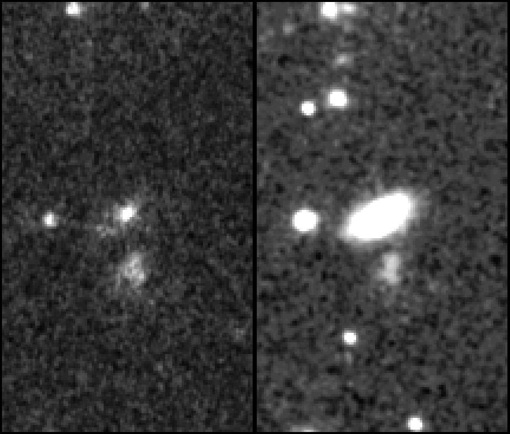 UVOT image on the left, v band on the right
***Highly ionized gas, ionized by nothing we can see. Dust reflecting ultraviolet light from no apparent source. No central X-ray source, which makes it very hard to hide
something behind a cloud of gas and dust that leaves it visible from the Voorwerp. This was starting to look like a giant version of a phenomenon that astronomers have had to rediscover for several generations now - the light echo.
http://www.galaxyzooblog.org/2008/03/20/voorwerp-fever/The illusion from which we are seeking to extricate ourselves is not that constituted by the realm of space and time, but that which comes from failing to know that realm from the standpoint of a higher vision. -L.H.
-
StefanR
- Posts: 1371
- Joined: Sun Mar 16, 2008 8:31 pm
- Location: Amsterdam
Unread post
by StefanR » Sun Jun 22, 2008 5:04 pm
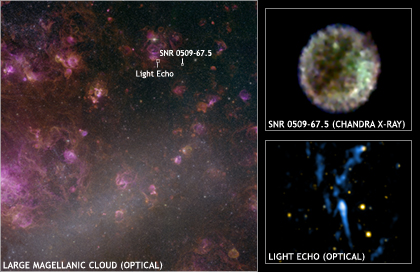
Astronomers have made the best ever determination of the power of a supernova explosion that was visible from Earth long ago. By observing the remnant of a supernova and a light echo from the initial outburst, they have established the validity of a powerful new method for studying supernovas.
Using data from NASA's Chandra X-ray Observatory, ESA's XMM-Newton Observatory, and the Gemini Observatory, two teams of researchers studied the supernova remnant and the supernova light echo that are located in the Large Magellanic Cloud (LMC), a small galaxy about 160,000 light years from Earth. They concluded that the supernova occurred about 400 years ago (in Earth’s time frame), and was unusually bright and energetic.
http://chandra.harvard.edu/press/08_rel ... 32008.htmlThe illusion from which we are seeking to extricate ourselves is not that constituted by the realm of space and time, but that which comes from failing to know that realm from the standpoint of a higher vision. -L.H.
-
StefanR
- Posts: 1371
- Joined: Sun Mar 16, 2008 8:31 pm
- Location: Amsterdam
Unread post
by StefanR » Mon Jun 23, 2008 5:02 am
Again ....similarities?
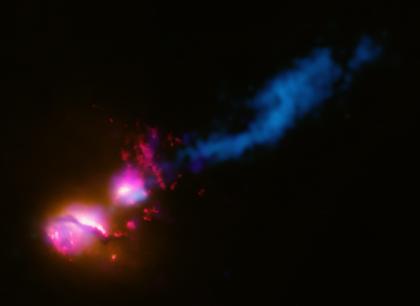
A powerful jet from a super massive black hole is blasting a nearby galaxy, according to new findings from NASA observatories. This never-before witnessed galactic violence may have a profound effect on planets in the jet's path and trigger a burst of star formation in its destructive wake
Known as 3C321, the system contains two galaxies in orbit around each other. Data from NASA's Chandra X-ray Observatory show both galaxies contain super massive black holes at their centers, but the larger galaxy has a jet emanating from the vicinity of its black hole. The smaller galaxy apparently has swung into the path of this jet.
http://chandra.harvard.edu/press/07_rel ... 21707.html
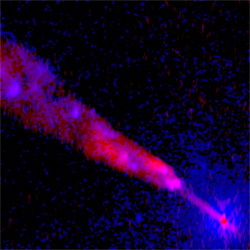
By combining radio and X-ray observations, astronomers have obtained their most detailed view yet of the effects
a powerful galactic jet has as it blasts its way through stars and gas on its way out from the centre of a galaxy. New observations of our nearest neighbouring radio galaxy, Centaurus A, (10 million light years away in the southern sky) show
intense X-rays in places where the fast-moving jet is apparently running into the gas and stars that make up the galaxy.
Only a small minority of galaxies have
powerful jets of electrically charged particles but, where they are present, they can have profound effects on the galaxies they inhabit.The orbiting observatory Chandra have discovered that
X-ray emission from jets is also common. The
X-rays come from electrons carrying large amounts of energy - comparable with the energies reached in the accelerators used in particle physics experiments on Earth.
The radio observations, taken between 1991 and 2002, showed that
parts of the jet are moving away from the centre of the galaxy at speeds of about half the speed of light. However, t
he regions of the jet that are emitting the most X-rays were stationary. The interpretation the team put on this finding is that the stationary regions are where the jet is stalled when it encounters clouds of gas or peculiar stars. The X-ray emission would be produced by the powerful shock generated as the fast jet flow runs into the stationary material. If this is true, it would be the first time that interactions in a jet have been seen in so much detail.
http://chandra.harvard.edu/press/03_rel ... 40103.html
Last edited by
StefanR on Mon Jun 23, 2008 5:52 am, edited 1 time in total.
The illusion from which we are seeking to extricate ourselves is not that constituted by the realm of space and time, but that which comes from failing to know that realm from the standpoint of a higher vision. -L.H.
Who is online
Users browsing this forum: No registered users and 9 guests