Scientists Manipulate Electrons Into Material Never Seen on Earth
Stanford scientists have created designer electrons that behave as if they were exposed to a magnetic field of 60 Tesla—a force 30 percent stronger than anything ever sustained on Earth. The work could lead to a revolution in the materials that make everything from video displays to airplanes to mobile phones.
"The behavior of electrons in materials is at the heart of essentially all of today's technologies," said Hari Manoharan, associate professor of physics at Stanford and a member of SLAC's Stanford Institute for Materials and Energy Sciences, who led the research. "We're now able to tune the fundamental properties of electrons so they behave in ways rarely seen in ordinary materials."
Moanoharan and his colleagues were inspired by the powerful properties of graphene, a one-atom thick sheet of densely-packed, bonded carbon atoms. They created the hand-crafted, honeycomb-shaped structures using a scanning tunneling microscope, which they used to place carbon monoxide molecules, one at a time, on a smooth copper surface. Carbon monoxide repels the electrons on the copper surface and forces them into a graphene-like honeycomb pattern.
The researchers then repositioned the carbon monoxide molecules on the surface so the electrons would behave as if they had been exposed to a magnetic field of otherworldly strength. Carbon monoxide molecules, which are black in the image, guide electrons, which are yellow-orange. Unlike ordinary electrons, they have no mass and travel at the speed of light as if they're in a vacuum.
The researchers say the material will be a powerful new test bed for physics. They hope to create lots more designer structures, as well as identify new nanoscale materials with unique electronic properties.The researchers report their work, which, incidentally, is very pretty to look at, in today's issue of Nature. [Nature]
Images: Manoharan Lab, Stanford/SLAC
Scientists claim to "Tune Electrons" into new materials
-
phyllotaxis

- Posts: 224
- Joined: Wed Aug 10, 2011 3:16 pm
- Location: Wilmington, NC
Scientists claim to "Tune Electrons" into new materials
http://gizmodo.com/5893211/scientists-m ... n-on-earth
-
StalkingGoogle
- Guest
Re: Scientists claim to "Tune Electrons" into new materials
It's tough to know what to make of this kind of press release journalism. It doesn't give much details on what's actually being done.
ETA - It would seem that the language used to explain this phenomenon is being deliberately muddied. Why say they're "tuning electrons" to "act as if" they're under the influence of various "fields"? If they're "acting as if" then they almost certainly ARE under the influence of those fields, unless everything known about electromagnetic forces is wrong.
ETA - It would seem that the language used to explain this phenomenon is being deliberately muddied. Why say they're "tuning electrons" to "act as if" they're under the influence of various "fields"? If they're "acting as if" then they almost certainly ARE under the influence of those fields, unless everything known about electromagnetic forces is wrong.
-
tharkun
- Posts: 32
- Joined: Wed Dec 16, 2009 7:37 pm
Re: Scientists claim to "Tune Electrons" into new materials
Miles Mathis response to this press realease:
http://milesmathis.com/desig.pdf
More evidence for his model of stacked spins creating different particles.
http://milesmathis.com/desig.pdf
More evidence for his model of stacked spins creating different particles.
-
Lloyd
- Posts: 4433
- Joined: Fri Apr 04, 2008 2:54 pm
Re: Scientists claim to "Tune Electrons" into new materials
* Tharkun, I just noticed his new article too.
* I like Mathis' model for building elements from subatomic particles, but I don't understand the particles themselves.
* Do you understand his model of the proton? He shows it as a disk, but I think the disk is just the photons shooting out of the proton, so I don't see why the disk is considered part of the proton. Do you?
* Here's an image of his alpha particle from this paper: http://milesmathis.com/oxygen.pdf:
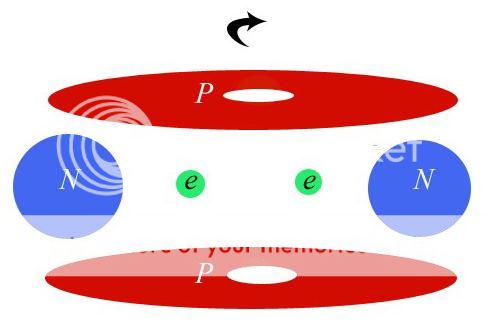
* The disk shape of the protons shows where the charge field circulates within elements. He has most of the elements built from alpha particles, or helium atoms, when the electrons are included.
* Assuming this model of the alpha is about correct, his explanation of the building of elements makes a lot of sense offhand. But I sure don't yet comprehend how the protons can be considered as disks, even if the photons they expel do produce a disk shape.
* I like Mathis' model for building elements from subatomic particles, but I don't understand the particles themselves.
* Do you understand his model of the proton? He shows it as a disk, but I think the disk is just the photons shooting out of the proton, so I don't see why the disk is considered part of the proton. Do you?
* Here's an image of his alpha particle from this paper: http://milesmathis.com/oxygen.pdf:
* The disk shape of the protons shows where the charge field circulates within elements. He has most of the elements built from alpha particles, or helium atoms, when the electrons are included.
* Assuming this model of the alpha is about correct, his explanation of the building of elements makes a lot of sense offhand. But I sure don't yet comprehend how the protons can be considered as disks, even if the photons they expel do produce a disk shape.
Who is online
Users browsing this forum: No registered users and 3 guests