Well pangea is very unlikely in my view, with instead the oceans undergoing EDM. So no continental drift nor Earth expansion. And having meteorites instead of planetary interactions does not thrill me much. And although it would be possible for the entire geological column to have begun formation only thousands of years ago, it seems that interstellar distances would be the main factor in major disturbances, and so at least tens of thousands of years are probably involved with long periods of stability.
I do see the geological record as being more useful than the historical or mythological evidence. And I do consider planetary science as the study of catastrophe and extinction.
Mo
11,000 B.C. Extinction
-
moses
- Posts: 1111
- Joined: Wed Mar 19, 2008 3:18 pm
- Location: Adelaide
- Contact:
-
kell1990
- Guest
Re: 11,000 B.C. Extinction
http://t.co/QYBs0B1x
Posted for the benefit of the group. It seems to show that some sort of impact was responsible for the dramatic temperature change @ around 13,000 bp.
Posted for the benefit of the group. It seems to show that some sort of impact was responsible for the dramatic temperature change @ around 13,000 bp.
-
StevenJay

- Posts: 506
- Joined: Thu May 01, 2008 11:02 am
- Location: Northern Arizona
Re: 11,000 B.C. Extinction
From the link:

 Interesting that they noted that the same sort of melt-glass resulted from a non-impact senario, but didn't follow that line of thought any further.
"known," eh?"The very high temperature melt-glass appears identical to that produced in known cosmic impact events such as Meteor Crater in Arizona, and the Australasian tektite field," said Kennett.
I can think of another force that can produce those temps."The melt material also matches melt-glass produced by the Trinity nuclear airburst of 1945 in Socorro, New Mexico," he continued. "The extreme temperatures required are equal to those of an atomic bomb blast, high enough to make sand melt and boil."
Interesting that they noted that the same sort of melt-glass resulted from a non-impact senario, but didn't follow that line of thought any further.It's all about perception.
-
kell1990
- Guest
Re: 11,000 B.C. Extinction
Also from the link: "The presence of a thick charcoal layer in the ancient village in Syria indicates a major fire associated with the melt-glass and impact spherules 12,900 years ago," he continued. "Evidence suggests that the effects on that settlement and its inhabitants would have been severe."StevenJay wrote:From the link:"known," eh?"The very high temperature melt-glass appears identical to that produced in known cosmic impact events such as Meteor Crater in Arizona, and the Australasian tektite field," said Kennett.
I can think of another force that can produce those temps."The melt material also matches melt-glass produced by the Trinity nuclear airburst of 1945 in Socorro, New Mexico," he continued. "The extreme temperatures required are equal to those of an atomic bomb blast, high enough to make sand melt and boil."
There is one major problem with the impact hypothesis: Where's the crater (or craters)? AFAIK the present explanation is that the object hit a glacier, and thus left no crater at all. But if it hit a huge slab of ice, then how did it get hot enough to melt sand beneath the glacier and how did the remnants get scattered all over the place, from California to (at least) Syria ? Why is there a "thick charcoal layer" in Syria but not other places?
One way that can account for all the available evidence is a massive electrical arc (think of a huge welding rod striking a metallic plate) moving across the affected area.
I'd previously thought that this might have been caused by a passing celestial object that affected the area from about South 10 to 15 degrees latitude to about 45 degrees North latitude. Now I think that it couldn't have spread further South than the Equator because the curvature of the Earth would have shielded most of the discharge. This, of course, is speculation but it's a better explanation than an impact without a crater.
-
sjw40364
- Guest
Re: 11,000 B.C. Extinction
Whatever it was, and I tend to favor the plasma discharge theory it must have been more dramatic than is speculated. We have worldwide myths of catastrophic events and our oldest civilization ruins date back to around 10,000-15,000 BCE, and Dave Talbot presents a compelling case on myths and their relations to an electrically active past.
-
seasmith
- Posts: 2815
- Joined: Thu Mar 27, 2008 6:59 pm
Re: 11,000 B.C. Extinction
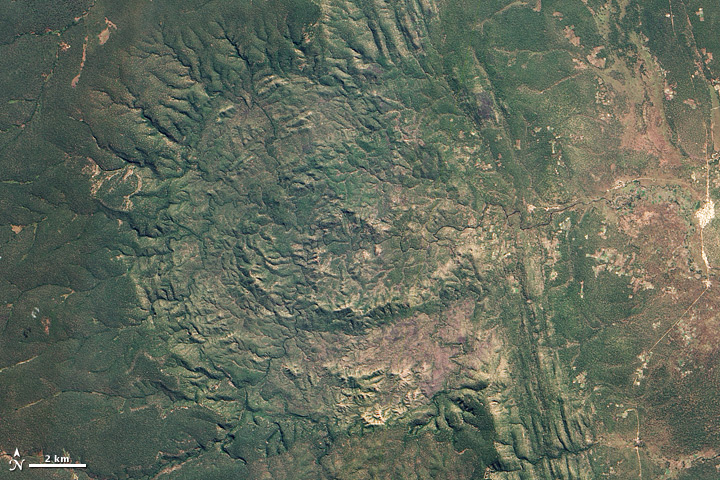
Luizi Structure, located in southeastern Congo
Satellite imagery suggested that Luizi might be an impact crater, but volcanoes and even salt domes can form structures that look like impact craters, so the researchers had to go into the field. They found shatter cones, and microscopic analysis of rock samples collected from the site revealed shocked quartz grains. Both shatter cones and shocked quartz are considered strong evidence of meteorite impacts.
Impact craters can be simple or complex. While simple craters have uncomplicated bowl shapes, complex craters sport features that can be counterintuitive, such as inner rings and central peaks. Geologists have linked both crater types to the action of high---
http://earthobservatory.nasa.gov/IOTD/v ... c=eoa-iotd
-
slug
- Posts: 15
- Joined: Thu Dec 10, 2009 12:34 pm
Re: 11,000 B.C. Extinction
I do not buy into this "star chart etching" interpretation of this surface.moses wrote: The map of the stars etched into an 'air shaft' in the Great Pyramid strongly suggests that this pyramid was not built anytime near 2,500 BC. It is most likely a depiction of the sky when the pyramid was built.
-
moses
- Posts: 1111
- Joined: Wed Mar 19, 2008 3:18 pm
- Location: Adelaide
- Contact:
Re: 11,000 B.C. Extinction
I do not buy into this "star chart etching" interpretation of this surface.
slug
Then possibly some worker was trying to etch his name or just got a chance to do some doodling, or perhaps the blocks were actually made of cement and some child did some finger work on it before it set.
Mo
slug
Then possibly some worker was trying to etch his name or just got a chance to do some doodling, or perhaps the blocks were actually made of cement and some child did some finger work on it before it set.
Mo
-
webolife

- Posts: 2539
- Joined: Mon Mar 17, 2008 2:01 pm
- Location: Seattle
Re: 11,000 B.C. Extinction
I'm with slug on this one.
Isolated out of context markings, like clouds, and the marbling on your shower wall, can be imagined to represent any shape your mind can fixate on. The alleged fuzzy-marked alignments are inexact at best, and this inexactness is being used to conclude an exact message by people living thousands of years ago... imaginative and amazing, and utterly incredible.
Isolated out of context markings, like clouds, and the marbling on your shower wall, can be imagined to represent any shape your mind can fixate on. The alleged fuzzy-marked alignments are inexact at best, and this inexactness is being used to conclude an exact message by people living thousands of years ago... imaginative and amazing, and utterly incredible.
Truth extends beyond the border of self-limiting science. Free discourse among opposing viewpoints draws the open-minded away from the darkness of inevitable bias and nearer to the light of universal reality.
-
kiwi
- Posts: 564
- Joined: Wed Jun 23, 2010 3:58 pm
- Location: New Zealand
Re: 11,000 B.C. Extinction
was pondering the other day as how the "proposed" distance of Alnilam (Orion Belt Star) was "figured" .... sorry to get all "sciency" here ... just curious , and suspect the Red-Shift is at the bottom of it 
http://en.wikipedia.org/wiki/Orion's_BeltAlnitak
Alnitak is approximately 736 light years away from Earth and, taking into consideration ultraviolet radiation, which the human eye cannot see, Alnitak is 100,000 times more luminous than the Sun.[2]
[edit]Alnilam
Alnilam is approximately 1340 light years away from earth and shines with magnitude 1.70. Considering ultraviolet light Alnilam is 375,000 times more luminous than the Sun.[3]
[edit]Mintaka
Mintaka is 915 light years away and shines with magnitude 2.21. Mintaka is 90,000 times more luminous than the Sun. Mintaka is a double star. Both stars orbit around each other every 5.73 days.[4]
-
kell1990
- Guest
Mammoths and electrical discharge
http://www.world-science.net/othernews/130520_mammoth
..."Either a comet scraping the atmosphere or a meteorite slamming into the Earth caused global-scale combustion, scorching the air, melting bedrock and altered the course of Earth’s history, according to researcher Kenneth Tankersley of the University of Cincinnati."
"“Imagine living in a time when you look outside and there are elephants walking around in Cincinnati,” Tankersley said. “But by the time you’re at the end of your years, there are no more elephants. It happens within your lifetime.” Tankersley and colleagues describe evidence for the event, estimated to have occurred and to have affected at least four continents about 12,800 years ago, in the research journal Proceedings of the National Academy of Sciences.
"
Tankersley is an archaeological geologist. He uses geological techniques, in the field and laboratory, to solve archaeological questions. He’s found what he said are answers to some of those questions in Sheriden Cave in Wyandot County, Ohio. It’s in that spot, 100 feet below the surface, where Tankersley has been studying geological layers that date to the “Younger Dryas” time period, about 13,000 years ago. It’s also one area where mammoths roamed.
About 12,000 years before that period, the Earth was at the Last Glacial Maximum – the peak of the Ice Age. Millennia passed, and the climate began to warm. Then something happened that caused temperatures to suddenly reverse course, Tankersley said, bringing about a century’s worth of near-glacial climate that marked the start of the geologically brief Younger Dryas.
There are only about 20 archaeological sites in the world that date to this time period and only 12 in the United States, he added. “There aren’t many places on the planet where you can actually put your finger on the end of the last ice age, and Sheriden Cave is one of those,” he said.
Tankersley found evidence that something came close enough to Earth to melt rock and produce other interesting effects. Foremost among the findings were carbon spherules, tiny balls of carbon formed when substances burn at very high temperatures. These show characteristics that indicate their origin, whether that’s from burning coal, lightning strikes, forest fires or something more extreme. Tankersley said the ones in his study could only have been formed from burning rock.
The spherules also were found at 17 other sites across four continents – an estimated 10 million metric tons’ worth – further supporting the idea that whatever changed Earth did so on a massive scale, he said.
“meltSomething came close enough to Earth and it was hot enough that it ed rock – that’s what these carbon spherules are. In order to create this type of evidence that we see around the world, it was big,” Tankersley said, contrasting the effects of an event so massive with the 1883 volcanic explosion on Krakatoa in Indonesia. “When Krakatoa blew its stack, Cincinnati had no summer,” he noted. “That’s just one little volcano blowing its top.”
Tankersley said while the cosmic strike had an immediate and deadly effect, the long-term side effects were far more devastating – similar to Krakatoa’s aftermath but many times worse – making it unique in modern human history. Toxic gas poisoned the air and clouded the sky, he argues, causing temperatures to plummet.
The roiling climate would have challenged plant and animal populations, producing what Tankersley has classified as “winners” and “losers” of the Younger Dryas. He said inhabitants of this time period had three choices: move to where they could make a similar living; downsize or adjust their way of living to fit the current surroundings; or die.
Humans at the time were just as resourceful and intelligent as we are today, he adds, and managed to fit among the first two groups. Mammoths were not so lucky.
“Whether we want to admit it or not, we’re living right now in a period of very rapid and profound global climate change. We’re also living in a time of mass extinction,” Tankersley said. “So I would argue that a lot of the lessons for surviving climate change are actually in the past.”
Humans of the Younger Dryas were hunter-gatherers. When catastrophe struck, they found news ways and new places to hunt game and gather wild plants, he said. Evidence found in Sheriden Cave shows that most of the plants and animals living there also endured. Of the 70 species known to have lived there before the Younger Dryas, 68 were found there afterward. The two that didn’t make it were the giant beaver and the flat-headed peccary, a sharp-toothed pig the size of a black bear.
Tankersley also cautions that the possibility of another massive cosmic event should not be ignored. Like earthquakes, tsunamis and volcanoes, these types of natural disasters do happen, and as history has shown, it can be to devastating effect.
“One additional catastrophic change that we often fail to think about – and it’s beyond our control – is something from outer space,” Tankersley said. “It’s a reminder of how fragile we are. Imagine an explosion that happened today that went across four continents. The human species would go on. But it would be different. It would be a game changer.”
*
..."Either a comet scraping the atmosphere or a meteorite slamming into the Earth caused global-scale combustion, scorching the air, melting bedrock and altered the course of Earth’s history, according to researcher Kenneth Tankersley of the University of Cincinnati."
"“Imagine living in a time when you look outside and there are elephants walking around in Cincinnati,” Tankersley said. “But by the time you’re at the end of your years, there are no more elephants. It happens within your lifetime.” Tankersley and colleagues describe evidence for the event, estimated to have occurred and to have affected at least four continents about 12,800 years ago, in the research journal Proceedings of the National Academy of Sciences.
"
Tankersley is an archaeological geologist. He uses geological techniques, in the field and laboratory, to solve archaeological questions. He’s found what he said are answers to some of those questions in Sheriden Cave in Wyandot County, Ohio. It’s in that spot, 100 feet below the surface, where Tankersley has been studying geological layers that date to the “Younger Dryas” time period, about 13,000 years ago. It’s also one area where mammoths roamed.
About 12,000 years before that period, the Earth was at the Last Glacial Maximum – the peak of the Ice Age. Millennia passed, and the climate began to warm. Then something happened that caused temperatures to suddenly reverse course, Tankersley said, bringing about a century’s worth of near-glacial climate that marked the start of the geologically brief Younger Dryas.
There are only about 20 archaeological sites in the world that date to this time period and only 12 in the United States, he added. “There aren’t many places on the planet where you can actually put your finger on the end of the last ice age, and Sheriden Cave is one of those,” he said.
Tankersley found evidence that something came close enough to Earth to melt rock and produce other interesting effects. Foremost among the findings were carbon spherules, tiny balls of carbon formed when substances burn at very high temperatures. These show characteristics that indicate their origin, whether that’s from burning coal, lightning strikes, forest fires or something more extreme. Tankersley said the ones in his study could only have been formed from burning rock.
The spherules also were found at 17 other sites across four continents – an estimated 10 million metric tons’ worth – further supporting the idea that whatever changed Earth did so on a massive scale, he said.
“meltSomething came close enough to Earth and it was hot enough that it ed rock – that’s what these carbon spherules are. In order to create this type of evidence that we see around the world, it was big,” Tankersley said, contrasting the effects of an event so massive with the 1883 volcanic explosion on Krakatoa in Indonesia. “When Krakatoa blew its stack, Cincinnati had no summer,” he noted. “That’s just one little volcano blowing its top.”
Tankersley said while the cosmic strike had an immediate and deadly effect, the long-term side effects were far more devastating – similar to Krakatoa’s aftermath but many times worse – making it unique in modern human history. Toxic gas poisoned the air and clouded the sky, he argues, causing temperatures to plummet.
The roiling climate would have challenged plant and animal populations, producing what Tankersley has classified as “winners” and “losers” of the Younger Dryas. He said inhabitants of this time period had three choices: move to where they could make a similar living; downsize or adjust their way of living to fit the current surroundings; or die.
Humans at the time were just as resourceful and intelligent as we are today, he adds, and managed to fit among the first two groups. Mammoths were not so lucky.
“Whether we want to admit it or not, we’re living right now in a period of very rapid and profound global climate change. We’re also living in a time of mass extinction,” Tankersley said. “So I would argue that a lot of the lessons for surviving climate change are actually in the past.”
Humans of the Younger Dryas were hunter-gatherers. When catastrophe struck, they found news ways and new places to hunt game and gather wild plants, he said. Evidence found in Sheriden Cave shows that most of the plants and animals living there also endured. Of the 70 species known to have lived there before the Younger Dryas, 68 were found there afterward. The two that didn’t make it were the giant beaver and the flat-headed peccary, a sharp-toothed pig the size of a black bear.
Tankersley also cautions that the possibility of another massive cosmic event should not be ignored. Like earthquakes, tsunamis and volcanoes, these types of natural disasters do happen, and as history has shown, it can be to devastating effect.
“One additional catastrophic change that we often fail to think about – and it’s beyond our control – is something from outer space,” Tankersley said. “It’s a reminder of how fragile we are. Imagine an explosion that happened today that went across four continents. The human species would go on. But it would be different. It would be a game changer.”
*
-
seasmith
- Posts: 2815
- Joined: Thu Mar 27, 2008 6:59 pm
Re: 11,000 B.C. Extinction
Now, in one of the most comprehensive related investigations ever, the group has documented a wide distribution of microspherules widely distributed in a layer over 50 million square kilometers on four continents, including North America, including Arlington Canyon on Santa Rosa Island in the Channel Islands.
This layer - the Younger Dryas Boundary (YDB) layer - also contains peak abundances of other exotic materials, including nanodiamonds and other unusual forms of carbon such as fullerenes, as well as melt-glass and iridium. This new evidence in support of the cosmic impact theory appeared recently in a paper in the Proceedings of the National Academy of the Sciences
http://www.spacedaily.com/reports/Compr ... o_999.htmlBut spherules do not form from cosmic collisions alone. Volcanic activity, lightning strikes, and coal seam fires all can create the tiny spheres. So to differentiate between impact spherules and those formed by other processes, the research team utilized scanning electron microscopy and energy dispersive spectrometry on nearly 700 spherule samples collected from the YDB layer.
The YDB layer also corresponds with the end of the Clovis age, and is commonly associated with other features such as an overlying "black mat" - a thin, dark carbon-rich sedimentary layer - as well as the youngest known Clovis archeological material and megafaunal remains, and abundant charcoal that indicates massive biomass burning resulting from impact.
The results, according to Kennett, are compelling...
-
kell1990
- Guest
Re: 11,000 B.C. Extinction
May I say, "Congratulations". <moderator edit> But anyway it gets through the grapewvine, I can only congratuate you for having the courage to say what you saw, and then live to defend it. If only some of the other people who follow this blog are actually so lucky.
As nearly as I can tell, from my limited view of the Electric Universe, this is the first time a bona-fide organization ever accepted such a paper. I could be completely wrong about that, but I think that as of just a few months ago, anything that even resembled the Electric Universe was shunned. Progress is being made.
I'd invite your fellow readers to take a look at the post called "Mammoths and electrical discharge" for how far the EU has come.
As nearly as I can tell, from my limited view of the Electric Universe, this is the first time a bona-fide organization ever accepted such a paper. I could be completely wrong about that, but I think that as of just a few months ago, anything that even resembled the Electric Universe was shunned. Progress is being made.
I'd invite your fellow readers to take a look at the post called "Mammoths and electrical discharge" for how far the EU has come.
Last edited by nick c on Wed May 29, 2013 7:57 am, edited 1 time in total.
Reason: inappropriate remark removed
Reason: inappropriate remark removed
-
JHL
- Posts: 158
- Joined: Wed Dec 10, 2014 3:11 pm
And there it is - Comet strike 10,950 BC
Looking forward to where this goes in upcoming months and years."Ancient stone carvings confirm how comet struck Earth in 10,950BC, sparking the rise of civilisations"
Experts at the University of Edinburgh analysed mysterious symbols carved onto stone pillars at Gobekli Tepe in southern Turkey, to find out if they could be linked to constellations.
The markings suggest that a swarm of comet fragments hit Earth at the exact same time that a mini-ice age struck, changing the entire course of human history.
[...]
Using a computer programme to show where the constellations would have appeared above Turkey thousands of years ago, they were able to pinpoint the comet strike to 10,950BC, the exact time the Younger Dryas begins according to ice core data from Greenland.
[...]
"If you consider that, according to astronomers, this giant comet probably arrived in the inner solar system some 20 to 30 thousand years ago, and it would have been a very visible and dominant feature of the night sky, it is hard to see how ancient people could have ignored this given the likely consequences."
The research is published in Mediterranean Archaeology and Archaeometry.
-
Grey Cloud
- Posts: 2477
- Joined: Sun Apr 13, 2008 5:47 am
- Location: NW UK
Re: And there it is - Comet strike 10,950 BC
Seasmith already posted this here:
http://www.thunderbolts.info/wp/forum/phpB ... 20#p119186
Link to the actual paper in my post below it.
http://www.thunderbolts.info/wp/forum/phpB ... 20#p119186
Link to the actual paper in my post below it.
If I have the least bit of knowledge
I will follow the great Way alone
and fear nothing but being sidetracked.
The great Way is simple
but people delight in complexity.
Tao Te Ching, 53.
I will follow the great Way alone
and fear nothing but being sidetracked.
The great Way is simple
but people delight in complexity.
Tao Te Ching, 53.
Who is online
Users browsing this forum: No registered users and 4 guests