Mars and Flowing Water

Historic planetary instability and catastrophe. Evidence for electrical scarring on planets and moons. Electrical events in today's solar system. Electric Earth.
User avatar
nick c
Posts: 3075
Joined: Mon Mar 17, 2008 3:12 am

Mars and Flowing Water

Unread post by nick c » Thu Aug 14, 2025 12:58 am

Source: Newton, Einstein, and Velikovsky, Charles Ginenthal, (2015)


Did Water Once Flow On Mars?

Rivers and oceans are impossible under today's conditions on Mars. Given the Martian temperatures, humidity, and low atmospheric pressure (less than 1% of Earth), liquid water cannot exist for long. Temperatures on Mars also, would not permit water in liquid form, other than temporary phenomena.

Except for a few areas near the equator and only in the height of summer can water exist as a liquid, and probably not for long. Temperatures well below the freezing point are the norm. Water underground on the edge of cliffs has been observed flowing (temporarily) down after having been uncovered by erosion or landslide. It is believed that there is Martian water frozen underground. But water in the form of rivers, lakes, or seas is an impossibility under the planet's present conditions.
 
The Martian Rivers
 
Mars' surface today is marked with numerous channels that have the appearance of river channels as seen on Earth. Numerous researchers that have examined these features have asserted that detailed examination of these features leads to one conclusion, at one time water flowed on Mars.

Richard A. Kerr, "The Solar System's New Diversity", Science, Vol. 265 (1995), p.1360....
The channels are the biggest enigma. There are three types and at least two appear to be water eroded tributaries and valleys. Some scientists [don't] believe it. Others, such as Paul Lowmay, of the Goddard Space Flight Center, say the branch like channels are 'conclusive proof' of liquid water. How to explain this evidence for liquid water on Mars has become one of the hottest issues in space science. It has stimulated all kinds of finagling and rethinking.
Since that was written things have not improved, the anomalous evidence of liquid water flowing on Mars has been reinforced by new evidence:
These winding ridges, preserved in the Martian highlands, suggest that rainfall—not just glacial melt—once played a major role in shaping the Red Planet’s surface. The findings, mapped using high-resolution orbital data, challenge long-held views of Mars as cold and dry, pointing instead to a time when it may have been warm, wet, and far more Earth-like than we imagined.
https://scitechdaily.com/this-martian-r ... nt-rivers/

A Massive Network of Ancient Riverbeds on Mars

Recent research has uncovered more evidence that the Martian dendritic channels are indeed dried river beds.

The evidence suggests that there was rainfall which fed streams and rivers that flowed into an ocean in the Northern Hemisphere where there is an enormous basin. Around this ocean basin there are the remains of shorelines. Numerous channels from the Southern Highlands descend into the Northern basin.
https://www.sciencedaily.com/releases/2 ... 082924.htm

The Counter Argument That There Was No Rainfall

Some planetary scientists originally theorized that the water in these rivers was sourced not from rain but rather from underground. They argued that there is a scarcity of small finely grooved tributary streams which should exist if the rivers were the result of rain and/or snow. But that argument has more or less been dropped due to the discovery that these small tributaries do exist, but have been eroded, buried over time, and filled with dirt and dust. The discovery was made by thermal imaging equipment (THEMIS) taken by the Mars Odyssey space probe. The small streams and riverlets do exist but over the centuries have been covered by erosion and dust. Precipitation of rain and snow appears to be the source of the dried up dendritic channels.


The Northern Ocean

That there was an ocean in the Northern Hemisphere is generally accepted today. There is an enormous basin which has a very smooth bottom consistent with what one would find in the abyssal plain of an ocean. There is a continental shelf around the basin with a precipitous cliff that plunges 6,000 to 10.000 feet into the abyssal plain.
 
A recently released set of topography maps provide new evidence for an ancient northern ocean on Mars. Benjamin Cardenas, assistant professor of geosciences at Penn State says the maps offer the strongest case yet that the planet once experienced sea-level rise consistent with an extended warm and wet climate, not the harsh, frozen landscape that exists today.
https://www.psu.edu/news/research/story ... vered-mars

Two Viking landers set down on this northern plain and took samples of the chemical composition. Both landers would have been about two miles underwater of the former ocean. The description of the findings was consistent with a former ocean bottom, according to Michael Carr the leader of the Viking Orbiter Imaging Team:
...a caliche [soil or alluvium cemented material] formation with a cement of soluble mobile salts mainly magnesium sulfate and possibly sodium chloride.
The Surface of Mars, Michael Carr

These are materials commonly found in Earth's seawater.
https://www.calendar-uk.co.uk/frequentl ... -the-ocean

Magnesium sulfate is described as "a precipitate of saline brine". Saline brine is of course salt water.
Encyclopedia Britannica: Micropedia, Vol.VI, p.488

There are also ancient shorelines surrounding the basin. The previously noted rivers flow from the Southern highlands down to the Northern Ocean. The river beds end at the ancient shore line where they formed deltas and flowed into the ocean.
https://agupubs.onlinelibrary.wiley.com ... 22JE007390
https://en.wikipedia.org/wiki/Mars_ocea ... te_note-23

Remains of ancient beaches:
https://news.berkeley.edu/2025/02/24/an ... n-on-mars/
User avatar
nick c
Posts: 3075
Joined: Mon Mar 17, 2008 3:12 am

Re: Mars and Flowing Water

Unread post by nick c » Thu Aug 14, 2025 1:20 am

Erosion on Mars
 
The question is, when was Mars last a water planet? The mainstream uniformitarian interpretation is that all these rivers flowed a billion or more years ago. The point is that it is difficult to accept that Mars moved into its present orbit within human memory, so it is much more palatable to remove the events in time and safely deposit them in the distant past.
But is that assumption justified?

One of the techniques for estimating the age of a planetary/or moon's surface is crater counting. Needless to say this is a pure uniformitarian technique that is based on the assumption that impact craters are formed at a regular rate and by counting them, one can get a ball park estimate of the age of the surface. This is totally irrelevant to catastrophism. A billion years of craters (according to the count) could have been formed in days under catastrophic conditions. It has been pointed out by mainstream critics that crater counts can be off by an order of magnitude or more. Any ages derived from using the 'crater count' method are pretty much worthless.

It is interesting to understand what Mars SHOULD look like if it were in its present orbit for billions of years. Before the realities of the space probes were to sink in, Mars was expected to be a desert with no sharp features, gently rolling hills, worn down craters. Carl Sagan explained this:
Sagan wrote:when men arrive [on Mars]...they will wander over a gently sloping landscape and enormous number of flat eroded flat bottomed craters.
Carl Sagan, "Mars, A New World To Explore", National Geographic, (Dec. 1967), p.828

Patrick Moore, later wrote about how wrong the expert scientific expectations were:
Patrick Moore wrote:The Martian scene proved to be utterly unlike what most people expected. Instead of gentle rolling plains, there were mountains, valleys, craters and volcanoes."
But Moore would be in for an even greater surprise because nobody expected to find that Mars would show features that it was formerly a water planet (somewhat) like Earth!

Mars is often engulfed in planet wide dust storms featuring enormous mountain sized dust devils. The biggest of these storms can be seen with telescopes on Earth. It is not uncommon for all of Mars to be obscured by the largest of these storms. What must be the erosive effect of billions of years of these monster dust storms?

The point is that if Mars has been in its present orbit around the present Sun it should have looked like Sagan expected. After a billion or more years of untold dust storms, all of the riverbed features, shorelines, etc. should have eroded away, leaving Mars like a planet wide cold desert of dust plains and rolling dunes.

Researchers at NASA Ames conducted wind tunnel experiments with a simulated Martian atmosphere (barometric pressure, wind speeds, chemical/mineralogical make up of surface materials) as per data gathered by the Viking Lander.
https://www.nasa.gov/thermophysics-faci ... aboratory/

The conclusion was:
The results yield extremely high rates of abrasion. Even using very conservative values for the various cases that can be considered, the surface of Mars ought to be reduced to a smooth plain.
Farouk El-Baz, M.H.A. Hassan, eds, Physics of Desertification, (1986) pp 182-185

The above experiment yielded about 2 centimeters (0.8 inches) of erosion per century. That is 660 feet of erosion in one million years. The results indicate that the surface of Mars is exposed to a highly erosive environment.

Clearly it is impossible for these riverbeds and most other features of the Martian surface to have survived millions or billions of years. Mars should look like Sagan mistakenly described it in pre space probe days.

Yet its features are sharp and fresh, indicative of a recent catastrophic past.

As a sidenote in Worlds In Collision (1950), p. 364, Velikovsky described what Mars should look like from the perspective of his theory.
The contacts with Mars with other planets larger than itself and more powerful make it highly improbable that any higher forms of life, if they previously existed there, survived on Mars. It is, rather, a dead planet; every higher form of life, of whatever kind it might have been, most probably had its Last Day. Their work could not survive either, The "canals" of Mars appear to be a result of the play of geological forces that answered in rifts and cracks the outer forces acting in collisions.

Maol
Posts: 611
Joined: Fri Mar 11, 2011 8:40 pm

Re: Mars and Flowing Water

Unread post by Maol » Sat Aug 16, 2025 5:51 pm

If it “rained for forty days and forty nights” here on Earth, might it be wet at Mars?

What if a massive body, a wandering lone planet or an as-of-yet undetected mini black hole (if there is such a thing) passed near or through the Oort Cloud and disrupted orbits of countless massive icy bodies presumed to exist there causing a veritable rain of billions and billions (imagine that in you-know-whose voice) of tons of ice to fall into the sun, or at least be deflected into orbits near the sun and inner solar system, whereupon some to fall on earth and the other inner planets, including Mars.

If it “rained for forty days and forty nights” here on Earth, might it be wet at Mars?

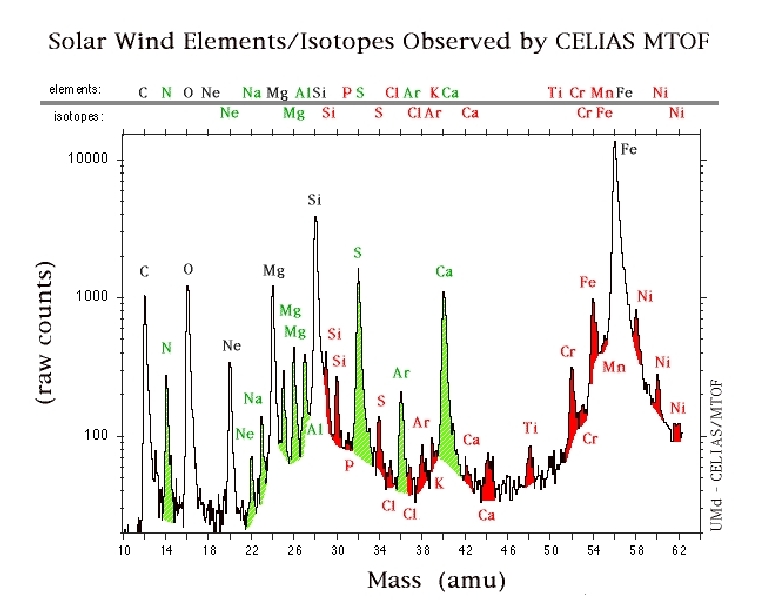
The relative abundances of elements in the solar wind and CMEs can raise “chicken or the egg” questions in regard to the atmosphere of the solar system and its bodies, planets, moons, asteroids, comets, planetesimals, Oort Cloud, etc.

Here’s another “what if”: Perhaps for some reason, such as an energy variation in the galactic circuit in which the Sun is a component, solar activity or energy output changes such that greater or lesser amounts of the various elements are expelled in the SW and CME’s, or energy conditions favorable for them to form molecules move further from or closer to the Sun …. for example, if heat increases, more volatile (lower boiling point) molecules will move further from the sun.

In other words, the “Goldilocks Zone” will move when solar activity changes and such change affects everything, not just water.

If it “rained for forty days and forty nights” here on Earth, might it be wet at Mars?

Some data from SOHO. Search for the word oxygen in this. There are several mentions of oxygen in the SW and CME's.

http://www.esa.int/esapub/bulletin/bull ... ming87.htm

The CELIAS solar-wind mass spectrometer (MTOF = Mass Time-of- Flight sensor) possesses unprecedented mass resolution for solar- wind composition

Image

User avatar
spark
Posts: 301
Joined: Sun Jun 08, 2014 2:36 pm

Re: Mars and Flowing Water

Unread post by spark » Sun Aug 17, 2025 7:10 am

Since Mars was orbiting brown dwarf Saturn along with Earth, it might have rained hot salt water on Mars just like on Earth creating oceans from the icy rings of Saturn which was probably a result of destruction of one of Saturn's salt rich icy moon when Saturn went Nova due to turning into a comet upon capture by the Sun once it entered heliosphere. There might be salt deposits left behind on Mars after all the water evaporated if this is the case.

User avatar
nick c
Posts: 3075
Joined: Mon Mar 17, 2008 3:12 am

Re: Mars and Flowing Water

Unread post by nick c » Sun Aug 17, 2025 2:26 pm

Hi Spark,
The findings that Mars was a water planet in its recent past, is certainly consistent with Saturn Theory.
The basin of the Boreal Ocean has been found to contain many salts, consistent with it being the bottom of a salt water ocean at some time in the past.

Lynn Rose, in the early 1970's in the journal Pensee proposed that Mars was an inner planet, possibly somewhere near Venus' present orbit. The thinking there is that Mars was knocked out of that orbit by close passages between Venus and Earth. Mars being much smaller got the worst of those encounters. It must be remembered that in its present orbit and atmospheric conditions Mars cannot maintain liquid bodies of water such as oceans, lakes, and rivers.

But of course in Saturn Theory which appeared in the late 1970's, Mars was an inner planet to Earth, but was in a much different solar system.

"Could Mars Have Been An Inner Planet", Lynn Rose, Pensee, and later published in the book Velikovsky Reconsidered (1976)

Post Reply

Who is online

Users browsing this forum: No registered users and 1 guest