Giotto, Space Probe to Halley's Comet
Posted: Tue Jul 22, 2025 8:04 pm
July Launches in the Electric Universe
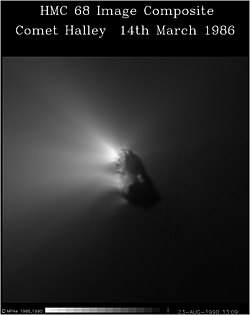
The Giotto Space Probe was launched on July 2, 1985 from French Guiana. It obtained gorgeous images of Comet Halley, which had the definite appearance of a dark, double-lobed rock, before its camera was obliterated by the encounter.
I bolded and shortened this Wikipedia entry:
Again, "Comet Grigg–Skjellerup (formally designated 26P/Grigg–Skjellerup) is a periodic comet. It was visited by the Giotto probe in July 1992.[6] The spacecraft came as close as 200 km, but could not take pictures because some instruments were damaged from ts encounter with Halley's Comet.[7]"
Wal Thornhill reported on the Giotto mission from an Electric Universe perspective in many of his analyses of comets, and the findings of the Giotto spacecraft also crossed the pages of the Thunderbolts Picture of the Day as well as making appearances in Spacenews.
The Giotto Space Probe was launched on July 2, 1985 from French Guiana. It obtained gorgeous images of Comet Halley, which had the definite appearance of a dark, double-lobed rock, before its camera was obliterated by the encounter.
I bolded and shortened this Wikipedia entry:
- Giotto was a European robotic spacecraft mission from the European Space Agency. The spacecraft flew by and studied Halley's Comet and in doing so became the first spacecraft to make close up observations of a comet. On 13 March 1986, the spacecraft succeeded in approaching Halley's nucleus at a distance of 596 kilometers. It was named after the Early Italian Renaissance painter Giotto di Bondone. He had observed Halley's Comet in 1301 and was inspired to depict it as the star of Bethlehem in his painting Adoration of the Magi in the Scrovegni Chapel.
Giotto trajectory
There were plans to have observation equipment on board a Space Shuttle in low-Earth orbit around the time of Giotto's fly-by, but they in turn fell through with the Challenger disaster.
[b]The plan then became a cooperative armada of five space probes including Giotto, two from the Soviet Union's Vega program and two from Japan: the Sakigake and Suisei probes. [/b]The idea was for Japanese probes and the pre-existing American probe International Cometary Explorer to make long distance measurements, followed by the Soviet Vegas which would locate the nucleus, and the resulting information sent back would allow Giotto to precisely target very close to the nucleus. Because Giotto would pass so very close to the nucleus ESA was mostly convinced it would not survive the encounter due to the spacecraft colliding at very high speed with the many dust particles from the comet. The coordinated group of probes became known as the Halley Armada.
Science Instruments
Giotto had 10 science instruments.[16][17]
MAG: a magnetometer
HMC (Halley Multicolour Camera): a 16-cm telescope and camera
DID (Dust Impactor Detector System): measured the mass of dust particles that hit the instrument
RPA (Rème Plasma Analyser): studied solar wind and charged particles
JPA (Johnstone Plasma Analyser): also measured solar wind and charged particles
PIA (Particulate Impact Analyser): studied the size and chemistry of particles
OPE (Optical Probe Experiment): examined the emissivity of gas and dust behind the spacecraft
EPA (Energetic Particle Analyser): analyzed alpha-particles, electrons, and neutrons
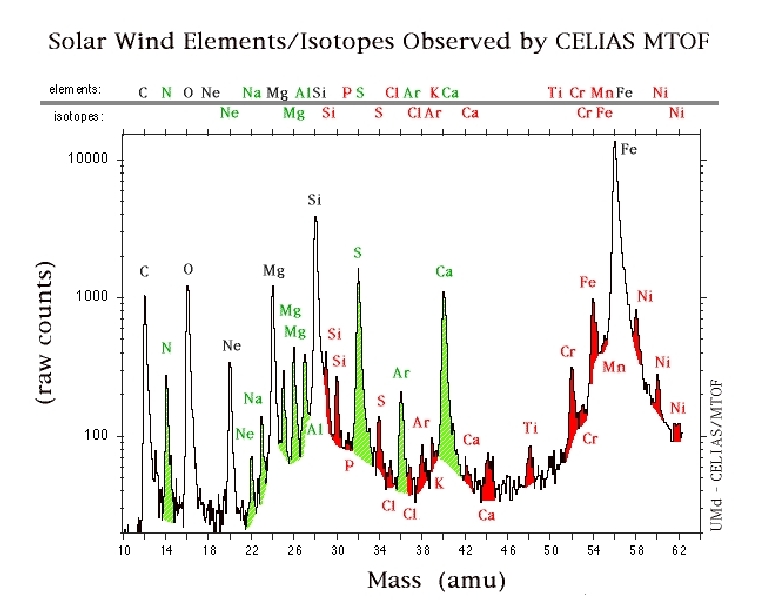
NMS (Neutral Mass Spectrometer): measured the composition of the particles around the comet
IMS (Ion Mass Spectrometer): measured the amount of ions from the sun and the comet
GRE (Giotto Radio Experiment): used Giotto's radio signals to study Halley's comet
Halley encounter
The Soviet Vega 1 started returning images of Halley on 4 March 1986, and the first ever of its nucleus, and made its flyby on 6 March, followed by Vega 2 making its flyby on 9 March. Vega 1's closest approach to Halley was 8 889 km.
Giotto passed Halley successfully on 14 March 1986 at 596 km distance, and surprisingly survived despite being hit by some small particles. One impact sent it spinning off its stabilized spin axis so that its antenna no longer always pointed at the Earth, and its dust shield no longer protected its instruments. After 32 minutes Giotto re-stabilized itself and continued gathering science data.
Another impact destroyed the Halley Multicolor Camera, but not before it took photographs of the nucleus at closest approach.
- First Earth flyby
Giotto's trajectory was adjusted for an Earth flyby and its science instruments were turned off on 15 March 1986 at 02:00 UTC.
Grigg–Skjellerup encounter
Giotto was commanded to wake up on 2 July 1990 when it flew by Earth in order to sling shot to its next cometary encounter.
The probe then flew by the Comet Grigg–Skjellerup on 10 July 1992 which it approached to a distance of about 200 km. Afterwards, Giotto was again switched off on 23 July 1992.
The cost of this mission extension was $6.3 million.[18]
Second Earth flyby
In 1999 Giotto made another Earth flyby but was not reactivated.[19]
Images showed Halley's nucleus to be a dark peanut-shaped body, 15 km long, 7 km to 10 km wide. Only 10% of the surface was active, with at least three outgassing jets seen on the sunlit side. Analysis showed the comet formed 4.5 billion years ago from volatiles (mainly ice) that had condensed onto interstellar dust particles. It had remained practically unaltered since its formation.
Measured volume of material ejected by Halley:
80% water,
10% carbon monoxide
2.5% a mix of methane and ammonia.
other hydrocarbons, iron, and sodium were detected in trace amounts.
Giotto found Halley's nucleus was dark, which suggested a thick covering of dust.[20]
The nucleus's surface was rough and of a porous quality, with the density of the whole nucleus as low as 0.3 g/cm3.[20] Sagdeev's team estimated a density of 0.6 g/cm3,[21] but S. J. Peale warned that all estimates had error bars too large to be informative.[22]
The quantity of material ejected was found to be three tonnes per second[23] for seven jets, and these caused the comet to wobble over long time periods.[20]
The dust ejected was mostly only the size of cigarette smoke particles, with masses ranging from 10 ag to 0.4 g. (See Orders of magnitude (mass).) The mass of the particle that impacted Giotto and sent it spinning was not measured, but from its effects—it also probably broke off a piece of Giotto[23]—the mass has been estimated to lie between 0.1 g and 1 g.[20]
Spacecraft achievements
Giotto made the closest approach to Halley's Comet and provided the best data for this comet.[24]
Giotto was the first spacecraft:- to provide detailed pictures of a cometary nucleus.[25]
to make a close flyby of two comets. Young and active comet Halley could be compared to old comet Grigg–Skjellerup.
to return from interplanetary space and perform an Earth swing-by.
to be re-activated from hibernation mode.
to use Earth for a gravity assist.[1]
- First Earth flyby
Again, "Comet Grigg–Skjellerup (formally designated 26P/Grigg–Skjellerup) is a periodic comet. It was visited by the Giotto probe in July 1992.[6] The spacecraft came as close as 200 km, but could not take pictures because some instruments were damaged from ts encounter with Halley's Comet.[7]"
Wal Thornhill reported on the Giotto mission from an Electric Universe perspective in many of his analyses of comets, and the findings of the Giotto spacecraft also crossed the pages of the Thunderbolts Picture of the Day as well as making appearances in Spacenews.