Page 1 of 1

The Wal Thornhill Electric Universe May Reader

Posted: Fri May 02, 2025 6:10 pm
by Brigit
This is a syllabus for reading Electric Universe publications through the years 1997 through 2022, designed to collect all publications within the month of May.

One advantage to this approach is that the reader is transported back through the events of the space age, but through an Electric Universe interpretation of the data, as it was constantly streaming back from the planets, moons, asteroids and comets, and from the telescopes.

I begin the May Reader with this piece called "Electric Weather" from 2004.
(The Wal Thornhill Electric Universe Reader will then continue by picking up in the Electric Universe in May,1997.)


Electric Weather
Wal Thornhill EU Views May 30th, 2004

The following excerpts come from a report that appeared in the Institute of Electrical and Electronics Engineers (IEEE) magazine, SPECTRUM, for April. The report demonstrates that when science has lost its way, engineers must use their intuition to make progress.
  • Electric Rainmaking Technology Gets Mexico’s Blessing
    But for now, doubters prevail north of the border.

    "From at least the early 1940’s to the end of the 20th century, it always rained more in the state of Jalisco, in central Mexico, than in its neighbor Aguascalientes. But in 2000, on a patch of parched pasture in Aguascalientes, workers from Mexico City-based Electrificación Local de la Atmósfera Terrestre SA (ELAT) erected a peculiar field of interconnected metal poles and wires somewhat resembling the skeleton of a carnival tent. Since then, about as much rain has fallen on the plains of Aguascalientes as on its more lush neighbor.

    The brainchild of a fractious group of Russian emigré’s, the poles and wires are in fact a network of conductors meant to ionize the air. If the technique is done properly, the thinking goes, the natural current between the earth and the ionosphere is amplified, leading — through a mechanism that is not fully understood — to rainfall. There are now 17 such installations in six states in Mexico, and in January, federal government agencies decided to back construction and operation of 19 more by 2006, potentially altering the weather in much of parched north and central Mexico. Meanwhile, by May, ELAT’s competitor Earthwise Technologies Inc., of Mexico City and Dallas, could win the right to establish ionization stations in southwest Texas’s water-starved Webb County, which would make it the first such installation in the United States."
    • image: Storm clouds
      caption with image: STORM CLOUDS GATHER: Scientists and authorities differ over whether ionizing the air can bring on big weather changes.
    'But some atmospheric scientists aren’t so sure the Russians aren’t selling snake oil. “[Ionization] is highly unconventional and in my realm of experience, I have seen no concrete evidence published in a refereed journal, nor have I seen sufficient credible eyewitness verification that the technology works as touted,” says George Bomar, the meteorologist charged by the Texas government with licensing the state’s weather modification projects.'
Comment: This is the common phenomenon of cognitive dissonance in science. The Russians are performing a weather experiment which should fail according to accepted theory. So the scientist complains that he has “seen no concrete evidence published in a refereed journal.” But the complaint reduces to a matter of belief. Scientists do not believe electrical power is input to weather systems. Referees who believe atmospheric electricity is an effect, rather than a cause of weather, would almost certainly find grounds for rejecting funding for, or publication of, such an experiment. The same applies to the publication of reports from credible eyewitnesses. For decades airline pilots witnessed strange lightning above storms but were discouraged from reporting it. The objection is unfair and unscientific. Advances come from challenging established beliefs.
  • "Ionization technology is called either IOLA (ionization of the local atmosphere) by Earthwise or ELAT (electrification of the atmosphere) by the company ELAT. IOLA and ELAT compete with conventional cloud seeding, which — though it also remains scientifically unproven — is used in more than 24 countries and 10 U.S. states. Cloud seeding usually involves dispersing a chemical agent such as silver iodide into cloud formations, which helps ice crystals form, leading, it is thought, to bigger clouds and more precipitation than without seeding. The ionization approach, according to Bissiachi, now ELAT’s vice president of R&D and operations, does a similar job but twice over. Ions attract water in the atmosphere, creating the aerosol that produces clouds, and they also charge the dust already in the air, making particles become more attractive nuclei for water droplets, which coalesce and fall to the ground as rain."
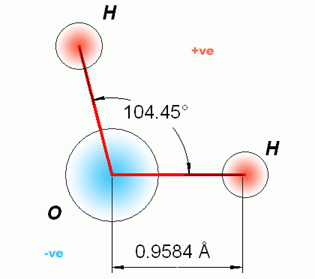
Comment: It seems that the basic problem in gaining acceptance for ionization technology is the facile description of what causes rain. And that is a problem inherited from the experts –’ the meteorologists and atmospheric scientists. The water molecule is fascinating because, unlike the nitrogen and oxygen molecules in the air, it is electrically polarized.
In an electric field, the water molecule will rotate to line up with the field. When it condenses in a cloud the average electric dipole moment of a water molecule in a raindrop is 40 percent greater than that of a single water vapor molecule. This enhancement results from the large polarization caused by the electric field induced by surrounding water molecules. In the atmospheric electric field the water molecules will be aligned with their dipoles pointing vertically and in a sense that is determined by the charge polarization in the cloud. It is interesting to note that the tops of storm clouds are positively charged and the base is negative. That is the reverse of the radial charge polarization within the Earth itself. And it is this charge polarization that gives rise to the low-order attractive force we call gravity. So it is proposed that water droplets in clouds experience an antigravity effect https://www.holoscience.com/wp/antigravity/. It appears to be related to the ‘Biefield-Brown Effect,’ where a charged high-voltage planar capacitor tends to move in the direction of the positive electrode. That effect may explain how millions of tons of water can be suspended kilometres above the ground, when cloud droplets are about 1,000 times denser than the surrounding air.

Of course, this raises the issue of charge separation in clouds. The conventional ‘isolated Earth’ view is that positive and negative charge is ‘somehow’ separated by vertical winds in clouds and that this process in thunderstorms is responsible for charging up the ionosphere and causing the atmospheric electric field. But this begs the question of cause and effect. Recent high-altitude balloon flights find that charge is not built up in the cloud, it already exists in the ionosphere above. In January 2002 I argued the ELECTRIC UNIVERSE® model:
  • “Thunderstorms are not electricity generators, they are passive elements in an interplanetary circuit, like a self-repairing leaky condenser. The energy stored in the cloud ‘condenser’ is released as lightning when it short-circuits. The short-circuits can occur either within the cloud or across the external resistive paths to Earth or the ionosphere. The charge across the cloud ‘condenser’ gives rise to violent vertical electrical winds within the cloud, not vice versa.”
    http://www.holoscience.com/news/balloon.html
This view accords with a recent report (17 November 2003) in Geophysical Review Letters by Joseph Dwyer of the Florida Institute of Technology, which says that according to conventional theory electrical fields in the atmosphere simply cannot grow large enough to trigger lightning. “The conventional view of how lightning is produced is wrong.” And so “the true origin of lightning remains a mystery.”

Water vapor in rising air cools and condenses to forms clouds. The conventional explanation for rising air relies upon solar heating. The electrical weather model has an additional galactic energy source (the same that powers the Sun) to drive the movement of air. It is the same energy source that drives ferocious high-level winds on the giant outer planets, where solar energy is extremely weak. Once the water vapor condenses into water droplets it is more plausible that millions of tons of water can remain suspended kilometres above the Earth by electrical means, rather than by thermal updraughts. The clouds would act to reduce thermals.

Returning to the article, can we explain how “the natural current between the Earth and the ionosphere is amplified” and how that might increase rainfall? It seems to follow naturally from the electric weather model because the ion generators are supplying mobile charge carriers into the dielectric or atmosphere, which increases the leakage current between the Earth and the ionosphere. The vertical leakage currents drive vertical motion of the air. In some instances these invisible currents are probably responsible for that unseen danger to aircraft — clear air turbulence. And we find the most severe vertical winds in thunderstorms, where electrical power is dramatically evident.
  • 'Earthwise’s installations are structures about 7 meters high, shaped like short open-topped air-traffic control towers, that house proprietary ion generators and blowers to lift the ions. Separate antennas amplify the ionization by manipulating the local electric and electromagnetic fields. ELAT’s installations work in the same manner but are more primitive in appearance, consisting of a 37-meter high central tower surrounded by 8-meter posts arranged hexagonally at a distance of 150 meters. The tower and posts are interconnected by wires, which when set to a high dc voltage by a 2-kilowatt generator, ionize air molecules such as nitrogen and oxygen. According to Bissiachi, as the ions waft upward, they produce about 1 milliampere of current. This current swamps the Earth’s natural current — about 1 picoampere — and can affect the weather up to 200 kilometers from the station, he says.

    Summing up all its tests from 2000 to 2002, ELAT and its U.S. and Canadian counterpart Ionogenics, in Marblehead, Mass., claim that ionization led to about double the average historical precipitation stimulating, among other things, a 61 percent increase in bean production in Mexico’s central basin in the last three years. Cloud seeding, in comparison, typically claims only a 10-15 percent improvement in rainfall.

    Despite the claimed successes, ionization has its critics. Atmospheric scientists contacted for this article noted that even the four years of testing was too brief a period to prove that the effects seen were not due to some sort of extraordinary variability in the local weather. Bissiachi claims that the criticism goes to a deeper prejudice. “Meteorologists are not used to thinking that electrical phenomena could be important to the normal hydrodynamic model,” he says.'
Weather modification technology has always had a hard time standing up to rigorous scientific scrutiny. Ross N. Hoffman, a vice president at Atmospheric and Environmental Research Inc. in Lexington, Mass., helped complete a scientific review of cloud seeding, which was released by the U.S. National Research Council, Washington, D.C., in November 2003. It found that even after more than 50 years of use, cloud seeding remained unproven from a scientific standpoint. “[Ionization] faces the same problems cloud seeding does,” he says. Among those are uncertainty about the natural variability of precipitation, the inability to accurately measure rainfall,and the need to randomize and replicate experiments. The last is particularly troublesome, since weather modification companies are typically hired to induce rain whenever they can. Randomly turning on or off the system to prove a point is not in the customer’s interest, Hoffman notes.

Ionization also suffers doubts about its basic plausibility. Brian A. Tinsley, a physicist at the University of Texas, Dallas, and an expert on the effects of ions and current in the atmosphere, points out that the ionosphere is about 250,000 volts positive compared with the ground. But the effect of the resulting current, and changes to it from cosmic rays and other phenomena, on droplet formation and precipitation is “relatively small” and restricted to certain types of clouds in specific locations, he says. Considering the size of the natural voltage and the modesty of its impact on rainfall, effective weather modification using ionization, he believes, would require enormous power input and hundreds of square kilometers of antenna arrays.

SAMUEL K. MOORE

Comment: If conventional theory fails to explain electrical storms it cannot be used to discount the results of ionization experiments. Instead, conventional theory suffers doubts about its basic plausibility. Weather experts have a limited view of the electrical nature of the Earth and its environment. The “enormous power input” is freely available from the galaxy. That galactic electrical power drives the weather systems on all of the planets and even the Sun. So the ionization experiment is rather like the control gate in a transistor, where a small current into the control gate influences the entire power output of the transistor. This method of weather control should eventually force the critics to think again.

Wal Thornhill

https://www.holoscience.com/wp/electric-weather/

The Wal Thornhill Electric Universe May Reader

Posted: Thu May 29, 2025 6:44 pm
by Brigit
Wal Thornhill says,
  • "In an electric field, the water molecule will rotate to line up with the field.

    When it condenses in a cloud the average electric dipole moment of a water molecule in a raindrop is 40 percent greater than that of a single water vapor molecule.

    This enhancement results from the large polarization caused by the electric field induced by surrounding water molecules.

    In the atmospheric electric field the water molecules will be aligned with their dipoles pointing vertically and in a sense that is determined by the charge polarization in the cloud. It is interesting to note that the tops of storm clouds are positively charged and the base is negative. That is the reverse of the radial charge polarization within the Earth itself. And it is this charge polarization that gives rise to the low-order attractive force we call gravity. So it is proposed that water droplets in clouds experience an antigravity effect."
bold added

In the electric dipole gravity model, earth is more positively charged in its interior, and more negatively charged in its exterior. The direction of the dipolar water droplets in a cloud align together, en masse. The negative poles of the dipolar water droplets all point downward. The negative charges within the water droplets in the cloud, and the overall negative charges on the surface of the earth, repel one another and the water droplets are suspended. Also, clouds are surrounded by enormous electric fields, which is the cumulative efield of all the Olympic-swimming-pools'-worth of water droplets suspended above.

Personal observation -- this is mildly interesting. We have a lot of clouds here in Washington. It rains a lot, but not all rain clouds rain. What makes the dark clouds hold their water and travel on, while some lighter clouds sprinkle for hours? (This is not gravitational.) I once saw a little bunch of songbirds in the front garden, and they suddenly all flew away. Moments later it started pouring rain. The way I interpreted this is that the birds were able to sense a discharge in the cloud above them; the small discharge (not lightning) depolarized the water droplets above, and it rained. Otherwise, the water droplets remain polarized and bound by their collective efields, and pass by.


Here is one of Gerald Pollack's presentations at an Electric Universe Conference where he talks about his experiments with water, and shares his discoveries about the properties of fourth-phase water.
  • Gerald Pollack: Weather and EZ Water -- An Intimate Role of Separated Charge | EU2017
    The Thunderbolts Project

    https://www.youtube.com/watch?v=KnwAUVNhU0s

    "Among atmospheric scientists, two central features of weather dynamics remain mechanistically uncertain: evaporation and cloud formation. Absent proper understanding, predicting weather patterns remains challenging. Even simple weather-related phenomena elude understanding. For example: (i) Why can clouds suspend themselves above the earth? From the weight of the constituent water droplets, the force of gravitation should pull clouds downward, but commonly it doesn’t. Clouds float. And (ii), why do dark clouds sometimes release their contents as rain, and other times not?

    His work on EZ water provides a basis for possible answers to those and related questions. The presentation will offer a fresh overview of possible mechanisms of weather. It will propose answers to these questions and offer insights into possible mechanisms of common, as well as exotic, weather phenomena such as hurricanes and tornadoes. Weather, after all, is a phenomenon centered on water — if EZ (fourth-phase) water exists, then it must play some role in those phenomena. The question we address is how, and Dr. Pollack postulates that charge plays a central role."

Re: The Wal Thornhill Electric Universe May Reader

Posted: Thu May 29, 2025 7:27 pm
by Brigit
The Wal Thornhill Electric Universe May Reader

1997 May
  • THOTH
    -A Catastrophics Newsletter-

    VOL I, No. 13
    May 16, 1997

    EDITOR: Michael Armstrong
    PUBLISHER: Walter Radtke

    CONTENTS:

    THE MYTH OF THE CENTRAL SUN (3)...........David Talbott
    NEWS ITEM: Aviation Week & Space Technology
    Comments
    ..............................Wal Thornhill
    EUROPA PREDICTION AND DISCUSSION..........Wal Thornhill
    BOOK ANNOUNCEMENT
    Controversy--Catastrophism and Evolution:
    The Ongoing Debate
    PLASMA SCIENCE AND TECHNOLOGY URL's.........Ian Tresman
    -----------------------------------------------
NEWS ITEM: Aviation Week & Space Technology
Wal Thornhill (walt at netinfo.com.au)

In the same issue of Aviation Week & Space Technology (Feb
3, 1997) that was referred to concerning Europa's terrain
(should that be Eurrain?), there is another item headlined -
"Twisters" Found In Stellar Clouds. Accompanying the
article are two stunning photographs from the Hubble Space
Telescope (HST) of the Lagoon Nebula.

[http://oposite.stsci.edu/pubinfo/PR/96/38.html].

Following is a partial quote from the report:
  • 'Analogous to Earth's tornadoes, the large difference in
    temperature between the hot surface and cold interior of the
    interstellar clouds, combined with the pressure of
    starlight, may produce strong horizontal shear to twist the
    clouds into their tornado-like appearance. While the spiral
    shapes suggest the clouds are twisting, future observations
    will be needed to confirm that.'
I would like you to note the exceedingly weak explanation
for the formation of the "twisters". It is yet another
manifestation of astronomers clinging to simple gas models
rather than more complex plasma models. It should also
be noted that earthly tornadoes are not well understood
either because, I would suggest, electrical effects are
ignored. Helical filaments are a natural configuration of
current carrying plasmas and are seen in the powerful jets
emanating from active galactic nuclei. I have no doubt that
the clouds in the Lagoon Nebula will be found to be twisting
(rather than being some pressure wave effect).

One of the telling arguments for the veracity of recent
planetary interactions is the recurring helical, serpentine
imagery associated in mythology with the planetary gods and
in particular, Jupiter's corkscrew thunderbolts.
-------------------------------------------

EUROPA PREDICTION AND DISCUSSION

[Wal Thornhill wrote]:

Back on 17 Jan, I posted an item about what I expected would
be found on the closer images of Europa.

The earlier post ran, in part, as follows:
  • Since so many of the moons of the outer planets have similar
    markings, I can visualize a situation where they may have
    repeatedly gotten in the way of a large discharge between
    the gas giant planets and other bodies, like Venus or Mars.
    The Saturnian scenario has not yet dealt with the minor
    players in the celestial drama, but the moons of Jupiter and
    Saturn must have been swarming around between them. If
    Europa, for instance, had come between Venus and Saturn (for
    argument's sake) while Venus was the focus of plasma streams
    from Saturn, then Europa would have been entwined (and I use
    that word deliberately) in the interplanetary plasma
    "ropes". As I have said of the markings on Venus, when the
    plasma ropes are constrained to flow parallel to the surface
    of a planet (or moon), the result is a number of parallel
    marks or scars often running for great distances. The
    precise appearance of the scarring depends on many factors:
    the dielectric properties of the surface material, gas pressure
    at the surface, etc.

    The argument is strengthened when it is remembered that even
    the tiny moons of Mars exhibit linear scarring and circular
    craters.

    Europa seems to have suffered many episodes of electrical
    scarring judging by the multiple layers of crisscrossing
    linear features. This would be expected if its orbit brought
    it repeatedly into the danger zone between Saturn and Venus.

    Electrical scarring seems to follow the law of fractals. So
    I would expect the new closer up shots of Europa to show
    similar scars down to the limit of resolution. That is,
    trenches consisting of circular craters, possibly being so
    close together as to appear continuous; levees on each side
    of the trenches; the parallel "racetracks" to be composed of
    many trenches, side by side.
    *****
[Response by James G. Acker]:

Wal,
Did you see the images released on April 9? The ones with
the "ice floes" that have broken into pieces, but where you
can still see the pattern continued on the broken pieces?

My question to you is--given the fact that the surface is
clearly active, does that in any way change your
interpretation of ANY of the features? I.e., can you grant
that maybe more than one type of process is at work on
Europa?

*****

[Response by Dave Talbott]:

Can't speak for Wal, but I spent about 45 minutes studying
the incredible recent close-up pictures of Europa. Clearly
there has been more recent activity on Europa than any
astronomer had imagined prior to the Voyager probes. There
are significant sections of the surface which have been
re-arranged by the movement of ice. These in particular
put a huge exclamation point the long, narrow channels,
whose formation COULDN'T be due to ice movement or any
geological process "deep within the planet," as the
planetary geologists had claimed.

Where melting has occurred and sheets of ice have been
randomly shifted about, you can a get a very dramatic
picture as to how irregular the spacing is between the
broken fragments under such conditions-literally nothing
like the thousands of narrow channels running side by side,
some up to hundreds of kilometers--which geologists had
tried to explain by fracturing and subtle movements of the
ice. And notice that in the fields of formerly melted ice,
after the various fragments had been frozen into place
again, additional channels were carved out, up, down, and
over the previous fragments. The consistent pattern of
these channels suggests an instrument being dragged along
the surface to plow out the long, parallel furrows. Try as
I may, I could not see anything in the character of the
channels to suggest internal geology. That recent chaotic
motions of planets and their moons might account for the
catastrophic melting and re-freezing would seem self-
evident.
*****

[Wal Thornhill]:

Jim,
Dave has effectively answered the question for me while I
was in Melbourne. The surface was recently active with both
electrical sculpting and melting. The evidence for an
episode of melting and re-freezing of the ice is graphically
depicted in photo P-48526. It must be water ice for the
creation of ice floes. Satellite photographs of Antarctic
sea ice breaking up do not show parallelism, constancy of
width, levee banks, the dark-light-dark appearance, or
anything to match the scale of the "cracks" on Europa.
Certainly nothing to match the appearance of "freeways".
The larger "cracks" range up to 70km in width and stretch as
far as 3,000 km in straight or curved paths across Europa's
surface. When seen in close-up, the "cracks" look like
furrows.
The best conventional explanation for this
appearance is some form of gas venting through the cracks
from below. But the material vented had to be "dirty" to
provide the colouration of the levees. It had to be
remarkably consistent over great distances. Then clean ice
had to fill the bottom of the "crack" to give the bright
centre line. (I would not expect to see any dark central
lines of dirty ice beneath the furrows when seen in cross
section where the ice floes have broken away. The photos are
not yet sufficiently detailed to test this suggestion).

The lightning discharge hypothesis is the only one to
explain all of the observed linear features from the
smallest to the largest scale.
The central line is bright
because that is where the lightning vapourized the ice to
blast it outwards and form the levees. We are looking at a
clean bed of ice at the bottom of the channel. The
colouration of the levees may come from shock heating and
rapid cooling of the ice and any resulting chemical changes
in dissolved or suspended material. (The same mechanism that
formed the green glass beads found near rilles on the Moon).
The larger furrows stand out as much more deeply coloured
than their surroundings. So it may be that the electric
discharges that created them were sufficiently intense
to cause nucleosynthesis in the form of the conversion of
oxygen atoms (from the water) to sulphur. Elemental sulphur
takes many colours ranging from yellow through red to black
(look at Io's surface) and could account for the reddish
colouration of the ejected material. Alternatively, and I
think less likely, the coloured material may be exogenous
and implanted by the discharge itself (as described by Ralph
Juergens).

Of course, when we finish discussing Europa, we have the
linear features on Ganymede and Callisto to explain--not to
mention the moons of Saturn, Neptune and Uranus.
*****

Wal Thornhill responded to further comments by James Acker:

[WT] The surface *was* recently active with both electrical
sculpting and melting. The evidence for an episode of
melting and re-freezing of the ice is graphically depicted
in photo P-48526. It must be water ice for the creation of
ice floes.

[JA] Well, that was expected. Good that we agree.

[WT] Satellite photographs of Antarctic sea ice breaking up
does not show parallelism, constancy of width, levee banks,
the dark-light-dark appearance, or anything to match the
scale of the "cracks" on Europa.

[JA] I don't think we can compare the sea ice of Antarctica
or the Arctic to Europa. The scale of heating is
dissimilar. Europa is postulated to have the same kind of
heat source as Io, though at a lesser intensity. Because
it's internal, it will have a different surface manifestation.
Believe it or not, "Aviation and Technology
Week" (or something similar) had an article on Europa. It
must be a weekly, because it was the same pictures I saw on
the Web. My office-mate gets it. The scientists are already
describing what they are seeing in the long ridge systems as
cracking, upwelling, and refreezing. I'm not surprised by
that. All I can say is that I think the lava lake analogy
is apt.

[WT] I used the Antarctic sea ice description because it's
the one often used as an analogue of the Europa markings and
in a book I saw in Melbourne, it had the photographs side by
side for comparison. There are close-ups of Europa which
show the same features and which I accept as fractured ice.
P47170 is an example with a circular pattern and wedge-
shaped cracks evident. I still think that the number of
special conditions required to satisfy the appearance, range
of sizes and sheer number of linear features argue against
the standard mechanism.

Certainly nothing to match the appearance of "freeways".
The larger "cracks" range up to 70km in width and stretch as
far as 3,000 km in straight or curved paths across Europa's
surface. When seen in close-up, the "cracks" look like
furrows. The best conventional explanation for this
appearance is some form of gas venting through the cracks
from below. But the material vented had to be "dirty" to
provide the coloration of the levees. It had to be
remarkably consistent over great distances. Then clean ice
had to fill the bottom of the "crack" to give the bright
centre line.

[JA] Looking very closely, I'm not sure of that. We may
be only seeing light and shadow. I say that based on the
appearance of the close-up and the cracks on the floes.

[WT] To get some idea of the coloration you need to look
at the global colour images where the contrast between the
reddish "cracks" and the white surface is quite marked.

[JA] Gotta delete the rest, sorry. I know you mentioned
Ganymede and Callisto. Ganymede is supposed to be ice and
rock, and Callisto doesn't have a lot of lines, just a lot
of craters. At least I think they're craters.
*****
[WT]
In the article "Strange Forces Alter Europa's Terrain" in
Aviation Week & Space Technology (Feb 3, 1997) and referred
to by Jim Acker, three forces are seen as shaping the moon's
surface. They are: lateral spreading of surface plates;
water vulcanism; and a mysterious local obliteration
process. I quote from the NASA description:
  • "This is the highest resolution picture ever taken of the
    Jupiter moon, Europa. The area shown is about 5.9 by 9.9
    miles (9.6 by 16 kilometers) and the smallest visible
    feature is about the size of a football field. In this
    view, the ice-rich surface has been broken into a complex
    pattern by cross-cutting ridges and grooves resulting from
    tectonic processes. Sinuous rille-like features and knobby
    terrain could result from surface modifications of unknown
    origins. Small craters of possible impact origin range in
    size from less than 330 feet (100 meters) to about 1300 feet
    (400 meters) across are visible."
Notice the use of the words "sinuous rille-like features".

The accompanying image:

[http://www.jpl.nasa.gov:80/galileo/europa/p48227.html]

shows detail down to a resolution of 230ft. It looks as if
the resurfacing has been caused by fracturing of the ice,
floating apart and re-freezing of the exposed water. The
re-frozen surface is more lightly scarred by furrows
(sinuous rilles?) which suggests that a short-lived thermal
and/or torsional event occurred during the scarring process.
The edges of the cracks are sharp. The distinction between
cracking and furrowing is easy to see and to term the
furrows evidence of water vulcanism is, in my opinion,
stretching the imagination past the elastic limit. The
furrows are no respecters of existing topography and the
levees are so consistent in appearance over long distances
that it begs explanation by the water vulcanologists as to
how this might be achieved by eruption of a fluid.

A rough calculation from the dimensions of one of the
furrows shows that the levees are formed solely from the
material excavated from the channel. It does not require
additional matter from beneath the crust nor does it
require subsidence of the fluid to leave the central
channel. This suits the electrical discharge formation
process, as does the uniformity over long distances and the
disregard for existing surface topography.
The arcuate
nature of the longest furrows on Europa may also be
consistent with the influence of the self-induced magnetic
field of a plasma discharge on the motion of the discharge.

Many of the moons of Jupiter and Saturn exhibit the same
kind of linear (often parallel) scarring, even though their
sizes and composition vary markedly. Some moons featuring
such scars are so small that to talk of volcanic features is
nonsense. As I remarked in an earlier posting on the
subject, I propose that many of the moons of the gas giants
were probably unfortunate enough to become secondary
electrodes in an interplanetary discharge between planets.
In such an event, since a moon is a better conductor than
surrounding space, plasma ropes will twine around the moon,
ripping charge carriers (electrons and ions) from the
surface and forming circular craters, rayed craters, and
furrows (or rilles) in the manner described by Ralph
Juergens for the Moon. The precise nature of the scarring
(rilles, circular craters, rays, etc.) will be determined
largely by the characteristics of each moon's surface, but
the hallmarks of electrical machining will be evident.


When it comes to the proposed plasma discharge experiment in
an evacuated chamber with magnetized spheres, it would be
worthwhile to include an extra sphere, representing a moon,
between the cathode and anode, with an electrical connection
so that its voltage may be varied. In this way it may be
possible to photograph the kind of effects to be expected on
an object like Europa.

Wal Thornhill
---------------------------------------------

bold added, Paulina W

Dr. Cj Ransom did zap an aluminum plated ball in an experiment, and he got long furrow-like dark lanes where the electric arc separated and travelled across the surface of the ball.

The Wal Thornhill Electric Universe May Reader

Posted: Thu May 29, 2025 8:01 pm
by Brigit
The Wal Thornhill Electric Universe May Reader

1997 May

THOTH
A Catastrophics Newsletter

VOL I, No. 14
May 21, 1997

EDITOR: Michael Armstrong
PUBLISHER: Walter Radtke

CONTENTS:

EDITORIAL SECTION...........................Michael Armstrong
THE MYTH OF THE CENTRAL SUN (4).............David Talbott
HYAKUTAKE X-RAYS....................................News Item
Submitted by Ian Tresman
MORE VENUS DIALOGUE.............................Wal Thornhill
New URL Section
-----------------------------------------------


HYAKUTAKE X-RAYS SHOW ABILITY TO MONITOR
COMETS AND SOLAR WIND

A supercomputer simulation of Comet Hyakutake's interaction
with the solar wind demonstrates that resulting X-ray emissions
can be used to monitor comets and solar wind phenomena, NASA-
funded researchers write in today's issue of "Science."

The simulation was conducted using an Earth sciences
supercomputer at the NASA Goddard Space Flight Center, Greenbelt,
MD. The results match and explain March 27, 1996, observations of
Comet Hyakutake by Germany's ROSAT satellite, the first detection of
X-ray emissions from any comet.
The model also supports a leading
theory for how the X-rays are generated.

"Cometary X-rays present a potentially powerful new tool to
monitor comet activity far from Earth, as well as the composition
and flux of the solar wind," said co-author Dr. Tamas Gombosi of the
University of Michigan, Ann Arbor. "By capturing these X-rays'
detailed energy spectrum, it might be possible to monitor the
propagation and evolution of spectacular solar wind phenomena, such
as the coronal mass ejections seen this January and April."

About one percent of the solar wind, which flows from the Sun
out past Pluto, is composed of minor ions: atoms (such as oxygen,
carbon and neon) that have been nearly stripped of their electrons
and thus have a high positive charge. Dr. Thomas Cravens of the
University of Kansas theorizes that these minor ions steal electrons
from neutral atoms and molecules of cometary origin. The electrons
are first seized in excited states, traveling in the ions' outer
orbitals. As the electrons fall to lower orbitals, Cravens' theory
asserts that X-rays are emitted, in addition to other forms of
radiation.

"Considering the magnitude and shape of the emission, we
believe the most satisfactory theory to be this mechanism of charge
exchange excitation," Gombosi said. "Other explanations produce
neither the crescent pattern nor the intensity observed by ROSAT and
duplicated by our simulation."


Within this pattern, some electron orbital transitions emit
distinct wavelengths of X-rays that can be measured. The computer
simulation shows that the overall X-ray spectrum for Comet Hyakutake
depends mainly on the solar wind composition, and not on the comet.
Because of this independence, researchers can determine the relative
size of the comet's atmosphere from the proximity of the brightest
X-rays to the icy nucleus.

"In Hyakutake, the brightest X-ray region was 18,700 miles
(30,000 kilometers) ahead of the comet, on the Sun side," said
University of Michigan co-author Dr. Michael Combi. "If the comet
has enough of an atmosphere, the solar wind minor ions recombine
with electrons far from the nucleus. If the comet were producing
less atmospheric gas, the place of maximum emission would be closer
to the nucleus," Combi said.

This theory will be tested on Comet Hale-Bopp, which is
scheduled to be observed by Japan's ASCA X-ray satellite this
September.
"Comet Hale-Bopp should have the emission shifted
further sunward; it is bigger than Hyakutake," Combi said.

Active comets are typically first observed in visible light
at large distances from the Sun. After discovery, the orbits
of comets can be established with very high accuracy as they
pass through the inner solar system. "If X-rays are observed
from the known location of a comet, one can conclude with great
confidence that the X-rays originated from the comet," Gombosi said.

The University of Michigan team used March 27, 1996, solar
wind density measurements from NASA's WIND spacecraft.
Their
model first considers the global interaction of the solar wind
with the comet. It projects the comet into a three-dimensional
grid that automatically applies finer resolution where more
activity occurs. This physics component predicts the
deflective paths and speed of the solar wind traveling through
the comet.

Other co-authors of the "Science" paper are Roman Haberli,
Darren De Zeeuw and Kenneth Powell. The University of Michigan
team is one of nine Grand Challenge Investigations funded by
the NASA High Performance Computing and Communication Program's
Earth and Space Sciences Project. Additional funding comes from
NASA's Office of Space Science, the National Science Foundation
and the Swiss National Science Foundation.

Simulation images are available on the World Wide Web at URL:

http://hpcc.engin.umich.edu/HPCC/recent3/index.html

Submitted by Ian Tresman
-----------------------------------------------


MORE VENUS DIALOGUE

[EDITOR'S NOTE: IN PREVIOUS POSTS WALLACE THORNHILL
HAS CONTENDED THAT THE PLANET VENUS SHOWS SUBSTANTIAL
EVIDENCE OF ELECTRICAL INTERACTION WITH ITS ENVIRONMENT,
A CONDITION SUGGESTING BOTH AN ELECTRICAL IMBALANCE
AND AN UNUSUAL, "COMET"-LIKE HISTORY.]

[Wal Thornhill, continuing his dialogue with Tim Thompson]:

The Venera spacecraft found continuous lightning activity from 32km down to about 2km altitude, with discharges as frequent as an amazing 25 per second. The highest recorded rate on Earth is 1.4/sec during a severe blizzard. The Pioneer lander recorded 1000 radio impulses.

Thirty-two minutes after landing, Venera 11 detected a very loud (82 decibel) noise which was believed to be thunder. Garry Hunt suggested at the time that:
  • '... the Venusians may well be glowing from the nearly continuous discharges of those frequent lightning strokes'.


A 'mysterious glow' was detected coming from the surface at a height of 16km by 2 Pioneer probes as they descended on the night hemisphere. The glow increased on descent and may have been caused by a form of St. Elmo's fire and/or chemical reactions in the atmosphere, close to the surface.

[Tim Thompson:]
>I cannot trace or verify Thornhill's remarks with regards >the Venera
>spacecraft. (PIB -- I assume Mr. Thornhill's original paper for the SIS
>included such references. Perhaps Mr. Thornhill or someone from the
>SIS can get a copy to Mr. Thompson for his perusal.) While the initial
>reports of lightning from Pioneer are easily available [1,2,3], those
>from Venera appear not to be [4,5], as they were published in obscure,
>or difficult to obtain sources. The Pioneer lightning detections were
>based on the observation of whistler mode waves (about 100 Hertz) when
>the orbiter neared periapse. The interpretation of those waves as
>lightning, supported by Scarf et al. [3], continues to be a matter of
>considerable controversy. There are a number of ionospheric processes
>that will produce such waves, and the Pioneer data lack sufficient
>spectral resolution to unambiguously tell the difference between lightning
>and these other possible sources.

[WT] My first obscure reference was NASA News 79-12 (4.19.79) p 1., as
follows:
  • "The Russian Venera spacecraft found continuous lightning activity from
    32km down to about 2km altitude, with discharges as frequent as an amazing
    25 per second. The Pioneer Orbiter also observed this lightning, measuring
    such discharges during every pass across the planet's night hemisphere. The
    eye would not be able to separate such frequent flashes and an observer on
    Venus might see the landscape and dense atmosphere bathed in a continuous
    eerie electrical glow, accompanied by continuous peals of thunder.

    Pioneer experimenters, Dr. Boris Ragent, Ames Research Center, and Dr.
    Jacques Blamont, University of Paris, now believe that the 'mysterious
    glow' measured by their instruments is real light on Venus, and not
    something happening on the spacecraft. The glow started at about ten miles
    altitude, and increased as the two night-side probes approached the
    surface.

    'Chemical fires' due to reactions of various compounds in the super-heated
    atmosphere close to, or on, Venus' surface have been cited as a possible
    source for the glow. Pioneer measurements suggest a 'chemical stew' near
    the surface whose reactions could fuel such fires.

    Lightning discharges also are a possible source of this glows except that
    the increasing intensity observed going down would be unlikely for
    lightning, as would be the very steady character of the glow."
More detail was given on pp.5-6, under the heading "Continuous Lightning
Confirmed":
  • "The Soviet Union's Venera spacecraft, which entered Venus' atmosphere in
    late December, detected 13 minutes of electromagnetic signals similar to
    terrestrial lightning storms. The signals began at above 32 km and ended at
    about 2 km. At times, the Soviet spacecraft detected as many as 25 strokes
    of lightning per second--an essentially constant bombardment of Venus'
    atmosphere. Thirty-two minutes after landing, Venera 11 acoustic equipment
    detected a very loud (82 db) noise which is believed to have been thunder.

    The first U.S. detection of lightning came on December 30, 1978, when the
    Pioneer Venus inditer instruments picked up intense and highly impulsive
    electric field signals characteristic of terrestrial lightning detected
    during the first day that the Orbiter's point of closest approach occurred
    on the night side of Venus, the signals were picked up near that closest
    point.

    Scientists said the lightning signals, which are well below the ionopause,
    are detectable either because they are coming through "holes" in the
    ionosphere, or because they are "whistler" signals which are able to pass
    through the ionosphere. Whistler radio waves on Earth are generated by
    lightning or by high energy electrons."
The second reference was, G. E. Hunt: A Pioneer's view of Venus, Nature 278
(1979), p.778:
  • "One of the most startling observations was made as the spacecraft
    descended toward the surface, where in the altitude range of 6-14 km,
    Iightning storms were encountered. At least 1.000 impulses of radio noise
    mere measured. Lightning on Venus is not unreasonable, since the
    atmosphere is electrically active. By way of comparison, there are
    typically 100 lightning strokes every second scattered all over the Earth.
    But on Venus there may be several times that number in a localized area.
    Instead of being illuminated for a brief instant by a dazzling flash of
    lightning, as on Earth, the Venusians may well be glowing from the nearly
    continuous discharges of those frequent lightning strokes."
The third reference was by R. A. Kerr: "Lightning found on Venus at last?",
Science 253 (1991), p. 1492, under the sub-heading: "Galileo's fortuitous
pass by Venus has yielded the best evidence yet that somehow Earth's
neighbor generates lightning".

This reference brings us forward by more than a decade and shows the change
in tone and some of the controversy that had arisen since the first
confident announcements. This is one good reason for looking at the
earliest discovery announcements, while free-wheeling ideas are often
expressed and before 'scientific correctness' steps in. You will note the
use of the word "somehow" above as a description of the mechanism for
lightning generation on Venus. This is central to the debate and is
symptomatic, as I said in my original post, of the ignorance of what causes
lightning (despite TT's confident assertion to the contrary).
But I will
come back to that later.

I have included most of the reference because it sets the scene in a highly
readable fashion:
  • "Earth's atmosphere crackles with lightning. Jupiter has it too, sporting
    bolts 100 times more powerful than terrestrial ones. There are signs of
    strong electric discharges in the atmospheres of Saturn, Uranus, and
    Neptune. But making a case that lightning flickers through the dense
    atmosphere of Venus has been difficult. Now new electric field observations
    from the Galileo spacecraft's swift flyby of Venus have provided strong
    evidence that--however it does it--Earth's sister planet can also electrify
    itself.

    The news from Galileo challenges some conventional wisdom. Theorists have
    long doubted that Venus' quiescent atmosphere could generate the strong
    electric fields needed for lightning, and past evidence for lightning on
    Venus has drawn strong challenges. In the absence of new missions dedicated
    to the study of Venus, the prospects for resolving the debate did not seem
    bright.

    That all changed when NASA replotted the trajectory of the Jupiter probe
    Galileo after the Challenger disaster. A Venus encounter hadn't been in the
    cards, but new safety considerations forced a cutback in the power of the
    rocket booster that would propel Galileo away from Earth after its release
    from the space shuttle's cargo bay. Unable to head directly for Jupiter,
    the craft was sent on a complex course that included one swing by Venus and
    two Earth flybys to give it a trio of gravity-assisted boosts. The
    serendipitous encounter with Venus gave space physicist Donald Gurnett of
    the University of Iowa and his team the opportunity to use the craft's
    plasma wave instrument - designed to study the electric field signals
    generated by plasmas moving in Jupiter's intense magnetic field - to listen
    for radio discharges from Venusian lightning.

    Listening for enlightenment wasn't a brand new idea. The Soviet Venera
    landers of the 1970s and the Pioneer Venus Orbiter, which reached Venus in
    1979, may have detected flashes, though the meaning of the data has been in
    dispute for a decade. But Gurnett and his colleagues expected that
    Galileo's instrument would be able to detect lightning signals with much
    more confidence than the earlier probes. And their expectations were
    rewarded on 9-10 February of last year, when Galileo swept by the night
    side of Venus and recorded six abrupt noise bursts that looked just like
    lightning signals.

    How convincing is the claim? Compared to Pioneer Venus, Galileo could
    record signals at much higher frequencies, up to 5.6 megahertz, which makes
    them easier to distinguish from plasma-generated signals and the usual
    types of spacecraft interference. "I would say our confidence is reasonably
    high," says Gurnett of his findings, which appear in Science this week (p.
    1522).

    And there are indications that the results are already impressing some of
    the doubters, if not immediately winning them over. Paul Cloutier of Rice
    University, a leading critic of the Pioneer Venus data, agrees that the
    Galileo results have strengthened the lightning advocates' case. "Gurnett's
    is perhaps the only credible result in the last few years that might be a
    detection of Venus lightning," he says. Lightning proponents such as space
    physicist Christopher Russell of the University of California, Los Angeles,
    go further. "I was confident before" that Pioneer Venus had detected
    lightning, says Russell, "but I'm pleased by the independent confirmation."
    Still, the data leave wide open the question of how Venus manages to
    produce its electricity. The atmosphere itself seems an unlikely candidate.
    "It's hard for people to imagine how the atmosphere of Venus would create
    lightning," says planetary scientist Larry W. Esposito of the University of
    Colorado. Venus, he points out, seems to lack the lightning-generation
    system so familiar in terrestrial thunderheads: strong updrafts of
    condensing vapor, which provide the particles that can carry opposite
    electrical charges and the vertical motions needed to separate them. (The
    sudden combination of the separated charges is a stroke of lightning. ) On
    Venus, the clouds tend to resemble fog banks, says Esposito. "You don't see
    much lightning in fog," he notes.

    Maybe the Venusian fog generates electric fields by some still-unimagined
    mechanism. Or maybe, researchers speculate, the lightning is born not from
    atmospheric processes but from geologic ones. On Earth, particles rubbing
    against each other inside turbulent plumes of volcanic ash sometimes
    generate lightning, and the same thing might happen on Venus."
Wal Thornhill (walt at netinfo.com.au)
-----------------------------------------------

bold added, P

Re: The Wal Thornhill Electric Universe May Reader

Posted: Thu May 29, 2025 8:38 pm
by Brigit
The Wal Thornhill Electric Universe May Reader

1998 May

THOTH
-A Catastrophics Newsletter-

VOL II, No. 8
May 15, 1998

EDITOR: Amy Acheson
PUBLISHER: Michael Armstrong
LIST MANAGER: Brian Stewart

CONTENTS
QUOTE OF THE DAY
APPLIED CATASTROPHICS. . . . . . . . . . . . . .Amy Acheson
A BRIEF ORIENTATION. . . . . . . . . . . . . . Dave Talbott
COMMENTARY ON THE ELECTRIC SUN . . . . . . . .Wal Thornhill
ELECTRICAL EFFECTS OF PASSING BODIES . . . . .Wal Thornhill
----------------------------------------------

QUOTE OF THE DAY:

Planetary catastrophes have had a far greater impact on the evolution of the
solar system, the history of our earth, and the evolution of human
consciousness than science has acknowledged.
Dave Talbott (THOTH II-4, February 28)
----------------------------------------------


COMMENTS ON ELECTRIC STARS
By Wal Thornhill

The possibility is that the sun is isothermal, or even that the standard
model does apply somewhere deep inside. The problem for the theorists is
that, if the photosphere is an anode phenomenon, the boundary conditions
defined by the photospheric temperature and apparent radius of the sun is no
longer applicable as it used in the standard solar model. So, yes, I am
suggesting that the sun is a different size than that suggested by the
photosphere. Therefore we don't know the true volume of the sun, nor the
surface temperature as required by the perfect gas theory.

As for the calculations about the density of the sun - which is
proportional to its mass - which in turn is determined by the measured
gravitational attraction of the sun for the Earth, I believe we have a
problem there too. As I mentioned in a more recent post, "our physics is
lacking in some crucial areas." To put it bluntly, I do not believe that
Einstein's view of gravity as curved space is correct or even helpful. There
is an alternative classical model which shows great promise and
relates the inertial and gravitational mass to induced electrostatic dipoles
in nucleons. That means that the gravitational "constant', G, is neither
constant nor universal. If that is so, we do not know the mass of the sun
either
!

Since we don't know the mass or volume of the sun, we cannot determine its
density. It is clear then that we can say little about the solar interior
conditions. And since the interpretation of helioseismology data is
constrained to a large extent by the standard solar model, any conclusions
from that source must be viewed with caution.

It also seems to me that there is a lack in the perfect gas theory used in
the standard solar model which may have profound consequences if the
"neo-classical" theory of gravity is correct in principle. That is, the
Maxwell-Boltzmann distribution law does not deal with electrostatic
polarization of atoms/molecules due to gravity. Such electrostatic
polarization occurs in a strong gravitational field because the nucleus of
each atom will be displaced within the atom, slightly toward the centre of
the sun***. Such radial atomic polarization would create an increasing
electrostatic field as you move out from the centre of the sun. That field
will be responded to by nucleons (according to the new theory of gravity) to
give a much greater effective gravitational field than would be produced by
the same matter if it were at the Earth's surface (for instance).
As if the
indeterminacy of mass and volume of the sun were not enough, such a
polarization effect would render invalid calculations of density versus
distance from the sun's centre, based on the perfect gas laws.

It has also occurred to me that the radial electrostatic polarization of the
sun may be responsible for focusing or initiating the cosmic discharge in
the first place. Once begun, the energy density of incoming cosmic rays at
the Earth's orbit, which equals the radiant energy output from the sun,
shows that little input is required from nuclear reactions at the sun to
explain the sun's radiant output. I have used the analogy of a power
transformer, where the cross-country power lines carry electrical power at a
lethal voltage but the transformer converts it to a lower, more useful
household voltage. Likewise, stellar transformers convert the lethal power
of galactic cosmic rays to a more benign level of radiation conducive to
life.

Naturally, at this early stage, many of the ideas expressed are
speculative.
But I am convinced that the sun exhibits all of the complex
phenomena associated with a plasma discharge.
Based on the standard solar
theory, Fred Hoyle wrote in Frontiers of Astronomy, 1955, p.106: "We should
expect on the basis of a straightforward calculation that the Sun would
'end' itself in a simple and rather prosaic way; that with increasing height
above the photosphere the density of the solar material would
decrease quite rapidly, until it became pretty well negligible only two or
three thousand kilometers up." The standard solar model has nothing but
adhocery to offer by way of explanation for the complex phenomena observed
on and above the photosphere. So despite the clever mathematical virtuosity
displayed, I suggest the standard model simply doesn't apply to our sun or
any other star. The field is wide open for new ideas!

Wal Thornhill

More responses to later questions on the same subject:

What I tried to emphasize is that the Einstein model of gravity is wrong. In
its place I favor a neo-classical physics approach which relates inertial
and gravitational mass to nuclear electrostatic dipoles and the transmission
of the electrostatic force at near infinite speed. In this model, the
Newtonian gravitational constant, G, is neither constant nor universal. It
depends to a great extent on the electric charge on the star
or planet. That is the reason why G is the most ill-determined "constant" in
physics.

By assuming that G is the same for the Earth and the sun, conventional
theory arrives at a mass of the sun which is fictional. Sure, gravity
operates on and above the sun in the way we expect from present theory, so
quantitatively the force works exactly according to Hoyle. But internally
(below the photosphere) the gravitational field will deviate from our
expectations of the standard solar model since we do not know the radial
distribution of charge or the radially cumulative effects of gravitational
electrostatic polarization of atoms and nuclei.

Intuitively I would expect that the contribution to the gravitational field
of the sun from the nuclei of atoms within the sun would rise much more
rapidly in the outer layers than expected in the standard model, where all
atoms of a particular element have the same mass regardless of where we find
them. (Remember, the stronger the electrostatic polarization, the
higher the apparent mass of an atom in the electrical model. It is precisely
the same effect we see in particle accelerators). The result would be a
quite different density profile from the standard model, with a much lower
density at the centre of the sun.

If you are curious about the electrostatic dipole model of gravity, I urge
you to write to the Classical Physics Institute, 492 Rockefeller Plaza, New
York City, New York 10185. There is much more depth, complexity and detail
in the theory than I am willing or able to repeat on this forum. For those
who need quantitative arguments - it's there. Some of the ideas expressed
above may not wholly conform to the ideas of others in this new and exciting
field. I am happy to be corrected.

Wal Thornhill
----------------------------------------------

ELECTRICAL EFFECTS OF PASSING BODIES
By Wal Thornhill

>Clark Whelton asks:
>
>Velikovsky had to explain his claim that the Earth slowed and >stopped, or
that the axis tipped, by attributing these >effects to standard
gravitational interaction with passing >bodies. In an electrical universe,
couldn't spin rate and >orientation of the axis be affected by electrical
interaction >with passing bodies, possibly even a comet?

Yes Clark, but the important thing in all of this, and something which
Velikovsky in his usual intuitive way presaged, is that gravity itself is
linked to electrostatics. It is not some innate quality associated with
matter, unrelated to its electrical structure.
With hindsight this seems so
bleeding obvious you wonder at the lack of common sense of "experts" - but
that is the nature of paradigm shifts.

The importance of this "discovery" cannot be overstated since at one stroke
it overcomes the objection that electric forces can play no part in
celestial dynamics because of the shielding quality of space plasma for
electrical forces. Plasma does not act as a shield for gravity, so if you
can change gravity by changing the electrostatic charge on a body the
effects can be felt by other bodies in the solar system. Of course, the most
dramatic changes in planetary charge occur when interplanetary discharges
take place.


A comet could have the effects you mention if it carried sufficient charge.

Of course, all of this has profound implications for the doomsayers amongst
the NEO researchers. . . . It is safe to
assume that asteroids carry considerable electrical charge. As evidence, the
presumed magnetic field detected during the Galileo spacecraft's flyby of
asteroid Gaspra. It surprised investigators, not least because it seemed to
be as strong as the Earth's.
That interpretation was based on calculations
of the presumed effect of an inert obstacle the size of Gaspra on the solar
wind. The fact that the solar wind disturbance was much larger than expected
is more easily explained as the extent of a Langmuir sheath (plasmasphere)
which shields a charged object from the surrounding plasma. It is
unnecessary to infer a magnetosphere.


As I wrote some time early last year concerning Tunguska and the great
Chicago fires, if such a body approached within the Earth's plasmasphere,
electrical effects would begin to be noticed up to a day before "impact".
Once it got close enough it would likely be destroyed by the Earth's own
defense system - a cosmic discharge. I
can guarantee that the "impact" would
look nothing like all of the simplistic artists' renditions which don't even
show so much as a spark of lightning.

~Wal Thornhill
----------------------------------------------

bold added, Paulina W
***It may be helpful to note: In the Electric Universe model, it is a powerful electric z-pinch that compresses the material of an interstellar molecular cloud into a star. The original dipolar gravitational field is set up at that moment. Wal Thornhill consistently likened planets, stars, and asteroids to electrets. Electrets are manufactured when a selected material is "struck" in a powerful electric field, and so an electret can maintain a permanent electric field.

Re: The Wal Thornhill Electric Universe May Reader

Posted: Thu May 29, 2025 9:07 pm
by Brigit
The Wal Thornhill Electric Universe May Reader

1998 May

THARSIS THOLUS
By Wal Thornhill

It is possible to point to some features on Earth which look like the
surface features on other bodies in the solar system. That was
superficially true of the collapsed lava tube and sinuous rilles on the
Moon. But the fact that confusion was rife for many decades about
whether craters on the Moon were of volcanic or impact origin is an
indication that we should be careful about attributing mechanisms based
on incomplete knowledge of our own planet and its geological history.


Professor V R Baker writes in The Channels of Mars, p.14:
  • "The new frontier of geomorphology lies in the comparative study of
    planetary surfaces. The comparison of planetary surfaces is mainly
    accomplished with orbital images or photographs. The interpreter of the
    landforms on those images relies on analogic reasoning to reconstruct
    the complex interaction of processes responsible for the observed
    features. Mutch (1979) has summarized the difficulties of this approach:
    (1) The method often assumes a unique correlation between the observed
    landforms and the responsible processes. Actually geomorphologists
    recognize that some landforms may be generated by different combinations
    of processes converging on the same result. This problem of
    "equifinality" is a continuing limitation on geomorphic analysis. (2)
    Photointerpreters are artificially constrained in their analyses by
    their range of familiarity with natural landscapes. For this reason the
    proposed analogs must be exhaustively pressed for their limitations as
    explanations for the phenomena under study.

    Mutch (1979) observed that the origins of landforms on other planets are
    established not so much by the individual study of analogs as by a
    consensus among the active investigators. After the photographs and
    images have been studied for many years, one explanation remains that
    explains the majority of terrain features and is not incompatible with
    the remaining ones. The decade that has elapsed since Mariner 9 has
    allowed consensus explanations to emerge for Mars, and these will be
    discussed in this chapter. However, controversial issues remain."
[Mutch, T A, Planetary
Surfaces: Rev. Geophys. & Space Phys., v. 17, no. 7, pp. 1694-1722].

So, the origin of the features on Mars basically relies on a show of
hands based on experience with features on Earth. However, Baker goes on
to say:
  • "...many Martian craters have a unique morphology, different from that
    observed elsewhere in the solar system. The ejecta surrounding the
    crater is layered, and each layer has an outer edge terminating in a low
    ridge or escarpment. The surfaces of well-preserved ejecta blankets
    typically display radial striae, ramparts, and concentric features."
Even the notorious "face" on Mars exhibits some of these features.

As I have shown in The Electric Universe, these features are all easily
explained by the electric arc model.
And that is the point of departure
between my interpretation and that of geologists. Geologists are
restricted in their models to tectonic, volcanic or impact forces. I
have one more model in my repertoire which actually embodies some of the
features of both volcanoes and impacts (in the form of anode melting at
the top of an electric arc 'blister', and the explosive qualities of an
arc). But there are additional features which provide the electric arc
signature. My model has the virtue of being reproducible in the
laboratory and it was there that I discovered the tendency for the arc
to impinge like a corkscrew - giving rise in some craters to corkscrew
terracing or incomplete formation of a circular crater. In my opinion,
Tharsis Tholus on Mars shows classic signs of such an effect.


Of course, the accusation is levelled by [skeptics] that I have not
provided mathematical proof that electric arcs of sufficient power could
create scars the size of Olympus Mons and Valles Marineris. And even if
they could, you cannot scale up electrical scarring effects from lab to
planet.

There are many answers to that. To begin with, it was no less than
Hannes Alfven, the pioneer plasma physicist, who pointed out the
enormous scalability of plasma effects and exhorted theorists to get
back in the lab to find out how things really work in space.
(I plan to
do that again as soon as possible). Also, if you read any recent
research on arcs in plasmas you will find statements such as: "While no
single, complete theory covers all aspects of arc formation....", [from the
latest issue of the Vacuum Society of Australia, Summer 1998]. And if
you read technical works on arc welding you find it is more an art than
a science. Once again, the phenomenology of plasma arc scarring must be
undertaken in the lab, not sitting in front of a computer fiddling with
some unrealistic model. Then we have the evidence amassed by the
Saturnists for prehistoric interplanetary discharges which reportedly
took on the plasmoid shape, only recently rediscovered in plasma labs.
Not only that, but a marked change in appearance of Mars ensued from one
such strike.

Back to Baker again:
  • "Concepts as basic as uniformitarianism must be
    seriously questioned. ...The relatively recent discovery of alien
    landscapes poses many disturbing questions for a science grown
    complacent with the study of the familiar."
Tharsis Tholus is classified as a Martian volcano, 150 kilometres across
and 8 kilometres high. It is also dubbed a geological puzzle because it
requires explosive and effusive eruption followed by collapse and
faulting in an attempt to explain its weird features. Not only that but
the faulting has to be almost vertical in every instance. Such a
succession of ad-hoc requirements stretches credibility beyond any
reasonable limit. I believe Tharsis Tholus was not formed by geological
forces. It is not volcanic. Tharsis Tholus is an example of an
electrical
fulgamite scar, topped by a typical spiral or corkscrew crater, as we
saw on the Moon. (Note that such a crater (King) on the Moon is given as
a textbook example of an impact! This is testimony to the confusion
between
astronomers and geologists as to which craters are caused by volcanism
and which by impact. The simple answer to the conundrum may be given by
the electrical model - neither of the conventional explanations is
correct in many cases).

A fulgamite (lightning arrestor scar) has a characteristic raised mound.
The 5 kilometre high gullies in the left side of the crater of Tharsis
Tholus have the same scalloped form as those carved by a colossal arc
from the walls of Valles Marineris. The complex mound has been machined
by 3 or more consecutive discharges during its formation, giving rise to
sharp differences in levels on its flanks and different radii of
excavation depending on the current density of each stroke of the arc.
You will note the beautiful arcuate walls at the bottom of the picture
which are characteristic of arc machining. Interestingly, earthly
lightning conductors often show 3 successive strokes in the one flash.
The first stroke lifts and creates the mound, the later ones machine or
distort the peak.
The main corkscrew machining seems to have begun at
the top right of the picture and proceeded in a counter-clockwise
motion,
producing the sloped terraces inside the crater.

The acid test will be when we get to the Moon and Mars and find no
central vent in the so-called volcanic mounds.

Wal Thornhill
----------------------------------------------