Plasma Physics and Galaxy Formation

Plasma and electricity in space. Failure of gravity-only cosmology. Exposing the myths of dark matter, dark energy, black holes, neutron stars, and other mathematical constructs. The electric model of stars. Predictions and confirmations of the electric comet.
galaxy12
Posts: 170
Joined: Sat Nov 18, 2023 2:22 pm

Plasma Physics and Galaxy Formation

Unread post by galaxy12 » Tue Jun 25, 2024 2:13 am

Basic Plasma Physics:

Plasma typically consists of neutral particles, positively charged atoms (ions) and negatively electrons. Negatively charged atoms (ions) are observed more rarely.

The forces between charged particles forms the basics of plasma physics.

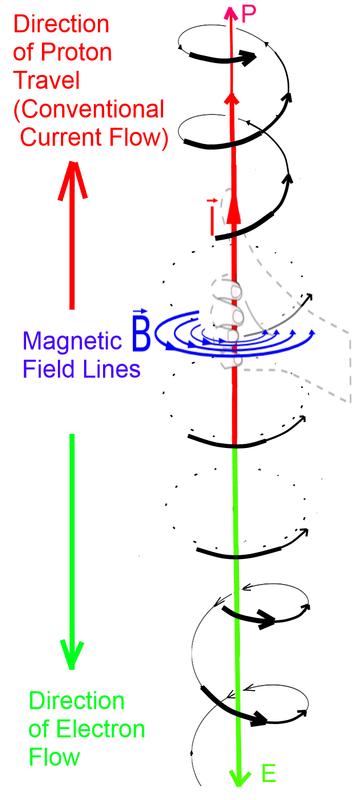
When a charged particle (positive ion or negative electron) moves, it creates a circular magnetic field within a plane perpendicular to its direction of movement and an electrostatic field parallel to its direction of movement. Often the first step in analyzing a moving charged particle is to draw the magnetic field lines using the "right hand rule."
To perform the right hand rule, point your thumb in the direction of travel of a positively charged proton or other ion, curl your fingers in a circular direction around the proton particle. Your fingers should point in the direction of the magnetic field lines around the proton from north to south. For electronics, you would point your thumb in the direction of conventional current flow (opposite to electron flow) and curl your fingers around the wire/conductor. Your fingers would again point in the direction of the magnetic field lines from north to south magnetic poles. For a negatively charged electron or other particle, you would need to point your thumb in the OPPOSITE direction to its movement to find the direction of magnetic field lines.
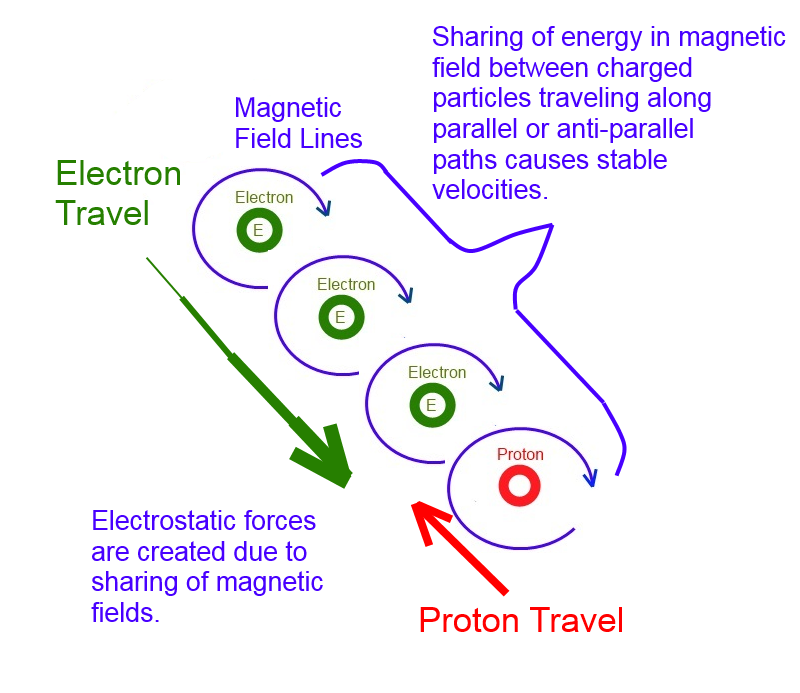
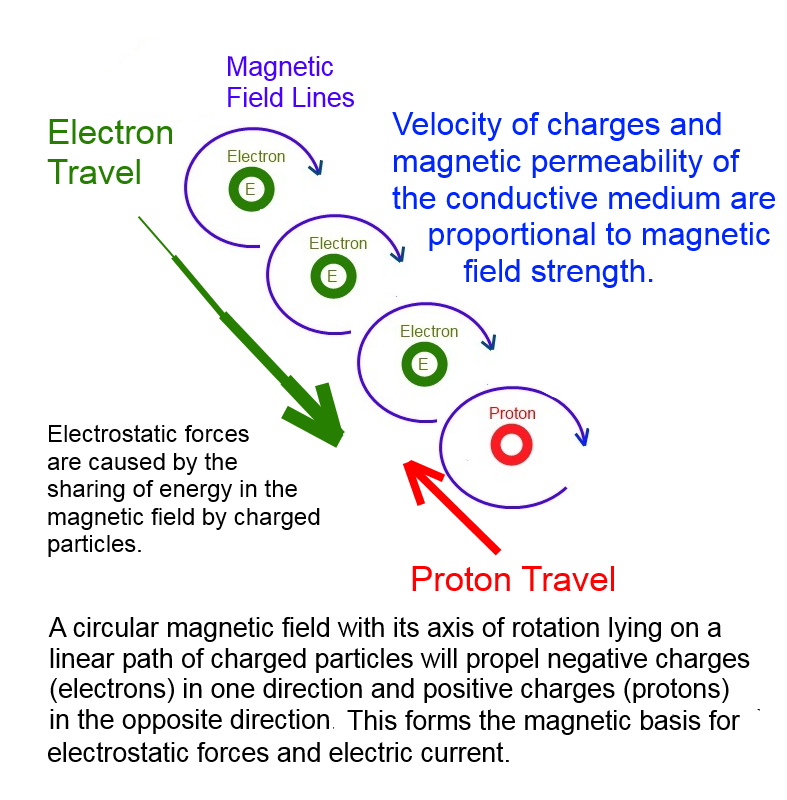
As can be seen by the right hand rule, the flow of charged particles will therefore create a circular magnetic field around the particles. Conversely, a circular magnetic field around a particle will create movement of the charged particle. The force created by the magnetic field around a group of charged particles traveling in parallel or anti-parallel is called an electrostatic force.
Image

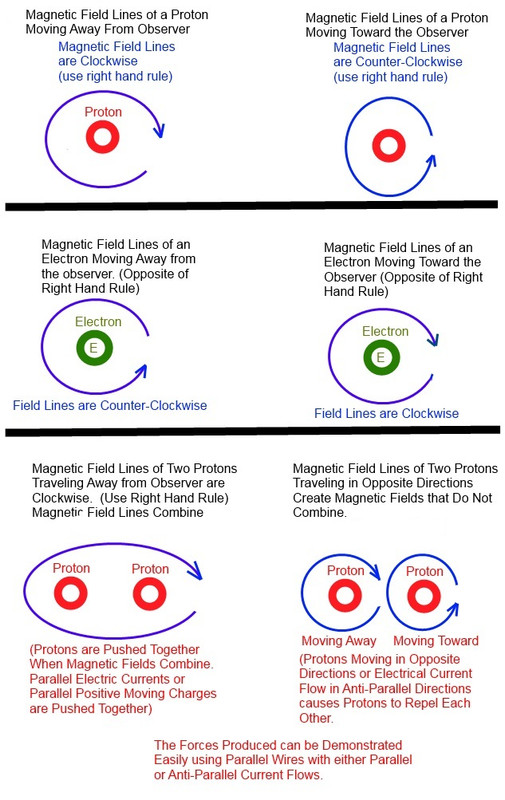
Using the right hand rule, it can be easily discerned that a positively charged particle (proton) will produce magnetic field lines that would appear circular and clockwise when the proton travels away from an observer. An electron would produce a magnetic field that would appear circular and counter-clockwise when the electron travels away from an observer.
Image

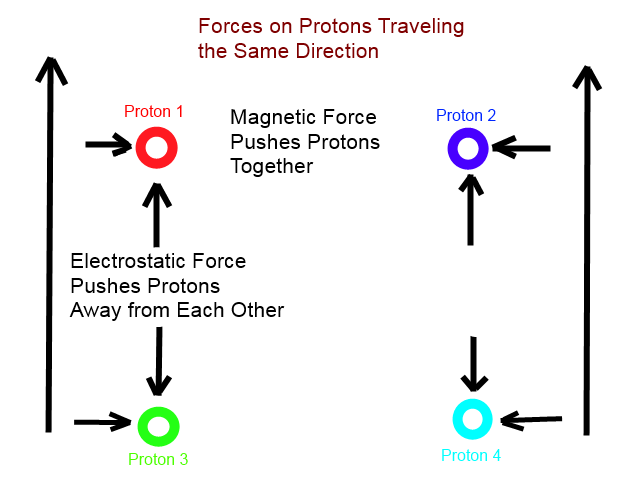
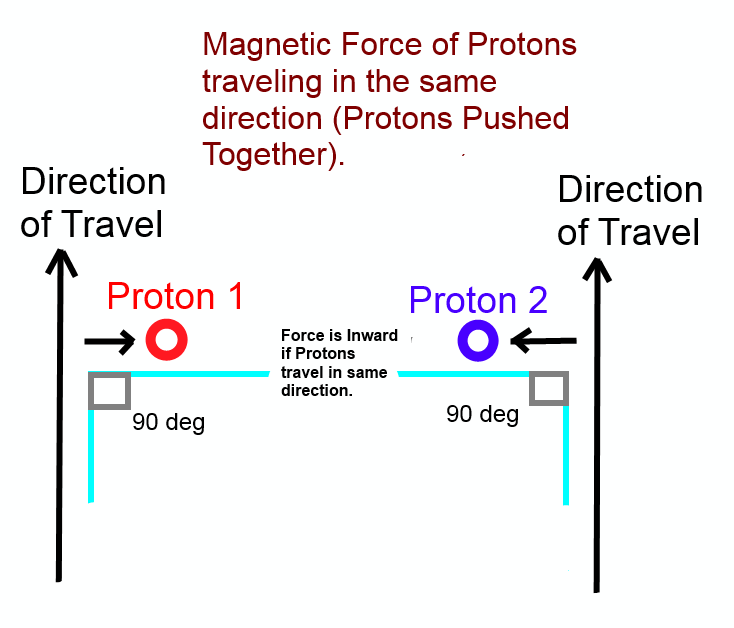
If particles of the same charge move in a parallel direction but are oriented perpendicular to each other, their magnetic field lines would be pointing in the same direction (both clockwise or both counter-clockwise) and would combine, causing an attractive force between them. Conversely, if the magnetic field lines are pointing in opposite directions, the forces would be repulsive between them.
Image

Electrostatic fields and electrostatic forces are created by the sharing of the the energy in magnetic fields when particles are traveling along the same linear paths in a parallel or anti-parallel direction. This "sharing" of magnetic field energy causes the particles to resist a change in current flow (inductance). Although both magnetic forces and electrostatic forces are derived from the energy in the magnetic field, they behave differently and always labeled as different forces and fields.

Image

The energy in a magnetic field is proportional to charge and velocity of the moving particles. The faster a charged particle moves and the higher its charge, the greater magnetic field strength. The momentum of higher mass particles (protons, positive ions) will better maintain their velocity and thus magnetic field strength compared to lower mass particles (electrons). Higher mass (usually positively charged) particles therefore play a much greater role in maintaining current flow. In a wire, the positive charged atoms are bound to the wire, so the movement and velocity of the electrons would be proportional to the magnetic field strength. In plasma in space, both electrons and protons are free to move and typically move in opposite directions along magnetically confined filaments when they share similarly oriented magnetic fields.
Image

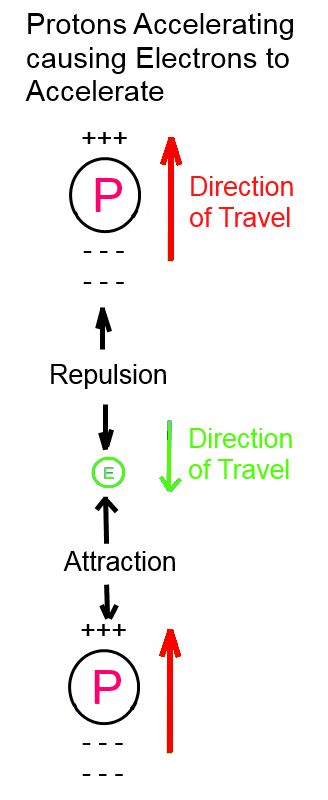
When a proton or positively charged particle accelerates, it will induce an acceleration of an electron in the opposite direction.
Image

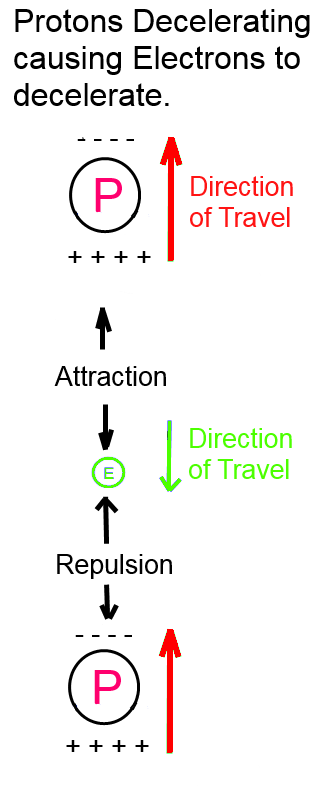
Conversely, if a positively charged atom or proton decelerates, it will cause the oppositely charged
electrons to decelerate.
Image

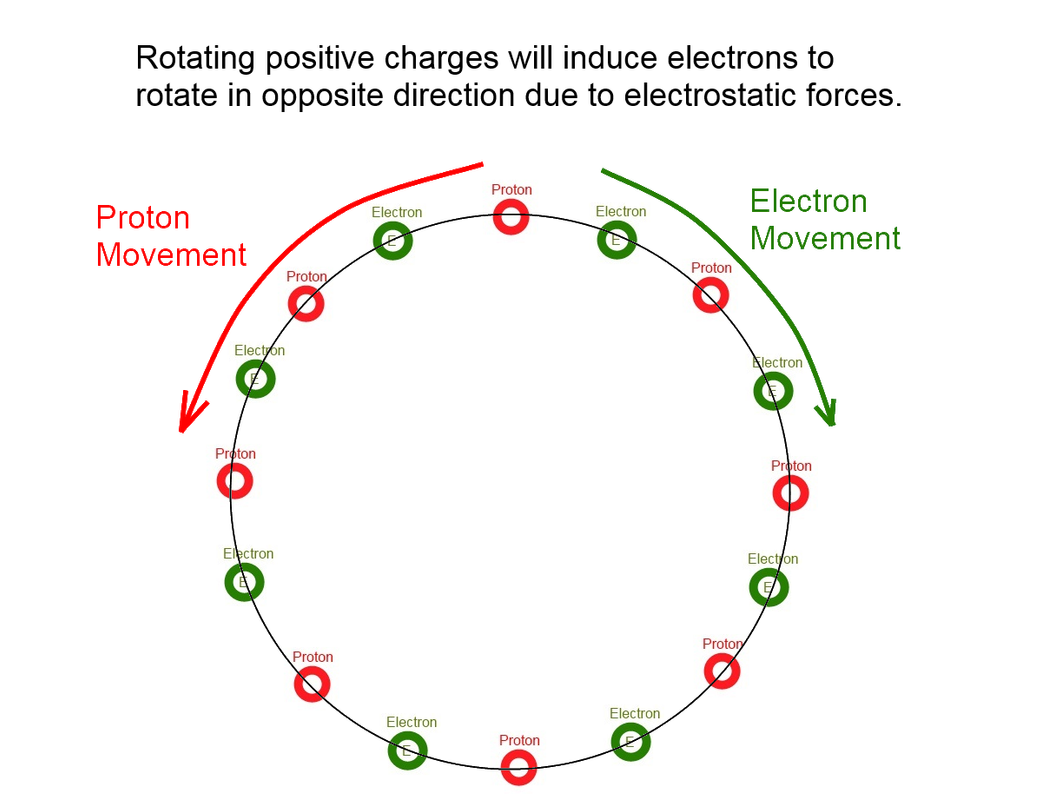
In a positively charged rotating structure, the positively charged ions rotate in one direction and electrostatic forces will cause electrons to rotate in the opposite direction.
Image

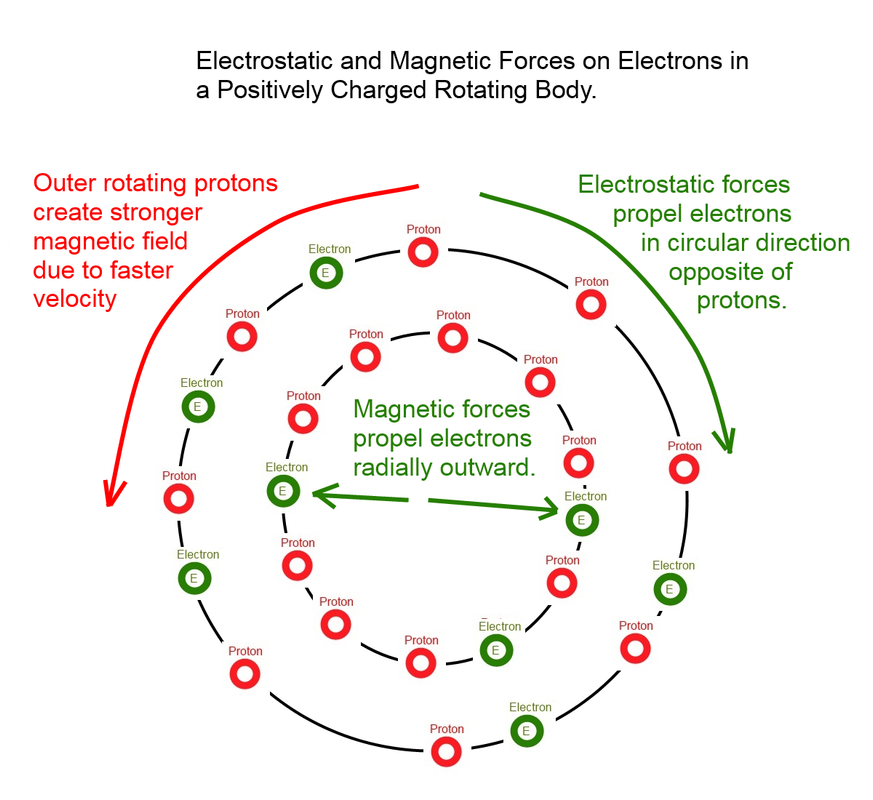
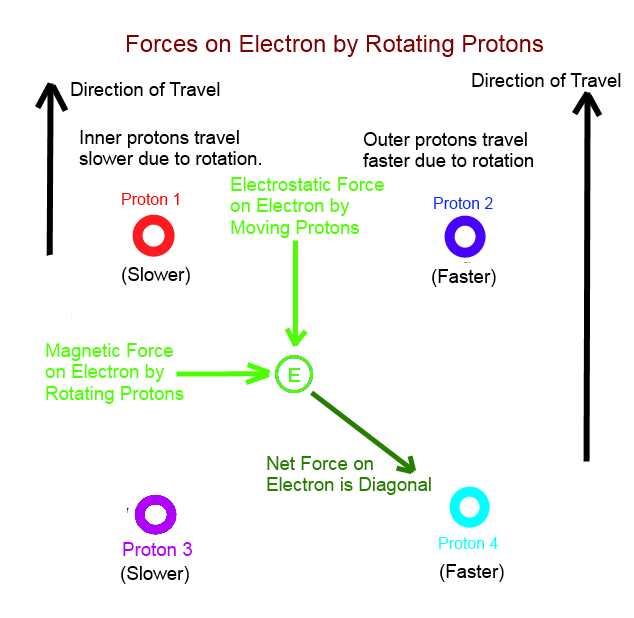
In a rotating cloud of gas or dust, magnetic forces hold the structure together and cause it to rotate more closely to a solid structure. The particles in the outer layers will have a higher velocity than particles in the inner layers. The higher velocity of particles in the outer layers creates a greater magnetic field there, causing electrons to be pulled to the outer layers. While electrostatic forces in a positively charged rotating body propel electrons in a circular direction, magnetic forces propel electrons radially outward.
Image

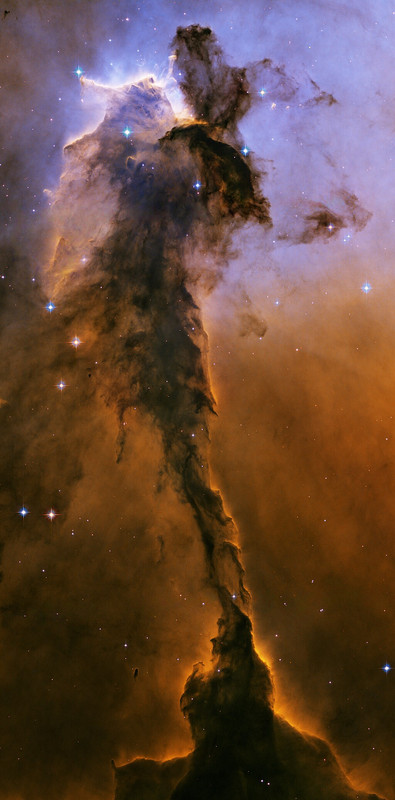
Gas or dust in space will slowly coalesce due to gravity to form large clouds or nebula. There
will always be some rotational momentum imparted as fast-moving atoms race toward each other due mostly to gravitational attraction. Under gravitational attraction, vibration of gas particles will keep them separated at distances proportional to their temperature with cooler particles closer together.
Image

The electric current generated by the rotating and positively charged cloud of gas and dust will cause magnetic fields that compress the gas/dust into a long cylinder shape. Rotation velocities and rotational axes of the gas/dust along the cylinder will not be uniform, causing momentum, magnetic and electrostatic forces that break the cylinder into rotating segments that are shaped like discs or pancakes. The central rotational axis of each disc-like structure will be positively charged and attract electrons.
Image

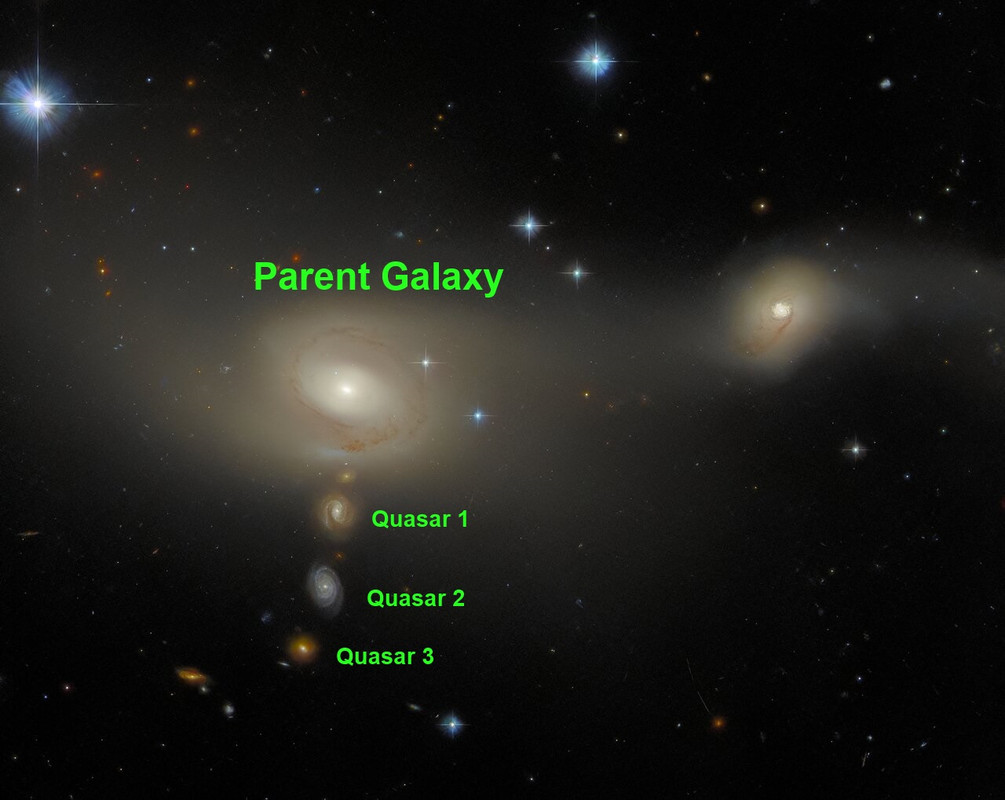
When several disc-like structures form along a massive cloud of gas and dust, the larger structure often evolves into the "parent" galaxy and the smaller structures are typically called "quasars." The parent galaxy will have a strong positively charged central core, pulling in electrons and emitting positively charged ions.
Image

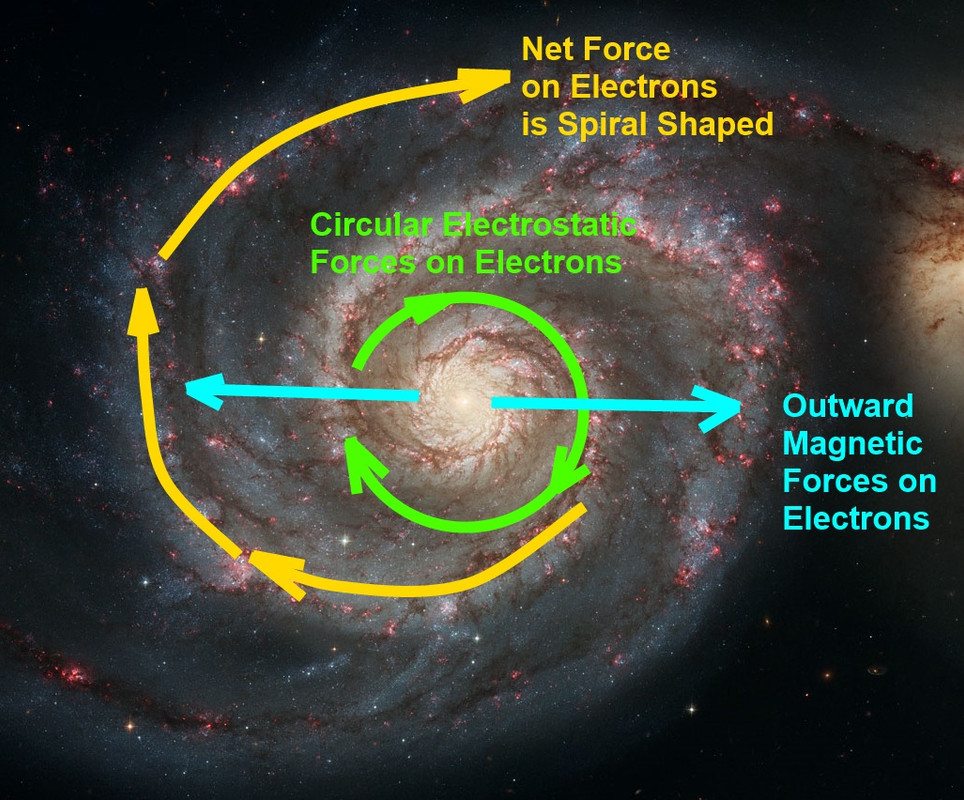
As explained earlier, electrostatic forces on electrons in a rotating body cause them to be propelled in a circular direction, opposite of the movement of the positively charged particles. The magnetic forces push the electrons radially outward. The resultant direction of the combined magnetic and electrostatic forces is diagonal outward.
Image

The diagonally directed outward movement of electrons creates a magnetic field that organizes material into spiral shaped arms.
Image

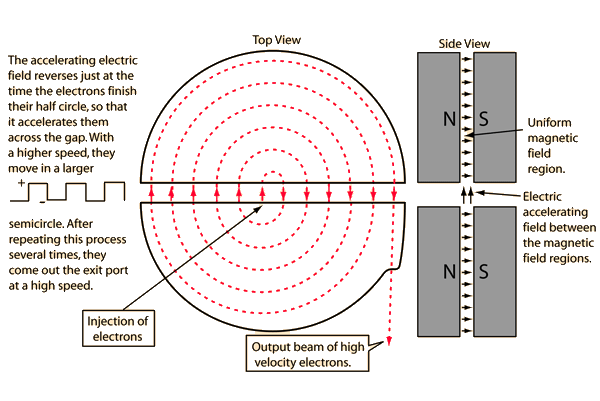
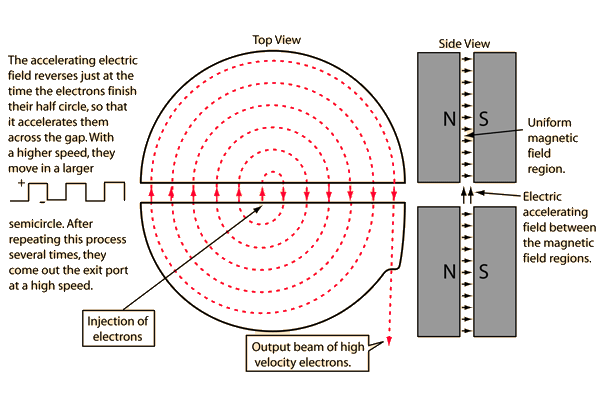
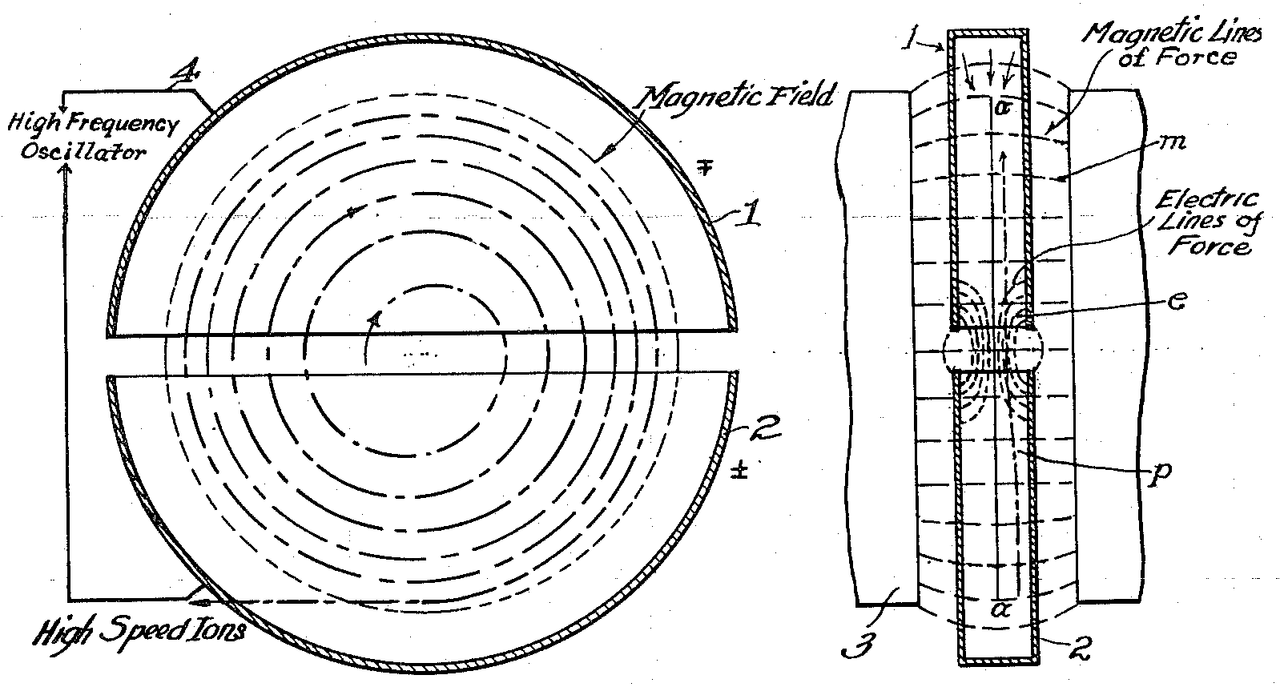
A similar phenomenon of electron acceleration can be seen in a cyclotron where the electrons flow in a spiral pattern outward from the rotational axis and are ejected at the outward edge.
Image

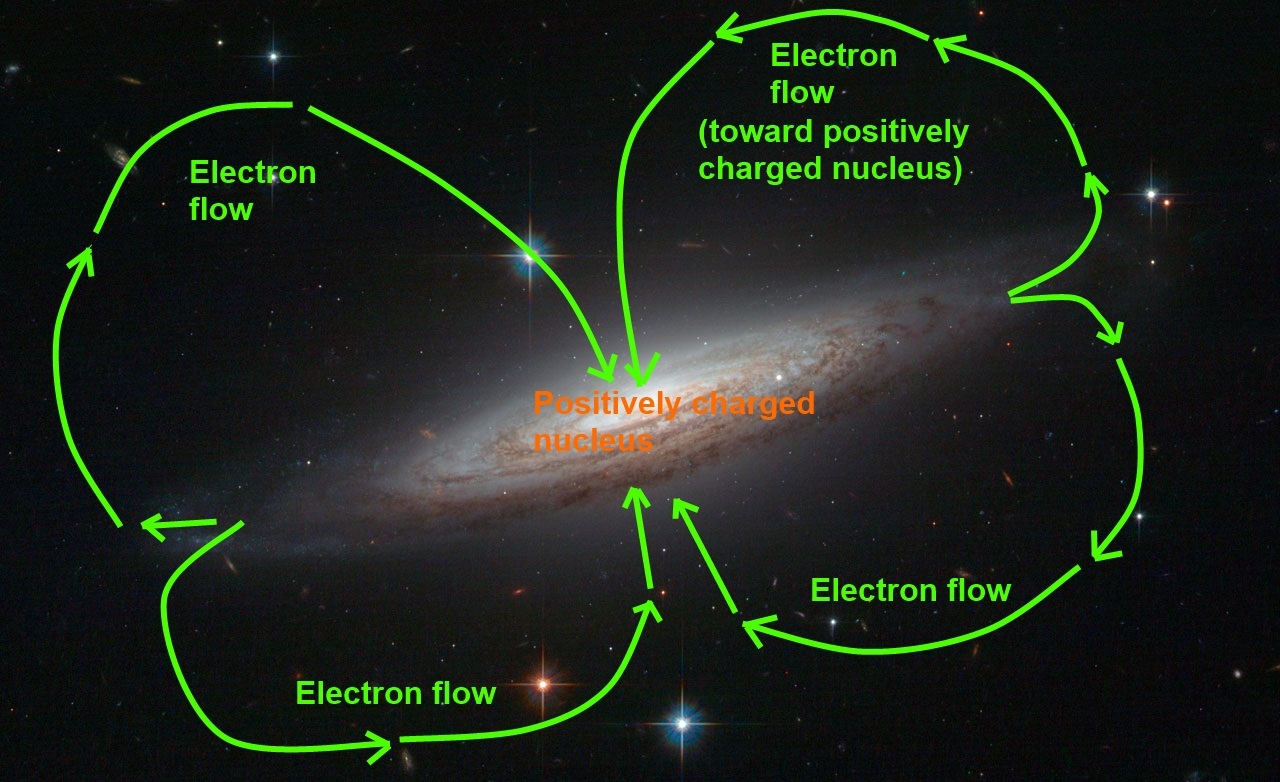
The electrons that are ejected from the spiral arms of a galaxy may continue traveling into space or take a looping path back toward the positively charged central core of the galaxy.
Image

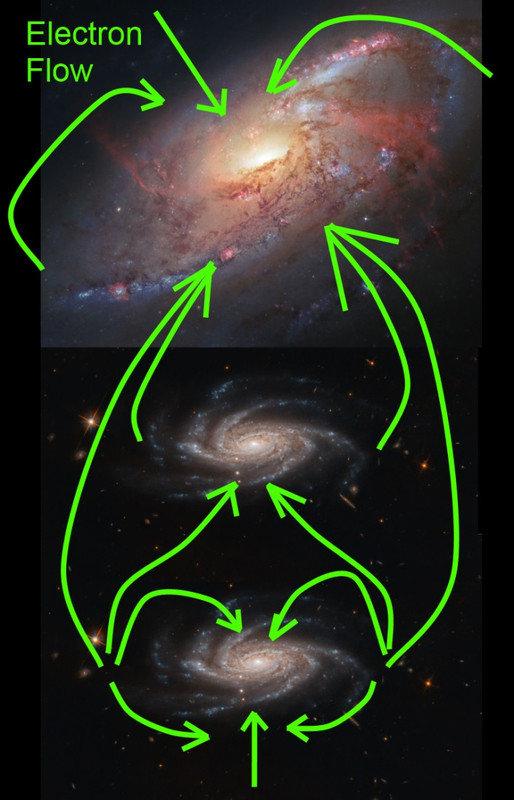
Parent galaxies with quasars can have a more complicated electron current flow since the larger parent galaxy's positively charged rotational axis will attract electrons from the quasars.
Image

BeAChooser
Posts: 1318
Joined: Thu Oct 15, 2015 2:24 am

Re: Plasma Physics and Galaxy Formation

Unread post by BeAChooser » Tue Jun 25, 2024 3:13 am

Why do talk about "gas" and "dust" generating electric current and being effected by magnetic fields?

For example ...

"In a rotating cloud of gas or dust, magnetic forces hold the structure together and cause it to rotate more closely to a solid structure."

"The electric current generated by the rotating and positively charged cloud of gas and dust will cause magnetic fields that compress the gas/dust into a long cylinder shape."

"Rotation velocities and rotational axes of the gas/dust along the cylinder will not be uniform, causing momentum, magnetic and electrostatic forces that break the cylinder into rotating segments that are shaped like discs or pancakes. The central rotational axis of each disc-like structure will be positively charged and attract electrons. "

galaxy12
Posts: 170
Joined: Sat Nov 18, 2023 2:22 pm

Re: Plasma Physics and Galaxy Formation

Unread post by galaxy12 » Tue Jun 25, 2024 3:59 am

Beachooser commented "Why do talk about "gas" and "dust" generating electric current and being effected by magnetic fields?"

That is a valid criticism. I should refer to the ionized gas and dust as plasma to be more accurate. Much of the ionized "gas and dust" are compressed electromagnetically into stars which are also plasma. Most of the universe is plasma for that matter.

galaxy12
Posts: 170
Joined: Sat Nov 18, 2023 2:22 pm

Re: Plasma Physics and Galaxy Formation

Unread post by galaxy12 » Tue Jun 25, 2024 3:04 pm

Correction: The third image should be replaced with the following one:

The text was correct:

If particles of the same charge move in a parallel direction but are oriented perpendicular to each other, their magnetic field lines would be pointing in the same direction (both clockwise or both counter-clockwise) and would combine, causing an attractive force between them. Conversely, if the magnetic field lines are pointing in opposite directions, the forces would be repulsive between them.

Image

galaxy12
Posts: 170
Joined: Sat Nov 18, 2023 2:22 pm

Re: Plasma Physics and Galaxy Formation

Unread post by galaxy12 » Wed Jun 26, 2024 4:17 pm

This is another image of a "cyclotron" that accelerates electrons spirally outward from the center of rotation.

Image

The website image is located at:

http://hyperphysics.phy-astr.gsu.edu/hb ... /cyclo.gif

From Wikipedia:

"A cyclotron is a type of particle accelerator invented by Ernest Lawrence in 1929–1930 at the University of California, Berkeley,[1][2] and patented in 1932."

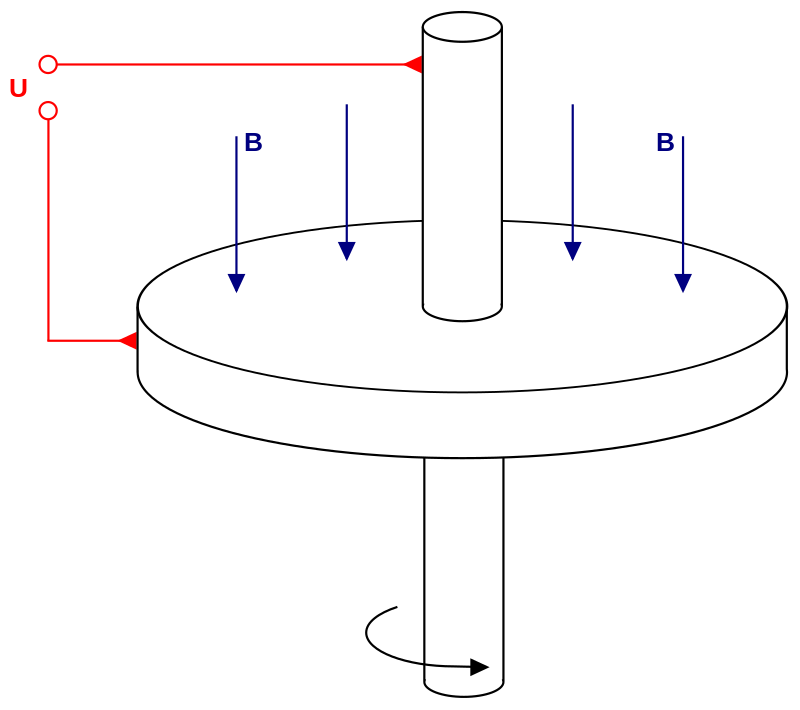
The theoretical basis for a cyclotron is based on a "Faraday Disc" or "homopolar generator" developed by Michael Faraday during his experiments in 1831.

Image

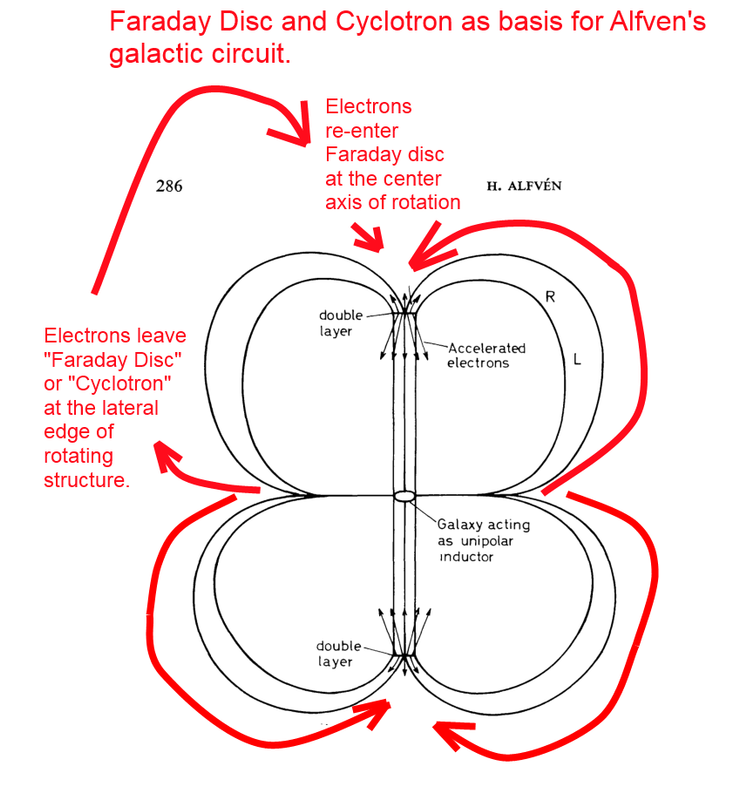
Hannas Alfven's "unipolar inductor" concept for a galaxy current flow seems to be based on the theories of the cyclotron by Ernest Lawrence' and the homopolar generator aka Faraday disc by Michael Faraday. Since space is a very good conductor of electricity, Alfven's concept did show that the electrons that exit the rotating edge of the "faraday disc" or "cyclotron" can travel through space and re-enter the disc at the center of rotation.

Image

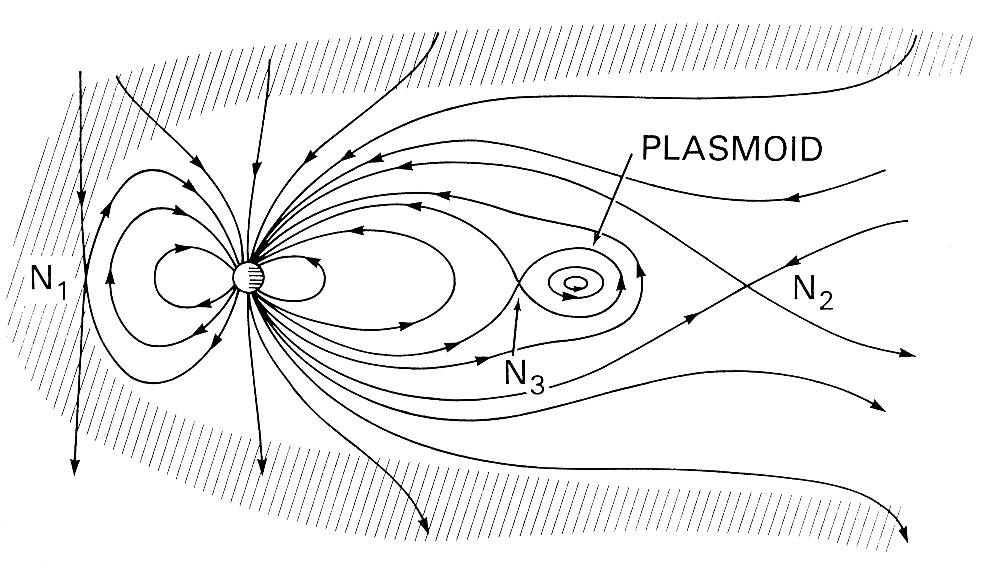
According to Wwikipedia, a plasmoid is a coherent structure of plasma and magnetic fields. Based on this very vague definition of a plasmoid, I suppose a galaxy or other rotating celestial object could be considered a type of plasmoid also.

Image

galaxy12
Posts: 170
Joined: Sat Nov 18, 2023 2:22 pm

Re: Plasma Physics and Galaxy Formation

Unread post by galaxy12 » Wed Jun 26, 2024 6:59 pm

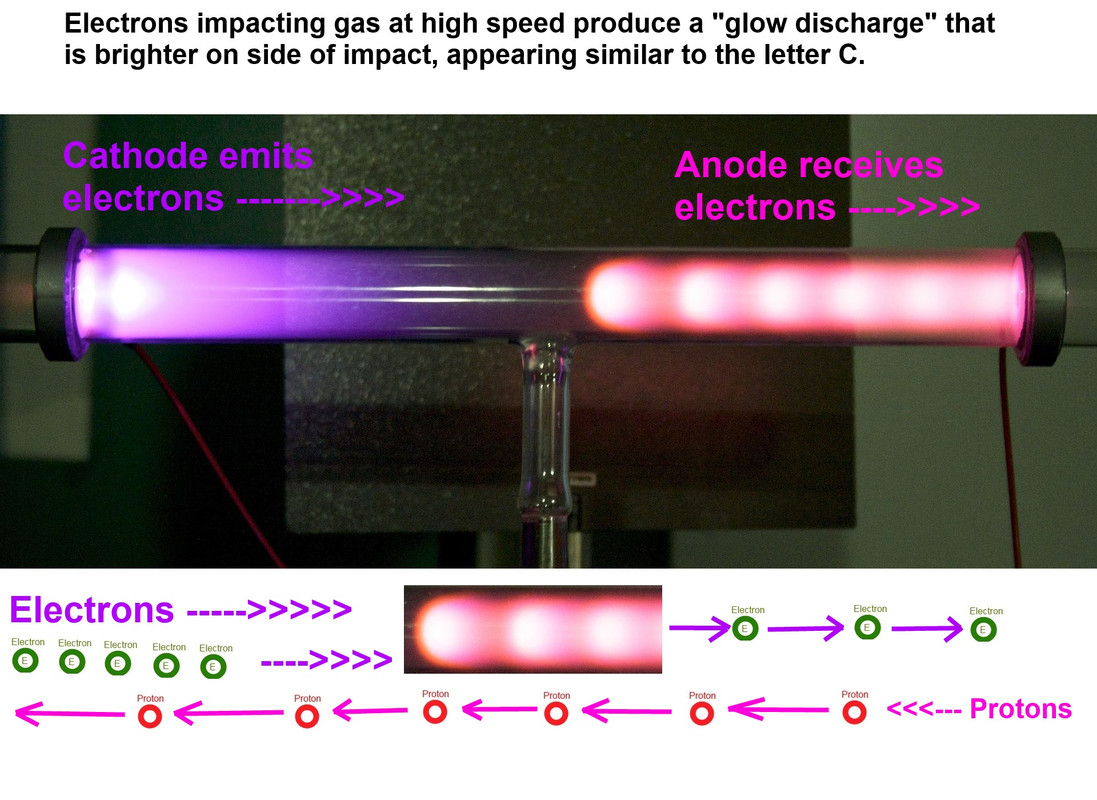
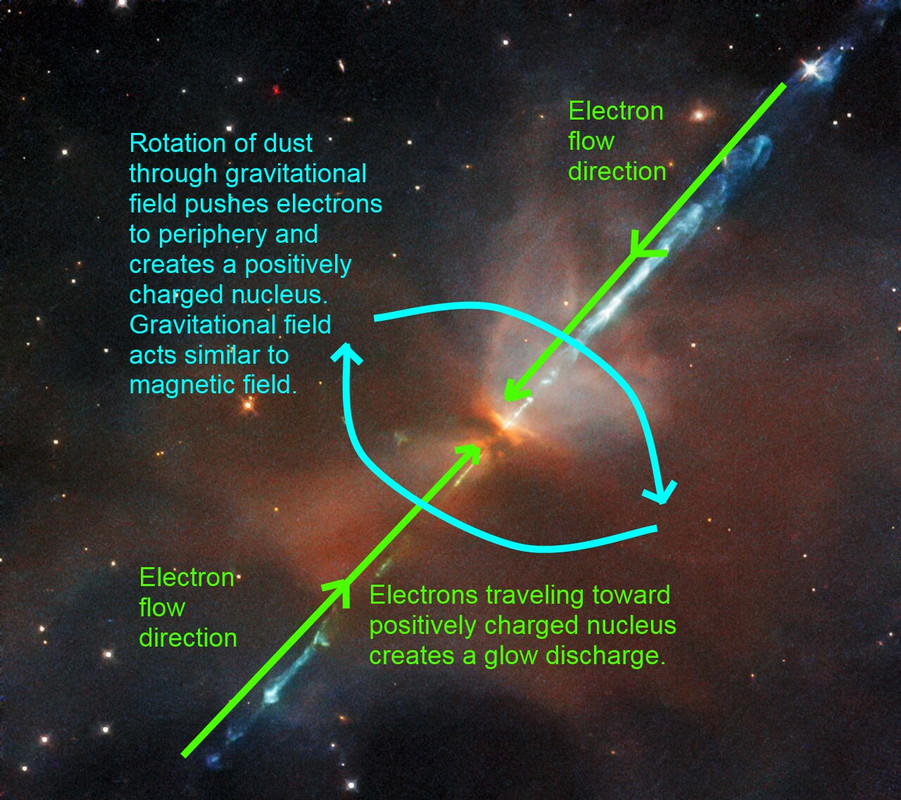
When electrons travel through space at high velocities and impact gas or dust, a "glow discharge" will be produced. The region of space that emits electrons can be considered a "cathode" and the region that receives the electrons is the "anode." This is similar to an old-fashioned television set or "cathode ray tube" where the "cathode" emits the electrons toward phosphorescent coated glass producing a "glow discharge." In space, it is usually easy to determine the direction of electron flow using telescope images because the side of the object or gas cloud impacted will be brighter. The electron impacts will often create a light emission that appears similar to the letter "C" with the orientation of the "C" showing the direction of electron flow. A normally oriented letter "C" suggests electrons are flowing left to right while a reverse letter "C" suggests electrons are flowing right to left. Positive ions will flow in the opposite direction of the electrons.

Image

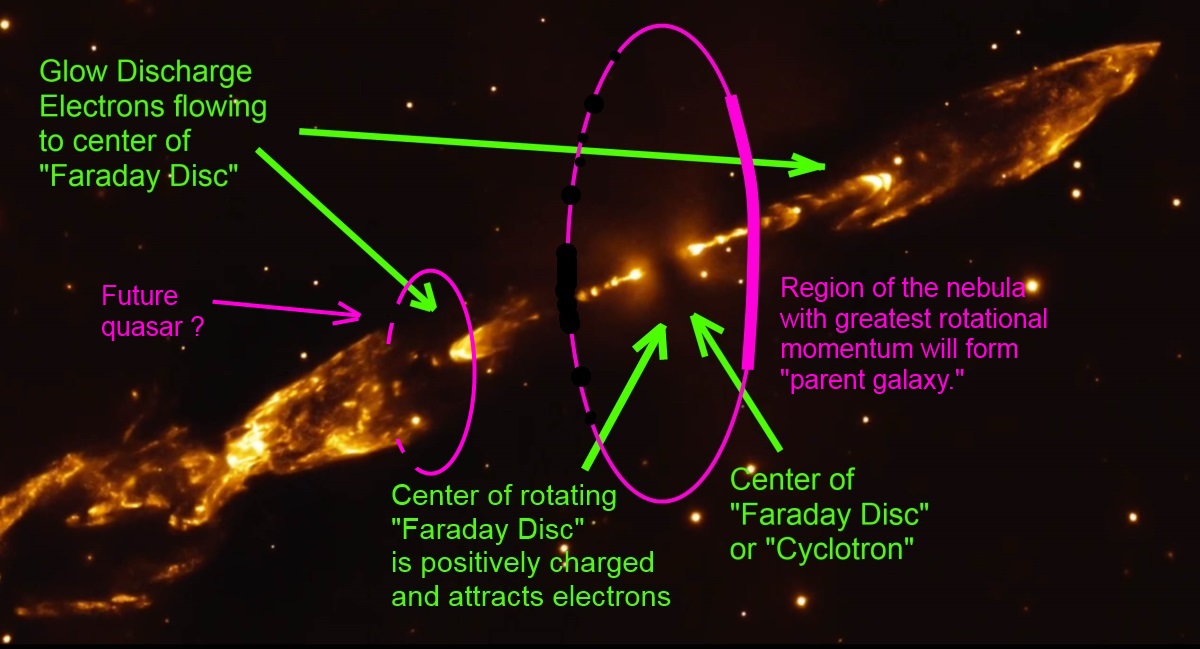
A rotating cloud of gas and dust (aka nebula) in space will form segmented regions behaving as "Faraday Discs" or "Cyclotrons" and eject electrons at the periphery of the cloud and receive electrons along the central axis of rotation. Since much of the rotating cloud is ionized, it may best be described as a rotating cloud of "plasma." The flow of electrons into the central axis and the outflow of positive ions from the central axis form "Birkeland Currents" that typically form layers of electrons and positive ions moving in opposite directions (double layers). The regions of the nebula that have the highest rotational momentum will produce the greatest positive charge in their center and may evolve to become the "parent galaxy" with smaller galaxies, aka "quasars" forming along the nebula's axis of rotation.

Image

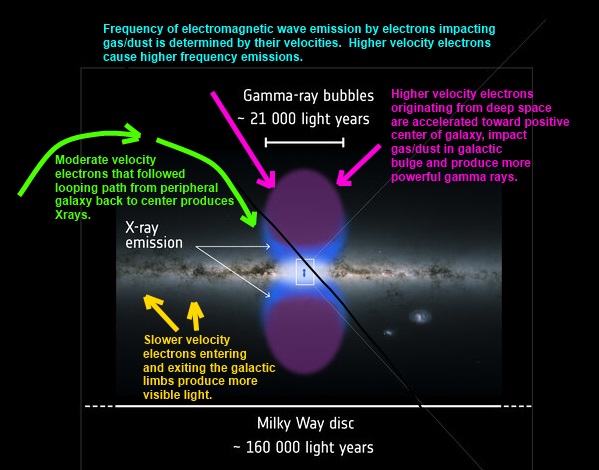
The high velocity of electrons impacting the gas/dust ionizes it, thus transforming it into "plasma." The higher the velocity of the electrons impacting the gas/dust, the higher frequency of electromagnetic radiation produced. Extremely high velocity electrons will produce X-rays and gamma rays upon impact. The central region of the "Faraday Disc" or "Cyclotron" will have the greatest positive charge and accelerate electrons to very high speeds, often producing high energy gamma rays. A large rotating galaxy, forming a large "Faraday disc" or "Cyclotron" in space, will form a highly positively charged central region that receives high velocity electron impacts, creating electromagnetic radiation emissions referred to as a "gamma ray bubble."

Image

BeAChooser
Posts: 1318
Joined: Thu Oct 15, 2015 2:24 am

Re: Plasma Physics and Galaxy Formation

Unread post by BeAChooser » Wed Jun 26, 2024 7:40 pm

An interesting exploration of PC/EU ideas in a visual format. A lot to think about.

galaxy12
Posts: 170
Joined: Sat Nov 18, 2023 2:22 pm

Re: Plasma Physics and Galaxy Formation

Unread post by galaxy12 » Thu Jun 27, 2024 3:26 am

Inter-galactic current flows:

We have discussed how the rotational momentum of a galaxy is converted to electrical current flow through the galactic arms by theories of the "Faraday disc" and "cyclotron". We have not yet discussed how current flow is converted to rotational momentum.

The galactic motor:

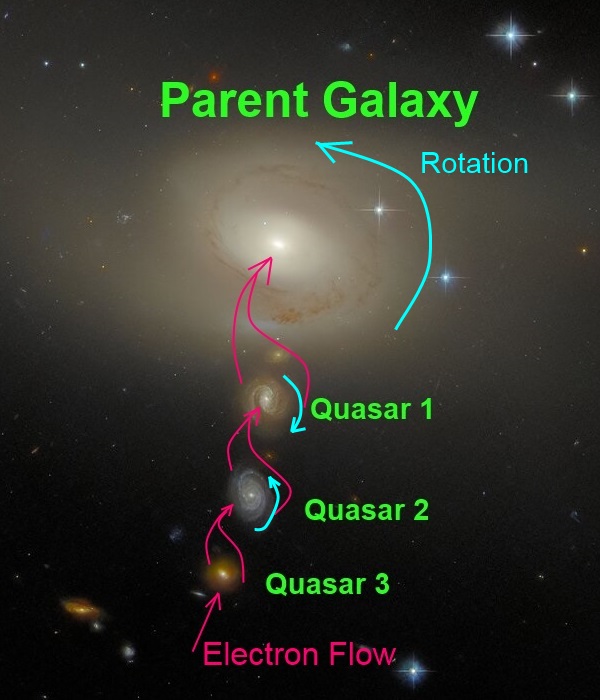
An increase in current flow through a galaxy creates an increase in rotational momentum of a galaxy by converting the "generator" effect of the "Faraday disc" or "cyclotron" into a "motor." The mechanism is similar to the way hobbyists convert a generator into a motor and vice versa. Many older model generators can be used as motors by inducing current flow through the generator's wires, thus creating rotational momentum from electricity. Increasing electron flow through a galaxy causes positively charged ions to be propelled in the opposite direction of electron current flow, producing a "motor" as opposed to a "generator." Intergalactic currents of electrons decrease the resistance of the galactic motor/generator by increasing the supply of available electrons to the positively charged central rotational axes. This allows "parent" galaxies to impart angular momentum to the smaller "quasars" by inducing electron flow toward the "parent" galaxy's highly positively charged central region.

There is an interesting phenomenon occurring in the image showing the parent galaxy and quasars that rotate in alternating directions along their axes. I do have a hypothesis for their alternate rotation directions but I will defer an explanation for now.

Image

Motor/generator in a solar system:

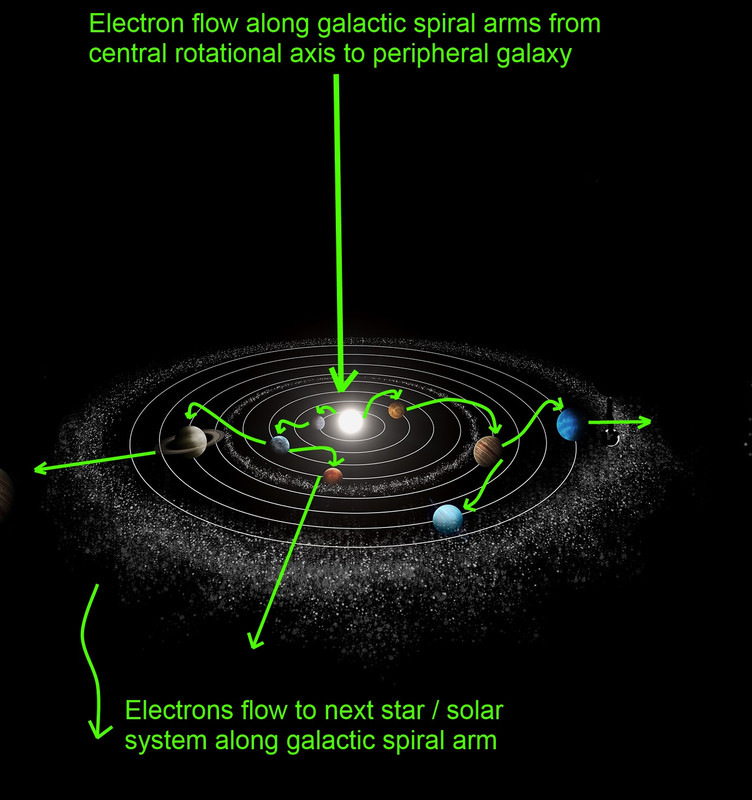
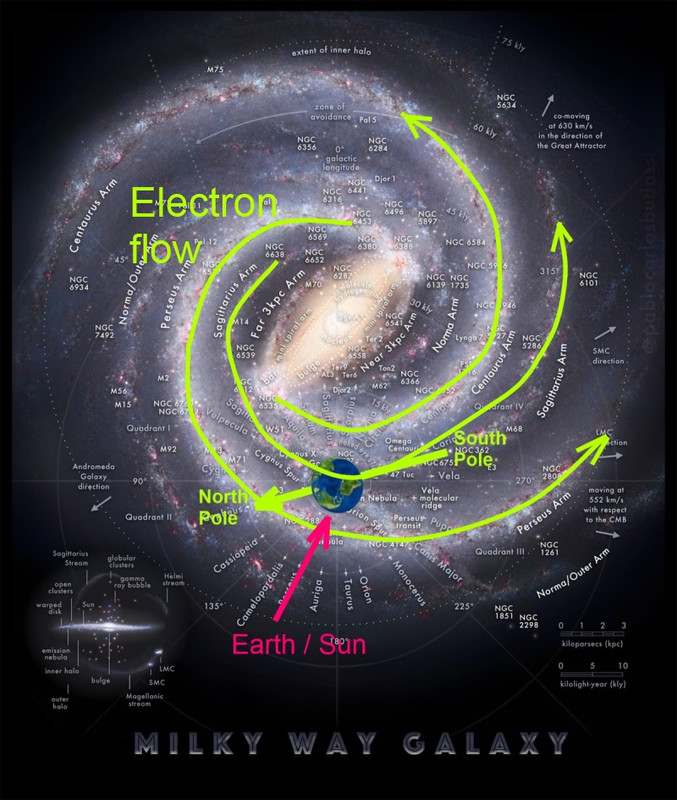
The same motor/generator effect can be seen with celestial objects other than galaxies such as solar systems, stars and even planets. When the current flow through the galactic arms increases, this causes an increase in rotational momentum of solar systems in the galactic arms through the the same motor-like effect.

Image

Image

galaxy12
Posts: 170
Joined: Sat Nov 18, 2023 2:22 pm

Re: Plasma Physics and Galaxy Formation

Unread post by galaxy12 » Thu Jun 27, 2024 5:12 pm

Neutral atoms:

Neutral atoms are not exactly neutral. All neutral atoms are composite particles composed of charged protons and electrons. Each of these protons, electrons and proton/electron pairs (neutrons) have spins and angular momentum contributing to their own magnetic fields. If all of these magnetic fields cancel out completely through opposing spin directions and opposing momentum, the atoms can be considered "neutral."

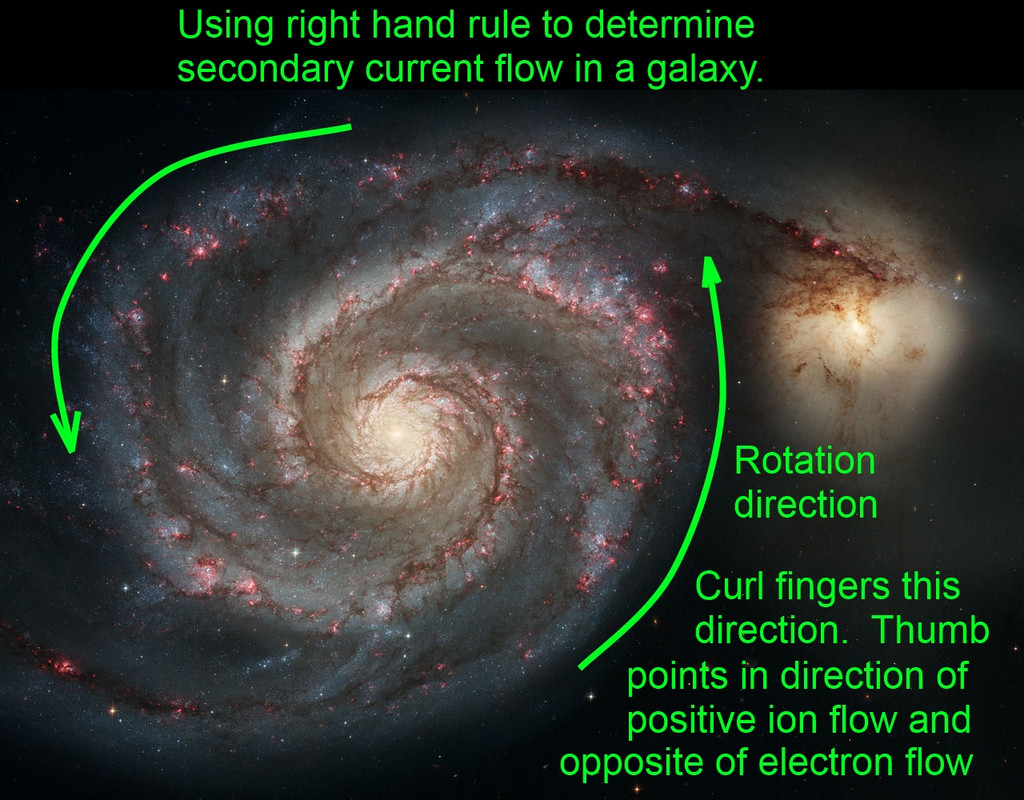
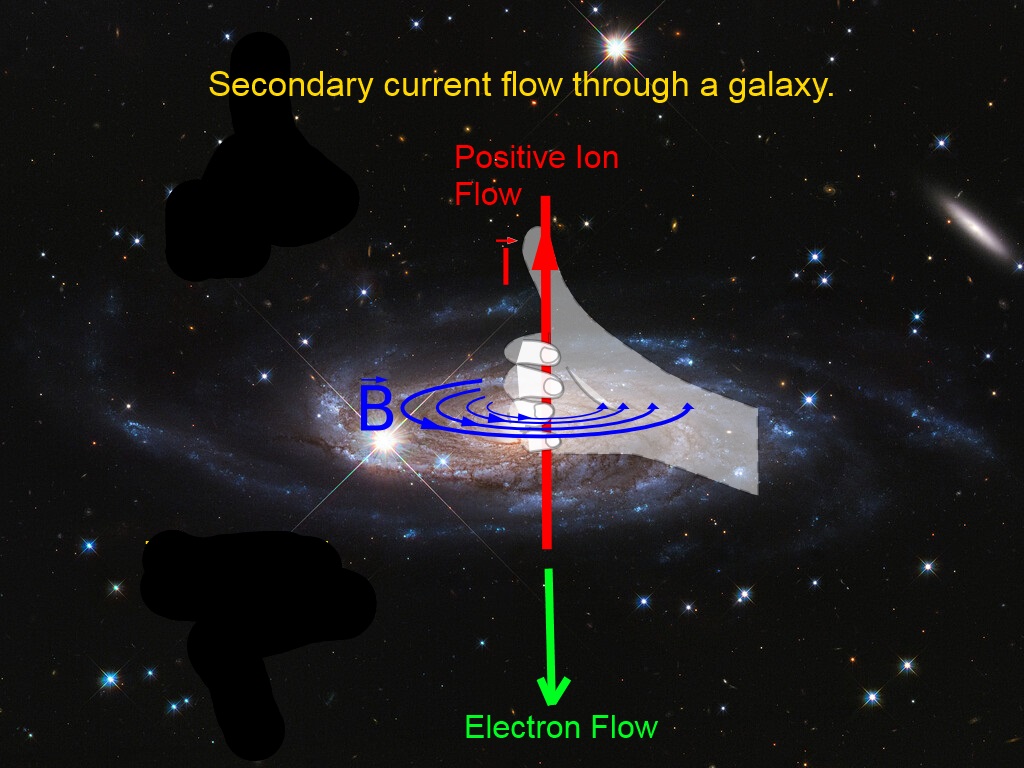
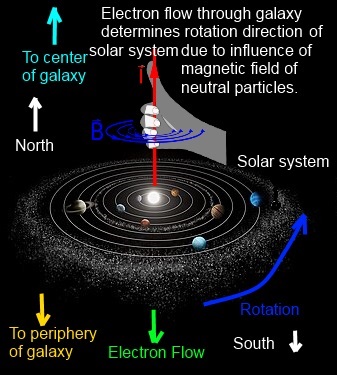
With extremely large, rotating structures, we must consider a secondary cause of magnetic fields. A galaxy consists of both neutral particles and charged particles (plasma). We have already discussed how plasma creates magnetic fields and how to use the "right hand rule" to determine both the direction of thes magnetic field lines and the direction of current flow through the galactic spiral arms. Neutral particles also rotate along with plasma in a galaxy or other rotating celestial object. Although the magnetic fields of a "neutral particle" may cancel out when measured locally, we must consider that the magnetic field lines of the neutral particle's component particles (protons, electrons) are rotating at great speeds along with a galaxy's spiral arms through space. We can therefore expect a "secondary" magnetic field to be produced by "neutral" particles through the rapid motion of the magnetic fields of "neutral" particles. The direction of the magnetic field lines of the secondary magnetic field would simply be the direction of rotation of the galaxy or other celestial object. We can easily use the right hand rule to determine the secondary current flow through a galaxy or celestial object.

Image

Image

The rotation direction of a solar system can be determined from the direction of current flow through the spiral arms of the galaxy.

Image

As previously discussed, the rotational momentum of a galaxy, solar system star or other celestial object will cause a current flow when the object acts as a "generator." We have to also consider that current flow will contribute to rotational momentum when the object acts as a "motor." We have to consider both the primary electrical currents caused by charged particles (plasma) and also the secondary electrical currents generated by "neutral" particles when analyzing galaxies, solar systems and other celestial objects.

galaxy12
Posts: 170
Joined: Sat Nov 18, 2023 2:22 pm

Re: Plasma Physics and Galaxy Formation

Unread post by galaxy12 » Fri Jul 05, 2024 1:57 am

Star formation and rotational momentum:

As discussed above, the rotational momentum of a nebula, galaxy or other celestial object creates both "primary" and "secondary" current flows. The rotation of positively charged plasma induces electron flow diagonally outward from the central axis of rotation. A "secondary" current flow along the celestial body's axis will be generated by particles that are neutral or not completely ionized. To determine the "secondary" current flow, we can use a custom modification of the right hand rule by curling our fingers in the direction of the object's rotation. Our thumb will point in the direction of positive ion flow while electrons will flow in the opposite direction.

Also previously discussed, current flows can also induce rotational momentum of a celestial object by transforming it from a "generator" to a "motor".

Celestial objects maintain a constant balance between current flow and rotational momentum. If current flow reduces, energy from rotational momentum will be converted into electrical current. If rotational momentum is reduced, energy from the magnetic field of the flowing charges (inductive energy) will act to maintain rotational momentum.

Examples:

Intergalactic current flows are able to induce rotational momentum of galaxies. Rotational momentum of galaxies induces intergalactic current flows. It is debatable whether the rotational momentum of a collapsing nebula initiates current flow or if intergalactic current flow induces rotational momentum of a galactic nebula. Both are likely the case in particular instances.

Unlike in galaxies, in star formation there is no debate that current flow is the obvious initiator of rotational momentum. Given that a galaxy is much larger than a star or solar system, the current flow through the galactic arms is the dominant force creating rotational momentum of a star. For this reason, we would expect stars and solar systems to rotate in a counter-clockwise direction when viewed from the interior portion of the spiral arm towards the distal spiral arm. This assertion obviously needs to be confirmed by telescopic evidence which should be theoretically possible.

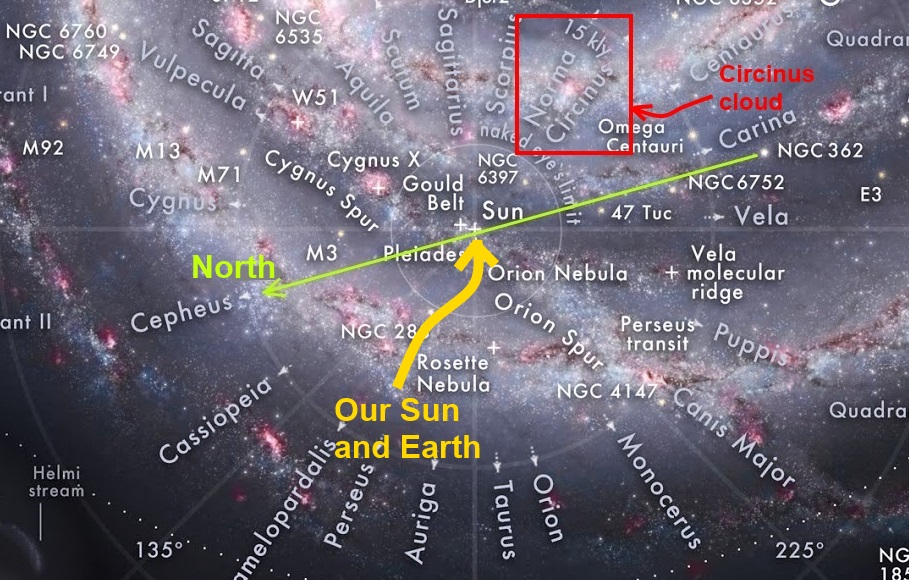
As an example, we can look at our own Milky Way galaxy in a nearby nebular cloud labeled Circinus-West cloud. It is about 2,500 light-years from Earth.

Image

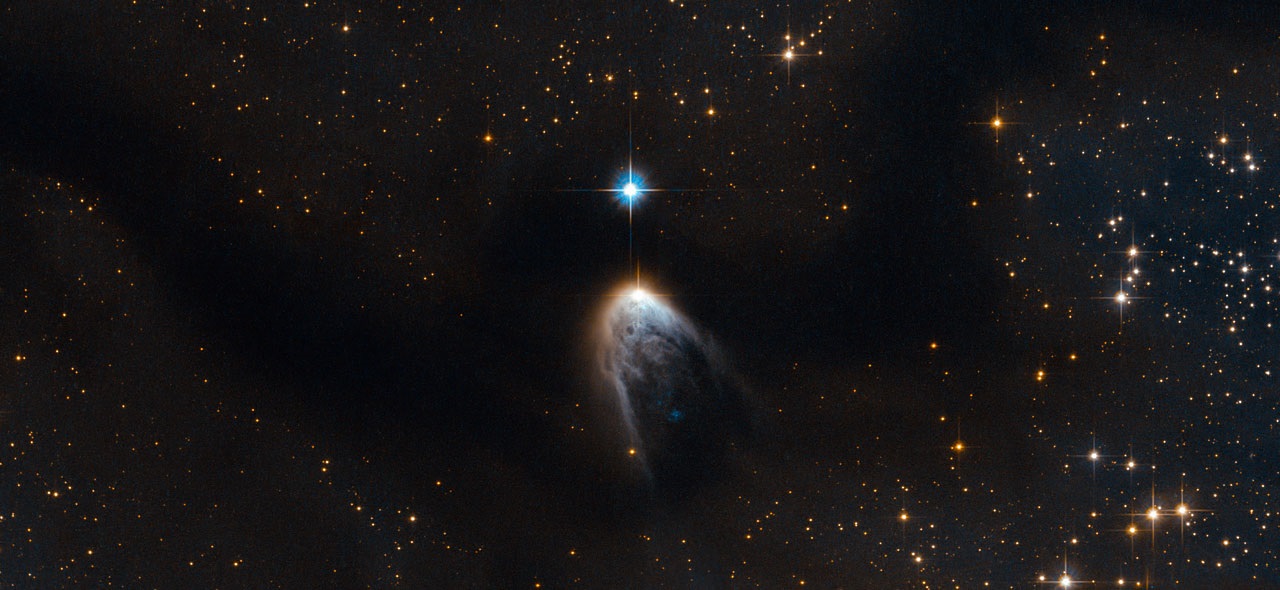
This hubble image shows IRAS 14568-6304, a star-forming region in the Circinus-West cloud.

Image

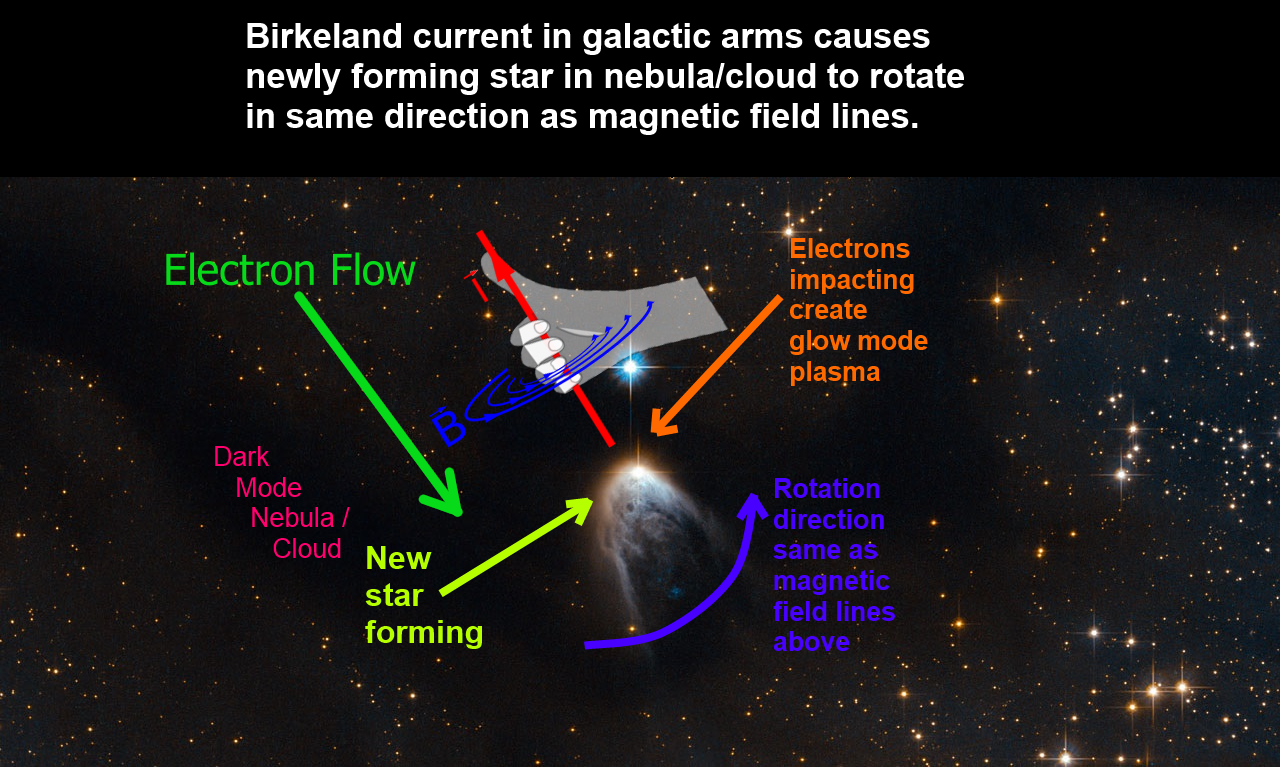
From this image, we can make several deductions. We can determine the direction of electron flow since the high velocity electrons impact the gas/dust in the central axis of a rotating cloud/nebula and create a glowing plasma discharge there. The side of the cloud the electrons impact emits the brightest "glow" discharge and the "tails" point in the direction of electron current flow. Since we know the direction of electron (and oppositely directed ion) flow from the image, we can determine the direction of rotation using the "custom modified right hand rule" explained above. If we point our thumb along the galactic arm toward the center of the galaxy in the direction of positive ion flow (opposite direction of electron flow) and curl our hand, our fingers will point in the direction of the star/cloud rotation. The electrons will be flowing away from the center of the galaxy toward the periphery of the galactic disc. The less ionized outer regions of the rotating cloud are dark and block the light from the more distant stars behind it.

Image

Post Reply

Who is online

Users browsing this forum: No registered users and 2 guests