Your promised explanation of the anode Sun model and how it gets 10^26W of power electrically hasn't moved on for ten days. Below is my summary of your position as presented up to Thursday 17th December. I can't see that you have made any further substantive statement since then, except the assertion that electrons beyond the heliosheath are streaming towards the Sun radially, for which I have requested a reference in a separate post:Brigit wrote: ↑Thu Dec 24, 2020 9:31 pm 2/2
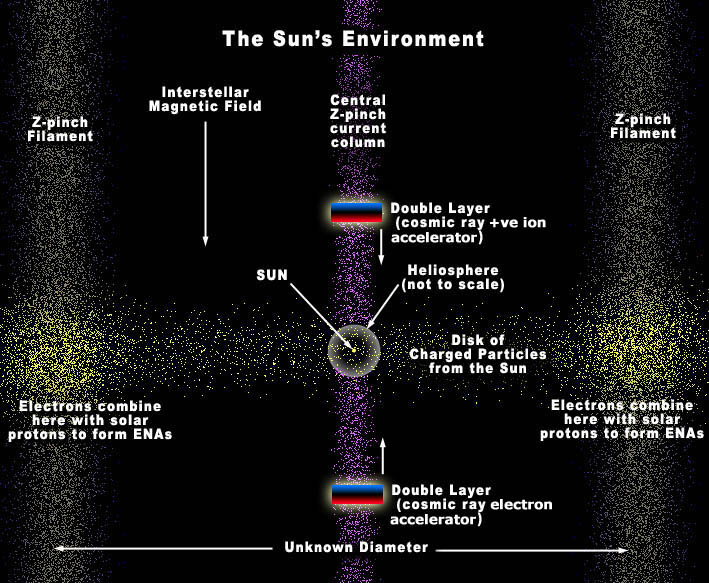
Nice eye. We don't want to whistle past the heliosheath. (It isn't the only double layer in the discharge, either.)
As every one has already noticed, we are actually all talking about three different objects, by the same name.
The heliosheath that Higgsy is referring to is a kinetic model based on velocity and such.
In the Plasma Universe the heliosheath is a plasma double layer. And
The Electric Universe picks up where the Plasma Universe leaves off, and the plasma double layer heliosheath also serves as a "virtual electrode" to the anode sun.
Summary on 26th December 2020
1. A proposition that a double layer at the heliopause is a cathode for the electric Sun
2. The volume of the heliosphere is really big
3. The electron density outside the heliopause seems to double or treble in the first few AU after crossing to the ISM from about 0.05 electrons per cm^3 to about 0.12 electrons per cm^3 at about 23AU.
4. Double layers exist and sometimes carry current and accelerate ions and electrons between the layers
5. The heliopause travels through the ISM encountering electrons. What will they do?
(6. Metals in the Universe being produced by nuclear fusion in the photosphere and chromosphere of stars is proposed as a bare assertion without physical justification)
7. An assertion that electrons beyond the heliopause stream radially towards the Sun (evidence for this assertion has been requested).
As the double layer is the first step in your argument (no. 1 above), could you quantify the key elements of this double layer, for example, how thick is it, what is the voltage drop across it, how is this double layer maintained (I know how double layers in general form, but how is this one maintained), what is the potential and electric field as one traverses the DL and so on?There have been questions raised about whether there is a plasma double layer at the heliosheath, how it got there, and how it is sustained and does not short out.
In the Plasma Universe, the universe is made of 99.9% matter in the plasma state. The plasma is inhomogeneous -- it is made up of plasmas of differing temperatures, magnetization, degree of ionization, chemical constituency, and relative motion. Transition regions or double layers form between cells and filaments of differing plasma types. Since the heliosheath is the boundary between the Sun's electrical environment and the interstellar medium, a plasma sheath is formed between the differing plasmas. See the ion thruster in Fig 12 for example.