by jacmac » Thu Jan 14, 2021 4:19 am:
"If I agree with the premise, and agree with "Sunward Electrons" should I stay here and share my disagreements about other parts ??"
Hi jacmac, say on, absolutely!
I was just making it clear that I felt that a discussion disputing the Plasma Universe model itself should go on another thread, if at all possible. That's just there for fans of singularities (:
Sunward Electrons
-
Brigit

- Posts: 1478
- Joined: Tue Dec 30, 2008 8:37 pm
Re: Sunward Electrons
"The important thing in all of this, and something which Velikovsky in his usual intuitive way presaged, is that gravity itself is linked to [subatomic] electrostatics. It is not some innate quality associated with matter, unrelated to its electrical structure." ~Wal Thornhill
-
Michael Mozina
- Posts: 2295
- Joined: Thu Feb 23, 2012 5:35 pm
Re: Sunward Electrons
I'm not sure there has to be a 'different voltage' per se, although the various double layers might step down the voltage to some degree.jacmac wrote: ↑Thu Jan 14, 2021 4:19 am And to Michael Mozina, who champions an electric circuit sun, as does Brigit, but in reverse polarity.
If the heliosheath electrode connects to the interstellar medium, how does the sun electrode connect to a different voltage
and where does this connection take place ?
I'd assume the heliosheath is the first "double layers" between the ISM and our solar system.
I "see" double layers but not the completed circuit.
Therefore, I see an electric cellular solar system completely inside the interstellar medium.
Jack.
Any circuit connections to the ISM will probably take place in the heliosheath itself.
-
Robertus Maximus
- Posts: 298
- Joined: Mon Sep 02, 2013 1:16 pm
Re: Sunward Electrons
Given the Sun's location in the Milky Way Galaxy, Juergens assumed the solar discharge was powered by a positive current being driven from the Sun to its environment. Remember, Juergens assumed that the Sun was highly negatively charged, it functioned as an anode only because its present environment carries a greater relative negative charge.Brigit wrote: ↑Wed Dec 09, 2020 6:16 pm Originally, Ralph Juergens used a gaseous electric discharge tube to describe many features of the electric sun, including the anode tufts. The anode sun model was further developed by Wal Thornhill, and also Donald Scott, to include the "virtual cathode" at the sun's heliopause. This model has been useful in the decades since for interpreting space discoveries, making predictions, and carrying out experiments.
Earl Milton, writing in the Society for Interdisciplinary Studies Review journal (Vol.5 No.1, 1980/81) used the 'gravity rubber-sheet' analogy to describe Juergens' model of an electric star:
Juergens concluded that electrical forces not only played a role in the cosmos but that they were responsible solely for a large number of the cosmic events. Juergens, unlike (Charles) Bruce, did not see the electrification of stellar atmospheres as the result of the mechanical separation of electrons and ions. (Remember that Bruce had proposed such a mechanism when he compared cosmic discharges with terrestrial atmospheres.) Juergens did not follow Bruce's model, where neutral astronomical bodies were surrounded by electrified atmospheres. Instead he saw the astronomical body as an inherently charged object which was immersed in a universe which could be described as an electrified fluid. His use of a universal electrified fluid rather than empty space between the astronomical bodies is similar to Einstein's notion of space-time curvature used to explain the action of gravity. Einstein pictured the Universe as a sort of sheet of elastic which was distorted by the masses imbedded in it. Where there was a mass there was much strain. Where there was no mass, there was little strain. A cavity surrounded each mass on the otherwise nearly flat fabric of space-time. Similarly Juergens conceived of space as an electrified fabric where the quantity of charge in the space varies from place to place over large distances. The astronomical objects themselves are swimming in that electrified fabric or fluid, and they also had a charge, which may or may not be compatible with the environment in which they reside.
Juergens utilised the rules of electricity (which most physicists agree upon) as the operative factor in cosmic processes. So, electric currents flow between a body and the space around it if the two are incompatible electrically. Over a long time, any object comes to be at peace with its environment, then the electric current stops. But until peace is achieved the body is surrounded by an electrical sheath, a region through which an electric current flows, and in which energy is released. The sheath need not produce any optical effect; but under certain conditions, such as around the Sun and about comets, the sheath is luminous.
One can view space electrically, and I will use only negative electricity in my description because I believe the Universe has a net negative charge. Space is a place where each cube of the space "contains" a certain number of negative charges. The bodies in the space and the atoms between the bodies also can have an excess negative charge over what theoretically we consider to be electrically neutral. The charge density need not be the same at all places, so you can have a situation where at one part of the Galaxy there are fewer negatives than elsewhere. Now, if such a situation occurs one would expect that negative charges would flow into the deficient region(s). Eventually equilibrium would be reached, thereafter there would be the same number of negatives everywhere.
Juergens, though he never wrote of why it would happen, viewed the phenomenon of a star as the result of a suddenly produced electric cavity in the fabric of space. The electric flow into the cavity, which is the Sun (and which includes on its rim the entire planetary system), supplies the energy which the star (here the Sun) radiates. The solar wind, a flow of electron-deficient atoms (ions) away from the Sun, carries the electric current. That a negatively charged body like the Sun can increase its charge by emitting a proton wind is reasonable only if the space surrounding the Sun is more negatively charged than is the Sun itself! Viewed as a body within an electrically neutral Universe, a like-behaving Sun would seem to be positively charged. (No electron wind flows from the Sun: solar wind electrons move randomly.) That the Universe cannot be neutral seems likely.
Juergens' electrical star begins as an electrical cavity, infinitesimally small and infinitely deep. The cavity sends out a signal to the cosmos asking for charge to fill the deficiency. Since there are not many atoms and fewer available electrons between the stars, the electrical flow is restricted. The Universe, though containing an excess of negative charge, is stingy when it comes to redistribution of its charges. It is like the behaviour of the Bank of England in troubled financial times: it circulates currency only of necessity. Just as it would be poor business for the bank to bankrupt its customers or to allow the population to starve, so also the electrified space must be maintained in a mildly conductive state if any electric redistribution is to be possible. This makes the presence of interstellar matter necessary to the functioning of the Universe. However, just as abundant money fuels inflation, too conductive a space invites annihilation. So as the Bank controls the supply of pounds, the cosmos limits the transaction between its parts. Thus, some electrons flow into the solar cavity. They flow to the Sun's surface, making it hot and liberating the observed solar output. The process which liberates energy seems not to satisfy the solar demand for electrons, so the Sun generates its own electrical flow toward distant space, the solar wind. By launching electron-deficient atoms into space the Sun gains electrons in a most efficient way. As the solar wind protons pass into the relatively more electron-rich space away from the Sun, the protons (which constitute most of the solar wind) can recombine with now-available electrons, completing indirectly the transfer of one electron from space on to the body of the Sun. So Juergens' notion of an electrical Sun describes a phenomenon that starts out as a very deep cavity which fills up as galactic electrons flow into and solar ions flow out of a widening and ever more shallow electrical cavity. Just reverse the black hole story and you end up with an electrical cavity that would be very, very broad and not very electrically attractive after a time.
In Juergens' picture the Sun's properties come from without; they arise from where the Sun is located, from the space with which it is interacting. The Sun is visible where the galactic current impinges upon it. The cosmos squeezes the Sun into a particular volume. Cosmic electrical pressure is attempting to squeeze the Sun's matter to the same electrical density as that in the distant space surrounding the Sun. It can not succeed because the Sun has far too few electrons in its matter, and so the solar energy output which sustains our lives continues. If the Sun, as it drifts through the Galaxy, should go into a region which is more electrical than where we are now, it must get smaller physically, that is, its real surface would move inward. But since the electrical processes at surface would intensify, the Sun would respond by building up a greater atmosphere. We would see the Sun change into a super giant star. On the other hand, if it drifts into a region of space where things weren't as electrically active as here, the Sun would quiet right down; it would physically increase in size but its atmosphere and activity would diminish. It would "cool" and become a red dwarf star.
Over four years ago I suggested that we could consider the loss of planetary atmospheric oxygen as analogous to the Sun's 'proton wind':
https://www.thunderbolts.info/forum/php ... 45#p114660
-
Solar

- Posts: 1457
- Joined: Mon Mar 17, 2008 10:05 am
Re: Sunward Electrons
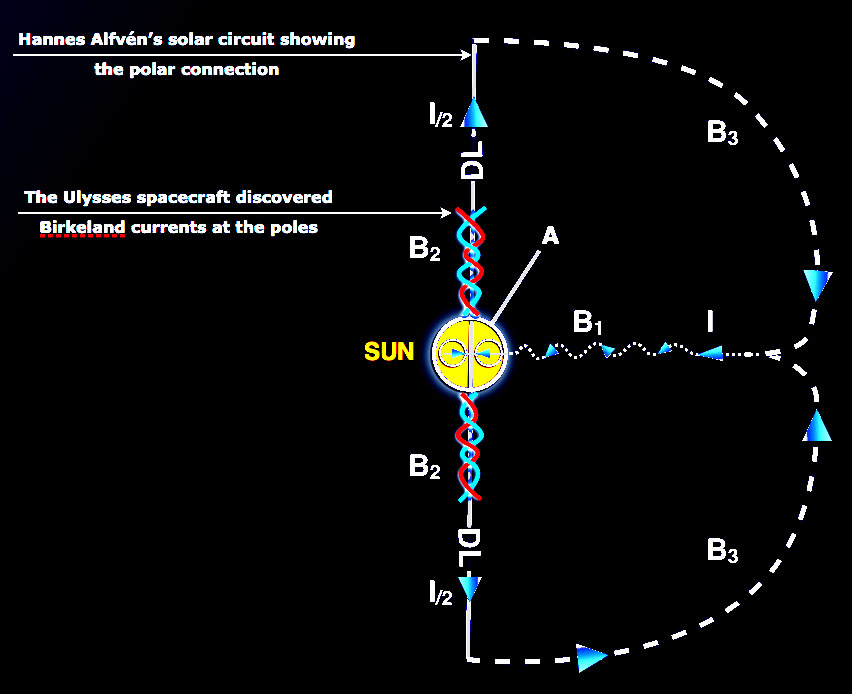
One of the captions in the image of Alfven's Solar Circuit says "The Ulysses spacecraft discovered Birkeland Currents at the poles". Image is from: :Holoscience: Alfvén Triumphs Again (& Again) - 2011Brigit wrote: ↑Tue Jan 05, 2021 9:05 pm So I have started with the cathode at the heliosheath, and the voltage across it supplied by the interstellar medium; which will be an ample source of Sunward Electrons, and eventually, a closed circuit. Hannes Alfven suggested a circuit which proposes it closes far out from the Sun's poles.
- Figure 21
https://www.holoscience.com/wp/wp-conte ... ircuit.jpg
"In the circuit model, it was noted that every circuit that contains an inductance is intrinsically explosive. This is true because a conductive circuit will tend to supply all of the inductive energy to any point of interruption of the circuit. Double layers are known to tend to interrupt current in a plasma. Hence, the entire energy of a circuit can be released at the point where a double layer forms regardless of the source of the energy of the circuit.
Prior to that:
Prior to that:The Sun’s heliospheric circuit is connected to the galaxy via the central column and the disk of charged particles. The current path is traced by magnetic fields. The “open” helical magnetic fields discovered high above the Sun’s poles by the Ulysses spacecraft are supportive of Alfvén’s stellar circuit model. And the solar “wind” would seem to connect to the broader disk of charged particles about the heliosphere. - Holoscience: Electric Sun Verified 2009
Prior to that: "Polar Coronal Plumes" and/or auroras were apparently generated in Birkeland's terrella experiment under what he referred to as "anode-globe" conditions:Tsurutani also studied polar plumes, long trails from the base of the Sun. The plumes form in the Sun’s polar regions, the upper and lower 30-degree latitude regions, and where these plumes occur, the magnetic field isn’t kinked, but instead forms long, thin, straight tubes. This means that the Alfven waves don’t operate in these regions, though scientists don’t yet know why.
“Ulysses was able to find that the Sun’s polar plumes stretch out past the orbit of Mars and maybe farther,” said Tsurutani. “What’s fascinating is how these plumes can be so thin and so long at the same time.” A plume could be 100 times wider than it is long (sic). The European Space Agency’s Solar and Heliospheric Observatory (SOHO) noted these polar plumes in 1996.
What is fascinating is that astrophysicists cannot “see” what they are looking at because of the dogma that electric currents cannot flow in space and the Sun cannot be electrically charged. The thin, straight tubes are diagnostic of Birkeland currents. Birkeland currents also have an outer twisted filament or rope-like form taken by electric current flowing in plasma. The Alfven waves are therefore more likely to be the structure of the magnetic field associated with Birkeland currents. Otherwise there is some unspecified activity required beneath the Sun’s surface to excite the Alfven waves, or “pluck the guitar string” as it is colorfully described. Unfortunately this “explanation” follows a well-established tradition of ascribing every weird feature of the Sun to poorly defined activity hidden from view inside the Sun. It is what is known as “pathological science” – a term coined by a pioneer of plasma physics and Nobel Laureate, Irving Langmuir. - Holoscience: Scientists fail to unravel the kinks in solar waves - 2001
Notice that several conical ie slightly ‘cone-shaped’ emissions are present in the image. The features have smaller diameter at their base and get wider as their distance increases from said base. Initially it seems that this ‘cone-shaped’ characteristic would run counter to the idea of a filament having consistent length. However, the bright spots where ‘contact’ is made with the upper and lower surfaces of the terrella chamber seem to reveal the presence of “beams” propagating along with, or in, each ‘cone-shaped’ haze.When, on the other hand, the anode-globe was magnetised, the flashes became more intense (see fig. 259), and the points of discharge were congregated in the vicinity of the magnetic poles of the globe. The discharge-rays gathered in two zones about the poles of the anode-globe, as might be expected; but there also appeared a faint band of light, of which an indication may be seen, round the magnetic equator of the anode-globe. - Birkeland Terrella Fig 259

Prior to that
The Sun itself offers comparison: Solar Eclipse 2008
The actual sun does not appear have upper and lower ‘surface’ area like the terrella for the “beams” to contact so that bright spots become visible. Its amazing to consider that these project somewhere out to heliospheric distances to "close" at the equator? The emissions are still ‘conical’ being smaller in diameter at their base and wider with increasing distance from the solar surface. Nonetheless, apparently these “tornado-like structures” have been observed by Ulysses spacecraft. In 2017 the authors of a paper examining data from Ulysses refer to the detection of “large-scale cylindrical (or conic-like) current sheets (CCSs) at high heliolatitudes”. See:
Fig 1 Graphic
PAPER is open access:
The footprints, or base, of these rather long "tornado-like structures" discharging from the solar surface inside polar coronal holes have been studied. See:We provide observational evidence for the existence of large-scale cylindrical (or conic-like) current sheets (CCSs) at high heliolatitudes. Long-lived CCSs were detected by Ulysses during its passages over the South Solar Pole in 1994 and 2007. The characteristic scale of these tornado-like structures is several times less than a typical width of coronal holes within which the CCSs are observed. CCS crossings are characterized by a dramatic decrease in the solar wind speed and plasma beta typical for predicted profiles of CCSs. Ulysses crossed the same CCS at different heliolatitudes at 2-3 AU several times in 1994, as the CCS was declined from the rotation axis and co-rotated with the Sun. In 2007, a CCS was detected directly over the South Pole, and its structure was strongly highlighted by the interaction with comet McNaught. Restorations of solar coronal magnetic field lines reveal the occurrence of conic-like magnetic separators over the solar poles in both 1994 and 2007. Such separators exist only during solar minima. Interplanetary scintillation data analysis confirms the presence of long-lived low-speed regions surrounded by the typical polar high-speed solar wind in
solar minima. Energetic particle flux enhancements up to several MeV/n are observed at edges of the CCSs. We built simple MHD models of a CCS to illustrate its key features. The CCSs may be formed as a result of non-axiality of the solar rotation axis and magnetic axis, as predicted by the Fisk-Parker hybrid heliospheric magnetic field model in the modification of Burger and coworkers. - High-latitude conic current sheets in the solar wind: Olga V. Khabarova, Helmi V. Malova, Roman A. Kislov, Lev M. Zelenyi et al 2017
Driving Jets from the Sun
"Our laws of force tend to be applied in the Newtonian sense in that for every action there is an equal reaction, and yet, in the real world, where many-body gravitational effects or electrodynamic actions prevail, we do not have every action paired with an equal reaction." — Harold Aspden
-
jacmac
- Posts: 934
- Joined: Wed Dec 02, 2009 7:36 pm
Re: Sunward Electrons
Michael"
AND I suggest the close interstellar medium around the solar system is of the same voltage, or charge, level throughout
(small local differences notwithstanding).
I think this is a basic problem with the EU emphasis on "circuit theory".
I have proposed a "cell" type structure in which the sun is not an electrode per se, but a pseudo electrode.
To make an analogy to a road for vehicles; the sun is a cul de sac.
Being different from a "dead end street" a cul de sac has room to turn around.
The solar plasma is self concentrating relative to the heliosheath,
self organizing as to its "sun" structure, and with a returning plasma moving outward we call the solar wind.
Robert:
Jack
ANDI'm not sure there has to be a 'different voltage' per se, although the various double layers might step down the voltage to some degree.
I think an electric circuit would need a voltage difference at the electrodes to function.Any circuit connections to the ISM will probably take place in the heliosheath itself.
AND I suggest the close interstellar medium around the solar system is of the same voltage, or charge, level throughout
(small local differences notwithstanding).
I think this is a basic problem with the EU emphasis on "circuit theory".
I have proposed a "cell" type structure in which the sun is not an electrode per se, but a pseudo electrode.
To make an analogy to a road for vehicles; the sun is a cul de sac.
Being different from a "dead end street" a cul de sac has room to turn around.
The solar plasma is self concentrating relative to the heliosheath,
self organizing as to its "sun" structure, and with a returning plasma moving outward we call the solar wind.
Robert:
I am very interested in this CAVITY ; but must wait for another day.Juergens, ...... viewed the phenomenon of a star as the result of a suddenly produced electric cavity in the fabric of space.
Jack
-
paladin17

- Posts: 438
- Joined: Mon Jul 14, 2014 2:47 pm
- Contact:
Re: Sunward Electrons
Not necessarily. Current (and electric field) may be induced, i.e. produced by e/m induction instead of potential difference. And, in fact, all the observations show that long-range currents in space are of exactly that nature - otherwise they'd be shut down by Debye screening. I talked about it here.
Therefore, in my opinion, the most viable idea for an "electric Sun" would be that of an "antenna", receiving externally induced field - either by breaking the external current and thus manifesting the energy of the whole [larger] circuit where it is, or by simply receiving the external energy as a "transformer coil".
From here, however, a whole bunch of very difficult questions arise. I've been thinking about it for a while and haven't found any decent models yet. But, as Sherlock Holmes said, "When you have eliminated all which is impossible, then whatever remains, however improbable, must be the truth" - IF the Sun is "electric" in the first place, of course.
-
Solar
- Posts: 1457
- Joined: Mon Mar 17, 2008 10:05 am
Re: Sunward Electrons
These two concepts remind me of Superconductivity where:paladin17 wrote: ↑Sat Jan 16, 2021 5:22 pmNot necessarily. Current (and electric field) may be induced, i.e. produced by e/m induction instead of potential difference. And, in fact, all the observations show that long-range currents in space are of exactly that nature - otherwise they'd be shut down by Debye screening. I talked about it here.
Therefore, in my opinion, the most viable idea for an "electric Sun" would be that of an "antenna", receiving externally induced field - either by breaking the external current and thus manifesting the energy of the whole [larger] circuit where it is, or by simply receiving the external energy as a "transformer coil".
i]IF[/i] the Sun is "electric" in the first place, of course.
The analogous "cul de sac" would seem to fall under Lenz Law and Meissner Effect. Now one might also have the wonders of Induction Lighting, with induced magnetic field and induced currents persisting to oppose external field changes (ISM clouds), no electrode, no cathode needed although the relationship may be said to behave similarly. There is more than one way to induce light.A conductor will oppose any change in externally applied magnetic field. Circulating currents will be induced to oppose the buildup of magnetic field in the conductor (Lenz's law). In a solid material, this is called diamagnetism, and a perfect conductor would be a perfect diamagnet. That is, induced currents in it would meet no resistance, so they would persist in whatever magnitude necessary to perfectly cancel the external field change. A superconductor is a perfect diamagnet, but there is more than this involved in the Meissner effect. - Perfect Diamagnetism
Problem is that EU has presented to many comparisons and some of them do not work well together. The z-pinch dynamic on the one hand does not work well with current flow through an incandescent bulb and filament approach on the other hand, which does not work well with a plasmoid approach either.
"Our laws of force tend to be applied in the Newtonian sense in that for every action there is an equal reaction, and yet, in the real world, where many-body gravitational effects or electrodynamic actions prevail, we do not have every action paired with an equal reaction." — Harold Aspden
-
jacmac
- Posts: 934
- Joined: Wed Dec 02, 2009 7:36 pm
Re: Sunward Electrons
Solar:
I was using a cul de sac to illustrate the end of the circuit at the sun. There is no "completed circuit."
But speaking of cul de sac and plasma, I offer this:
It looks to me like the granules that make up the photosphere might be each related by induction
to corresponding parts of the bottom of the corona.
Each granule seems to rise up, turn over, and go back down. Like a mini cul de sac. Like this )
Each corresponding bottom part of the corona is shaped opposite, like a mini cul de sac. Like this (
Place two vertical lines in between to represent the chromosphere double layer II
All together we have )II(
Back to back cul de sacs.
This reminds me of a segment of a transformer symbol; an induction device.
In this paper https://lesia.obspm.fr/turbu/talks/Grec ... _turbu.pdf
the author proposes that discontinuities in the solar wind plasma indicates individual "flux tubes"
And to my point above he says:
from Solar
YESThe analogous "cul de sac" would seem to fall under Lenz Law and Meissner Effect. Now one might also have the wonders of Induction Lighting, with induced magnetic field and induced currents persisting to oppose external field changes (ISM clouds), no electrode, no cathode needed although the relationship may be said to behave similarly. There is more than one way to induce light.
I was using a cul de sac to illustrate the end of the circuit at the sun. There is no "completed circuit."
But speaking of cul de sac and plasma, I offer this:
It looks to me like the granules that make up the photosphere might be each related by induction
to corresponding parts of the bottom of the corona.
Each granule seems to rise up, turn over, and go back down. Like a mini cul de sac. Like this )
Each corresponding bottom part of the corona is shaped opposite, like a mini cul de sac. Like this (
Place two vertical lines in between to represent the chromosphere double layer II
All together we have )II(
Back to back cul de sacs.
This reminds me of a segment of a transformer symbol; an induction device.
In this paper https://lesia.obspm.fr/turbu/talks/Grec ... _turbu.pdf
the author proposes that discontinuities in the solar wind plasma indicates individual "flux tubes"
And to my point above he says:
The granules and the flux tubes (Birkeland currents) are the same scale.A sketch of the flux tube texture of the solar-wind plasma. Each flux tube contains a
different plasma and the flux tubes move independently. An end view (right) depicts
the cross sections of the network of tubes. The scale sizes of the flux tubes correspond
to the scale sizes of granules on the solar surface. (From Borovsky, 2008).
from Solar
There is more than one way to induce light.
-
Brigit
- Posts: 1478
- Joined: Tue Dec 30, 2008 8:37 pm
Re: Sunward Electrons
by Robertus Maximus » Fri Jan 15, 2021 2:18 pm
"Earl Milton, writing in the Society for Interdisciplinary Studies Review journal (Vol.5 No.1, 1980/81) used the 'gravity rubber-sheet' analogy to describe Juergens' model of an electric star:
"Juergens did not follow Bruce's model, where neutral astronomical bodies were surrounded by electrified atmospheres. Instead he saw the astronomical body as an inherently charged object which was immersed in a universe which could be described as an electrified fluid. His use of a universal electrified fluid rather than empty space between the astronomical bodies is similar to Einstein's notion of space-time curvature used to explain the action of gravity. Einstein pictured the Universe as a sort of sheet of elastic which was distorted by the masses imbedded in it. Where there was a mass there was much strain. Where there was no mass, there was little strain. A cavity surrounded each mass on the otherwise nearly flat fabric of space-time. Similarly Juergens conceived of space as an electrified fabric where the quantity of charge in the space varies from place to place over large distances. The astronomical objects themselves are swimming in that electrified fabric or fluid, and they also had a charge, which may or may not be compatible with the environment in which they reside."
Thank you for the Earl Milton quote, which is of historic interest. Now insofar as the electricians use drops in altitude to illustrate voltage, that is a helpful illustration. The reason it is helpful is that the ball in the elastic sheet is a diagram of the electric field as if there was no double layer plasma sheath surrounding the anode sun.
"Earl Milton, writing in the Society for Interdisciplinary Studies Review journal (Vol.5 No.1, 1980/81) used the 'gravity rubber-sheet' analogy to describe Juergens' model of an electric star:
"Juergens did not follow Bruce's model, where neutral astronomical bodies were surrounded by electrified atmospheres. Instead he saw the astronomical body as an inherently charged object which was immersed in a universe which could be described as an electrified fluid. His use of a universal electrified fluid rather than empty space between the astronomical bodies is similar to Einstein's notion of space-time curvature used to explain the action of gravity. Einstein pictured the Universe as a sort of sheet of elastic which was distorted by the masses imbedded in it. Where there was a mass there was much strain. Where there was no mass, there was little strain. A cavity surrounded each mass on the otherwise nearly flat fabric of space-time. Similarly Juergens conceived of space as an electrified fabric where the quantity of charge in the space varies from place to place over large distances. The astronomical objects themselves are swimming in that electrified fabric or fluid, and they also had a charge, which may or may not be compatible with the environment in which they reside."
Thank you for the Earl Milton quote, which is of historic interest. Now insofar as the electricians use drops in altitude to illustrate voltage, that is a helpful illustration. The reason it is helpful is that the ball in the elastic sheet is a diagram of the electric field as if there was no double layer plasma sheath surrounding the anode sun.
"The important thing in all of this, and something which Velikovsky in his usual intuitive way presaged, is that gravity itself is linked to [subatomic] electrostatics. It is not some innate quality associated with matter, unrelated to its electrical structure." ~Wal Thornhill
-
Brigit
- Posts: 1478
- Joined: Tue Dec 30, 2008 8:37 pm
Re: Sunward Electrons
Since in the Plasma Universe the plasma is not homogenous, regions of different plasma properties form boundaries around themselves, called double layers. This means that there is no sloping sheet in open space leading to an electrically charged sun, for electrons to follow.
Instead the "sheet," or really the line representing the electric potential, is interrupted by the plasma double layer heliosheath, and is shown in the diagram below. While not in the full detail of a spherically symmetric plasma discharge, it is similar to the electric potential experienced by charged particles within a plasma discharge tube (see Fig 3 pg 1).
The plasma double layer is where all of the voltage difference between the interstellar medium and the Sun is.
Within the heliosheath, the electric field strength is very slight, but enough to direct the incoming electrons radially to the Sun, and enough to accelerate the positively charged solar wind away from the Sun:
Please see "Space News: Voyager 1 Mystery: Solar Wind Ceases"
https://www.youtube.com/watch?v=98GdebTOIak
dur 6:32
Instead the "sheet," or really the line representing the electric potential, is interrupted by the plasma double layer heliosheath, and is shown in the diagram below. While not in the full detail of a spherically symmetric plasma discharge, it is similar to the electric potential experienced by charged particles within a plasma discharge tube (see Fig 3 pg 1).
The plasma double layer is where all of the voltage difference between the interstellar medium and the Sun is.
Within the heliosheath, the electric field strength is very slight, but enough to direct the incoming electrons radially to the Sun, and enough to accelerate the positively charged solar wind away from the Sun:
- Figure 21
https://i.ibb.co/937bXmL/heliosphere-vi ... -scott.png
The virtual cathode at the Sun's heliosheath is an electrical phenomenon, as evidenced in part by: 1. the sudden standstill or "collapse" of the solar wind protons; 2. the reversal of the electric field at the heliospheric boundary; 3. the passing of the Voyagers into denser plasma; 4. the acceleration of positive ions away from the Sun

Please see "Space News: Voyager 1 Mystery: Solar Wind Ceases"
https://www.youtube.com/watch?v=98GdebTOIak
dur 6:32
"The important thing in all of this, and something which Velikovsky in his usual intuitive way presaged, is that gravity itself is linked to [subatomic] electrostatics. It is not some innate quality associated with matter, unrelated to its electrical structure." ~Wal Thornhill
-
jacmac
- Posts: 934
- Joined: Wed Dec 02, 2009 7:36 pm
Re: Sunward Electrons
Robertus Maximus:
From Earl Milton,
supplying the energy the sun then radiates out.
This is what I was getting at with the cul de sac analogy.
Electricity in, radiation out, (The solar wind is perhaps a feedback flow to the heliopause)
I do not have trouble with the Sunward Electrons.
I have been having trouble with the anode and cathode words.
Brigit:
That's why I chose to describe the solar system as like a CELL within the ISM rather
than part of a CIRCUIT with an anode and a cathode.
The cell collects charged particles (and all that dust that disappears near the sun) from the ISM,
condenses it all to it's core,
organizes things in a very complicated way,
producing irradiation and all the rest,
AND sends charges back out as the solar wind.
IMO.... so far
Jack
From Earl Milton,
The "cavity" of Juergens is where the electricity flows radially in,Juergens,...... viewed the phenomenon of a star as the result of a suddenly produced electric cavity in the fabric of space. The electric flow into the cavity, which is the Sun (and which includes on its rim the entire planetary system), supplies the energy which the star (here the Sun) radiates.
supplying the energy the sun then radiates out.
This is what I was getting at with the cul de sac analogy.
Electricity in, radiation out, (The solar wind is perhaps a feedback flow to the heliopause)
I do not have trouble with the Sunward Electrons.
I have been having trouble with the anode and cathode words.
Brigit:
I agree.The plasma double layer is where all of the voltage difference between the interstellar medium and the Sun is.
That's why I chose to describe the solar system as like a CELL within the ISM rather
than part of a CIRCUIT with an anode and a cathode.
The cell collects charged particles (and all that dust that disappears near the sun) from the ISM,
condenses it all to it's core,
organizes things in a very complicated way,
producing irradiation and all the rest,
AND sends charges back out as the solar wind.
IMO.... so far
Jack
-
paladin17
- Posts: 438
- Joined: Mon Jul 14, 2014 2:47 pm
- Contact:
Re: Sunward Electrons
This figure is clearly wrong.Brigit wrote: ↑Fri Jan 22, 2021 11:21 pm
- Figure 21
https://i.ibb.co/937bXmL/heliosphere-vi ... -scott.png
The virtual cathode at the Sun's heliosheath is an electrical phenomenon, as evidenced in part by: 1. the sudden standstill or "collapse" of the solar wind protons; 2. the reversal of the electric field at the heliospheric boundary; 3. the passing of the Voyagers into denser plasma; 4. the acceleration of positive ions away from the Sun
If there are "tens of billions of volts" of potential difference at the heliosheath, we'd observe significant high energy (tens of GeV) electron fluxes from the ISM (as they'd be accelerated by this heliosheath field). Whereas the proton fluxes would be seriously diminished and the protons would have a much lower energy (they'd be stopped or slowed down by the same heliosheath field).
In reality, cosmic rays are mostly protons. Moreover, I am not sure there is a significant difference in the cosmic ray spectrum between the inside and outside of the heliosphere. If such a difference doesn't exist or is minimal (which I suspect to be the case), one can obviously claim that the heliosphere boundary is not a double layer. Which I do. Instead, I claim that it is a current sheet.
-
Michael Mozina
- Posts: 2295
- Joined: Thu Feb 23, 2012 5:35 pm
Re: Sunward Electrons
http://www.solarsystemcentral.com/heliosphere_page.htmlpaladin17 wrote: ↑Sat Jan 23, 2021 4:38 pm Moreover, I am not sure there is a significant difference in the cosmic ray spectrum between the inside and outside of the heliosphere. If such a difference doesn't exist or is minimal (which I suspect to be the case), one can obviously claim that the heliosphere boundary is not a double layer. Which I do. Instead, I claim that it is a current sheet.
Can you explain to me how this information helps (or hinders) your position? I think I'm guilty of using the terms "double layer" and "current sheet" interchangeably at times, particularly as it relates to the heliosphere, so I'd appreciate you expanding upon your explanation of the difference between those two terms as it relates to the heliosphere and cosmic rays.
-
paladin17
- Posts: 438
- Joined: Mon Jul 14, 2014 2:47 pm
- Contact:
Re: Sunward Electrons
Perhaps the easiest way to show that it's a current sheet is by using an analogy with the Earth's magnetosphere (or any other really). Here we have two current sheets of this sort: the "bow shock" sheet and the "magnetopause" sheet. The plasma regions they separate differ in temperature, density and magnetization, which is also the case (as observations show) in both the heliopause and the heliospheric bow shock.Michael Mozina wrote: ↑Sat Jan 23, 2021 10:15 pmhttp://www.solarsystemcentral.com/heliosphere_page.htmlpaladin17 wrote: ↑Sat Jan 23, 2021 4:38 pm Moreover, I am not sure there is a significant difference in the cosmic ray spectrum between the inside and outside of the heliosphere. If such a difference doesn't exist or is minimal (which I suspect to be the case), one can obviously claim that the heliosphere boundary is not a double layer. Which I do. Instead, I claim that it is a current sheet.
Can you explain to me how this information helps (or hinders) your position? I think I'm guilty of using the terms "double layer" and "current sheet" interchangeably at times, particularly as it relates to the heliosphere, so I'd appreciate you expanding upon your explanation of the difference between those two terms as it relates to the heliosphere and cosmic rays.
An easy way to understand why that's the case is to consider magnetization: if you have different magnetic fields at opposite sides of some boundary, there should be a current somewhere to make it possible. Ergo, the boundary itself is a current sheet. And double layer is a different phenomenon entirely.
-
Solar
- Posts: 1457
- Joined: Mon Mar 17, 2008 10:05 am
Re: Sunward Electrons
Here is a very brief four page document from 2011 conference regarding this "stagnation region" as initially detected by V1. The plasma wave instrument aboard V1 does not work. The probe had to be "rolled" several times and the Low Energy Charged Particle (LECP) instrument was used to infer particle velocities and trajectories. Note that "only the radial speed VR slowed to ∼0 km s−1" ie the outward radial 'expansion', or "radial flow" of the heliosphere. The other velocity components slowed but were never zero. Also note that these kind of "stagnation regions" can be "transient" i.e. they come and they go. See:Brigit wrote: ↑Fri Jan 22, 2021 11:21 pm
- Figure 21
https://i.ibb.co/937bXmL/heliosphere-vi ... -scott.png
The virtual cathode at the Sun's heliosheath is an electrical phenomenon, as evidenced in part by: 1. the sudden standstill or "collapse" of the solar wind protons; 2. the reversal of the electric field at the heliospheric boundary; 3. the passing of the Voyagers into denser plasma; 4. the acceleration of positive ions away from the Sun
Please see "Space News: Voyager 1 Mystery: Solar Wind Ceases"
https://www.youtube.com/watch?v=98GdebTOIak
dur 6:32
Here again is graphic representation of some of the heliosphere features. The stagnation region is approx 8.6 AU 'thick':Abstract: Voyager 1 at 119 AU and Voyager 2 at 97 AU are exploring deep within the heliosheath where the interaction between the solar wind and the local interstellar medium becomes increasingly complex. Voyager 1 recently encountered a region where the wind has slowed as it approaches contact with the heliopause. Energetic protons accelerated at the termination shock diffuse along the spiral magnetic field as they are convected outward with the subsonic solar wind. The resulting anisotropy in the intensity provides a measure of the convective flow and field-aligned diffusive flows. Measurements by the Low Energy Charged Particle instrument indicate that the radial flow speed that was ∼55 km s−1 in mid-2007 had decreased to ∼0 km s−1 by April 2010 when Voyager1 was at 113 AU. The longitudinal speed also decreased in late 2010, suggesting the flow turned northward. However, observations by the Cosmic Ray Subsystem reveal that the northward speed that was 75±9 km s−1 on day 215 of 2007 also decreased to an average speed of 28±3 km s−1 during the period from day 2010/126 through 2011/308. This indicates that the flow was not deflected northward, but had slowed, forming a quasi-stagnation region from ∼113 to beyond 119 AU. Models suggest that the transient presence of such regions may be produced by variations in the dynamical pressure associated with Merged Interaction Regions or with the eleven-year cycle of high speed winds at higher latitudes. Voyager Observations in the Heliosheath: A Quasi-Stagnation Region Beyond 113 AU - E. C. Stone, A. C. Cummings)
Heliosphere: It is beyond this stagnation region designated in yellow the edge of which is Heliopause that increases in plasma density (and number of electrons Ne) increases - not during the time V1/V2 spent crossing this region.

The reason for mentioning this is because of previous works by P. Firsch, Jeffrey L. Linsky, Seth Redfield et al who study the "molecular clouds" in the circumsolar environment. The nature of their work involves "scintillation screens", spectra of absorption lines, and/or "scattering screens" which can sometimes reveal the actual interacting 'surfaces' of some of these "clouds" aka filaments at larger scales.
One of the things that were assessed is that enhanced electron densities "lie close to the edges of several of our dynamical clouds". The point is that the increased plasma/electrons densities detected beyond the heliopause might be related to the heliosphere interacting with the interfacial 'surface' of such clouds.
Last edited by Solar on Sun Jan 24, 2021 6:33 pm, edited 1 time in total.
"Our laws of force tend to be applied in the Newtonian sense in that for every action there is an equal reaction, and yet, in the real world, where many-body gravitational effects or electrodynamic actions prevail, we do not have every action paired with an equal reaction." — Harold Aspden
Who is online
Users browsing this forum: No registered users and 1 guest