I have a question about the sun being an anode in the overall solar system circuit, with the cathode being (as I understand it) basically the entire “our side” of the double layer heliosheath, and the return side being accomplished by an overall drift. Since we’re not talking about a static discharge, but rather the sun being a “load” on the system, how can it maintain an overall positive charge within a current stream?
Doesn’t “anode” and “cathode” require an object, i.e. “anode with respect to X”? Even if we were talking nails wired to a battery, with their tips submerged in an electrolyte for some simple electroplating, the nails would be an anode and a cathode with respect to the electrolyte medium, but wouldn’t they be the opposite with respect to the battery? With the nail cathode downstream from the battery cathode (or is it upstream?), surely it wouldn’t retain its “cathode”-ness from the point of view of the battery… And the battery itself isn’t functioning as simply an anode or a cathode, it is both.
So let’s scale this up to the sun, playing the role of the battery (I’ll address the obvious problem with that in a moment). Isn’t it a bit incorrect to say that the sun is an anode (implying overall)? I mean, I’ll buy that it is an anode specifically with respect to the solar wind / equatorial helical sheath current (what IS the proper name for that thing anyway?!). But at the same time, isn’t the sun also a cathode with respect to the polar inflow?
OK, I understand a big flaw with the “battery” comparison is the whole (albeit important) bit about the sun not being its own power source. Got it. Then let’s make the analogy that it is like a laptop’s wall-wart transformer – big current going past that it is plugged into, and functions as a load upon, while it also manages its own little electrical system, powered by the big one… Still, the wall-wart is not an overall anode or cathode - it has both.
Another issue I have to ask about concerns the charge polarity of both the “solar wind” and the polar inflow: I’ve seen drawings (here, I think, but I’m not certain where) showing the “solar wind” as positively charged, and the polar inflow as negatively charged, both of which are net negative charge events… How can that be? Wouldn’t that make the sun – rather than maintaining a net charge neutrality – go negative at essentially a 2X rate? Shouldn't both protons and electrons flow into and out of the sun (albeit in opposite directions)?
I ask these questions mainly to make certain that I actually understand what I *think* I understand. If anyone can either confirm, or correct, or clarify the issues, I would be most grateful. It may be overly obvious to most people, for example, that the labels “anode” and “cathode” are from the point of view of, and in relationship to, whatever is being affected or used as a conductive medium, but since we’re talking about a closed circuit I just want to be sure, lest I spout off and sound like a fool amidst polite company that just happens to more than I.
Solar Anode?
-
Shelgeyr

- Posts: 178
- Joined: Tue Oct 14, 2008 1:36 pm
- Location: Texas
Solar Anode?
Shelgeyr
Sometimes I feel like a tiger’s got my leg...
Sometimes I feel like a tiger’s got my leg...
-
MGmirkin

- Moderator
- Posts: 1667
- Joined: Thu Mar 13, 2008 11:00 pm
- Location: Beaverton, Oregon, USA
- Contact:
Re: Solar Anode?
Potentially, one would think so...Shelgeyr wrote:Shouldn't both protons and electrons flow into and out of the sun (albeit in opposite directions)?
(Electric current)
http://en.wikipedia.org/wiki/Electric_current
(Electric Current -- Conventions)Wikipedia wrote:This flowing electric charge is typically carried by moving electrons, in a conductor such as wire; in an electrolyte, it is instead carried by ions, and, in a plasma, by both.
http://en.wikipedia.org/wiki/Electric_c ... onventions
Wikipedia wrote:A flow of positive charges gives the same electric current as a flow of negative charges in the opposite direction. Since current can be the flow of either positive or negative charges, or both, a convention for the direction of current which is independent of the type of charge carriers is needed. Therefore the direction of conventional current is defined to be the direction of the flow of positive charges.
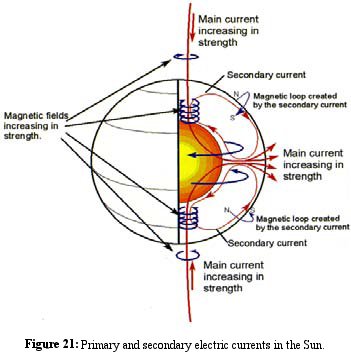
Red arrows generally follow conventional currents (protons / +ions), as I understand it. Electrons / -ions (sometimes called the electron current) would flow in generally the opposite direction. Keeping in mind this is a very general diagram and the entirety of current flow would not necessarily be as "cleanly" at the equator / poles.
Granted, it's known there's an [equatorial] heliospheric current sheet. Will be interesting to see if they find some structure(s) in / over the solar poles... I mean, we already know there are coronal holes at the poles. Which I tend to think fit well with Birkeland's terella experiments (from a hundred years ago!)... See Fig. 260a:
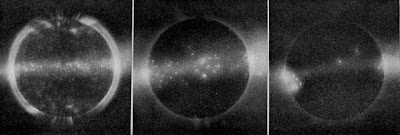
So, at the poles, one might consider the possibility there could be electrons flowing out and/or +ions flowing in. Or, equatorially, there may be a net flow of +ions outward, and electrons inward. Whether and how strongly this is so, I think still remains to be proven empirically. That is to say, whether, where and how much of an electron drift current exists. Likewise, whether there's some similar +ion drift current over the poles?
WRT how a sun/star might maintain a positive voltage with respect to its surrounds, it's hard to say, but there's certainly the notion that has been forwarded by others before and elsewhere that stars may act to separate charges to some degree by way of gravity. How might this be so? Consider that a star is generally considered to be held together by gravitation. Then there's the notion that heavier things tend to sink in a gravitational field. Protons are heavier than electrons. A gravitational field may tend to generate electric dipoles in its atoms by offsetting the positively charged nucleus from the center of the atom (toward the star's center of gravity). This may the set up something like an electret with a radially oriented electric field (lots of tiny dipoles summed over the volume of the body). As Wal notes in one of his articles, in such a body, the lighter more mobile electrons may/will migrate toward the surface. Conversely, the heavier, less mobile particles of nuclei may then tend to sink. Thus, setting up the aforementioned electret effect and/or charge polarization (more positive charges on the inside, more negative charges on the outside).
If this be so, then, the positively charged internal components would self-repel and halt collapse, potentially also causing the core of the object to become isodense (largely the same density throughout). There's apparently some evidence for this in the radial pulsations of the sun.
Just one potential way to look at things. It also leads in to discussion of sunspots:
(Twinkle, Twinkle Electric Star)
http://www.holoscience.com/news.php?article=x49g6gsf
(The Electric Sun)Wal Thornhill wrote:Sunspots are a clearing of the tufts where a dark discharge from an equatorial plasma toroid encircling the Sun punches through them. Birkeland had the general idea figured out in 1913! The dark center, or umbra, of the sunspot shows the cooler temperature of the Sun beneath the bright plasma. The sunspot penumbra, in which we are looking at the sides of the “hole” punched through the tuft layer, shows the structure of the tufts. They are bright tornadic cylinders of plasma, thousands of kilometers long.
http://www.electric-cosmos.org/sun.htm
Don Scott wrote:In a plasma, both the dimensions and the voltages of the anode tufts depend on the current density at that location (near the anode). The tufts appear and/or disappear, as needed, to maintain a certain required relationship between +ion and electron numbers in the total current. This property of anode tuft plasmas was discovered, quantified, and reported by Irving Langmuir over fifty years ago.
In the Electric Sun model, as with any plasma discharge, tufting disappears wherever the flux of incoming electrons impinging onto a given area of the Sun's surface is not sufficiently strong to require the shielding produced by the plasma double layer. At any such location, the anode tufting collapses and we can see down to the actual anode surface of the Sun. Since there is no arc discharge occurring in these locations, they appear darker than the surrounding area and are termed "sunspots". Of course, if a tremendous amount of energy were being produced in the Sun's interior, the spot should be brighter and hotter than the surrounding photosphere. The fact that sunspots are dark and cool strongly supports the contention that very little, if anything, is going on in the Sun's interior. The center of the spot is called its umbra.
That is to say, the solar interior may be a positively charged object, with the solar photosphere being an arc-mode electric "shell" of sorts that also acts to screen the internal charge from the outside world to some degree. Sunspots allow that internal charge a freer path outward, in theory.Don Scott wrote:Because there is no anode tufting where a spot is located, the voltage rise (region a to b in the energy plot above), which normally limits the local flow of positive ions leaving the anode surface, does not exist there. In sunspots, then, a large number of ions will flood outward toward the lower corona. Such a flow constitutes a large electrical current - and, as such, will produce a strong localized magnetic field near the sunspot.
The Sun's corona is difficult to see except in solar eclipses and in X ray images. This is because the corona is a "normal glow" discharge compared to the tufts which are in "arc mode". In some X ray images of the Sun (such as the one shown in the first figure at the very top of this page) we can see "coronal holes" - large dark regions in the brighter image of the solar corona. The bright regions in X-ray images of the corona indicate hotter, more energetic areas; these are mainly above the sunspot regions.
(Our Misunderstood Sun)
http://www.holoscience.com/news.php?article=ah63dzac
[image]

Cheers,
~Michael Gmirkin
"The purpose of science is to investigate the unexplained, not to explain the uninvestigated." ~Dr. Stephen Rorke
"For every PhD there is an equal and opposite PhD." ~Gibson's law
"For every PhD there is an equal and opposite PhD." ~Gibson's law
-
Shelgeyr
- Posts: 178
- Joined: Tue Oct 14, 2008 1:36 pm
- Location: Texas
Re: Solar Anode?
Thanks, Michael! You've given me a bunch to ponder. I had forgotten that graphic showing the current directions around the sun. I'll chew on this info for awhile and probably come back with some follow-up questions, but in the meantime you've been most helpful. Thanks again!
Shelgeyr
Sometimes I feel like a tiger’s got my leg...
Sometimes I feel like a tiger’s got my leg...
-
seasmith
- Posts: 2815
- Joined: Thu Mar 27, 2008 6:59 pm
Re: Solar Anode?
Solar Anodes
For a crowd that purports to embrace the concept of a cosmos of a most nebulous nature, that is the Electric Universe, there seem to be more than a few (not you Michael) who are unable or unwilling to wrap their heads around its most universal characteristic.
Simply speaking, that may be called Polarity.
We recognize the various ebbs and flows of charge carriers, this way and that, throughout the stellar systems and galaxies, as identified by classes of plasma formations; and inevitably the question of cathode to the “Solar (net) Anode” arises .
Why would it be heretical to accept that, on universal scale, there would be grand plasmic circuits and pulsing cycles?
That we Perceive a world emerging in a nascent state of solar plasma, taking form in the common 4D framework of ponderable matter and then naturally exiting our existal matrix;
back to an aetheric ground state via the attracting poles.
These poles, euphemistically being called white poles, black holes, great attracters and etc., are no longer just phantasies. They do exhibit however, all the hallmarks of any extremely energetic discharge point, be it on Io, Mars or a Lexan plate.
A huge formation of charge carriers disappears in a relatively tiny spot , often with very dramatic peripheral effects.
Happy Memorial Day
For a crowd that purports to embrace the concept of a cosmos of a most nebulous nature, that is the Electric Universe, there seem to be more than a few (not you Michael) who are unable or unwilling to wrap their heads around its most universal characteristic.
Simply speaking, that may be called Polarity.
We recognize the various ebbs and flows of charge carriers, this way and that, throughout the stellar systems and galaxies, as identified by classes of plasma formations; and inevitably the question of cathode to the “Solar (net) Anode” arises .
Why would it be heretical to accept that, on universal scale, there would be grand plasmic circuits and pulsing cycles?
That we Perceive a world emerging in a nascent state of solar plasma, taking form in the common 4D framework of ponderable matter and then naturally exiting our existal matrix;
back to an aetheric ground state via the attracting poles.
These poles, euphemistically being called white poles, black holes, great attracters and etc., are no longer just phantasies. They do exhibit however, all the hallmarks of any extremely energetic discharge point, be it on Io, Mars or a Lexan plate.
A huge formation of charge carriers disappears in a relatively tiny spot , often with very dramatic peripheral effects.
Happy Memorial Day
-
seasmith
- Posts: 2815
- Joined: Thu Mar 27, 2008 6:59 pm
Re: Solar Anode?
addendum
<The pointy ends of (dual) aetheric vorticies>
~
<The pointy ends of (dual) aetheric vorticies>
~
-
Dragoneye
- Posts: 18
- Joined: Wed Jul 16, 2008 11:18 am
Re: Solar Anode?
Would a transformer be a better analogy to our solar system than and anode/cathode system?
-
mharratsc
- Posts: 1405
- Joined: Mon Jan 26, 2009 7:37 am
Re: Solar Anode?
PnP transistor? 
Mike H.
"I have no fear to shout out my ignorance and let the Wise correct me, for every instance of such narrows the gulf between them and me." -- Michael A. Harrington
"I have no fear to shout out my ignorance and let the Wise correct me, for every instance of such narrows the gulf between them and me." -- Michael A. Harrington
Who is online
Users browsing this forum: No registered users and 7 guests