Most here would know of Anthony Perratt's quasar evolution simulations of galaxy formation, based on Alfven's models. This also lines up with Halton Arp ejection observations and models.
Described well here:
http://www.plasma-universe.com/index.ph ... _formation

"Peratt's galaxy formation simulation: Simulation of plasma in two adjacent Birkeland filaments of width 35 kpc and separation 80 kpc. The axial extent of the simulation is only 10 kpc, so the formation of a 3-d disk is not demonstrated by this calculation."
note:
35kpc filament width : 80kpc seperation
= modeled 0.43 ratio of filament to seperation
anyways, as we know, if you replace "quasar or birkeland current" with "black hole" you'll get way more search results and papers with todays tools... I came across this paper/archive which stood out to me...
http://adsabs.harvard.edu/abs/2009arXiv0905.3566W
http://www.ledas.ac.uk/cgi-bin/atel/ind ... ?read=2061
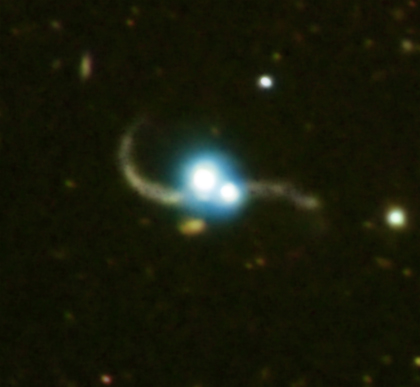
<1.9kpc width : 5.1kpc seperationThe radio-quiet quasar SDSS J1536+0441 shows two broad-line emission systems that Boroson and Lauer interpret as a candidate binary black hole system with a separation of 0.1 pc (0.02 mas). From new VLA imaging at 8.5 GHz, two faint sources, separated by 0farcs97 (5.1 kpc), have been discovered within the quasar's optical localization region. Each radio source is unresolved, with a diameter of less than 0farcs37 (1.9 kpc).....
Observed 0.37 ratio of filament to seperation?
As it turns out, this 'quasar' upon enhanced resolution is a... well 'binary quasar'...
Have a look at the image here:

To me the above Perratt Modelled ratios and observed ratios are darn close....ie.. 0.4 = 0.4
Can we expect upon enhanced resolution that quasars will reveal similar binary relationships. Alot would depend on the angle we view the quasars/birkeland filaments... is this just a fluke perpendicular observation of birkeland currents..... it's pretty clear these "quasars", "black holes", "birkeland currents" are interacting.... They do match a prediction of the Alfven model no?
Ofcourse the size/magnitude is slightly different... but as we know plasma / current scales well... certainly those scales.... anyways just something that stood out to me...
As these new telescopes and imaging technologies come online VLA, SKA, VLT are we going to be able to have the resolution to separate these objects... of course interacting objects imaged perpendicular to their plane will show up first.