

I thought it was no point in presenting this hypothesis at the thunderbolts forum as it seems like the electric universe model has a positively charged Sun, and a solar fusor model requires a negatively charged Sun to work, so I thought, but I was wrong.
The ground we walk on is also positive compared to the negatively charged ionosphere of Earth. And between the positively charged ground and the negatively charged ionosphere we have a strong electric field. What if we also have such an electric field on the Sun?
During solar quiet the magnetic field of the Sun looks something like this:
http://qdl.scs-inc.us/2ndParty/Images/C ... rs_wbg.png

The current sheet springs out from magnetic equator and the helmet streamer area is an extra hot area of the million degree Corona.
At Earth we also have something similar, between the aurora ovals we have a lot of lightning strikes, with lightning going down, and electrons going down are the same as an electric current going up. In the magnetotail of Earth’s geomagnetic field we also have a current sheet and something that looks like a helmet streamer:
http://www.igpp.ucla.edu/public/THEMIS/ ... /Fig-1.jpg

http://www.nature.com/nphys/journal/v9/ ... 664-f1.jpg

In the magnetotail of Earth we have observed a phenomenon which creates oppositely accelerated concentrated particle jets and electrons flow along magnetic flux lines and create intensive aurora. This phenomenon is usually explained by magnetic reconnection. What it looks like is a plasma pinch, like in plasma pinch fusion, in addition we have magnetic waves/oscillations that also get concentrated in this area, and changing magnetic fields can do work. Changing magnetic fields is also a great charge separator as light electrons are more easily accelerated than heavy ions, and opposite charges may also be accelerated opposite ways.
http://sci.esa.int/science-e-media/img/ ... on_565.jpg

The magnetic field of the Sun turns approximately every 11 year when the Sun has a lot of Sunspots, sunspot systems also create a local magnetic field, coronal loops and helmet streamers. Again we get a similar picture: http://scitechdaily.com/images/Astronom ... Flares.jpg

Here we get a build-up of accelerated electrons that may work as a virtual cathode, that may help to accelerate the positive part of the plasma downflow, and help to drag up positive particles from the photosphere of the Sun. Nasa is currently working on a plasma pinch device, where they use coronal discharge and a virtual cathode to accelerate a plasma jet, and pinches it by using magnetic fields: http://1.bp.blogspot.com/-o6wYBY3Oolg/T ... fusion.png And again we have a similar picture.

https://ase.tufts.edu/cosmos/pictures/C ... ig6_21.jpg

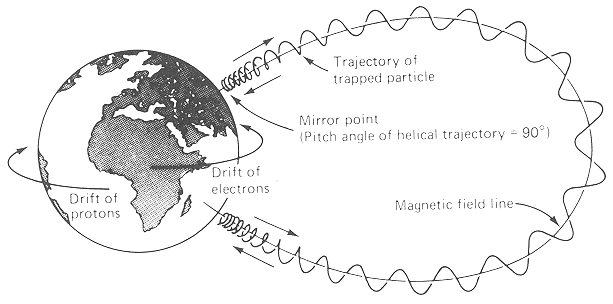
I don't think they got this explanation fully correct, it seems like the photosphere and below is positively charged and work as an anode, then positively charged particles reject each other and are accelerated upwards along magnetic flux lines. The build up of electrons act as a virtual cathode which also help to accelerate the electrons. Electrons and ions like protons have a hard time leaving the system as they are bound by the magnetic field lines and the bottleneck reconnection area, even waves may be partly trapped inside the system. And when positive particles accelerate past the virtual cathode they are pulled back by the cathode and gravity and loops back towards the Sun. We get particles flowing in both directions along strengthened magnetic fields, and if they don’t crash in the loop they crash at the base of the loop, or get mirrored and continue to particle bounce in the loop. The loop easily creates proton proton fusion, and makes more easily fusable fusion fuel like deuterium and tritium and when the concentration gets high enough we might get a nuclear fusion explosion which we call a solar flare. From solar flares we measure increased neutron emissions, we measure increased number of positrons in the solar wind and we observe the positron annihilation line in the light spectrum at 511keV and the neutron decay line at 2,2 MeV.“Fig. 6.10 . A solar flare is powered by magnetic energy released from a magnetic interaction site above the top of a coronal loop. Electrons are accelerated to high speed during a solar flare, generating a burst of radio energy as well as impulsive loop-top hard x-ray emission. Some of these non-thermal electrons are channeled down the loop and strike the chromosphere at nearly the speed of light, emitting hard x-rays by electron-ion bremsstrahlung at the loop footpoints. When beams of accelerated protons enter the dense, lower atmosphere, they cause nuclear reactions that result in gamma-ray spectral lines and energetic neutrons. Material in the chromosphere is heated very quickly and rises into the coronal loop, accompanied by a slow, gradual increase in soft x-ray radiation. This upwelling of heated material is called chromospheric evaporation, and occurs in the decay phase of the flare.”
Fusion is not that hard as long as we use kinetic energy instead of heat and pressure, many have built fusors in their garage, where deuterium is accelerated in by an electric field. One of the problems with fusors is that they lose energy due to the non-virtual cathode.http://www.polywellnuclearfusion.com/Po ... /Fusor.jpg
This massive acceleration of energized particles through the chromosphere creating and dragging magnetic fields with them, will make a conductive path which also the virtual electrons can follow, and they go down to the photosphere. This would also be kind of a short circuiting of the system, and might itself lead to nuclear chain reactions, this could even be what triggers the solar flare. After the solar flare the virtual cathode is then gone and the system cannot sustain itself.
So basically we have similar situations on the whole Sun, a positive photosphere, an insulating chromosphere and an electron rich transition region at the top of the chromosphere acting as a virtual cathode. This would then explain how spicules grow and fall. The grow by coronal discharge from the photosphere anode and attraction by the transition region virtual cathode, once they go up past the virtual cathode, they are pulled down by the cathode and gravity. Some of the ions in the spicule might also pick up electrons and get more neutral and gravity pulls it back to the Sun. Some fully ionized particles might also go for a bounce along the solar magnetic fields, like particles do in Earth’s magnetic field. Again such bouncing might lead to particles crashing and nuclear reactions. Waves in the magnetic field like Alven waves might further energize these positively charged particles. And both currents and nuclear reactions like fusion might add to the waves and oscillations.
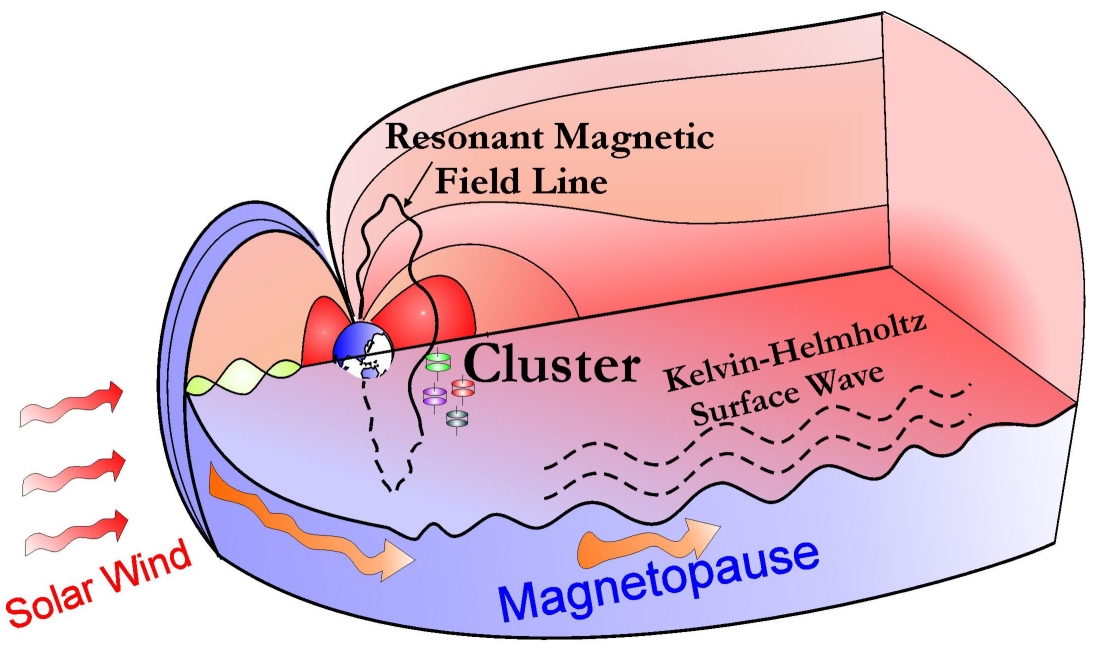
If we draw the parallel to Earth once more, where solar wind interacts with the geomagnetic field,we see that interstellar wind is probably interacting with the huge outer heliosphere. Not only through magnetohydrodynamics and induction, but waves, setting the magnetic fields in motion so they can do work on charged particles. And most intense these waves get in the helmet streamer/magnetotail bottleneck where they are concentrated. Waves might also come from the magnetotail and enter the bottleneck and go towards the Sun, and if we have a current here we might say it is alternating. The waves will also contribute with oscillations like in the geomagnetic field.http://sci.esa.int/science-e-media/img/ ... -waves.jpg
http://sole-terra.aquila.infn.it/img/ulf1.gif

Are thunderstorms and sunspots a similar phenomenon?
The similarities between Earth and the Sun go further as it seems like we also have fusion in the tranquil atmosphere of Earth. Thunderstorms show signs of nuclear reactions both in lightning and in the ionosphere above the thunderstorm. In thunderclouds we find clouds of positrons and neutrons. We measure high energy gamma rays from lightning, and rocket experiments dragging a tritium enriched wire to release lightning has recreated these gamma rays. There has also been measured a higher deuterium and tritium content in rain and hail from thunderstorms.
Above thunderstorms in the ionosphere there has been observed big clouds of positrons shooting out in space along magnetic field lines together with gamma ray flashes. Currently is does not seem to be a good explanation for this, most say it is a ultra high energy cosmic ray attracted to the storm system which gives the blast, but such a high energy cosmic ray has never been measured.
So it seems like we have nuclear reactions and fusion both in the lower and upper parts of a thunderstorm system, and it seems like we have nuclear reactions and fusion in the lower and upper parts of sunspot systems. And it might not be a coincidence and thunderstorms and sunspots are similar in nature, as they might be caused by a discharge phenomenon across a layer of insulating gas.http://cdn.phys.org/newman/gfx/news/hir ... shazar.gif

If we have a virtual cathode of electrons in the ionosphere/thermosphere above the thunderstorm caged by a downward magnetic field, the cathode could pull in positive particle clouds from space along magnetic flux lines, like another place where the flux line crosses the ionosphere, or it could drag in positive particles from the plasmasphere surrounding earth or high energy particles from the Van Allen belts. Such an accelerated cloud of positive particles accelerated from space towards the ionosphere above a thundercloud will make x-ray and gamma ray of nuclear reactions. Mainly proton-proton collisions producing the observed positrons and deuterium.http://3.bp.blogspot.com/-c8ce29m2RRI/U ... mmaRAY.png

A virtual cathode could also set positive particles in the atmosphere in upwards motion, if they crash with gas it will create more ionization and a more conductive atmosphere. If the atmosphere gets conductive enough electrons from the virtual cathode might even go downwards. They might reach the positive top of the thundercloud, and get a discharge, after such a discharge there is not enough force to push the magnetic field downward and it springs back up again and pushes the remaining free electrons up with it. But it is hard to know what is exactly happening as thunderstorm phenomena are usually thought of as an electric phenomenon, and I don’t seem to find any detailed information on magnetic fields in thunderstorm systems.
The main difference between how science explains sunspots and thunderclouds are that sunspots are usually explained as a magnetic phenomenon, while thunderstorms are usually explained as an electric phenomenon. Which is odd as you can’t separate the force of electromagnetism, as most easily explained by the right hand law, which show that magnetism, electricity and force is bound together. We currently operate with four forces of nature, weak and strong nuclear force, gravity and electromagnetism and to fully explain sunspots and thunderclouds it seems like we have to use all the forces of nature.
Here is a list of similarities between sunspots and thunderstorms:
1. Both sunspots and thunderclouds are in a gas rich insulating atmospheric layer.
2. Both sunspots and thunderclouds have magnetic fields which could trap a virtual cathode in the plasma above.
3. Both sunspots and thunderclouds show strong signs of nuclear reactions and fusion in both lower levels and upper levels.
4. Positron bursts shooting out in space has both been measured from solar flares and from the ionosphere above thunderclouds, together with high energy gamma ray bursts.
5. We measure increased deuterium and tritium content in rain and hail from thunderstorms, and we measure increased deuterium and tritium content in solar wind from solar flares.
6. We measure increased neutron emissions from solar flares and we measure neutron emissions from thunderclouds.
7. We measure high energy gamma and x-rays from high and low levels in sunspot systems and thunderstorms.
8. Both solar flares and thunderclouds show signs of a shock front/cosmic ray spallation cascade, as something is coming from above and crashing into a denser atmosphere.
9. Both Sunspots and thunderclouds are extremely rare in polar regions, and seems to be located where the magnetic field is closed by a bottleneck/magnetic-reconnection-area.
10. Thunderstorms are more frequent during periods of high sunspot activity as high solar wind activity trigger thunderstoms.http://www.bbc.com/news/science-environment-27406358 If sunspots are created in the same way, they might be triggered by interstellar wind pushing against the heliosphere, and less interstellar wind will give fewer sunspots. There has been great changes in the direction of the interstellar wind lately, and there is a strange heliospheric ribbon at the outskirts of the heliossphere. One theory is that the Sun is heading out of the local interstellar cloud and into more empty space with more energized particles.https://upload.wikimedia.org/wikipedia/ ... arrows.jpg Our Sun has just turned its magnetic field after an all-time low sunspot period, so it might now be experiencing less intense interstellar wind. We could then expect less sunspots and more cosmic rays in the coming years. Looking at the Moscov neutron monitor it seems that the cosmic ray counts are already huge even if the sun just reversed its magnetic field, so we might also get an all-time high cosmic ray count during the next years.

11. The atmosphere of Earth and the Sun has a correlating temperature gradient:
https://goo.gl/photos/e6wxVznowsNREZVT7Overlay of solar temperature gradient and temperature gradient Earths atmosphere.
Well that was basically it. I got the urge to take up my solar model pondering as I was studying black holes and could not grasp why scientists think stars are rather quietly dragged into black holes. A black hole close to a star will make the star undergo intense outer fusion burning, often resulting in a super nova which is the outer atmosphere of a star exploding in a chain reaction. Supernova remnants often has a star left in the middle of the supernova cloud, so this star did not explode from the inside out, it was its atmosphere exploded. And those neutron stars does not seem to be neutron stars, but stars with pulsating fusion, like a pulsating fusor with particles bouncing, or the possibility for ring currents and grand particle jets. The only thing that goes quietly into a black hole is the stellar core remnants, made of iron. Iron is neither fuel for fusion or fission and those black holes cleans it up and plays a part in renewing the elemental balance in the universe. And black holes are not singularities, the universe is balanced, and black holes are the entrance to a wormhole with a white hole in the other end. And when I studied the black hole in the middle of the galaxy, it did not seem black at all, as all observations are more consistent with Sag A* being a white holehttp://physics.stackexchange.com/questi ... white-hole, pushing out energy, a part of a galactic engine, but that is another story.