Hi,
Mainstream has a very poor explanation for star and planet momentum inside galaxies. Does EU have an explanation for it? I mean why is the Earth orbiting the Sun at 108 000 km/h or the Sun orbiting the center of the Milky Way at 70 000 km/h? How did they acquire that speed in the first place?
Thanks
Momentum

-
D_Archer

- Posts: 1255
- Joined: Sat Apr 18, 2009 4:01 am
- Location: The Netherlands

-
Electro

- Posts: 394
- Joined: Tue Apr 28, 2015 8:24 pm
Re: Momentum
I don't care about the speed. I just want to know how they acquired their movement (not their own rotation). If we can't explain it better than the mainstream, the theory is then incomplete.
-
ElecGeekMom
- Posts: 328
- Joined: Tue May 27, 2008 9:01 am
Re: Momentum
Good question.
The motion of the heavenly bodies reminds me of those toys that look like lightbulbs with fans inside. One side on each blade of the fan is black, the other is white. When you shine light on it, the fan rotates. No wind can get to it because the fan is sealed inside the bulb.
The motion of the heavenly bodies reminds me of those toys that look like lightbulbs with fans inside. One side on each blade of the fan is black, the other is white. When you shine light on it, the fan rotates. No wind can get to it because the fan is sealed inside the bulb.
-
Electro
- Posts: 394
- Joined: Tue Apr 28, 2015 8:24 pm
Re: Momentum
Or perhaps we can find an analogy with the plasma globe?

-
Electro
- Posts: 394
- Joined: Tue Apr 28, 2015 8:24 pm
Re: Momentum
Or maybe something like this:
http://phys.org/news/2010-09-scientists ... video.html
http://phys.org/news/2010-09-scientists ... video.html
.Because the technique can be applied to a wide range of materials, it could also be used to study airborne particles such as atmospheric aerosols, as well as to model dusty plasmas and interstellar dust, among other applications
-
Electro
- Posts: 394
- Joined: Tue Apr 28, 2015 8:24 pm
Re: Momentum
Or, the rotating magnetic field is giving stars their momentum?
http://phys.org/news/2015-06-magnetic-f ... .html#nRlv

http://phys.org/news/2015-06-magnetic-f ... .html#nRlv
-
scowie
- Posts: 91
- Joined: Tue Jan 21, 2014 8:31 am
Re: Momentum
When you ask how the speed/momentum is acquired it sounds like you think that two bodies having no relative speed would be the starting point and that some deviation from this occured for some reason. That really makes no sense if you think about it.
If two bodies are separated by a great distance, having the same speed would be an amazing coincidence. It would be like rolling two billion-sided dice and getting the same number on each! Speeds are different when there is no reason for them to be the same.
If two bodies are separated by a great distance, having the same speed would be an amazing coincidence. It would be like rolling two billion-sided dice and getting the same number on each! Speeds are different when there is no reason for them to be the same.
-
nick c

- Site Admin
- Posts: 2483
- Joined: Sun Mar 16, 2008 8:12 pm
- Location: connecticut
Re: Momentum
Why not?Electro wrote: I mean why is the Earth orbiting the Sun at 108 000 km/h or the Sun orbiting the center of the Milky Way at 70 000 km/h? How did they acquire that speed in the first place?
-
BeAChooser
- Posts: 169
- Joined: Wed Oct 14, 2015 7:24 pm
Re: Momentum
I’m new here but here's the way I understand it works. As a cloud of rotating plasma begins to coalesce into a star and planets (and that is the mainstream model: http://csep10.phys.utk.edu/astr161/lect ... bular.html ), there is a problem that the mainstream’s gravity-only astrophysicists simply ignore. A slowly rotating cloud may tend to collapse under gravity but there is a point where the outward rotational force will counteract further collapse. Stars can’t form without doing something with this excess rotational energy (angular momentum). It must be dissipated to enable the cloud to collapse further … but the mainstream model has no believable way to do this. So it just ignores it.Electro wrote:Mainstream has a very poor explanation for star and planet momentum inside galaxies. Does EU have an explanation for it? I mean why is the Earth orbiting the Sun at 108 000 km/h or the Sun orbiting the center of the Milky Way at 70 000 km/h? How did they acquire that speed in the first place?
There is a second problem … that the star, as the most collapsed object, should be spinning the fastest (like a pirouetting dancer pulling in her arms). But if you observe our own solar system, the Sun spins slowly. Almost the entire angular momentum in the solar system (99%) is to be found in the orbiting planets. This appears to be typical of star systems. And again, the mainstream's approach to this difficulty is to ignore it. To this day, my understanding is that they still don’t have a good model for how star systems actually form. They just gloss over any problems they can’t explain.
But plasma universe proponents do have a model and it’s based on ordinary physics. It overcomes both of the above obstacles, and more. It's a VERY detailed one that was proposed by Nobel Prize winner, Hannes Alfven, and his colleague Gustaf Arrhenius, back in the 70s (https://books.google.com/books?id=pvrtC ... es&f=false ; see pages 138-143, in particular). Sadly, their model has been essentially ignored by mainstream *scientists* ever since.
They theorized that because inner part of the charged protostellar plasma cloud would spin faster than the outer part, an electric current would be generated, "flowing out along the solar magnetic field lines, through the cloud and back to the sun at its equator" . The interaction of the currents and magnetic fields would cause the inner cloud to slow down, and the outer cloud to speed up, transferring angular momentum outward, and allowing further collapse. They theorized that force free plasma filaments, they called them “superprominences”, could transfer the angular momentum from the sun to the plasma from which the planets formed ... and because the filaments pinch the plasmas together in the process, they would also help speed up planet formation. Here’s a graphic of this process: http://www.angelfire.com/rnb/pp0/superprom.jpg . They noted that there would be what they termed “jet streams” forming from the matter in the system along the equatorial axis (in the disk) where atoms in the plasma state would coexist with neutral grains of matter. They said these jet streams would be of decisive importance as an intermediate stage in the accretion of planets and satellites from grains. Inside the jet streams, the grains would accrete to larger bodies and eventually to planets and satellites. I think this model explains how the planets and the star in a star system gain and distribute their angular momentum.
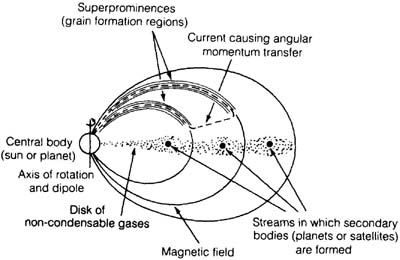
As to galaxies, they form by the interaction of 2 galactic sized, current carrying Birkeland filaments. This was laid out in 1978 and 1981, in a papers titled “Interstellar Clouds and The Formation of Stars” and “Cosmic Plasma”, by Alfven (and Per Carlqvist). They postulated an electrical solar and galactic model (see http://articles.adsabs.harvard.edu/cgi- ... etype=.pdf and https://books.google.com/books?id=gAnvC ... en&f=false ). They drew a circuit that was really just a scaled up version of the homopolar motor that Michael Faraday invented and said that galactic discs behave like the conductive plates in a homopolar motor. Birkeland currents flow within the galactic disks, powering their stars. The galaxies are, in turn, powered by intergalactic Birkeland currents. Their model explained the rotation curve of galaxies that started the whole Dark Matter nonsense. As two intergalactic sized, current carrying, Birkeland filaments interact, they begin to wind about each other, creating the top level angular momentum of the clouds in which the galaxy will form. That angular momentum is in turn transferred to the stars as they form causing them to move about the galaxy core. All the motions are influenced by the large magnetic fields that are created in the homopolar motor that the galaxy then represents. That's the way I understand it, at least.
-
Electro
- Posts: 394
- Joined: Tue Apr 28, 2015 8:24 pm
Re: Momentum
Thank you for your reply. The process for galaxy formation does shed light on star momentum. However, EU reject accretion for planet formation, and stars are formed electrically by Z-pinch.
-
webolife

- Posts: 2539
- Joined: Mon Mar 17, 2008 2:01 pm
- Location: Seattle
Re: Momentum
It's called a radiometer, and is a great tool for explaining the centropic pressure theory of light.ElecGeekMom wrote:Good question.
The motion of the heavenly bodies reminds me of those toys that look like lightbulbs with fans inside. One side on each blade of the fan is black, the other is white. When you shine light on it, the fan rotates. No wind can get to it because the fan is sealed inside the bulb.
Electro,
I agree with some of the other comments above that it is not sensible to begin with a universe with no motion. No scientific model can possibly explain the creation of energy, kinetic, potential, or otherwise. Conservation of momentum is a primordial element. As BeAChooser mentioned above, electric accretion [Z-pinch] is as good a model as gravitational, and doesn't have the inherent problems regarding the distribution of angular momentum in our solar system and other star systems.
Truth extends beyond the border of self-limiting science. Free discourse among opposing viewpoints draws the open-minded away from the darkness of inevitable bias and nearer to the light of universal reality.
-
querious
- Posts: 564
- Joined: Mon Jun 23, 2008 8:29 pm
Re: Momentum
Then where did the planets get their angular momentum?webolife wrote:As BeAChooser mentioned above, electric accretion [Z-pinch] is as good a model as gravitational, and doesn't have the inherent problems regarding the distribution of angular momentum in our solar system and other star systems.
-
Electro
- Posts: 394
- Joined: Tue Apr 28, 2015 8:24 pm
Re: Momentum
Well, according to the Electric Universe theory, planets are ejected from red dwarf stars, brown dwarfs and gas giants. According to the General Theory of Stellar Metamorphosis (GTSM), planets are stars and stars are planets. Planets are simply the result of the evolution of a star, when it cools off and dies. Since it's a star, it already has the momentum.querious wrote: Then where did the planets get their angular momentum?
Who is online
Users browsing this forum: No registered users and 21 guests