How to calculate a Magnetopause

Beyond the boundaries of established science an avalanche of exotic ideas compete for our attention. Experts tell us that these ideas should not be permitted to take up the time of working scientists, and for the most part they are surely correct. But what about the gems in the rubble pile? By what ground-rules might we bring extraordinary new possibilities to light?

Moderators: MGmirkin, bboyer

Locked
User avatar
StevenO
Posts: 894
Joined: Tue Apr 01, 2008 11:08 pm

How to calculate a Magnetopause

Post by StevenO » Mon Nov 02, 2009 3:24 am

Another brilliant "Electric" Universe paper by Miles Mathis:

The Magnetopause calculated by the Unified Field
Miles Mathis
Image

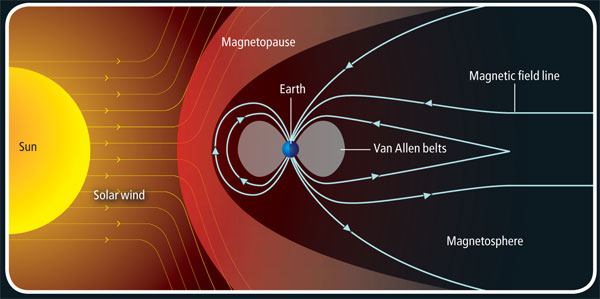
Abstract: I will use my simple unified field to explain several anomalies in the action of the Solar Wind and in magnetospheric exclusion of ions. Using this same field, I will calculate, with simple math, the distance of the Earth's magnetopause (this has never been done). Then, using this same equation, I will predict a distance for the ionopause of Venus—a distance not yet known.

It has been found that the Solar Wind works differently with positive ions and negative ions.* Protons are accelerated by the Wind in an even manner, passing the Earth in numbers and at velocities that can be predicted from various models by the temperature of the corona. But electrons behave in an unpredictable manner, not being accelerated at the proper velocity. They are moving too slowly. They have also been found to be diverted by magnetic field lines, while the protons were not.

This phenomenon, though long known, has never been explained. The standard model cannot explain it because the dipole field of electromagnetism is supposed to be balanced. That is to say, the proton is not given more charge than the electron, or vice versa. The electron attracts the proton just as much as the proton attracts the electron. Given a field of potential like this, there is no way to explain the different behavior of negative charge and positive charge. According to the standard model, the solar system is nearly neutral as a whole, so ions are accelerated due to very limited field or no fields. In other words, they are not being accelerated by some long-range potential between the Sun and outerspace, they are being accelerated by short-range potential differences in the outer layers of the Sun, or are being ejected directly from the interior as thermonuclear by-products. Other explanations are also advanced. But none can explain the data. If the ions are accelerated by charge, then the electrons should be going in opposite directions to the protons. If they are accelerated by mass, the electrons should be accelerated more, not less. The proton has more inertia, so it should resist acceleration better. Likewise if ions are ejected from the solar interior: electrons should be ejected at greater velocities, since they are smaller. Or, if they are both ejected near c, and are nearly equivalent due to the limit at c, then they should be nearly equal. In no case should the electron be accelerated less, or be more easily diverted.

But the plasma or electrical sun model can also not explain it. The only prominent competing theory of solar energy to attract any attention in the past half-decade has been the electrical model, which came (in twisted channels) from Velikovsky and plasma research. According to this theory, the Sun is a giant anode being fed energy from cathodes in the rest of the galaxy. But if this is so, then only the protons should be accelerated out from the Sun. The electrons should either never be ejected, or they should loop back immediately. This theory is also contradictory in the way it treats the Earth and the Solar Wind. According to Ralph Juergens (following Tesla), the Earth acts like a well of negative charge. As such, it should repel negative ions in the Solar Wind. Instead, we find that the Earth, via its magnetosphere, excludes both negative and positive ions. The E/M field, which is supposed to be field of potential in both the standard and plasma models, is not acting like a field of potential.

Both models use plasma to explain Solar Wind exclusion, but neither model is consistent. Let's look at how Wikipedia uses plasma to explain Solar Wind exclusion. On the page entitled “Magnetosphere”, we are told of the Solar Wind that:

Its composition resembles that of the Sun—about 95% of the ions are protons, about 4% helium nuclei, with 1% of heavier matter... and enough electrons to keep charge neutrality.

See a problem there? You cannot maintain charge neutrality with 99% positive charge. That leaves less than 1% negative charge, and <1% cannot balance >99%. The electron and proton have equivalent charges, by the first postulate of modern theory. Then we are told,

Physical reasons make it difficult for solar wind plasma with its embedded [interplanetary magnetic field] to mix with terrestrial plasma whose magnetic field has a different source. The two plasmas end up separated by a boundary, the magnetopause, and the Earth's plasma is confined to a cavity inside the flowing solar wind, the magnetosphere.

“Physical reasons.” I will have to remember that next time someone asks me a question about mechanics. “Physical reasons,” I will say. I am not questioning that plasmas may create these boundaries, I am pointing out that we require a mechanical explanation for it. An existential explanation will not do. “Because plasmas work like that” is not a mechanical explanation.

Since neither the standard model nor the plasma model has given us a satisfactory explanation for the electromagnetic action of the Solar Wind, I will offer a third model here, one that is far simpler and far more comprehensive.

In a series of other papers, I have shown that the Solar System is neither wholly gravitational, as the standard model would have it, nor mainly electrical, as the plasma model would have it. Like all else in the universe, the Sun and its environs are driven by the unified field. I have shown that Newton's main gravitational equation is really a simple unified field equation, and that it has contained the charge field from the beginning. I will now show how this explains various electrical anomalies in the Solar Wind and in the electrical fields of Solar System bodies.

The Sun is neither a classical anode nor a simple thermonuclear machine. Nor is it, at the foundational level, a direct outcome of plasma physics. Plasma physics, like all other physics, is underpinned by the unified field. Instead, the Sun is both a huge fusion reactor and a huge recycler of the charge field. In fact, it requires this recycling of the charge field in order to feed the fusion process.

To begin my explanation, I remind you once again that the charge field in my mechanics is not equivalent to either the electrical field or the magnetic field. The charge field underlies the E/M field, but is not strictly equivalent to it. The E/M field is a field of ions, but the charge field is a field of real charge photons—not virtual or messenger photons, but real particles with mass and radius and spin. These charge photons work strictly mechanically, by bombardment. All material particles (except photons) emit a steady stream of charge photons, to create the charge field. Since the Sun is composed of a stupendous number of material particles, it emits a stupendous charge field. This charge field is emitted spherically or radially and is, in the first instance, always repulsive. The charge field is monopole: its velocity and momentum is always radially out from the center. It varies in only one way: the charge photons may be upside-up or upside-down. In other words, the photons may be spinning either left or right. As a matter of convenience and symmetry, we may call the left spinners anti-photons. But both photons and anti-photons are emitted in the same direction. They are not dipole. They differ only in spin, not in field potential or linear motion.

“Where do these photons come from?” you may ask. “Shouldn't an emission field with mass cause a conservation of energy problem?” It doesn't, because the field is recycled. All the masses that emit the charge field also absorb or capture the charge field. It is the spin of the mass that allows it to do this. As I have shown with the atomic nucleus, the spin of the particle or collection of particles creates a low pressure at the axis poles. The charge field goes in at the poles and is ejected equatorially. All matter is an engine that exists by recycling this charge field. As with the proton and nucleus, so with all macro-spheres. Spin creates pressure variations in the charge field, which creates the simple engine. The Sun (and Earth) capture the charge field at the poles, and re-emit it everywhere else—but most along the equator.

The electromagnetic field is driven by the charge field, by direct bombardment. At first glance, you would think the electrons and protons would be driven equally, or that the electrons would be driven faster because they are smaller. But on looking closer, you see that the size difference between the electron and proton causes just the opposite effect, in a simple mechanical way. The electrons are driven less by the photon wind, because they can dodge greater parts of it than the proton. The radius of the electron is some 1800 times less than the radius of the proton, so large parts of the photon wind simply miss it. Therefore, the proton is driven more efficiently. This explains in a direct manner the data from the Solar Wind.

It also explains the deflection of the electron by planetary or Solar magnetic fields. Magnetic fields are caused by the spins on the photons, not by the linear momentum. The proton feels more of the linear field, since it gets hit more often, but it resists the spins of the photons better because it is larger. The protons and electrons are also spinning and are also emitting small charge fields of their own. But, contra the standard model, the proton actually has a greater charge than the electron, simply because it has a greater radius and therefore a greater angular momentum. This greater angular momentum allows it to resist the much smaller angular momentum of the charge field. The electrons, although hit less often, are more likely to be deflected (as a statistical matter on individual ions), because they feel a much greater relative force from the angular momenta of the photons.

In this way, the Sun is both anode and cathode, but only as regards the charge field. Due only to pressure differences, it attracts the charge field at its poles and emits the charge field everywhere else.

On a smaller scale, this also applies to the Earth. The Earth's spin makes it both anode and cathode to the charge field. It recycles the charge field, and the charge field drives the E/M field. This explains the genesis of the Earth's E/M field without postulating dynamos in the Earth. This also explains why the Earth, like all macro-bodies, often seems to be an infinite well of negative charge. Neither the standard model nor the electrical/plasma model can explain why the Earth should act like an infinite well of negative charge. For example, it absorbs a huge amount of mainly positive cosmic rays each year for billions of years with no drain. My unified field theory explains it by re-defining charge. The Earth recycles both protons and electrons, so both forms of charge are continuously renewed. There is no dipole, so the amount of one charge does not deplete the potential of the other. In fact, there is no potential at all, except the real pressure difference in the charge field, and the apparent electrical difference caused by the size differential between the electron and proton. And the magnetic field is not caused by potential either. It is caused by spin. In the magnetic field, quanta aren't turned by potential differences, they are turned by angular momentum.

This re-definition of the charge field and thereby the electromagnetic field resolves all at once the Velikovsky affair and the role of E/M in celestial mechanics. In fact, it solves all the problems of celestial mechanics, all the way back to Halley and Laplace.

Astrophysicists in the 50's and 60's could not accept Velikovsky's claims for electrical perturbations between solar system bodies, and physicists of all sorts still cannot accept any evidence of large electrical influences from anyone, and this is because neither the outsiders nor the insiders have been able to say how these influences can fit into equations of celestial mechanics—equations that already work almost perfectly in most situations. Shapley in the 40's and 50's could not countenance any pervading E/M field in the solar system for any reason, because he knew the equations of Kepler and Newton and Laplace already worked. There was no room for an addition. Sagan made the same arguments in the 70's and 80's, and current mainstream physicists are holding firm to that line. This is quite understandable, since the plasma physicists still haven't shown them where to fit the E/M field into the current successful equations. Velikovsky was full of ideas, but he never supplied a single line of convincing math.

But my simple equations do just that. I show where the E/M field fits into Newton's gravitational equation. The E/M field is already in the equation, hidden by G, so no external correction is necessary in most situations. Likewise, I have shown that the E/M field is already inside Kepler's ellipse equation and inside Laplace's great inequality equations. It has never been a matter of overthrowing celestial mechanics, or of creating a new unified field equation. I have shown that it was always just a matter of understanding that Newton's equation was already a unified field equation. Because Newton's mass field was already a unified field, Einstein's field equations are already unified field equations, too. We did not need to unify, we needed to segregate, so that we could see how both fields create the current equations mechanically.

If you have not yet read my analysis of Newton's gravitational equation, none of this will be plausible, so I encourage you to do so. But those readers who have will understand that this explains the boundary between the Earth and the Sun, the so-called magnetopause. The boundary between the plasmas is caused mechanically by the charge field, since the Earth's charge field is what creates and defines its plasma to begin with. At the foundational level, the boundary is the boundary between the charge field of the Earth and the charge field of the Sun. Both field are summed radially out, so we simply have a meeting of two spherical fields, one much smaller than the other. Since the charge field is always repulsive, it will exclude all ions, positive and negative, unless the ions are too energetic to be excluded (as with cosmic rays).

This is why Venus can also exclude the Solar Wind, even without a magnetosphere. The ability to exclude has little to do with the magnetic field and more to do with the charge field. Venus has enough mass to create a charge field strong enough to exclude the charge field of the Sun at that distance. With the Earth, the same is true. It is not the magnetosphere that excludes the Solar Wind, it is the charge field. The charge field creates both the magnetosphere and the boundary, and the boundary is only at the edge of the magnetosphere because both the charge field and the magnetosphere pause at the same place, for the same reasons. The magnetopause is at the charge-pause, because the magnetic field is caused by the charge field. The magnetic field would not be expected to extend beyond the charge field, because the charge field creates the magnetic field. And the magnetic field would not be expected to stop short of the charge-pause, because there is no reason for it to stop short. Ions are driven up by the charge field, and will persist as long as the charge field persists.

By this logic, you can see that it is the difference in the charge field densities that creates the differences in plasma fields, and the boundary. The boundary is that distance where the two charge fields have equal power. They have equal exclusion—defined as linear momentum—but one has more curvature than the other. This means that the magnetic or orthogonal components are not equal, creating a boundary and a “sideways” force. So the Solar Wind doesn't stop or blowback, it goes around. Since the Earth's field has more curvature, the magnetic component at the boundary acts to accelerate the Solar Wind once more. This is why the Wind is going faster as it passes close to the Earth than it was before it got there.

Wiki tells us that the magnetopause is 10-12 earth radii in the direction of the Sun. Using my mechanics, we can calculate that distance directly—something the standard model never does and cannot do. The mass of the Sun is 332,990 Earth's and its density is .255 Earth's. We seek a charge density on the surface of the Sun, and we can get that by just looking at the words. We seek a “charge density”. That could be written “charge x density”, and, as I have shown, charge is just a variant definition of mass. Therefore, we re-write the product as “mass x density.” M x D = 84,986. The Sun's charge density is 84,986 times that of the Earth. So we find by simple math that the charge field density is vastly different than the material density. We are finding the charge field density at the surface of the Sun, so we must sum all the mass “behind” that surface. All that mass emits charge photons.

Now we seek the point between Earth and Sun where the two charge densities are equal. Since I have proved elsewhere that the charge field, when emitted by spheres, diminishes as 1/r^4, we can solve. If the Sun's relative charge density is 84,986 at 1 Sun radius, at 214 Sun radii it will be .00004052. If the Earth's density is 1 at 1 Earth radius, at 12.53 Earth radii it will be .00004057. That is where the charge field strengths match. Since Wiki is measuring from the Earth's surface, we must subtract one Earth radius, giving us 11.53 Earth radii for the charge-pause.

The mainstream cannot supply this simple math because their E/M field has no mechanics underneath it. They are still trying to solve with potentials, which are forces at a distance. The standard model likes to denigrate Newton for having a gravitational field containing force at a distance, but modern E/M theory still is based on force at a distance, even in QED. QED has no foundational mechanics, except a pseudo-mechanics based on the virtual messenger photon. Virtual particles are even more brazen cheats than “physical reasons,” since “physical reasons” is just a dodge. Virtual particles are a non-mechanical lie, told straight to your face.

I encourage you to seek any mainstream math for the distance of the magnetopause. There is none because there can be none. The estimate from Wiki quoted above of 10-12 Earth radii is based on orbiter data, not on math or mechanics. It has to be rough because the orbiter data is rough. But, in fact, there is almost no variance in the magnetopause average. The magnetopause is dependent on the charge-pause, and the charge-pause is determined by the vital statistics of the bodies. Unless the Earth's or Sun's masses or radii change, the charge fields will not change. The magnetic fields can change, due to the ions present, but the charge field cannot change. For this reason, the magnetopause must always return to the average set by the charge-pause, and this average is solid. It is a number that can be found easily, as I just showed.

We can do the same math on Venus, showing that the smaller charge-pause is caused by the nearness of the Sun, not by the lack of a magnetosphere. The mass of the Sun is 408,589 Venus' and its density is .2706 Venus'. If the Sun's relative charge density is 110,548 at 1 Sun radius, at 153.6 Sun radii it will be .0002. If Venus' density is 1 at 1 Venus radius, at 8.4 Venus radii it will be .0002. So the charge-pause of Venus is 7.4 Venus radii from the surface, in the direction of the Sun. That is assuming the low angular momentum of Venus does not further retard its charge field emission. There is some evidence that the speedy and heavy atmosphere of Venus may help in charge field capture at the poles**, but I don't yet have a mathematical expression for the charge field that includes spin. Notice, however, that the standard model has no number, mathematical or from data, for the ionopause distance of Venus. I have just estimated it with simple math. This gives me a chance to make another prediction. I predict that the ionopause of Venus will be found at near 7.4 Venus radii. If it is less than that, I predict it will be found to be because Venus has very little spin.

*Ogilvie, Journal of Geophysical Research, vol. 76, no. 34.
**The Venus Express probe, launched by the European Space Agency in late 2005, has discovered a huge double atmospheric vortex at the south pole.


Original article can be found here: The Magnetopause calculated by the Unified Field
First, God decided he was lonely. Then it got out of hand. Now we have this mess called life...
The past is out of date. Start living your future. Align with your dreams. Now execute.

User avatar
junglelord
Posts: 3693
Joined: Mon Mar 17, 2008 5:39 am
Location: Canada

Re: How to calculate a Magnetopause

Post by junglelord » Mon Nov 02, 2009 7:43 am

I am curious as to the view of Mr Wallace Thornhill and Stephen Crothers on Miles work.
:?:
If you only knew the magnificence of the 3, 6 and 9, then you would have a key to the universe.
— Nikola Tesla
Casting Out the Nines from PHI into Indigs reveals the Cosmic Harmonic Code.
— Junglelord.
Knowledge is Structured in Consciouness. Structure and Function Cannot Be Seperated.
— Junglelord

jjohnson
Posts: 1147
Joined: Mon Feb 16, 2009 11:24 am
Location: Thurston County WA

Re: How to calculate a Magnetopause

Post by jjohnson » Mon Nov 02, 2009 10:28 am

I have posted my opinion that the EU model needs more/better mathematical grounding for some time, as well as have been getting my eyes opened by Miles for about a year now. He has laid a very interesting, mathematically simple and mechanically grounded foundations as to a very mechanical, normal explanation for how things work. This is one more example, and I think EU enthusiasts should take a serious look at it. Skeptical? Yes (little hollow spinning spheres of what, precisely?) -Open minded? By all means - think what ti could mean if it works hand in glove with the EU interpretation of the workings of the universe? Are there some changes in order? Likely - that's what we're about here. See if this can be adapted, and if useful predictions can be made. -like Mile's prediction of the extent of Venus' field, for example. Do we have any measurements by probes up-sun or down-sun from Venus which show a pause at or near the estimated radial distance? If no, is it no to the measurement, or no to the distance with a different distance being observed?
An interesting thing about Miles is that he isn't afraid to note that Newton's orbital mechanics do work for most cases in terms of pragmatic applications, which we see all the time - there are places where gravity dominates, and places where it can't, and he ties it neatly into a combined field theory. We should feel compelled to pay close attention to his thoughts until or unless they can get falsified, just as with anybody else. They are plausible and compelling, at least to a non-mathematician like me. As taught in my undergrad pilot training courses, "cooperate and graduate"! If these tools work, use 'em!

Lloyd
Posts: 4433
Joined: Fri Apr 04, 2008 2:54 pm

Re: How to calculate a Magnetopause

Post by Lloyd » Tue Nov 03, 2009 3:44 pm

* Hey, I started a thread on Mathis at http://thunderbolts.info/forum/phpBB3/v ... =10&t=2582. Looks like I was about 7 hours after this thread started. Quite a coincidence. I hadn't gotten around to reading the above paper of his yet, but now I have read it here. It sure makes a lot of sense. And his findings seem to have a whole lot of implications for EU theory. For one thing, Wal has been saying for some time that the electrical force is about 39 orders of magnitude greater than gravity, but Mathis seems to show that is incorrect, that both are in the same league. Maybe I'll get time to look up his specific findings sometime. Or anyone else is also welcome to.
* I suppose this thread may get moved to the NIMI board, since it doesn't uphold EU theory very much. But I think Mathis is going to have a strong influence in EU theory nonetheless. He's made a few statements that seem faulty, but by and large, he seems to clear up a lot errors in science, as well as math, that will help us all. He seems to be correct in stating and showing that Newton's and Einstein's equations are already unified field equations and that what proportion each one has can be determined. He seems to know a fair amount about plasma physics and Velikovsky's ideas already, so he might be a big help in advancing EU theory, if not science as a whole.
* If we were organized, we'd probably agree among ourselves that each of us read different parts of his material and report here or at my thread with our briefings. His stuff is at http://milesmathis.com.

User avatar
StevenO
Posts: 894
Joined: Tue Apr 01, 2008 11:08 pm

Re: How to calculate a Magnetopause

Post by StevenO » Tue Nov 03, 2009 4:07 pm

Hi Lloyd,

I agree with you that Miles is mandatory reading material for anyone supporting EU theory. His conclusions may not be all to our liking, but he explains that the base E/M (photon) field of astral bodies has been overlooked in astronomy and cosmology as it was hiding inside Newtons or Coulomb's equations. That has a large impact. It would support our case if we are familiar with his theories regarding that and with cranking some of the numbers. Next to this prediction on Venus' Magnetopause he made some predictions on the base E/M fields of the earth and moon:

- at earth, the repulsive E/M field is about 0.1% of the strenght of gravity
- since gravity is proportional to radius and the E/M field scales with the fourth power of radius:
- then at the size/density of the moon, the repulsive E/M field is almost 40% of the strenght of gravity
- this explains why the moon is responsible for the tides and biological moon cycles (E/M push)
- this should be clearly demonstrable with some experiments at the moon's surface (when NASA returns)
- imagine the relative strenght of the repulsive E/M field at the small size of a comet or meteor
- the equal size of the moon and sun in the sky is no coincidence, since gravity is proportional to radius

I'm familiar with all of Miles' work, so don't hesitate to ask any questions.
First, God decided he was lonely. Then it got out of hand. Now we have this mess called life...
The past is out of date. Start living your future. Align with your dreams. Now execute.

Lloyd
Posts: 4433
Joined: Fri Apr 04, 2008 2:54 pm

Re: How to calculate a Magnetopause

Post by Lloyd » Wed Nov 04, 2009 6:02 pm

* Here are some of the major parts of Mathis's paper on The Unified Field Theory, since it's partly what he used to calculate the boundaries of the magnetosphere.
The Unified Field Theory, by Miles Mathis
http://milesmathis.com/uft.html
Unified field equations already exist. Newton’s equations already include electromagnetism, and so do Einstein’s. The only problem is that Newton and Einstein did not see that.
- In the 1940’s the Dutch geophysicist and ocean explorer F. A. Vening Meinesz showed that gravity is very slightly stronger over deep oceans. ... In the 1850’s J. H. Pratt showed that the Himalayas do not exert the expected gravitational pull. They do not deflect a plumbline. [This is because there's more E/M radiation from mountains than from oceans, and the E/M radiation opposes gravity.]
- We will start with Newton’s equation. Newton’s famous gravity equation is a heuristic equation, and Newton admitted that from the very beginning.

F = GMm/R^2

Neither the numerator nor the denominator were chosen for theoretical reasons. They were chosen because they work. Newton and others could see that there was a drop off, and given the barebones theory of gravity, they could see that it needed to be exponential. Two was the first exponent to try, and it worked, so mission accomplished. ... in this case, the fact that a heuristic equation so quickly became dogma was very bad for physics and the theory of gravity. The equation became the theory and no one ever felt it necessary to create a real theory—one that could tell us why the masses were multiplied or why the exponent of R was 2, for example.
- If force is really due to acceleration and mass alone, as Newton said (and as I still accept), we shouldn't expect the gravitational equation to look like it does. For one thing, we seem to have more force than we have mass capable of producing it. We have a mass times a mass, which is always going to be more than a mass plus a mass. How can we have more mass in our equation than we have in our field? It doesn't make sense. Then we have a distance in the denominator instead of the numerator. In the basic force equation

F = ma = ms/t^2

... the distance is in the numerator. Again, somewhat strange. But strangest of all is the constant G, a tiny number with lots of mysterious parameters.

G = 6.67 x 10^-11m^3/kgs^2

- ... in my paper on the Universal Gravitational Constant ... I show that part of the dirty work G does is in allowing Newton to create a dimension called mass. Newton gives the dimensions [to G that] he should have given to mass.... So the first thing we can do in our housecleaning is dump that ad hoc dimension m, returning to length and time. Maxwell showed in one of his papers* that mass can be expressed as length^3/time^2 (L^3/T^2), and if we do that then G loses most of its mystery. G loses all its dimensions, and force is then L^4/T^4 or (V^2)^2. Force becomes a velocity squared squared.
- ... the E/M field equations are exactly like Newton’s equation. They already express a unified field without being aware of it. Classically, the equation for electric force is the same as Newton’s equation, substituting charge for mass and using a different constant.

E = kQq/R^2

This is no accident, since this is another heuristic equation. Like Newton’s equation, it has existed for centuries with little or no underlying theory or full explanation of variables. What we need is not a unified field; what we need is a segregated field. We don’t need to bring the two forces together, we need to separate them. Only then can we re-unify them with full understanding.
- ... if mass is a three-dimensional acceleration, the proton and electron will be accelerating by that equation just as will stars and planets and people. The electron orbit, no matter how complex and probabilistic it is (or is not), must express both repulsion and apparent attraction, since all relationships in the universe are a balancing of the two. QED has measured the resultant forces very accurately (all of which it assigns to E/M), but it has not yet assigned the mechanical causes of these forces in the correct way. It assumes that gravity is absent or negligible, but this is not true. QED has mis-assigned a motion, and this mis-assigned motion hides gravity at the quantum level.
- I have said that Newton’s equation is not how a straight gravitational field equation should look, so how should one look? Let us say that you are an electron and I am an electron. We are both trapped in some field, so that although we may be moving very fast relative to other things, relative to eachother we are not moving.
- Newton gives us F = ma. If I am the little variables and you are the big, then the force to keep both of us from moving would be

F = ma + MA

But to keep us from getting nearer, we don’t really need to include both masses in the equation. Notice that if we must stay the same distance apart, we can achieve that in two different ways. One is the way we just wrote an equation for: we keep you from moving and we keep me from moving. To keep both of our accelerations from being expressed we need ma + MA amount of force. But we can keep the distance between us the same in another way, with much less force. Say you weigh a lot more than I do, and we want to apply all our force to me instead of you. That will get your mass out of the equation. So we let you move toward me freely, and then we apply a force to me to accelerate me away from you at the same rate you are approaching.

F = ma + mA = m(A + a)

The first part, ma, keeps me from moving toward you. The second part, mA, pushes me away from you at the same rate you are approaching. Therefore, we stay in equilibrium.
- That is the logical force for gravity, defined as it is. The force to keep gravity from working is the same as the force of gravity. To completely nullify a force, you apply an equal and opposite force. We have done that, and so we have found the size of gravity. But let us label that force in a new way, to differentiate it from Newton’s F. Let us use the letter H.

H = m(A + a)

Now, if we subtract that from Newton’s equation, we should find an electromagnetic field equation.

F = GMm/R^2
E = F – H
E = [GMm/R^2 ] – [m(A + a)]
E = (m/R^2 )[GM – AR^2 – aR^2]

That is the E/M field equation that was buried in Newton’s equation. ... Notice that we don’t need the larger mass to calculate a gravitational force, but we do need it to calculate an electromagnetic force. This is logical since we assume that both masses are creating a real bombarding field with subparticles, in order to mechanically express the E/M repulsion. We do not assume this with the gravitational field, since we are expressing the gravitational field with motion only.
- So we return to our equation H = m(A + a) and notice that A must be a received number, not a given number. It must come in as data, and that data is compromised by the time separation. So we need a transform for it. As I showed, A is arriving too small, so we need to make it a bit larger. This knowledge will help make sure we develop the proper transform. Let us define our initial velocity as zero, as if the acceleration just started when we started to measure.

AM = 2vM/t
Am = 2vm/t

R = ct
t = R/c

vm = vM + AMtR = vM + AMR/c
Am = 2[vM + AMR/c ]/t
Am = 2[vM + AMR/c ]/2[vM/AM]
Am = AM + AM2R/vMc
Am = AM (1 + 2R/ct)
H = m(a + A + 2AR/ct )

That is the new relativistic gravitational equation. We have to know a velocity or time for the larger mass, not just an acceleration. Obviously this is because an acceleration doesn’t tell us a relative velocity. You and I could both have the same acceleration, but you would still catch me if your initial velocity was greater than mine.
- Now we have to go on and do the same thing for the E/M field.

E = [GMm/R^2 ] – [m(A + a)]

Clearly, the second term being the same, it will be affected in the same way we just found. The first term requires a mass transform on the larger mass. We are measuring from the smaller mass, remember, so we don’t need a transform on it in either term. It is a local number and can be left as-is.
- The reason we need to transform the larger mass.... Maxwell showed how mass is L^3/T^2, and that looks just like a 3-D acceleration to me. So I treat it just like an acceleration. Therefore we transform it for the same reason and in the same way we just transformed the acceleration, because it is an acceleration.
- There is one difference, however. I showed that we needed a bigger acceleration due to the time difference. But we will need to find a smaller mass. The reason is simple. In that first term we are multiplying masses. As I showed earlier, there is no reason to multiply masses to find a gravitational field. You multiply masses to compute the E/M field, and this is because you are finding a field density. That is also why you need the distance between the objects. You need to compute the bombarding force of your radiation field, and to get that you need a density. We already know that from current equations, whether Maxwell’s field equations or others. Well, multiplying masses makes sense in that case, since the density is made up of radiation from both objects, and collisions are found by multiplying densities.
- So, again, I am going to treat mass as an acceleration, and run the equations just as with acceleration, only reversing the sign.

AM = 2vM/t
Am = 2vm/t
MM = 2L^2vM/t
Mm = 2L^2vm/t
vM/t = MM/2L^2
vm/t = Mm /2L^2
R = ct
t = R/c

vm = vM – AMtR = vM – MMR/L^2c
Mm /L^2 = 2[vM – MMR/L^2c ]/t
Mm /L^2 = 2[vM – MMR/L^2c ]// 2L^2vM/MM
Mm /L^2 = MM/L^2 – MM^2R/L^4c vM
Mm = MM – 2MMR/ct

E = (GmM/R2 )(1 – 2R/ct ) – m(a + A + 2AR/ct )

That's the new Relativistic E/M field equation. It describes the repulsion between any two objects. It is always in vector opposition to the gravitational force. According to this equation, no two objects attract eachother due to the E/M field, not macro-objects and not quanta. Therefore, all objects have the same charge. Any apparent attraction is only a result due to compound motions or fields.
- Now let us re-unify the field.

F = E + H
F = (GmM/R^2 )(1 – 2R/ct )
F = (GmM/R^2) – (2GmM/Rct )

That is the new Relativistic compound equation, which can replace Einstein's equations. Einstein's field equations are updates of Newton, so his equations are also compound equations. This equation includes both the gravitational field and the E/M field. Therefore it is a Unified Field Equation. Einstein’s field equations are also Unified Field Equations, and it is sad that he never realized it.
- Notice that R/t can be thought of as a velocity. Since the problem is gravitational, we are dealing with accelerations, not velocities. Nonetheless, we get a transform in a familiar form. [1 – (2R/ct)] then becomes [1 – (2v/c)], which should look familiar to all experts on Relativity.

jjohnson
Posts: 1147
Joined: Mon Feb 16, 2009 11:24 am
Location: Thurston County WA

Re: How to calculate a Magnetopause

Post by jjohnson » Wed Nov 04, 2009 11:37 pm

Miles is a particularly valuable kind of resource. He enjoys feedback and hearing that I and StevenO and others post here on Thunderblogs about him. He is a sort of math prodigy because he can look at what might be daunting equations written by big names, which have become the fixed stuff of legend and supposedly unassailable, and take them apart and put them back together in a very plausible, consistent, mechanical way. He sees the errors and the solutions pop up in his mind.

By "mechanical" I mean he sees the working of the universe the way I do - it all looks pretty mechanical and totally interconnected to me, and he looks for mechanical connections using real time intervals and real dimensions and real "stuff" to obtain the mathematical effects of his equations. That beats the $hit out of a lot of the stuff put out by theoretical computational astrophysicists, n'est çe pas? Pardonnez mon français, JungleLord heh heh

Where Miles is weak, and he wrote me this the other day, "I am still weak on facts. As an outsider and a relative novice, I don't know as much as I would like to."

[Who does, besides trial lawyers and politicians? ]

He went on, " I often have to rely on readers to send me problems, since I am not in the normal channels of info. Serendipity plays a large part, also, in what problems I happen to see during a certain month." I hope Miles doesn't mind a brief quote, but I think we need to see each other in a particularly advantageous light. He is a good theoretician and mathematician. He is a left brain - right brain Renaissance kind of guy - he paints very romantically in addition to his theoretical math. He enjoys hearing about problems that need solving. He makes math up that works in the real world, as near as I can tell. I used his unified field theory (gravity and E/M) to calculate the surface gravities for all the planets in the same way as he did for the Moon, and then looked them all up. Except for Jupiter and Saturn, which turned out a little higher than I found in the "conventional" solar system parameters on the Hyperphysics web site, the accelerations were right there, using nothing but radius and density. No G, no mass. I expect some differences for two reasons: No one has ever dropped a golf ball on Mercury or Pluto or anywhere else besides the Moon and Earth, and timed the fall,so they are estimating based on Newton's equations and orbital observations and calculations, and diameters taken a long way away. Also, what IS the radius of a gas giant planet that is mostly atmosphere? What is the "surface" gravity of a planet without a visible solid or liquid surface? So a little slop is to be expected when I do Excel spreadsheets using other people's radii and densities. e-mail me if you want a copy; I don't have a web site yet.

Miles needs us to send him ideas for problems to solve, without swamping him, I might add, because he needs and values his free time in order to really think and concentrate on whatever he is absorbed in at the moment. We have technical problems of various types that might profit from his beady gaze. We may have to undergo a mathematical paradigm shift or two of our own, whilst we're at it, but what the heck. In for a penny; in for a pound. We can't expect the mainstream to suffer something we're unwilling to undergo, right? That's hardly fair.

Let's see now, if Miles has shown that Mercury is right where it has to be because the three vectors (gravity radially inward, the Sun's E/M field radially out, and the centripetal escape acceleration radially out) balance precisely at that orbital distance from the Sun, can I solve for a radius for Venus or another planet given the planetary radius and density? Does Venus have to be at its present radius (or semimajor axis) in order for its vectors to balance?

MIles makes another nice observation in his Moon paper - the E/M force, which diminishes as the 4th power, gets stronger as one approaches a body faster than does gravity's acceleration, and it gets weaker much faster as one moves outward radially from the body. This means that the E/M part of the unified force pair acts as a steering correction to help keep an orbital configuration balanced and steady. That observation may answer the question about why the supposed long-term instabilities in Newtonian orbital mechanics do not seem to occur as far as we have observed so far.

Of course, EU posits that perhaps odd things do go on and there may be evidence that planetary misadventures may have occurred in the nearer past than we are used to thinking. Could be true - that's not my main interest on this forum. How stars work is. If we can actually show how our own star works, with plausible, testable evidence (much of which has been amassed already - we just have to keep pushing it up the mountain to the Judges' bench again and again - then perhaps we can extrapolate to all stars. It's a start. The folks at Marshall Spaceflight Center's solar branch and some of the associated universities are increasingly slipping in Birkeland current sheets and plasma and just about everything without using the "E" word. That's a funding killer right there! So far.

Good night, Gracie!

Locked

Who is online

Users browsing this forum: No registered users and 3 guests