Mainstream solar magnetic field theory "broken"

Plasma and electricity in space. Failure of gravity-only cosmology. Exposing the myths of dark matter, dark energy, black holes, neutron stars, and other mathematical constructs. The electric model of stars. Predictions and confirmations of the electric comet.

Moderators: MGmirkin, bboyer

Aardwolf
Posts: 1330
Joined: Tue Jul 28, 2009 7:56 am

Mainstream solar magnetic field theory "broken"

Unread post by Aardwolf » Mon Jul 09, 2012 5:36 am

Interesting post over at Wattsupwiththat today.

http://wattsupwiththat.com/2012/07/09/w ... more-67063
If these motions are indeed that slow in the Sun, then the most widely accepted theory concerning the generation of solar magnetic field is broken, leaving us with no compelling theory to explain its generation of magnetic fields and the need to overhaul our understanding of the physics of the Sun’s interior.
Oh dear. :lol:

Direct link to the paper below.

http://arxiv.org/pdf/1206.3173.pdf

Michael Mozina
Posts: 1701
Joined: Thu Feb 23, 2012 10:35 am
Location: Mt. Shasta, CA
Contact:

Re: Mainstream solar magnetic field theory "broken"

Unread post by Michael Mozina » Mon Jul 09, 2012 1:07 pm

Oh dear is right!

Not only does that particular observation falsify mainstream models related to magnetic field creation at the surface, it destroys virtually every "explanation" they've ever offered to explain corona temperatures. More importantly it completely falsifies their claims that heavy elements like Iron and Lead will stay "mixed together" in the solar atmosphere! With convection only flowing at around 1 percent of their predicted speed, there's no way in hell for them to explain how hydrogen stays mixed together with iron in the solar atmosphere. In short, that one observation falsifies several key aspects of standard solar theory, not that anyone here is actually surprised. ;)

Michael Mozina
Posts: 1701
Joined: Thu Feb 23, 2012 10:35 am
Location: Mt. Shasta, CA
Contact:

Re: Mainstream solar magnetic field theory "broken"

Unread post by Michael Mozina » Wed Jul 11, 2012 10:27 am

Aardwolf wrote:Interesting post over at Wattsupwiththat today.

http://wattsupwiththat.com/2012/07/09/w ... more-67063
If these motions are indeed that slow in the Sun, then the most widely accepted theory concerning the generation of solar magnetic field is broken, leaving us with no compelling theory to explain its generation of magnetic fields and the need to overhaul our understanding of the physics of the Sun’s interior.
Oh dear. :lol:

Direct link to the paper below.

http://arxiv.org/pdf/1206.3173.pdf
The more I've read through that paper and thought about the implications of that paper on standard solar theory, the more I'm convinced that this observation is one of the most important "discoveries" ever made in terms of it's effect on current solar physics.

The mainstream has two major problems on their hands if that observation is confirmed by later studies. In terms of it's effect to mainstream solar theories on the exterior events we observe in satellite imagery, and on the sun's interior composition, it's *huge*.

The first obvious problem it creates is it destroys their flares are caused by magnetic reconnection claims. They can't explain a strong enough magnetic field now to even justify making any claims about magnetism being the driving force of coronal loops and flares. They *desperately need* that convection process to generate strong magnetic fields at the surface. They only have 1 percent of the total energy that they expected to have at the surface. In effect, they lost their power source to explain coronal loop activity and solar flare with that observation.

The second major influence that has to be considered is how that convection rate influences their beliefs about heavy and light elements remaining 'mixed together' in the solar atmosphere. They were *really* counting on that strong convection as a justification for that erroneous claim. Now that the upward flow is only 1% of what they *need*, they have a serious problem with elemental separation. The heaviest elements of the sun should start to collect in the core if the convection rate is actually that slow. That would probably "snuff out"' any fusion core concept in their model and it will have a profound effect on the heliosiesmology models and assumptions, particularly near the core of the sun. In terms of the mass separation problems this observation creates in their model, this is a "really big deal' IMO.

FYI, mass separated plasma layers are far more likely now than ever before. The whole justification for claiming plasmas would stay "mixed' together" in the solar atmosphere just went up in heliosiesmology smoke. ;)

sjw40364
Guest

Re: Mainstream solar magnetic field theory "broken"

Unread post by sjw40364 » Wed Jul 11, 2012 11:59 am

Some of you come and give me some support, although I do not actually believe I need any, but man are these people stubborn. I figure since I am in the process of being banned (prevented from responding for 48 hours), I must be doing something right.
http://wattsupwiththat.com/2012/07/09/w ... nt-1030026

Michael Mozina
Posts: 1701
Joined: Thu Feb 23, 2012 10:35 am
Location: Mt. Shasta, CA
Contact:

What does this mean to solar theory and electric sun theory?

Unread post by Michael Mozina » Fri Jul 13, 2012 9:40 am

http://wattsupwiththat.com/2012/07/09/w ... more-67063
http://arxiv.org/pdf/1206.3173.pdf

The more I've thought about these finding about solar convection, and it's implication to solar physics, the more I realize just what a drastic effect this has not only on standard solar theory, but to Alfven's solar model as well. While Alfven didn't limit himself to a fully internal power source to explain coronal loops, he did envision the convection process to be the driving energy source of the circuit. Unlike Juergen's, he didn't really envision it being a primarily externally powered process. That does seem to create a significant problem for Alfven's circuit theories, whereas slow convection really doesn't have as drastic effect to either a Juergen's model or a Birkeland solar model.

Even before these slow convection numbers were released, I tended to favor a "mass separated" solar model, or more specifically a series of plasma double layers arranged by atomic weight. The primary resistance I have always met from the mainstream is related to convection. The mainstream has long contended that the convection process would keep Iron and Nickel and Lead mixed together with hydrogen and helium at the surface of the photosphere. If these convection number are correct however, that argument dies a horrific observational death. There isn't enough energy to explain why mass separation would not occur.

That creates a *serious* problem from the mainstream model. If heavier elements tend to sink, they would all tend to collect in the core of the standard model. That would create a "heavy core' that would snuff out the possibility of hydrogen fusion occurring in the core of their model as they constantly claim. There would be a giant ball of iron where their fusion core is supposed to be located.

The mainstream also has a *serious* issue with solar flares and coronal heating. They lost their power source. That convection process was supposed to be the thing that generates current and creates the magnetic fields that they claim 'reconnect' in solar flares. With only 1 percent of the energy they expected, that no longer works. Every single one of their published papers on solar flares *assumes* that convection provides the energy to make it all happen. Without it, they've lost their power source, and they have no viable explanation for solar flares again. That observation of slow convection is an absolute death sentence to mainstream solar theory.

Dotini
Posts: 315
Joined: Wed Mar 10, 2010 7:44 am
Location: Seattle

Re: What does this mean to solar theory and electric sun the

Unread post by Dotini » Fri Jul 13, 2012 11:14 am

I'm very excited too, Michael.

But, to play devil's advocate for a moment, it must be admitted:
1) The slow convection study is only one datapoint. More are surely needed over a full solar cycle to establish this as accepted fact, wouldn't you think?
2) Hitherto, helioseismology has been viewed with some skepticism from certain quarters, including ours. To put all eggs in one freshly painted basket could be imprudent. Live by the sword, die by the sword.
3) The biggest problem of all for us is quantifying charge density on sol, and other stars, I think. To have a real science, we really should have these numbers nailed, and it may take awhile.
4) Paradigms change only when the old adherents retire, or anomalies pile up over the gunwales. Advocating cuts in university astronomy department budgets and patiently cataloging anomalies might be productive endeavors. ;)

Respectfully submitted,
Steve

quantauniverse
Posts: 251
Joined: Sat Oct 02, 2010 7:08 pm
Location: USA
Contact:

Re: What does this mean to solar theory and electric sun the

Unread post by quantauniverse » Fri Jul 13, 2012 12:13 pm

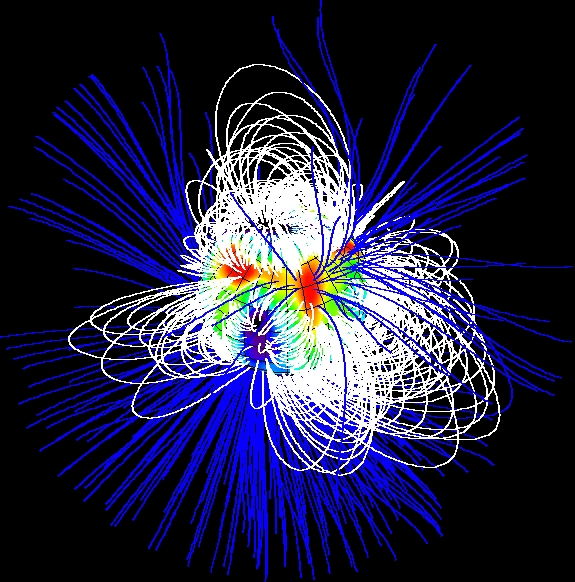
The standard solar gravity fusion model has been proven wrong by the sun's MRI, and is based on gravity forming stars by fusion. Duvall's team at NASA admits solar models are failures, and that an overhaul of new physics is needed for the sun's interior. Current dogmatic gravity cosmology no longer explains sunspots, nor the sun's magnetic field. What we know here is that electricity and magnetism produce solar phenomena (stars). The Zeeman-doppler effect shows the magnetic field structures around other stars, besides the sun. The photo is the magnetic field of the star called Su Aur. EU cosmology proves again to be true, and gravity merely phony theoretics. Image
http://holographicgalaxy.blogspot.com/2 ... odels.html
Last edited by quantauniverse on Fri Jul 13, 2012 12:39 pm, edited 1 time in total.

Michael Mozina
Posts: 1701
Joined: Thu Feb 23, 2012 10:35 am
Location: Mt. Shasta, CA
Contact:

Re: What does this mean to solar theory and electric sun the

Unread post by Michael Mozina » Fri Jul 13, 2012 12:36 pm

Dotini wrote:I'm very excited too, Michael.

But, to play devil's advocate for a moment, it must be admitted:
1) The slow convection study is only one datapoint. More are surely needed over a full solar cycle to establish this as accepted fact, wouldn't you think?
Absolutely. I agree with you 100 percent on that issue.
2) Hitherto, helioseismology has been viewed with some skepticism from certain quarters, including ours. To put all eggs in one freshly painted basket could be imprudent. Live by the sword, die by the sword.
I've tried to give the basic technology of Helioseismology the benefit of the doubt, although I have questioned their density models which they tend to use in these calculations. That is particularly true now that these convection observations conflict with their theory.
3) The biggest problem of all for us is quantifying charge density on sol, and other stars, I think. To have a real science, we really should have these numbers nailed, and it may take awhile.
I agree with you that electric sun models are much more complicated than standard theory as it relates to many aspects of solar theory. It will take awhile to come up with a complete model, but keep in mind that if these results hold up, the mainstream's model is pretty much falsified outright. They'll also need a new model and new quantified features to go with it. There will be a pretty level playing field if the standard model is falsified.
4) Paradigms change only when the old adherents retire, or anomalies pile up over the gunwales. Advocating cuts in university astronomy department budgets and patiently cataloging anomalies might be productive endeavors. ;)

Respectfully submitted,
Steve
Again, I tend to agree, but I'd say that the *serious* anomalies are starting to pile up on them. That extremely slow convection rate isn't something they can easily work around IMO. It has significant implications to many aspects of their theory, most notably the things I mentioned in the opening post.

IMO the "trick" here will be to "get the word out", and making a little headway in terms of "denting" current theories a bit. The plasma redshift issue will be the downfall of BB theory IMO, and the convection rate will spell doom to their solar model, assuming that these numbers hold up to future studies.

flyingcloud
Posts: 490
Joined: Fri Nov 07, 2008 2:07 am
Location: Honey Brook

Unexpectedly slow motions below the Sun's surface

Unread post by flyingcloud » Fri Jul 20, 2012 10:02 am

Unexpectedly slow motions below the Sun's surface

http://phys.org/news/2012-07-unexpected ... rface.html

(Phys.org) -- The interior motions of the Sun are much slower than predicted. Rather than moving at the speed of a jet plane (as previously understood) the plasma flows at a walking pace. The result of this new study, whose lead author is from the Max Planck Institute for Solar System Research, will be published in an upcoming issue of Proceedings of the National Academy of Sciences (PNAS). The scientists use observations of solar oscillations from NASA's Solar Dynamics Observatory (SDO) to see into the Sun's interior. As Laurent Gizon and Aaron C. Birch from the Max Planck Institute for Solar System Research comment in the same issue of PNAS, these new observations demonstrate the unique capabilities of helioseismology with SDO to probe the mysteries of the deep solar interior.

In its outermost third, the Sun behaves like a simmering pot of water: heat from below causes the plasma to rise to the surface where it is cooled and descends back down into the interior. This mechanism, named convection, transports energy outward and controls the Sun’s structure and evolution.

In its outermost third, the Sun behaves like a simmering pot of water: heat from below causes the plasma to rise to the surface where it is cooled and descends back down into the interior. This mechanism, named convection, transports energy outward and controls the Sun’s structure and evolution.

The scientists, led by Shravan Hanasoge from Max Planck Institute for Solar System Research, were now for the first time able to constrain the flows deep within the convection layer from direct observations of the Sun’s surface with the help of helioseismology. Helioseismology is similar to Earth seismology. “We observe oscillations of the solar surface and use them to infer properties, such as flows, in the solar interior”, explains Laurent Gizon, director of the Department “Physics of the Interior of the Sun and Sun-like Stars” at the Max Planck Institute for Solar System Research and Professor at the Institute for Astrophysics at the University of Göttingen.

Plasma flows with less than one metre per second
The team of scientists from the Max Planck Institute for Solar System Research, Princeton University, NASA’s Goddard Flight Center and New York University was able to determine the flow velocities at a depth of 55000 kilometres, which is eight percent of the solar radius. Surprisingly, the flow velocities of the plasma were found to be less than a few meters per second. Gizon puts this into perspective saying “This is a hundred times less than predicted by numerical models of solar convection”.

The key to these new results was data from NASA’s space probe SDO, which has been observing the Sun’s surface since early 2010. The scientists analysed data from the Helioseismic and Magnetic Imager (HMI) onboard SDO. The analysis was only possible due to the combination of high resolution and full spatial coverage of the observations. The huge amount of data collected by HMI - thousands of high-resolution images of the whole Sun per day - are archived and processed in the German Data Center for SDO hosted at the Max Planck Institute for Solar System Research, a unique facility in Europe.

Acoustic waves in the sun reveal the velocity of convection currents

HMI measures the velocity of the Sun's surface. When a solar acoustic wave trapped within the Sun reaches the surface, it causes the surface to move – and can thus be detected by HMI. In this way, the scientists were able to measure the time it takes for solar acoustic waves to travel from a point on the solar surface through the interior to another point on the surface. Convective flows affect the speed of propagation of the waves. Hence, it is possible to learn about the velocities of the convective flows in the solar interior from measurements of wave travel times. Modelling the interaction of solar acoustic waves with convection is a topic of current research, undertaken within the German Research Foundation’s Collaborative Research Center “Astrophysical flow instabilities and Turbulence” at the Max Planck Institute for Solar System Research and the University of Göttingen.

Gizon says “The unexpectedly small velocities measured using helioseismology are the most noteworthy helioseismology result since the launch of HMI”. Adds Birch, “There is no clear way to reconcile the observations and theory”. Gizon then concludes “This result not only sheds a new light on the Sun – but also on our current inability to understand one of the most fundamental physical processes in the Sun and stars: convection”.


More information: Shravan M. Hanasoge, et al., Anomalously weak solar convection, Proceedings of the National Academy of Sciences, July 24 2012, 109, 30 (published online ahead of print June 4) doi:10.1073/pnas.1206570109

Laurent Gizon and Aaron C. Birch, Helioseismology challenges models of solar convection, Proceedings of the National Academy of Sciences, July 24 2012, 109, 30

seasmith
Posts: 2815
Joined: Thu Mar 27, 2008 6:59 pm

Re: Unexpectedly slow motions below the Sun's surface

Unread post by seasmith » Fri Jul 20, 2012 11:31 am

Image


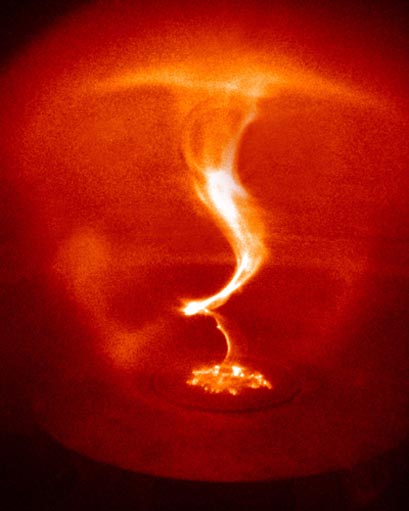
If the interstellar currents do flow through the sun's core in a helical form, something like above, it's motion Would be relatively slow compared to the peripheral instabilities (not shown here) and resultant solar surface effects.


http://www.thunderbolts.info/wp/forum/phpB ... f=3&t=6264

User avatar
viscount aero
Posts: 2381
Joined: Mon May 12, 2008 11:23 pm
Location: Los Angeles, California
Contact:

Re: Unexpectedly slow motions below the Sun's surface

Unread post by viscount aero » Sat Jul 21, 2012 2:28 am

“This result not only sheds a new light on the Sun – but also on our current inability to understand one of the most fundamental physical processes in the Sun and stars: convection”.


They may have a "current inability to understand" that "one of the most fundamental physical processes in the Sun and stars" is probably NOT "convection."

Dotini
Posts: 315
Joined: Wed Mar 10, 2010 7:44 am
Location: Seattle

Re: Unexpectedly slow motions below the Sun's surface

Unread post by Dotini » Sat Jul 21, 2012 5:00 am

viscount aero wrote:“This result not only sheds a new light on the Sun – but also on our current inability to understand one of the most fundamental physical processes in the Sun and stars: convection”.
It goes deeper than this. NASA are on record as saying that magnetism probably underlies the explanation for their Big Problems of coronal heating, CMEs, sunspot cycle, etc., and now the previously accepted explanation of how the magnetic field is generated is thrown into doubt by the new findings. They thought the rapid churning of plasma in the convection layer drove a solar dynamo, but their numbers don't work if the plasma motion is only 1/100th the required strength. So now they can't explain the magnetic field itself! So now it's back to the drawing board - or maybe back to Alfven, Peratt and Jeurgens for a rethink.

Respectfully submitted,
Steve

sjw40364
Guest

Re: Unexpectedly slow motions below the Sun's surface

Unread post by sjw40364 » Sat Jul 21, 2012 8:23 am

Dotini wrote:It goes deeper than this. NASA are on record as saying that magnetism probably underlies the explanation for their Big Problems of coronal heating, CMEs, sunspot cycle, etc., and now the previously accepted explanation of how the magnetic field is generated is thrown into doubt by the new findings. They thought the rapid churning of plasma in the convection layer drove a solar dynamo, but their numbers don't work if the plasma motion is only 1/100th the required strength. So now they can't explain the magnetic field itself! So now it's back to the drawing board - or maybe back to Alfven, Peratt and Jeurgens for a rethink.

Respectfully submitted,
Steve
No, we are about to embark on the theory of "magnetic reconnection", the next big revelation in science since relativity. There will be no mention of electric currents except for how they are created by time varying magnetic fields. You will hear nothing about how it requires charges moving in opposition (current) to form a magnetic field, only about the currents formed due to Lorentz forces. They will maintain this stance for the next 100 years. Our best hope is the accidental discoveries they make while trying to prove theirs. Those in power rarely give up their theories until they are forced to. History shows this to be correct, but at least we can be sure of lots of good data over the next few years to help define our theory more solidly for the future.

http://www.nasa.gov/mission_pages/rbsp/ ... phere.html

Michael Mozina
Posts: 1701
Joined: Thu Feb 23, 2012 10:35 am
Location: Mt. Shasta, CA
Contact:

Re: Unexpectedly slow motions below the Sun's surface

Unread post by Michael Mozina » Sat Jul 21, 2012 4:15 pm

Dotini wrote:So now it's back to the drawing board - or maybe back to Alfven, Peratt and Jeurgens for a rethink.

Respectfully submitted,
Steve
Actually Alfven's explanation of solar energy sources, coronal loops, solar flares, and atmospheric activity was also relatively dependent on a fast convection process to generate rapid plasma rotation patterns around sunspots, and relatively positive and negative charges at the surface of the photosphere. Alfven's solar theories were heavily dependent upon the standard solar model. It's not nearly as immune from these slow convection findings as you might suspect. The only two solar models that are not dependent upon a fast convection to generate electrical fields in the solar atmosphere are Jergen's externally driven model, and Birkeland's cathode sun. Those seem to be the only two solar models left standing at the moment.

sjw40364
Guest

Re: Unexpectedly slow motions below the Sun's surface

Unread post by sjw40364 » Sun Jul 22, 2012 7:04 am

Michael Mozina wrote:Actually Alfven's explanation of solar energy sources, coronal loops, solar flares, and atmospheric activity was also relatively dependent on a fast convection process to generate rapid plasma rotation patterns around sunspots, and relatively positive and negative charges at the surface of the photosphere. Alfven's solar theories were heavily dependent upon the standard solar model. It's not nearly as immune from these slow convection findings as you might suspect. The only two solar models that are not dependent upon a fast convection to generate electrical fields in the solar atmosphere are Jergen's externally driven model, and Birkeland's cathode sun. Those seem to be the only two solar models left standing at the moment.

True, but Alfven also was unaware of the currents flowing into the sun. He devised his model based on currents confined within the sun. He tried to fit his ideas to standard cosmology, something that can't be done and still expect accurate results.

The problem lies at the very heart of our scientific terms. A neutron is considered as having no charge, even though it has a rest mass slightly more than a proton and 1,839 times greater than an electron. E=mc2 demands that it have charge. There is a big difference between particles that have both negative and positive charges in balance, and one that has no charge, i.e. would not exist. Likewise my post on the Strong Force. http://www.thunderbolts.info/wp/forum/phpB ... f=3&t=6374

Being balanced with a neighboring proton or electron is not the same as not affecting it from lack of charge. It is both attracting and repelling, not sitting there inert. This sleight of hand is why no calculations have been devised to explain gravity electrically, half the charges are ignored because it is assumed they don't exist. EU theory is no better in this regard. Everyone agrees the neutron has rest mass, yet they then assume since charges are balanced it has no charge, contrary to the fact that mc2 also equals E. It is time to start taking the errors out of our science.

Locked

Who is online

Users browsing this forum: No registered users and 10 guests