I have heard that Dave Talbott and Donald E. Scott have disagreed with a lot of Velikovsky's claims, but have given him special credit on his main premises - such as the story of the planet Venus among some other events.
I do think that people can get somewhat dogmatic and absolutist about their view of earth's history; whether they are on the side of gradualism or on catastrophism. I'm wondering if really, the earth's landscape is a result of a combination of both.
Any thoughts?
Catastrophism vs. Gradualism - a false debate?
-
PersianPaladin

- Posts: 668
- Joined: Sat Jan 15, 2011 8:38 am
- Location: Turkey
-
starbiter

- Posts: 1445
- Joined: Mon Mar 17, 2008 9:11 am
- Location: Antelope CA
- Contact:
Re: Catastrophism vs. Gradualism - a false debate?
Hello PP: This is subject to change, but i don't think we see anything on the surface of Earth that is due to gradualism. To a great depth the surface of Earth seems fresh. If we listen to the descriptions of myth and legend with a literal ear, a picture emerges that would make gradualism untenable. The world wide events described in Worlds in Collision were a bummer, with consequences.
michael
michael
I Ching #49 The Image
Fire in the lake: the image of REVOLUTION
Thus the superior man
Sets the calender in order
And makes the seasons clear
www.EU-geology.com
http://www.michaelsteinbacher.com
Fire in the lake: the image of REVOLUTION
Thus the superior man
Sets the calender in order
And makes the seasons clear
www.EU-geology.com
http://www.michaelsteinbacher.com
-
PersianPaladin
- Posts: 668
- Joined: Sat Jan 15, 2011 8:38 am
- Location: Turkey
Re: Catastrophism vs. Gradualism - a false debate?
http://www.extremescience.com/zoom/inde ... nt-everestThey've also determined that the Himalayan Mountains are still growing higher, at a rate of about 2.4 in/6.1cm per year. That's twice as fast as previously thought. A growth rate of 2.4 in/6.1cm per year doesn't sound like very much. But, if you think about it, that means in the last 26,000 years the Himalayans have risen almost a mile into the upper reaches of the earth's atmosphere!
There is evidence of gradualism on the earth. I would argue that plate tectonics is essentially an electrical process. Why should electrical processes all neccessarily have to occur within very short timescales or with catastrophic characteristics? Let's not throw the baby out with the bathwater shall we?
However...I also see evidence of catastrophic examples of Electric discharge machining (EDM), such as in the case of the Grand Canyon. Donald E. Scott mentioned this in his book, and it has also been covered elsewhere on this site.
My argument is, that we should be prepared to accept a combination of gradualism and catastrophism that has marked the earth in history. Ultimately, all processes are electrical in nature.
-
starbiter
- Posts: 1445
- Joined: Mon Mar 17, 2008 9:11 am
- Location: Antelope CA
- Contact:
Re: Catastrophism vs. Gradualism - a false debate?
If the events described in WiC transpired 3500 to 5000 years ago, the window for gradualism is greatly reduced. Even if the Himalayas are rising, the results would not be visible to an observer on the surface, IMHO.
michael
michael
I Ching #49 The Image
Fire in the lake: the image of REVOLUTION
Thus the superior man
Sets the calender in order
And makes the seasons clear
www.EU-geology.com
http://www.michaelsteinbacher.com
Fire in the lake: the image of REVOLUTION
Thus the superior man
Sets the calender in order
And makes the seasons clear
www.EU-geology.com
http://www.michaelsteinbacher.com
-
Sparky
- Posts: 3517
- Joined: Tue Jul 20, 2010 2:20 pm
Re: Catastrophism vs. Gradualism - a false debate?
I have to agree.....PersianPaladin wrote:http://www.extremescience.com/zoom/inde ... nt-everestThey've also determined that the Himalayan Mountains are still growing higher, at a rate of about 2.4 in/6.1cm per year. That's twice as fast as previously thought. A growth rate of 2.4 in/6.1cm per year doesn't sound like very much. But, if you think about it, that means in the last 26,000 years the Himalayans have risen almost a mile into the upper reaches of the earth's atmosphere!
There is evidence of gradualism on the earth. I would argue that plate tectonics is essentially an electrical process. Why should electrical processes all neccessarily have to occur within very short timescales or with catastrophic characteristics? Let's not throw the baby out with the bathwater shall we?
However...I also see evidence of catastrophic examples of Electric discharge machining (EDM), such as in the case of the Grand Canyon. Donald E. Scott mentioned this in his book, and it has also been covered elsewhere on this site.
My argument is, that we should be prepared to accept a combination of gradualism and catastrophism that has marked the earth in history. Ultimately, all processes are electrical in nature.

this winter i watched as many John Ford westerns as i could...in them i now see electrical scaring, whereas before i saw amazing rock formations... yesterday i watched a movie that was suppose to be in vietnam, with amazing mountains covered with thick vegetation, hiding most of the electrical scaring that created them.
Gradualism may not account for some things, but this being a wet planet, one must take into account the power of water, especially in those areas that receive large amounts of rain or on coasts of seas and oceans...So, i would argue that water has gradually worn at any electrical activity, and electrical discharge machining has scarred and hidden previous gradualism.
The discovery of EDM on other space objects must be given much weight when theorizing about earth. But just because lightning hit my house does not mean that what was left of the house was lightning built!

"It is dangerous to be right in matters where established men are wrong."
"Doubt is not an agreeable condition, but certainty is an absurd one."
"Those who can make you believe absurdities, can make you commit atrocities." Voltaire
"Doubt is not an agreeable condition, but certainty is an absurd one."
"Those who can make you believe absurdities, can make you commit atrocities." Voltaire
-
webolife

- Posts: 2539
- Joined: Mon Mar 17, 2008 2:01 pm
- Location: Seattle
Re: Catastrophism vs. Gradualism - a false debate?
Some of the elements of the dichotomy "catastrophism vs gradualism" that have been explored on this forum may be characterized in a number of ways:
1. A naturalistic viewpoint: uniformitarianism,"the present is the key to the past" [eg. Lyell, Hutton, Steno et.al.] -- the everyday processes we see around the world have continued in the same way and at the same rate as far back or forward in time as conceivable. The general reason for such a view is that it assumes that scientists will be able to study it in the conventional manner, under appropriately limited experimental controls and expectations.
2. An extraterrestrial viewpoint : [eg. Velikovsky, Talbot, Dwardu, et.al.] -- generally, perhaps regularly, the cosmos is shaken by the violent upheavals that accompany electrical field fluctations at the galactic level, disturbing the orbits of the planets, and carving out the topography of those planets and their moons by electrical discharge, superaurorae, or what have you, often alleged to occur within the human history timeframe.
3. A variety of combinations or compromises of the viewpoints 1 and 2, in which astronomical events occur periodically to upset the otherwise uniformitarian "peace", not unlike S.J.Gould's "punctuated equilibrium".
4. Creationist viewpoint A: typically recognizing the current uniform status quo, the view that God started natural processes and continues to maintain them via orderly systems and patterns we call the "laws" of the universe, but Who may interupt those processes according to His?Her purposes -- unliked by proponents of viewpoint #1, because they can't reliably put God into a scientific box... also don't like the personal accountability implied by recognition of a Supreme Being Who still has an interest in the creation. Not incompatible with #1.
5. Creationist viewpoint B: Mostly the same as viewpoint #4, with the exception that catastrophic events are seen to be the norm, rather than exceptions to the "status quo". Similar in natural philosophy to Viewpoint #2.
6. Combinations or compromises between viewpoints 4 and 5
7. Combinations or compromises between 1 through 6
The question of "Origins" is a different topic and being explored on a different thread, but it might make for some interesting discussion for this thread to explore observable evidences for catastrophism or gradualism on Earth or in the universe, with the idea of promoting/disputing either view. In which case the thread title should be switched to simply Catastrophism vs Gradualism... Or points made with reference to other threads that already cover this topic rather handily?
1. A naturalistic viewpoint: uniformitarianism,"the present is the key to the past" [eg. Lyell, Hutton, Steno et.al.] -- the everyday processes we see around the world have continued in the same way and at the same rate as far back or forward in time as conceivable. The general reason for such a view is that it assumes that scientists will be able to study it in the conventional manner, under appropriately limited experimental controls and expectations.
2. An extraterrestrial viewpoint : [eg. Velikovsky, Talbot, Dwardu, et.al.] -- generally, perhaps regularly, the cosmos is shaken by the violent upheavals that accompany electrical field fluctations at the galactic level, disturbing the orbits of the planets, and carving out the topography of those planets and their moons by electrical discharge, superaurorae, or what have you, often alleged to occur within the human history timeframe.
3. A variety of combinations or compromises of the viewpoints 1 and 2, in which astronomical events occur periodically to upset the otherwise uniformitarian "peace", not unlike S.J.Gould's "punctuated equilibrium".
4. Creationist viewpoint A: typically recognizing the current uniform status quo, the view that God started natural processes and continues to maintain them via orderly systems and patterns we call the "laws" of the universe, but Who may interupt those processes according to His?Her purposes -- unliked by proponents of viewpoint #1, because they can't reliably put God into a scientific box... also don't like the personal accountability implied by recognition of a Supreme Being Who still has an interest in the creation. Not incompatible with #1.
5. Creationist viewpoint B: Mostly the same as viewpoint #4, with the exception that catastrophic events are seen to be the norm, rather than exceptions to the "status quo". Similar in natural philosophy to Viewpoint #2.
6. Combinations or compromises between viewpoints 4 and 5
7. Combinations or compromises between 1 through 6
The question of "Origins" is a different topic and being explored on a different thread, but it might make for some interesting discussion for this thread to explore observable evidences for catastrophism or gradualism on Earth or in the universe, with the idea of promoting/disputing either view. In which case the thread title should be switched to simply Catastrophism vs Gradualism...
Or points made with reference to other threads that already cover this topic rather handily? Truth extends beyond the border of self-limiting science. Free discourse among opposing viewpoints draws the open-minded away from the darkness of inevitable bias and nearer to the light of universal reality.
-
Eaol

- Posts: 33
- Joined: Tue Mar 29, 2011 7:23 pm
Re: Catastrophism vs. Gradualism - a false debate?
I find myself thinking something like #2. Of course, I can be wrong, as I have been before.
-
601L1n9FR09
- Posts: 111
- Joined: Sun Apr 03, 2011 10:24 am
Re: Catastrophism vs. Gradualism - a false debate?
While the current rate of change would seem to be gradual, it was uniformity dogma that insisted catastrophism and gradualism are mutually exclusive. Not that this debate can ever be won by either side, current gradual rates of geologic change are residual effects of previous catastrophes. At least it could be argued and increasingly so.
Things will continue to change at an almost imperceptible rate until the next catastrophe. Naturally there will be evidence of both.
Things will continue to change at an almost imperceptible rate until the next catastrophe. Naturally there will be evidence of both.
-
The Great Dog

- Posts: 255
- Joined: Thu Apr 02, 2009 4:58 pm
Re: Catastrophism vs. Gradualism - a false debate?
601L1n9FR09 --
Exactly.
Exactly.
There are no other dogs but The Great Dog
-
PersianPaladin
- Posts: 668
- Joined: Sat Jan 15, 2011 8:38 am
- Location: Turkey
Re: Catastrophism vs. Gradualism - a false debate?
There are very large areas on Mars which basically look as smooth as a fresh ice-cream cone. This may be explained by the fact that the planet has not been magnetically active (internally) for a long time. This is in contrast to the Earth, which has a more active plate tectonic system and thus presents a much more dynamic surface geology. While, there is strong evidence of electric discharge machining on Mars - there is evidence that Earth has been shaped by a mixture of EDM and plate-movements which have resulted in such features like long mountain ranges at the boundaries of continents. Hence, I would argue for a punctuated equilibrium scenario - with a general continuum of gradualism with occasional catastrophic disturbance from inter-planetary discharge exhibited by the unstable orbits of Mars and Venus.
I think we could perhaps move forward with such an understanding?
Regards,
~PP.
I think we could perhaps move forward with such an understanding?
Regards,
~PP.
-
webolife
- Posts: 2539
- Joined: Mon Mar 17, 2008 2:01 pm
- Location: Seattle
Re: Catastrophism vs. Gradualism - a false debate?
I agree with FRO9 and Dog.
Albeit with a creationist premise. Science may be incapable of answering the "why" question, but that doesn't mean I can't try... PP, the "time scale" question undergirds whichever view one will choose. So I recommend readers to the Carbon Dating thread, and other Radiometric Dating threads on this forum, for more info. about how old the earth is...
Albeit with a creationist premise. Science may be incapable of answering the "why" question, but that doesn't mean I can't try... PP, the "time scale" question undergirds whichever view one will choose. So I recommend readers to the Carbon Dating thread, and other Radiometric Dating threads on this forum, for more info. about how old the earth is...
Truth extends beyond the border of self-limiting science. Free discourse among opposing viewpoints draws the open-minded away from the darkness of inevitable bias and nearer to the light of universal reality.
-
PersianPaladin
- Posts: 668
- Joined: Sat Jan 15, 2011 8:38 am
- Location: Turkey
Re: Catastrophism vs. Gradualism - a false debate?
Regardless of debates over age...what I've described is entirely reasonable.webolife wrote:I agree with FRO9 and Dog.
Albeit with a creationist premise. Science may be incapable of answering the "why" question, but that doesn't mean I can't try... PP, the "time scale" question undergirds whichever view one will choose. So I recommend readers to the Carbon Dating thread, and other Radiometric Dating threads on this forum, for more info. about how old the earth is...
If EM activity on certain portions of the earths surface renders dating methods potentially inconclusive, this does not negate room for combinations of gradualism and catastrophism.
-
PersianPaladin
- Posts: 668
- Joined: Sat Jan 15, 2011 8:38 am
- Location: Turkey
Re: Catastrophism vs. Gradualism - a false debate?
I'm not sure if all mountains are the result of an EM discharge or duning process. There is evidence to suggest that some prominent ranges are a result of continental plate collisions, subduction, etc.
The existence of deep roots beneath some of the mountain ranges implies that we have some gradualism going on in the planet:-
I know I'm going to quote from a religious book, but I find it very interesting that the Koran refers to mountains as being created like "pegs":-
"Have We not made the earth as a bed, and the mountains as pegs?" (Quran, 78:6-7)
Is there scientific evidence to support this?
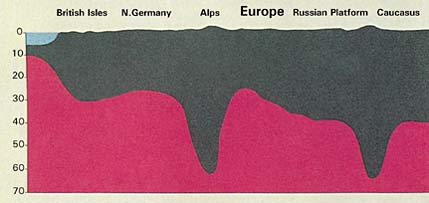
The mountains, like pegs, have deep roots embedded in the ground. (Anatomy of the Earth, Cailleux, p. 220.)
Original link:-
http://www.islam-guide.com/ch1-1-b.htm#footnote1
If electrical discharge events created most mountains, then I wouldn't expect to see such deep roots underneath them. This is not to negate electrical discharge machining contributing to some features. For example, the Grand Canyon really is an anomaly in terms of how it forms a deep rift in the Colorado Plateau. The characteristics of the canyon are unique in their structure and differ very much from the fold-type nature of many of the mountains we see such as those on plate margins - i.e. Andes and the Rockies. The equivalent on Mars, is Valles Marineris - which is ultimately just a scaled-up version of the Grand Canyon.
The existence of deep roots beneath some of the mountain ranges implies that we have some gradualism going on in the planet:-
http://honolulu.hawaii.edu/distance/gg1 ... gram8.html"In Eastern North America, the Appalachian Mountains continue to exist more than 200 million years after the plate collisions that formed them. Given rates of erosion, these mountains should have worn flat tens of millions of years ago; yet they still stand, indicating that some uplift must be continuing.
The cause of this puzzling late stage uplift was discovered in 1859 by British surveyor, G. B. Airy. While working in India, Airy discovered that plumb bobs, iron weights used to level sighting instruments were less attracted by the gravity from the nearby Himalayan Mountains than they should be if the Himalaya were directly underlain by the same dense rock presumed to form most of the Earth's interior.
This suggested there was less mass present beneath the Himalaya than previously thought. To explain this discrepancy Airy concluded that a low density root must lie beneath the range. Geophysical studies have since confirmed that the crust beneath the Himalaya extends to a depth of 75 kilometers, twice as thick as ordinary continental crust."
I know I'm going to quote from a religious book, but I find it very interesting that the Koran refers to mountains as being created like "pegs":-
"Have We not made the earth as a bed, and the mountains as pegs?" (Quran, 78:6-7)
Is there scientific evidence to support this?
The mountains, like pegs, have deep roots embedded in the ground. (Anatomy of the Earth, Cailleux, p. 220.)
Original link:-
http://www.islam-guide.com/ch1-1-b.htm#footnote1
If electrical discharge events created most mountains, then I wouldn't expect to see such deep roots underneath them. This is not to negate electrical discharge machining contributing to some features. For example, the Grand Canyon really is an anomaly in terms of how it forms a deep rift in the Colorado Plateau. The characteristics of the canyon are unique in their structure and differ very much from the fold-type nature of many of the mountains we see such as those on plate margins - i.e. Andes and the Rockies. The equivalent on Mars, is Valles Marineris - which is ultimately just a scaled-up version of the Grand Canyon.
-
platyhelminth
- Posts: 31
- Joined: Tue May 17, 2011 5:52 am
Re: Catastrophism vs. Gradualism - a false debate?
No, a huge geological structure has been found beneath the colorado plateau : see http://www.dailymail.co.uk/sciencetech/ ... anyon.htmlpersianpaladin wrote:For example, the Grand Canyon really is an anomaly in terms of how it forms a deep rift in the Colorado Plateau. The characteristics of the canyon are unique in their structure and differ very much from the fold-type nature of many of the mountains we see such as those on plate margins - i.e. Andes and the Rockies. The equivalent on Mars, is Valles Marineris - which is ultimately just a scaled-up version of the Grand Canyon.
This has been reported in the forum for the first time here : http://thunderbolts.info/wp/forum/phpBB3/v ... 735#p51184
colorado canyon may become a future mid ocean rift like the east african rift :

So ...
We will see if it is empirism versus dogmatism OR if it is just another battle between different dogmas.
We will see if it is empirism versus dogmatism OR if it is just another battle between different dogmas.
-
PersianPaladin
- Posts: 668
- Joined: Sat Jan 15, 2011 8:38 am
- Location: Turkey
Re: Catastrophism vs. Gradualism - a false debate?
Well you are misinterpreting my post. The article that you posted is talking about the entire Colorado Plateau, and there are no relative continental plate depth measurements with respect to the surrounding United States. The article you posted also talks about dynamics with magma in the asthenosphere and the upper portions of the crust. The references I quoted concerns crustial depth anamolies directly under mountain ranges relative to other areas.
Who is online
Users browsing this forum: No registered users and 5 guests