Historic planetary instability and catastrophe. Evidence for electrical scarring on planets and moons. Electrical events in today's solar system. Electric Earth.
Moderators: MGmirkin, bboyer
-
Plasmatic
- Posts: 800
- Joined: Thu Mar 13, 2008 11:14 pm
Unread post
by Plasmatic » Fri Sep 26, 2008 7:32 pm
I have had several folks complain that my ionizer experiment vids are too hard to find in the CRT thread. While it has just about the most views of any thread ever on the forum, it is quite lengthy and some tire of digging in there.
So here is a quick link to all of my vids including the "comet" one.
http://www.youtube.com/user/MnemoHistory
Enjoy....I will be doing something in the future that will be way cooler than this

"Logic is the art of non-contradictory identification"......" I am therefore Ill think"
Ayn Rand
"It is the mark of an educated mind to be able to entertain a thought without accepting it."
Aristotle
-
Steve Smith
- Guest
Unread post
by Steve Smith » Fri Sep 26, 2008 8:51 pm
I really enjoy watching those videos. Zane Parker's experiments with the CRT and yours with the ionizer are impressive. Zane recreates the embossed Lichtenberg figures on Mars and you recreate the surface of the Moon -- both with remarkable similarity.
I assume the ionizer is running on AC current. Is your screwdriver (probe) connected to an electrical source?
Zane's fingertip is obviously a DC connection at low ppower. Assuming the AC power in the ionizer, there could be some elements in each variable that might account for the differences in the formations on the planets and moons. The two flavors of discharge seem to correspond to what is created. Now, Zane also produces wide, flat craters but when the ionized fiberglass dust settles back onto the CRT, the Lichtenberg figures are revealed. Do you notice anything similar?
-
Plasmatic
- Posts: 800
- Joined: Thu Mar 13, 2008 11:14 pm
Unread post
by Plasmatic » Fri Sep 26, 2008 11:07 pm
Hi Steve. To answer your question on the probe,I used the wires surrounding the oppositely charged dust on the collection grid to energize the probe . You can see the discharge come from the wire to the probe on a few occasions on the videos.
I have not created anything that resembles a lichtenberg pattern.
I have seen electric wind erosion in some case where the probe isnt touching the surface but dust just starts to erode from the area below the probe without discharging.
"Logic is the art of non-contradictory identification"......" I am therefore Ill think"
Ayn Rand
"It is the mark of an educated mind to be able to entertain a thought without accepting it."
Aristotle
-
nick c
- Site Admin
- Posts: 2483
- Joined: Sun Mar 16, 2008 8:12 pm
- Location: connecticut
Unread post
by nick c » Sun Sep 28, 2008 10:02 am
Plasmatic:
I love that video. Now that is nuts and bolts science and you didn't even have a million dollar government grant

It is a powerful piece of evidence in support of the EDM mechanism as the source of the cratering on various solar system bodies. I would like to see some examples of craters formed in impact experiments so some critical comparisons could be made.
nick c
-
substance
- Posts: 160
- Joined: Sat Jun 21, 2008 12:07 am
- Location: Germany
-
Contact:
Unread post
by substance » Sun Sep 28, 2008 2:47 pm
Hi, Plasmatic. Great videos! Can you make detailed explanation of this system so that other people (like me for example) can replicate the experiment, make videos, write about that and simply make electrical cratering more known under the general public. I`d really love to make my own moon surface in my garage.

My personal blog about science, technology, society and politics. - Putredo Mundi
-
Plasmatic
- Posts: 800
- Joined: Thu Mar 13, 2008 11:14 pm
Unread post
by Plasmatic » Fri Oct 03, 2008 9:48 pm
Hi Substance.
I simply took the cover off an ionizer and puffed talc powder on it . I then used a screw driver to discharge onto the collection grid. I am supposed to do something soon with a new freind who is a prof. of EE. It will be a veritable education because I will have to build the set up from scratch. As of now I know almost nothing about electronics.
"Logic is the art of non-contradictory identification"......" I am therefore Ill think"
Ayn Rand
"It is the mark of an educated mind to be able to entertain a thought without accepting it."
Aristotle
-
substance
- Posts: 160
- Joined: Sat Jun 21, 2008 12:07 am
- Location: Germany
-
Contact:
Unread post
by substance » Sat Oct 04, 2008 12:14 am
I`m eagerly awaiting this project of yours. You know, there is an astoundingly small amount of experiments relating to EU these days, or at least if there are any, they never reach public attention.

My personal blog about science, technology, society and politics. - Putredo Mundi
-
squiz
- Posts: 52
- Joined: Sun Jun 01, 2008 2:05 am
Unread post
by squiz » Sun Oct 05, 2008 12:36 am
Awesome stuff, really impressive in it's simplicity and the formations are remarkably consistent with what we see on the moon. Can't wait to see what you have in the works.
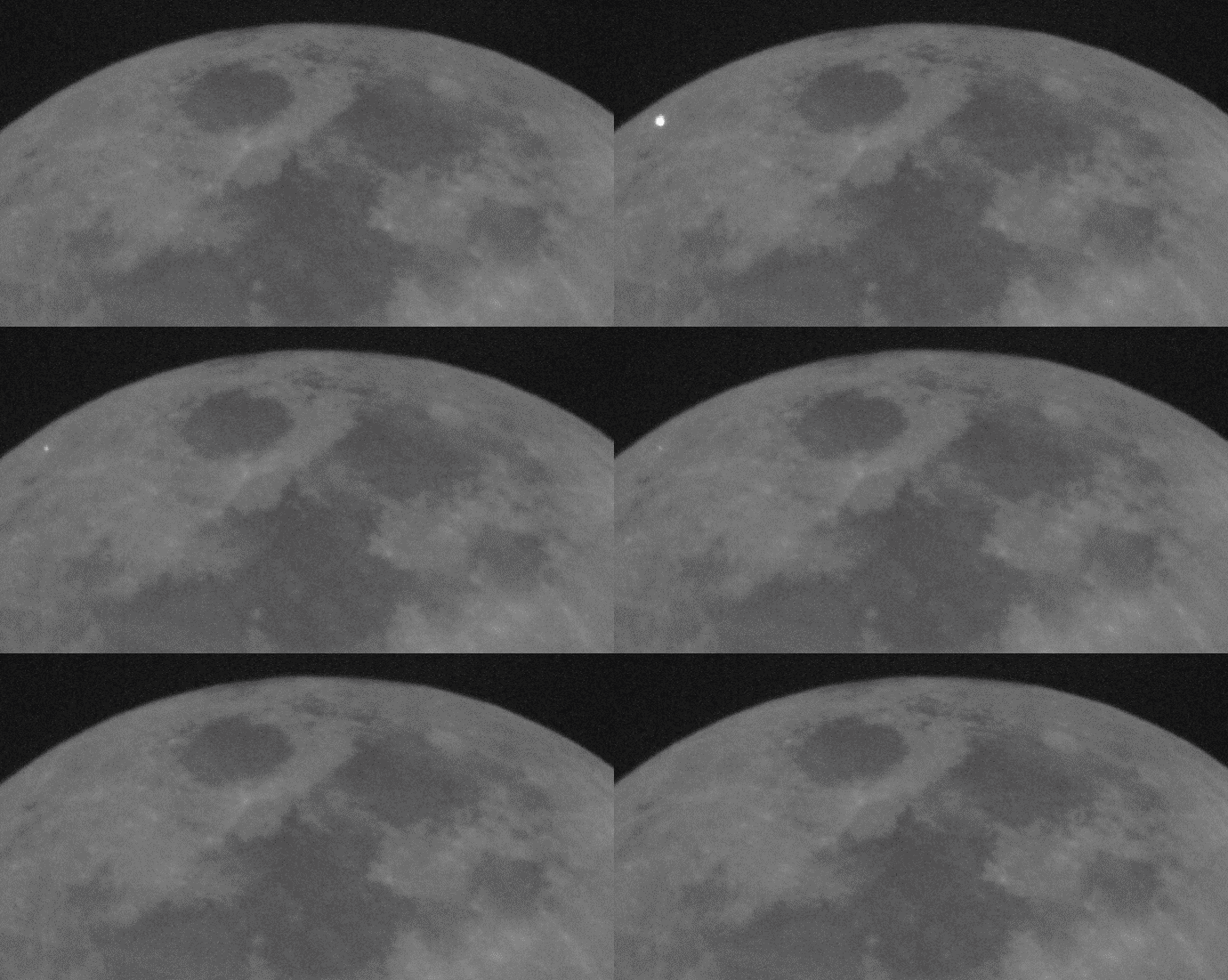
The real thing caught on camera?
-
substance
- Posts: 160
- Joined: Sat Jun 21, 2008 12:07 am
- Location: Germany
-
Contact:
Unread post
by substance » Sun Oct 05, 2008 10:20 am
Hey squiz, where did you get this video? Is there some description accompanying it?
EDIT: I looked up the URL of the image and researched a little bit on the topic. Turns out the official explanation is that the moon simply farts from time to time some kind of explosive gas...

My personal blog about science, technology, society and politics. - Putredo Mundi
-
Plasmatic
- Posts: 800
- Joined: Thu Mar 13, 2008 11:14 pm
Unread post
by Plasmatic » Sun Oct 05, 2008 10:25 pm
I have a clip where you see exactly the same thing on the ionizer. Ill try and load it soon.
"Logic is the art of non-contradictory identification"......" I am therefore Ill think"
Ayn Rand
"It is the mark of an educated mind to be able to entertain a thought without accepting it."
Aristotle
-
substance
- Posts: 160
- Joined: Sat Jun 21, 2008 12:07 am
- Location: Germany
-
Contact:
Unread post
by substance » Mon Oct 06, 2008 4:29 am
Sorry for my dumb question, but what exactly is a ionizer? I mean, I know what the word means, but what do you use such a thing for in your daily life? How does it look like?
My personal blog about science, technology, society and politics. - Putredo Mundi
-
Solar
- Posts: 1372
- Joined: Mon Mar 17, 2008 3:05 am
Unread post
by Solar » Mon Oct 06, 2008 5:04 am
Odd. Seems as if one side of the moon has been favored over the other when you look at
this photo. It would be interesting to correlate the time of year/observation with that etc. and perhaps the side that seems that seems to have more "impacts" faced the Quadrantids or Perseids meteor showers. I wouldn't accord all of these to electric discharge but there does seem to be an odd statistical anomaly in the mix.
In periods of the year coinciding with the arrival of the Quadrantids or Perseids meteor showers, lunar flashes can rise to rates as high as one per hour, and although the impact rate decreases as the Moon exits the stream of debris, it would never reach zero. "Even when no meteor shower is active, we still see flashes," Cooke explained.
The same is available for Earth as well. If you are lucky enough, in a clear, dark night sky, you can see a few meteors per hour, even though there is no meteor shower active at the time. In fact, on the Moon occur two times more random meteorite impacts that any determined by the passing through a debris stream. "That's an important finding. It means there's no time of year when the Moon is impact-free," said Suggs.
Seems it would make for an interesting 10yr study or so. Not even that; just the periods when the moon is not in the debris field. Is Hubble busy?
Or perhaps the new and forth coming 1.4 billion pixels "
Panoramic Survey Telescope and Rapid Response System, or Pan-STARR" to detect NEOs. Is it me, or does it seem unusual that the meteorite impact and dinosaur extinction theory has gotten to the point that some feel the need to monitor NEOs.
"Our laws of force tend to be applied in the Newtonian sense in that for every action there is an equal reaction, and yet, in the real world, where many-body gravitational effects or electrodynamic actions prevail, we do not have every action paired with an equal reaction." — Harold Aspden
-
substance
- Posts: 160
- Joined: Sat Jun 21, 2008 12:07 am
- Location: Germany
-
Contact:
Unread post
by substance » Mon Oct 06, 2008 6:08 am
Solar wrote:Odd. Seems as if one side of the moon has been favored over the other when you look at
this photo. It would be interesting to correlate the time of year/observation with that etc. and perhaps the side that seems that seems to have more "impacts" faced the Quadrantids or Perseids meteor showers. I wouldn't accord all of these to electric discharge but there does seem to be an odd statistical anomaly in the mix.
Wouldn`t this be the case if one side of the moon was more positively charged, while the other was had more negative charge? Just an idea, seems logical, I don`t know why.
My personal blog about science, technology, society and politics. - Putredo Mundi
Who is online
Users browsing this forum: No registered users and 27 guests