"Electric power flows along the spiral arms of a galactic circuit where it is concentrated and stored in a central plasmoid within the galactic bulge. When the current density reaches a critical threshold, it discharges along the galaxy’s spin axis as an energetic jet of plasma. That phenomenon has been replicated in the laboratory with a plasma focus device."
So you are saying that galaxies are pulsed phenomena???
I think they are continuous.
So is the Birkeland current connected the arms of the galaxy?? How does that work? And the plasmoid stores enough energy to produce the jet???????
It has been my observation that everything flows outward from the center. Hydrogen gas flows outward from the center of the galaxy. Are the any observations of stuff going going inward?
Think about Arp and AGN's. They eject stuff outward.
What is the circuit for a galaxy?????
-
Sparky
- Posts: 3517
- Joined: Tue Jul 20, 2010 2:20 pm
Re: What is the circuit for a galaxy?????
Far from the best person to address your questions, but will make some points anyway.

sorry, if i had a fast connection i could find images and articles to offer you... read all of these for a broad, better understanding: ....GL
I think it is more like there are many complex things going on, and some of them are pulsed. Much like the sun, where it seems to be constant in it's light output, but looking more closely, all sorts of things are going on.So you are saying that galaxies are pulsed phenomena???
There are maps of the universe that show filaments of energy/magnetic fields connecting galaxies. Kinda like x-mas tree lights...where it all starts is unknown.So is the Birkeland current connected the arms of the galaxy?? How does that work?
I may be in terrible error, but i think extrapolation is the only thing we have now which concludes current flow inward..Are the any observations of stuff going going inward?
sorry, if i had a fast connection i could find images and articles to offer you... read all of these for a broad, better understanding:
....GL"It is dangerous to be right in matters where established men are wrong."
"Doubt is not an agreeable condition, but certainty is an absurd one."
"Those who can make you believe absurdities, can make you commit atrocities." Voltaire
"Doubt is not an agreeable condition, but certainty is an absurd one."
"Those who can make you believe absurdities, can make you commit atrocities." Voltaire
-
JohnMT
- Posts: 99
- Joined: Fri Dec 12, 2008 5:52 am
Re: What is the circuit for a galaxy?????
Hi all,
A very small Schematic Diagram of a Galaxy is all very well (which has been presented before), but like yourselves, I too am very interested indeed perchance to study a detailed presentation of the actual 'Electric Circuit' that apparently pervades just our immediate realm of the Sun and the numerous associated stars contained within its locality, perhaps say to around 100 light years radius or so of the Sun, presented diagramatically as an 'Electric Circuit'...as in an Electrical Wiring Diagram...if you will.
Now such an achievement, if possible, would be absolutely fascinating and eventually by extension, the same process could also apply to the rest of the known stars in our Milky Way Galaxy too...and of course our immediate neighbourhood of Galaxies too.
I wonder, has such a work been carried out as yet within the EU fraternity?...detailed I mean?
I appreciate that such a detailed survey would be quite an immense undertaking and very demanding to the compiler (there of course being the 3-D aspect too), but with our current computer technology etc, surely there is much to assist in this pursuit.
Just enquiring.
[Prof. Don Scott...are you there? ]
]
Cheers,
John
A very small Schematic Diagram of a Galaxy is all very well (which has been presented before), but like yourselves, I too am very interested indeed perchance to study a detailed presentation of the actual 'Electric Circuit' that apparently pervades just our immediate realm of the Sun and the numerous associated stars contained within its locality, perhaps say to around 100 light years radius or so of the Sun, presented diagramatically as an 'Electric Circuit'...as in an Electrical Wiring Diagram...if you will.
Now such an achievement, if possible, would be absolutely fascinating and eventually by extension, the same process could also apply to the rest of the known stars in our Milky Way Galaxy too...and of course our immediate neighbourhood of Galaxies too.
I wonder, has such a work been carried out as yet within the EU fraternity?...detailed I mean?
I appreciate that such a detailed survey would be quite an immense undertaking and very demanding to the compiler (there of course being the 3-D aspect too), but with our current computer technology etc, surely there is much to assist in this pursuit.
Just enquiring.
[Prof. Don Scott...are you there?
] Cheers,
John
-
D_Archer

- Posts: 1255
- Joined: Sat Apr 18, 2009 4:01 am
- Location: The Netherlands
Re: What is the circuit for a galaxy?????
Hi,
The simplest circuit would be this:
http://www.evilmadscientist.com/article ... polarMotor
A galaxy is sometimes described in EU Theory as an homopolar motor/generator.
Regards,
Daniel
ps. Wiki: http://en.wikipedia.org/wiki/Homopolar_generator
The simplest circuit would be this:
http://www.evilmadscientist.com/article ... polarMotor
A galaxy is sometimes described in EU Theory as an homopolar motor/generator.
Regards,
Daniel
ps. Wiki: http://en.wikipedia.org/wiki/Homopolar_generator
- Shoot Forth Thunder -
-
JohnMT
- Posts: 99
- Joined: Fri Dec 12, 2008 5:52 am
Re: What is the circuit for a galaxy?????
Hi Daniel,
I appreciate what you say and thanks for your post.
Also, I am conversant with the Homopolar Mootor Principle/Faraday Cage etc, which does seem to fit the overall view within the confines of the EU
From my own perspective and in order to briefly explain myself:
During my long experience as an Aircraft Engineer (and as a Consultant), I have spent many hundreds and hundreds of hours pouring over numerous Electrical Schematic Wiring Diagrams in order to gain at least a glimpse to where begin with, as to where a particular problem may lie, so that eventually a solution might be found (and on all systems too) and then having found the cause, correct the situation.
Further, it was essential during my work to have access to 'Detailed Wiring Diagrams', so that I could 'home-in' so to speak, as to the true cause or nature of the problem.
In the 'Field', most times I was successful, but other times not so...in which case I had to refer to the designer/maufacturer of the system themselves to ensure that the aircraft might fly safely.
Of occasion, even their inticate designs etc had to be modified.
Be that as it may, there is nonetheless a principle here and herein lies my point.
Perhaps it is rather a tall order, but it seems to me that devoid of any detailed 'Wiring Diagrams' etc, all that the EU fraternity have presented to date are just mere 'Schemetics' and various 'Principles' etc such as the Homopolar Motor (unless I am mistaken, if there are more ideas)
Maybe in the not so distant future, some brilliant EU proponent, highly skilled in Electrical Theory/Engineering (and obviously much more skilled in electronics than I am, for I was just a problem solver), might perchance produce such a detailed 'Wiring Diagram' of most if not all the Stellar bodies existing within just our immediate locality, say for a radius of around 100 lightyears or so, which in proportion to the immensity of the 'Milky Way' is a comparatively insignificant domain.
I am essentially talking about 'potential differences' measured in volts, existing amongst and controlling the existence of all stellar objects, including their comparative Anodic and Cathodic differences and origins etc., that according to our EU 'Schematics' and Principles, most if not all stars must possess.
Like I suggested, such a task would be a huge undertaking, for the presentaion would also have to be of a 3-D nature (I have only dealt with 'Line' diagrams in my time) and the results would also similarly have to affect those stellar objects exisiting much beyond my suggested radius...and so on.
Then of course, there would be the mathematics involved...but who knows...as an optimist myself, maybe a successfully 'Peer Reviewed Paper'' may eventually be presented 'to boot', which would forever silence all our proverbially ignorant antagonists.
Just a few thoughts and trust I have explained my aspirations on the subject reasonably well.
Cheers,
John
I appreciate what you say and thanks for your post.
Also, I am conversant with the Homopolar Mootor Principle/Faraday Cage etc, which does seem to fit the overall view within the confines of the EU
From my own perspective and in order to briefly explain myself:
During my long experience as an Aircraft Engineer (and as a Consultant), I have spent many hundreds and hundreds of hours pouring over numerous Electrical Schematic Wiring Diagrams in order to gain at least a glimpse to where begin with, as to where a particular problem may lie, so that eventually a solution might be found (and on all systems too) and then having found the cause, correct the situation.
Further, it was essential during my work to have access to 'Detailed Wiring Diagrams', so that I could 'home-in' so to speak, as to the true cause or nature of the problem.
In the 'Field', most times I was successful, but other times not so...in which case I had to refer to the designer/maufacturer of the system themselves to ensure that the aircraft might fly safely.
Of occasion, even their inticate designs etc had to be modified.
Be that as it may, there is nonetheless a principle here and herein lies my point.
Perhaps it is rather a tall order, but it seems to me that devoid of any detailed 'Wiring Diagrams' etc, all that the EU fraternity have presented to date are just mere 'Schemetics' and various 'Principles' etc such as the Homopolar Motor (unless I am mistaken, if there are more ideas)
Maybe in the not so distant future, some brilliant EU proponent, highly skilled in Electrical Theory/Engineering (and obviously much more skilled in electronics than I am, for I was just a problem solver), might perchance produce such a detailed 'Wiring Diagram' of most if not all the Stellar bodies existing within just our immediate locality, say for a radius of around 100 lightyears or so, which in proportion to the immensity of the 'Milky Way' is a comparatively insignificant domain.
I am essentially talking about 'potential differences' measured in volts, existing amongst and controlling the existence of all stellar objects, including their comparative Anodic and Cathodic differences and origins etc., that according to our EU 'Schematics' and Principles, most if not all stars must possess.
Like I suggested, such a task would be a huge undertaking, for the presentaion would also have to be of a 3-D nature (I have only dealt with 'Line' diagrams in my time) and the results would also similarly have to affect those stellar objects exisiting much beyond my suggested radius...and so on.
Then of course, there would be the mathematics involved...but who knows...as an optimist myself, maybe a successfully 'Peer Reviewed Paper'' may eventually be presented 'to boot', which would forever silence all our proverbially ignorant antagonists.
Just a few thoughts and trust I have explained my aspirations on the subject reasonably well.
Cheers,
John
-
D_Archer
- Posts: 1255
- Joined: Sat Apr 18, 2009 4:01 am
- Location: The Netherlands
Re: What is the circuit for a galaxy?????
Hi John,
I understand your point. The difficulty is in actually detecting the current flows and where they lead. This would require our species to produce a lot of langmuir probes and send them out radially away from our solar system to all directions and have them map the currents, ie to have a real circuit diagram. To do this is beyond our civilizations reach for now.
I posted the homopolar moter/generator idea to make clear how probably our galaxy distributes the energy, so maybe you could visualize how the current goes in a diagram yourself. The current in the disc goes from the center to the edge, probably with a curve, just as a galaxies spiral arm. Our sun would be a little atom in the disc.
This is a map of our stellar neighborhood, probably our local current filament goes from Barnards star to Ross then to Groombridge, Centauri, our sun, aftter that?...Sirius perhaps. And before that?, some other star towards the galactic centre.
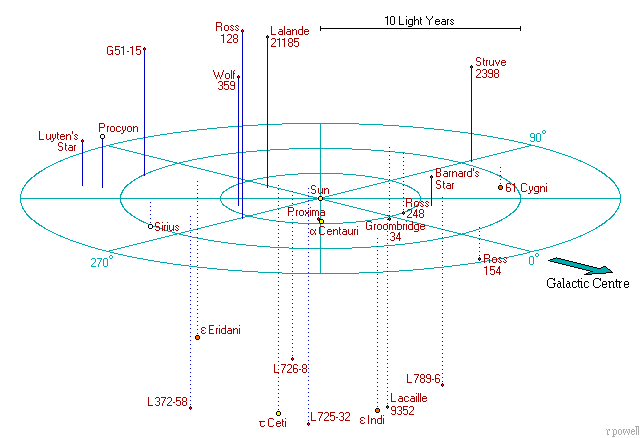
So, no real electric diagrams yet, but yes your idea to actually having such a map, with real distances as well and in 3D is great.
Regards,
Daniel
I understand your point. The difficulty is in actually detecting the current flows and where they lead. This would require our species to produce a lot of langmuir probes and send them out radially away from our solar system to all directions and have them map the currents, ie to have a real circuit diagram. To do this is beyond our civilizations reach for now.
I posted the homopolar moter/generator idea to make clear how probably our galaxy distributes the energy, so maybe you could visualize how the current goes in a diagram yourself. The current in the disc goes from the center to the edge, probably with a curve, just as a galaxies spiral arm. Our sun would be a little atom in the disc.
This is a map of our stellar neighborhood, probably our local current filament goes from Barnards star to Ross then to Groombridge, Centauri, our sun, aftter that?...Sirius perhaps. And before that?, some other star towards the galactic centre.
So, no real electric diagrams yet, but yes your idea to actually having such a map, with real distances as well and in 3D is great.
Regards,
Daniel
- Shoot Forth Thunder -
-
jjohnson
- Posts: 1147
- Joined: Mon Feb 16, 2009 11:24 am
- Location: Thurston County WA
Re: What is the circuit for a galaxy?????
Hi, John,
I know exactly what you are after. I got Don Scott's book up front and tried to work the equations for current incident upon the Sun, myself, based on his Appendix C, the observed gross solar radiation, the supposed collecting area of the heliosphere, etc. with no luck. My problem was, what is the voltage differential from the heliosphere to the, say, surface of the photosphere?
I wrote Don and asked. He said quite openly that he and no one else really knows the answer to that question. It has not been measured. I have mulled this circuitry over and over ever since and still do not have a good grasp of it. I now understand electron drift velocity and its irrelevance to speed of propagation of force in a circuit, and that the infalling electrons necessary to power the Sun do not have to (and are not found to) move at a relativistic velocity by the time they arrive at the Sun. In general the real particle inflows and outflows about the Sun are still not well understood nor mapped, so far as I can find. The equatorial neutral sheet has magnetic fields above and below it which 'flip' every 11 years or so, and those fields are generated by currents, but whether they are currents on and in the Sun or currents in space away from the Sun is also pretty fuzzy in my mind.
Nereid's question elsewhere regarding the balance of flows in and out is a valid one, but it should be modeled in terms of net charge and power. The components of the circuit need to be modeled as typical circuit elements, and the resistance of the Sun and the interplanetary medium (plasma) through which the current moves needs to be accurately assessed. Better, measured by probes in space. In a lot of space, for accuracy, not just in the ecliptic. There are surely capacitances and inductances in the heliospheric system, and whether they are the double layer plasma sheaths or the equatorial torii around the Sun and various planets or wherever, those, too, will have to be identified and their 'values' ascertained in order for a model circuit to work correctly.
The problem with circuitry models using plasma as the conductors (vice metal wires) is that it's hardly as passive as metal wires! It recreates itself constantly with various time constants. It moves about, changing lengths; it creates sheaths here and there and then dissolves them as needed; it changes direction; it stores and discharges energy; it is influenced by local ionization characteristics; it has waves; it aligns with the dynamics of magnetic fields and in turn re-determines and influences those very fields. How in hell do we model a circuit with wires that behave like Medusa's hair.
This is not a trivial problem.
The sketches of circuits that we see at stellar and galactic scales so far are what astronomers term, in their jargon, cartoons. A cartoon in this context is just a working sketch of ideas of how things work, and not associated with the more common humorous context. A cartoon can be a sophisticated computer graphic depiction, or a rough sketch using a burnt stick and a napkin, as my architect friends would call it. It is usually a simple line drawing, diagrammatically showing force field lines, vectors, particle motion, trajectories and the like - to show the concept of the dynamics involved in the problem or its description, or even its solution. It is a simplified shorthand - sort of the artistic analog of a bullet-point outline, or the Executive Summary at the beginning of a long report.
We need to break the circuitry down, assign values and run it on SPICE or something similar to see how it works at describing even the simplest things.
In my head I imagine the Sun as a lightbulb in a DC circuit with a steady battery source. Gross simplification. Some assumptions are forced, here, such as the voltage around the circuit, and the radiant flux (at all frequencies) coming off the lightbulb, and the resistance, etc. Even this simple a circuit, disregarding the pathways followed in conducting power into the lightbulb, is not as simple as it looks at first. Like everything is, after a closer look, right?
The assumptions are crucial, and have to accord with "reality" as closely as possible to make the output as plausible and "realistic" as possible. If you are good at circuit theory you can probably make a start on such a simple model, and then pick up on electrodynamics to get an insight into the things that might be going on within your wiring diagram that affect it. Care to play with that and let us in on your thinking as it progresses?
Under some circumstances I think that solving this problem successfully might be called "a life's work".
Jim
I know exactly what you are after. I got Don Scott's book up front and tried to work the equations for current incident upon the Sun, myself, based on his Appendix C, the observed gross solar radiation, the supposed collecting area of the heliosphere, etc. with no luck. My problem was, what is the voltage differential from the heliosphere to the, say, surface of the photosphere?
I wrote Don and asked. He said quite openly that he and no one else really knows the answer to that question. It has not been measured. I have mulled this circuitry over and over ever since and still do not have a good grasp of it. I now understand electron drift velocity and its irrelevance to speed of propagation of force in a circuit, and that the infalling electrons necessary to power the Sun do not have to (and are not found to) move at a relativistic velocity by the time they arrive at the Sun. In general the real particle inflows and outflows about the Sun are still not well understood nor mapped, so far as I can find. The equatorial neutral sheet has magnetic fields above and below it which 'flip' every 11 years or so, and those fields are generated by currents, but whether they are currents on and in the Sun or currents in space away from the Sun is also pretty fuzzy in my mind.
Nereid's question elsewhere regarding the balance of flows in and out is a valid one, but it should be modeled in terms of net charge and power. The components of the circuit need to be modeled as typical circuit elements, and the resistance of the Sun and the interplanetary medium (plasma) through which the current moves needs to be accurately assessed. Better, measured by probes in space. In a lot of space, for accuracy, not just in the ecliptic. There are surely capacitances and inductances in the heliospheric system, and whether they are the double layer plasma sheaths or the equatorial torii around the Sun and various planets or wherever, those, too, will have to be identified and their 'values' ascertained in order for a model circuit to work correctly.
The problem with circuitry models using plasma as the conductors (vice metal wires) is that it's hardly as passive as metal wires! It recreates itself constantly with various time constants. It moves about, changing lengths; it creates sheaths here and there and then dissolves them as needed; it changes direction; it stores and discharges energy; it is influenced by local ionization characteristics; it has waves; it aligns with the dynamics of magnetic fields and in turn re-determines and influences those very fields. How in hell do we model a circuit with wires that behave like Medusa's hair.
This is not a trivial problem.
The sketches of circuits that we see at stellar and galactic scales so far are what astronomers term, in their jargon, cartoons. A cartoon in this context is just a working sketch of ideas of how things work, and not associated with the more common humorous context. A cartoon can be a sophisticated computer graphic depiction, or a rough sketch using a burnt stick and a napkin, as my architect friends would call it. It is usually a simple line drawing, diagrammatically showing force field lines, vectors, particle motion, trajectories and the like - to show the concept of the dynamics involved in the problem or its description, or even its solution. It is a simplified shorthand - sort of the artistic analog of a bullet-point outline, or the Executive Summary at the beginning of a long report.
We need to break the circuitry down, assign values and run it on SPICE or something similar to see how it works at describing even the simplest things.
In my head I imagine the Sun as a lightbulb in a DC circuit with a steady battery source. Gross simplification. Some assumptions are forced, here, such as the voltage around the circuit, and the radiant flux (at all frequencies) coming off the lightbulb, and the resistance, etc. Even this simple a circuit, disregarding the pathways followed in conducting power into the lightbulb, is not as simple as it looks at first. Like everything is, after a closer look, right?
The assumptions are crucial, and have to accord with "reality" as closely as possible to make the output as plausible and "realistic" as possible. If you are good at circuit theory you can probably make a start on such a simple model, and then pick up on electrodynamics to get an insight into the things that might be going on within your wiring diagram that affect it. Care to play with that and let us in on your thinking as it progresses?
Under some circumstances I think that solving this problem successfully might be called "a life's work".
Jim
-
Lloyd
- Posts: 4433
- Joined: Fri Apr 04, 2008 2:54 pm
Re: What is the circuit for a galaxy?????
* Doesn't this explain it pretty well?
http://www.thunderbolts.info/tpod/2005/ ... rcuits.htm
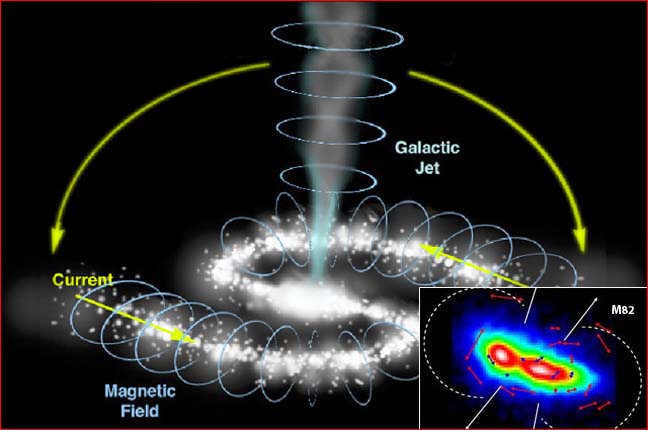
* I assume that the circles represent magnetic fields around the electric current. The bipolar jets diffuse into radio lobes and the current circles back to the spiral arms. I assume that something in each galaxy, or maybe in each star system, acts as a self-generating battery of charge separation that keeps the currents flowing.
http://www.thunderbolts.info/tpod/2010/ ... 4winds.htm

http://www.thunderbolts.info/tpod/2005/ ... rcuits.htm
* I assume that the circles represent magnetic fields around the electric current. The bipolar jets diffuse into radio lobes and the current circles back to the spiral arms. I assume that something in each galaxy, or maybe in each star system, acts as a self-generating battery of charge separation that keeps the currents flowing.
http://www.thunderbolts.info/tpod/2010/ ... 4winds.htm
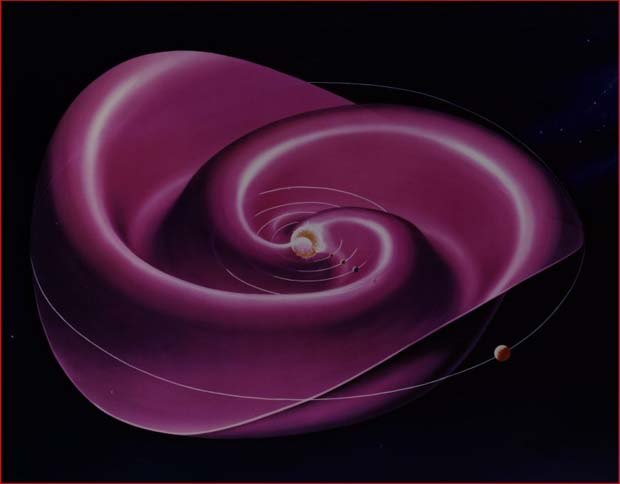
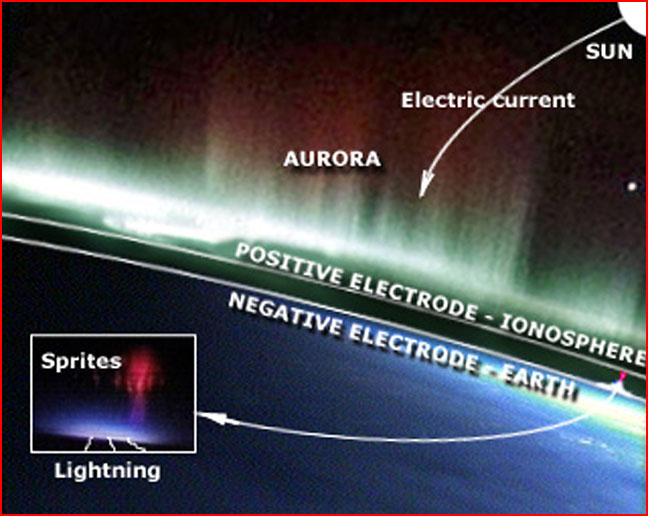
* Below is a diagram from http://www.plasma-universe.com/Electric ... ce_plasmas and two TPOD diagrams.In a galactic circuit, electric power flows inward along the spiral arms where it is concentrated and stored in the central plasmoid. When it reaches a certain current density it discharges, usually out of the galaxy’s spin axis as an energetic jet of plasma. Laboratory experiments have replicated the phenomenon with a plasma focus device.
- Electromagnetic forces confine those jets into thin filaments that remain coherent for thousands of light-years. Chandra's observations of NGC 1068 indicate that material from the galactic core reaches more than 3000 light-years from its source, but that estimate could be off by a significant factor. Jets usually end in double layer lobes that extend for many times the size of the galaxy and radiate copiously in radio frequencies. The diffuse currents then flow toward the galaxy’s equatorial plane and spiral back into its nucleus.
Who is online
Users browsing this forum: No registered users and 3 guests